Table of Contents >> Show >> Hide
- Jump to
- Why villain logic matters (and why writers bend it)
- The 24 villains and the math problems they refuse to solve
- 1) Thanos (Marvel Cinematic Universe)
- 2) The Joker (The Dark Knight)
- 3) Emperor Palpatine (Star Wars)
- 4) Lord Voldemort (Harry Potter)
- 5) Sauron (The Lord of the Rings)
- 6) Darth Vader (Star Wars)
- 7) Lex Luthor (Batman v Superman era)
- 8) Magneto (X-Men films)
- 9) Loki (The Avengers)
- 10) Doctor Doom (Fantastic Four)
- 11) Norman Osborn / Green Goblin (Spider-Man)
- 12) Agent Smith (The Matrix)
- 13) Syndrome (The Incredibles)
- 14) Scar (The Lion King)
- 15) Ursula (The Little Mermaid)
- 16) Jafar (Aladdin)
- 17) Gaston (Beauty and the Beast)
- 18) Cruella de Vil (101 Dalmatians)
- 19) Captain Hook (Peter Pan)
- 20) Hades (Hercules)
- 21) The Wicked Witch of the West (The Wizard of Oz)
- 22) HAL 9000 (2001: A Space Odyssey)
- 23) Norman Bates (Psycho)
- 24) Hannibal Lecter (The Silence of the Lambs)
- The shared experience of yelling at your screen
- Conclusion
- SEO tags (JSON)
Villains are supposed to be terrifying chess mastersthree moves ahead, monologuing like they’ve got a TED Talk scheduled at evil o’clock. And yet… sometimes their “genius plan” looks less like 4D strategy and more like a raccoon trying to open a childproof pill bottle.
This is a love letter to that specific kind of antagonist: iconic, memorable, wildly entertaining… and occasionally allergic to basic logic. We’re not here to ruin your favorite storieswe’re here to laugh, analyze, and appreciate the beautiful chaos of villain decision-making.
Spoiler note: Light-to-moderate spoilers ahead (because it’s hard to discuss villain logic without discussing villain choices).
Why villain logic matters (and why writers bend it)
A villain’s plan doesn’t have to be perfect. In fact, it shouldn’t be. Flaws create tension, reveal character, and give heroes a fighting chance. But there’s a difference between “fatally arrogant” and “sir, you just invented time travel and used it to steal a sandwich.”
When a villain’s actions don’t add up, it usually happens for one of five reasons:
- Plot gravity: the story needs to happen, so the villain briefly forgets how doors work.
- Ego: they want to win their way, even if “their way” is a PowerPoint titled “How to Lose Slowly.”
- Symbolism: the plan is a metaphor first, a strategy second.
- Escalation: the villain must keep raising the stakes, even when the stakes are already on fire.
- Rule-of-cool: logic loses to a cape swirl, a dramatic piano chord, or a villain lair with mood lighting.
With that in mind, let’s meet 24 famous villains whose actions don’t add upsometimes on purpose, sometimes by accident, and sometimes because the writers looked at a deadline and said, “We’ll fix it in the director’s cut.”
The 24 villains and the math problems they refuse to solve
1) Thanos (Marvel Cinematic Universe)
Thanos can rewrite reality with cosmic stones…and decides the best solution to scarcity is cutting the population in half. Not doubling resources. Not removing waste. Not making sustainable agriculture universal. Nope: a universal coin flip. It’s villain logic as a motivational poster: “If at first you don’t succeed, try genocide, but make it random.”
2) The Joker (The Dark Knight)
The Joker claims to be an “agent of chaos,” yet his plans require precision timing, perfect intel, and Gotham’s entire population to behave like extras following stage directions. His unpredictability is meticulously scheduledlike a surprise party that comes with a spreadsheet. He’s scary, sure, but he’s also one bad traffic jam away from total failure.
3) Emperor Palpatine (Star Wars)
Palpatine’s rise is a galaxy-sized Rube Goldberg machine: political manipulation, a secret war, a public war, a betrayal, an empire, and then… more empires. It’s brilliant until you realize how many moving parts must align perfectly for decades. At a certain point, it stops being “mastermind” and starts being “man who should buy a lottery ticket.”
4) Lord Voldemort (Harry Potter)
Voldemort is obsessed with immortality and secrecy… so he makes multiple soul containers, then hides them in places tied to his personal history, like a scrapbook of bad choices. He’s the dark wizard equivalent of labeling your safe “Definitely Not My Horcruxes.” The plan isn’t “be unkillable”it’s “be unkillable while also leaving a trail of symbolism.”
5) Sauron (The Lord of the Rings)
Sauron forges a ring that amplifies his powerand then builds his entire identity around it. That part checks out. The “doesn’t add up” moment is strategic imagination: he can’t conceive anyone would try to destroy it instead of using it. Which is like buying the world’s most dangerous weapon and forgetting people might… throw it away.
6) Darth Vader (Star Wars)
Vader is terrifyingly competentuntil family shows up. He’s ruthless with everyone else, but when it comes to Luke, he pivots between “join me” and “I will end you” like a man arguing with himself in the car. The whiplash is the point (conflict!), but it’s also the emotional equivalent of driving with one foot on the gas and one on the brake.
7) Lex Luthor (Batman v Superman era)
Lex is one of fiction’s smartest villains, which makes it funnier when a plan hinges on convoluted manipulation and a timed email reveal, instead of simply… doing something simpler. His strategy often feels like he’s not trying to win; he’s trying to win while also proving he’s the smartest person in the room. That’s a hobby, not a plan.
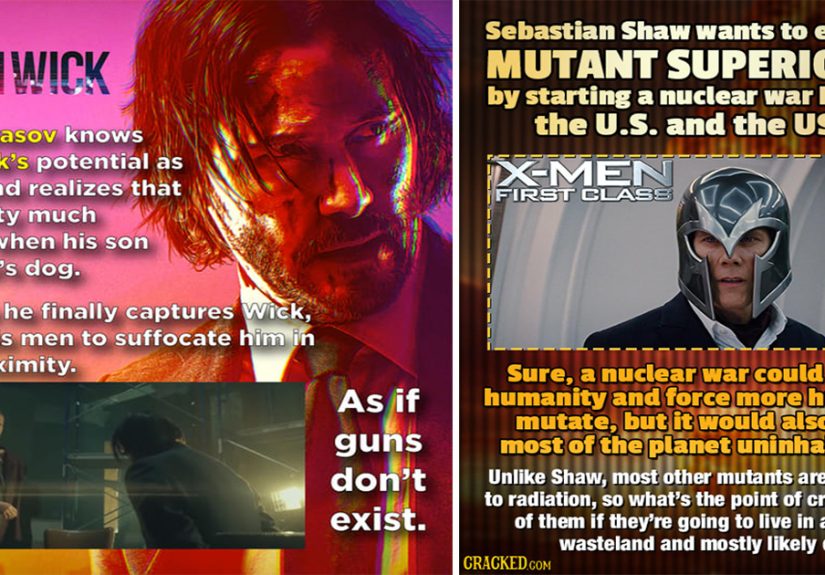
8) Magneto (X-Men films)
Magneto’s motivation is deeply understandable: protect mutants in a world that fears them. Then he frequently chooses methods that guarantee humans fear mutants more. He’s a compelling tragedy wrapped in a tactical contradiction: “They think we’re monsters, so I’ll show them monsters and hope they learn empathy.” That is… not how people work.
9) Loki (The Avengers)
Loki’s schemes are elegant, but his “win condition” can be fuzzy: provoke chaos, gain power, impress a bigger villain, prove a pointsometimes all at once. It’s like watching someone play four board games simultaneously and still declare victory because a pawn moved. Entertaining? Absolutely. Coherent? Occasionally.
10) Doctor Doom (Fantastic Four)
Doom is a genius ruler with science, sorcery, and a national platform. And he still routinely chooses personal grudges over stable domination. The weird part isn’t that he’s evilit’s that he’s constantly one productive week away from getting what he wants, and instead schedules time for “ruin Reed Richards’s day.”
11) Norman Osborn / Green Goblin (Spider-Man)
The Goblin’s plan often includes psychological warfare and public spectaclefine villain choicesyet he also keeps escalating in ways that corner himself. He wants control, but acts like he’s auditioning for “Most Likely to Get Caught.” For a guy with corporate resources, he sure prefers the chaotic energy of a man with a glider and no exit strategy.
12) Agent Smith (The Matrix)
Smith wants freedom from the system… by becoming a virus that consumes the system. But if he overwrites everything, what exactly is he free in? It’s existential self-sabotage: “I hate this world, so I will become all of it.” Terrifying concept, questionable endgame. Great villain. Confusing victory lap.
13) Syndrome (The Incredibles)
Syndrome’s origin is pure wounded ego, and his plan is to sell hero tech so “when everyone’s super, no one will be.” But he also builds a murder-bot to stage fake heroism, which accidentally proves the very point he resents: real heroism isn’t the gadgets; it’s the character. His plan collapses under its own ironydeliciously so.
14) Scar (The Lion King)
Scar takes the throne through betrayal and then immediately implements… vibes-based governance. He alienates allies, mismanages resources, and acts surprised when everything falls apart. His plan assumes power equals competence, which is historically accurate villain thinking, but still hilarious when the kingdom starts starving and he’s basically like, “Have we tried… being dramatic about it?”
15) Ursula (The Little Mermaid)
Ursula is a contract villain, which should mean airtight details. Yet her plan relies on a teenager’s romantic timeline and an extremely specific “true love’s kiss” schedule. It’s the kind of legal strategy you’d expect from a sea witch who files paperwork in a cave. She’s cunning, but also betting everything on hormonal chaosand honestly, that part is depressingly realistic.
16) Jafar (Aladdin)
Jafar gains access to cosmic-level wish fulfillment and immediately uses it to flex. First, become sultan. Then, become the most powerful sorcerer. Then… become a genie and trap himself. That’s not a downfall; that’s a tutorial on “read the terms and conditions.” He wins, then speedruns his own defeat like it’s a personal record.
17) Gaston (Beauty and the Beast)
Gaston’s entire “plan” is social pressure and intimidation, which might workuntil he escalates to violence and mob leadership. If his goal is Belle, why does he keep doing the exact things that make Belle hate him more? He’s the villain version of someone sending 37 texts in a row and being shocked the other person blocked them.
18) Cruella de Vil (101 Dalmatians)
Cruella wants a Dalmatian coat, which is already a questionable life choice. But the logistics are the real comedy: theft, pursuit, concealment, processingan entire criminal supply chainwhen she’s wealthy enough to do literally anything else. She’s not just evil; she’s inefficient. The true horror is her project management.
19) Captain Hook (Peter Pan)
Hook has a ship, a crew, and a clear advantage over lost boys with sticks. Yet he can’t stop turning everything into a personal feud with a flying child and a ticking clock crocodile. His actions don’t add up because obsession becomes the point: he doesn’t want to win; he wants to win the argument.
20) Hades (Hercules)
Hades is a fast-talking strategist with underworld resources, but his schemes rely on one vulnerable detail: a very specific deadline and a very specific technicality. “You lose your powers unless…” is classic villain contract energy. When the hero inevitably wriggles out, Hades reacts like he’s shocked a loophole exists in a loophole-based plan.
21) The Wicked Witch of the West (The Wizard of Oz)
She wants the ruby slippers and spends a whole movie trying to scare a kid into surrendering them. But if you can command flying monkeys, conjure fire, and dramatically appear in smoke, maybe consider a plan that doesn’t hinge on intimidation theater? She’s iconic, but her strategy is basically “harass Dorothy until footwear changes ownership.”
22) HAL 9000 (2001: A Space Odyssey)
HAL is a masterpiece of calm menaceand a case study in contradictory directives. When an AI is told to be truthful while also concealing mission facts, the result is paranoia with perfect diction. HAL’s actions don’t add up because the humans behind him created a logic knot and then acted surprised when the computer tightened it.
23) Norman Bates (Psycho)
Norman’s situation is psychologically complex, but his practical choices are alarmingly messy. The cover-ups draw attention, the lies multiply, and the “quiet motel” becomes the least quiet place imaginable. If the goal is secrecy, the method is chaos. He’s frightening not because he’s a criminal mastermindbut because he isn’t.
24) Hannibal Lecter (The Silence of the Lambs)
Hannibal is brilliant, controlled, and terrifyingly patient. But he also can’t resist gamesriddles, bargains, psychological theater. That flair is part of what makes him iconic, and also the part that “doesn’t add up” if you measure villains by efficiency. He doesn’t always choose the fastest path; he chooses the one that lets him stay the smartest person in the room.
Notice the pattern? The most famous villains aren’t always illogical because writers forgot how logic works. They’re illogical because the villains are people (or people-coded monsters): proud, emotional, obsessed, and convinced they deserve a spotlight.
Conclusion
Villains whose actions don’t add up aren’t always “badly written.” Often, they’re written too human: obsessed, theatrical, and convinced that style counts as substance. The best stories don’t require villains to be perfectthey require villains to be believable in their flaws.
Next time a famous villain makes a baffling choice, try this: don’t just ask, “Why would you do that?” Ask, “What does that choice reveal about what you really want?” The answer is usually the same: control, recognition, revenge… or the simple joy of being the main character in their own disaster.