Table of Contents >> Show >> Hide
- Before You Start: Know What Type of Golf Cart Battery You Have
- Safety First, Because Battery Acid Is Not a Personality Trait
- Method 1: Test Golf Cart Batteries with a Multimeter
- Method 2: Use a Hydrometer on Flooded Golf Cart Batteries
- Method 3: Perform a Load Test or Real-World Voltage Drop Test
- How to Tell Which Golf Cart Battery Is Bad
- Common Mistakes That Make Battery Testing Less Accurate
- When the Problem Is Not the Batteries
- Practical Experience: What Golf Cart Owners Usually Learn the Hard Way
- Conclusion
If your golf cart has started acting like a sleepy turtle instead of a zippy little neighborhood chariot, the batteries are usually the first suspects. And honestly, that makes sense. Golf cart batteries do the heavy lifting every time you cruise to the clubhouse, haul tools around a property, or make the world’s most important trip: the one to get snacks. When performance drops, range shrinks, or the cart feels weak on hills, testing the batteries can save you from random guesswork and expensive parts-swapping.
The good news is that you do not need a laboratory, a PhD in electrochemistry, or a dramatic movie montage to figure out what is going on. In most cases, you can get useful answers with three practical methods: a voltage test, a specific gravity test, and a load test. Together, these checks help you spot a weak battery, confirm whether the pack is fully charged, and decide whether the problem is the batteries themselves, a charging issue, or simple maintenance.
This guide breaks down the 3 easy ways to test golf cart batteries in plain English, with real-world tips, common mistakes to avoid, and a few battery truths that every golf cart owner should know. Spoiler alert: sometimes the “dead battery” is just undercharged, neglected, or thirsty. Batteries are high-maintenance in the same way houseplants are high-maintenance, except houseplants do not power a golf cart uphill.
Before You Start: Know What Type of Golf Cart Battery You Have
Before testing anything, identify the battery type in your cart. Most traditional golf carts use flooded lead-acid batteries, often in 6-volt, 8-volt, or 12-volt units wired together into a larger battery pack. These batteries can usually be tested with a multimeter, a hydrometer, and a load test.
Some carts use AGM batteries, which are sealed and do not allow hydrometer testing because you cannot sample the electrolyte. Newer carts may use lithium batteries, which are a different animal entirely. Lithium packs usually rely on a battery management system, onboard diagnostics, display screen, or app-based monitoring rather than old-school hydrometer checks.
So, if your cart has flooded lead-acid batteries, all three methods below are useful. If it has AGM batteries, skip the hydrometer test. If it has lithium, focus on pack voltage, built-in diagnostics, charge status, and any fault codes from the BMS.
Safety First, Because Battery Acid Is Not a Personality Trait
Testing golf cart batteries is not difficult, but it does require care. Wear safety glasses and gloves, use insulated tools when possible, and work in a well-ventilated area. Keep sparks, flames, and cigarettes far away from the battery compartment. If you are checking flooded batteries, remember that the electrolyte is acidic, and it deserves your respect.
Also, never top off flooded batteries with acid. Use distilled water only, and usually add it after charging unless the plates are exposed and need to be covered before a charge. Clean obvious corrosion from the battery tops and terminals, but do not let cleaning solution get inside the cells. A clean battery is easier to inspect, easier to test, and less likely to fool you with bad connections.
Method 1: Test Golf Cart Batteries with a Multimeter
Why this method matters
A multimeter test is the fastest and easiest way to check golf cart battery voltage. It tells you whether each battery is properly charged and whether one battery is noticeably weaker than the others. This is often the first step when diagnosing golf cart battery problems because it is quick, inexpensive, and surprisingly revealing.
What you need
A digital multimeter, a notepad or phone for recording readings, and a little patience. The patience part is important because the most accurate open-circuit voltage test happens after the batteries have been at rest. In other words, no charging and no driving for a while. A short rest helps, and a longer rest is even better.
How to do it
First, fully charge the battery pack. Then let the cart sit with no load and no charger connected. After that, set your multimeter to DC voltage and measure each battery individually at its terminals. Write down every reading. Do not trust your memory. Your memory is great for birthdays and old song lyrics, but terrible for a row of battery voltages.
Once you have the numbers, compare them. In a healthy pack, the batteries should be fairly close to one another. If one battery is much lower than the rest, that battery is waving a little red flag at you. It may be undercharged, sulfated, or developing a weak cell.
How to read the numbers
Exact voltage values vary a bit by manufacturer, battery design, and temperature, but for many flooded lead-acid batteries, a rested battery will read roughly like this:
- 6-volt battery: around 6.3 to 6.4 volts when fully charged
- 8-volt battery: around 8.4 to 8.5 volts when fully charged
- 12-volt battery: around 12.6 to 12.7 volts when fully charged
If a battery is notably below those ranges after a proper charge and rest, something is off. A slightly low reading may mean incomplete charging. A much lower reading than the others can point to a bad battery. The key is not just one number by itself, but how that battery compares with the rest of the pack.
What this test tells you best
A multimeter is excellent for spotting voltage imbalance, undercharged batteries, and pack inconsistency. It is also a great screening tool before deeper testing. What it does not do perfectly is measure battery capacity under real demand. A battery can show decent voltage at rest and still fall flat on its face once the cart starts pulling power. That is why method three exists.
Method 2: Use a Hydrometer on Flooded Golf Cart Batteries
Why this method matters
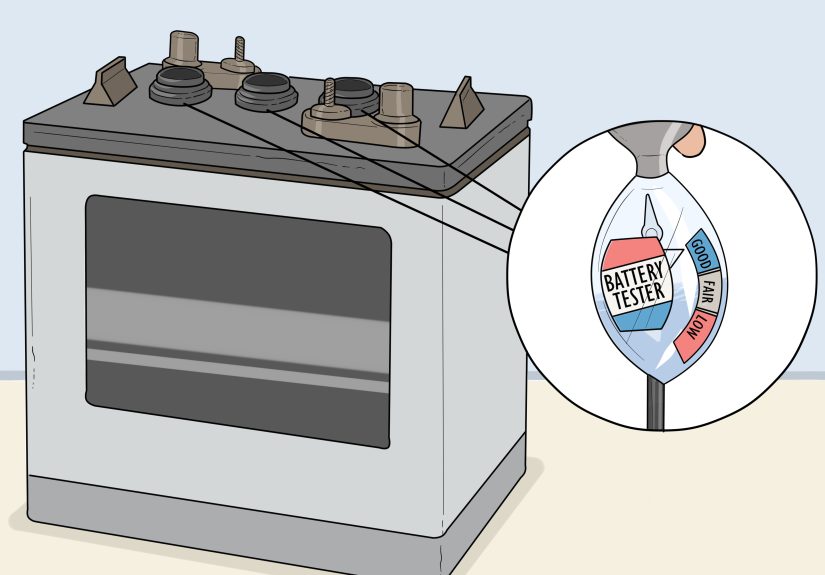
If you want a clearer look inside a flooded lead-acid battery, the hydrometer test is your best friend. A hydrometer measures the specific gravity of the electrolyte, which is a strong indicator of state of charge and battery health. In plain English, it tells you whether the chemistry inside the battery is doing what it is supposed to do.
This test is especially helpful when voltage readings leave you with questions. Voltage can be affected by recent charging or discharging. Specific gravity gives you another angle, and often a more precise one for flooded batteries.
What you need
A battery hydrometer, gloves, eye protection, and a rag for cleanup. This method is only for flooded lead-acid golf cart batteries. Do not attempt it on AGM or lithium batteries.
How to do it
Make sure the batteries are charged. Open the vent caps carefully. Insert the hydrometer into one cell, draw enough electrolyte to float the indicator, note the reading, and return the electrolyte to the same cell. Repeat for every cell in every battery. Yes, it takes a little time. No, this is not the moment to rush like you are late for tee time.
Record every cell reading. Then compare them. Healthy cells in a healthy battery pack should be relatively close to one another. If one cell or one battery has readings that are significantly lower than the others, that is often a sign of trouble.
What numbers are normal?
For many flooded deep-cycle batteries, a fully charged cell is often around 1.270 to 1.277 specific gravity at about 80 degrees Fahrenheit. Temperature matters, though. If the electrolyte is warmer or cooler, the reading needs correction. A common rule of thumb is to adjust the reading by about 0.004 for every 10 degrees Fahrenheit above or below 80 degrees.
The most important thing is consistency. If most cells are clustered together and one cell is far behind, that weak cell can drag the whole battery down. And in a multi-battery golf cart pack, one sick battery can act like that one person on a group project who contributes chaos and excuses.
What this test tells you best
A hydrometer helps identify:
- Low state of charge
- Cell imbalance
- A developing bad cell
- Possible chronic undercharging or sulfation
If hydrometer readings stay low even after a full charge, the battery may be nearing the end of its useful life. If readings vary widely from cell to cell, you may be dealing with imbalance, damage, or a battery that needs professional evaluation.
Method 3: Perform a Load Test or Real-World Voltage Drop Test
Why this method matters
Here is where weak batteries get exposed. A battery can look decent at rest but collapse under demand. That is why a load test is one of the most useful ways to tell whether your golf cart batteries still have real strength or are just bluffing.
In a shop, a technician may use a dedicated load tester or conductance tester. At home, many owners use a practical version of the same idea: checking how the battery voltage behaves while the cart is under load.
How to do a simple at-home version
Fully charge the batteries first. Then measure and record the voltage of each battery. After that, put the cart under a normal demand situation, such as driving up a moderate hill, accelerating from a stop, or operating the cart during a typical trip. As soon as possible, measure the batteries again, or have someone monitor voltage drop during the loaded condition if you have the tools and experience to do it safely.
If one battery sags far more than the others, that battery is often the weak link. In a healthy battery pack, all batteries will drop somewhat under load, but one should not fall dramatically behind the group.
What to watch for
- The cart slows down sharply on hills
- Acceleration feels weak even after charging
- One battery gets hotter than the others
- One battery shows a much bigger voltage drop than the rest
- Range is terrible even though the charger appears to finish normally
These clues can point to a battery that still takes a charge but cannot hold it well under demand. That is a classic sign of aging or internal damage. If the cart has decent resting voltage but performs badly under load, this test often tells the real story.
How to Tell Which Golf Cart Battery Is Bad
If you are trying to identify which golf cart battery is bad, the smartest approach is to combine all three tests. One battery that shows lower open-circuit voltage, lower specific gravity, and deeper voltage sag under load is usually your culprit. That battery may be failing on its own, or it may have been weakened by chronic undercharging, poor watering habits, corrosion, or age.
Also remember that golf cart batteries age as a team. Replacing one battery in an old pack can sometimes buy a little time, but it may also create imbalance if the rest of the batteries are already tired. In many cases, if the pack is old and multiple batteries test poorly, replacing the full set is the more reliable long-term move.
Common Mistakes That Make Battery Testing Less Accurate
Testing right after charging
Freshly charged batteries can hold a temporary surface charge that makes voltage look better than it really is. Letting the batteries rest improves accuracy.
Ignoring water levels
Low electrolyte in flooded batteries can distort readings and damage the plates. Check levels regularly and top off with distilled water at the correct time.
Only testing the whole pack
A battery pack can have acceptable total voltage while one battery inside it is weak. Always test each battery individually.
Skipping recordkeeping
If you write down readings over time, trends become obvious. Without records, you are basically diagnosing battery health with vibes.
When the Problem Is Not the Batteries
Sometimes the batteries are innocent. If all batteries test fairly evenly and show good charge levels, the issue may be elsewhere. A faulty charger, dirty or loose cable connections, damaged terminals, bad solenoid, worn cables, or controller problems can all make a golf cart feel weak. That is why battery testing is so valuable. It helps rule batteries in or out before you start replacing random parts and funding your mechanic’s next vacation.
Practical Experience: What Golf Cart Owners Usually Learn the Hard Way
In real life, most golf cart owners do not test their batteries because they are excited about electrochemistry. They test them because the cart starts behaving weirdly at the worst possible time. Maybe the cart makes it to the mailbox but not back. Maybe it crawls up the hill to the clubhouse like it is carrying bricks. Maybe it charges overnight, then acts offended by the idea of a full afternoon ride. That is usually when people finally open the battery compartment and meet the truth.
One of the most common experiences is finding out that the whole battery pack is not “dead.” Usually, one battery is the drama queen. The owner checks voltage across the pack and thinks everything looks close enough. But when each battery is tested separately, one of them is clearly lagging behind. That single weak battery can make the entire cart feel tired, jerky, or short-ranged. It is the electrical version of having one bad wheel on a shopping cart.
Another common lesson is that charging does not equal recovering. Plenty of owners plug in the charger, see the light come on, and assume all is well. Then they learn that a battery can accept a charge and still have poor capacity. It may show decent voltage after charging, but once the cart is under load, the voltage drops fast and the performance falls apart. That is why so many experienced owners swear by load testing or real-world voltage-drop testing. Resting numbers are helpful, but loaded numbers are honest.
Flooded batteries also teach people a very humbling maintenance lesson: water matters. A lot. Owners who skip watering checks often discover low electrolyte, exposed plates, corrosion, and shortened battery life. Others overwater before charging and end up with messy overflow, corrosion on the tops of the batteries, and a mild desire to time-travel and correct their choices. Once people learn to check levels routinely, use distilled water, and add it at the right time, battery performance and lifespan often improve.
There is also the surprisingly useful habit of keeping records. The owners who write down voltage readings, hydrometer readings, charge dates, and performance notes usually catch problems early. They see the pattern before the cart strands them. The owners who do not keep records tend to rely on memory, instinct, and hopeful staring. Hopeful staring is not a recognized diagnostic tool.
People with newer lithium-powered carts often go through a different experience. They open the battery area expecting old-school maintenance, only to discover there is no watering routine and no hydrometer step. Instead, they need to read the battery management system, look for fault codes, or check the display for state of charge and health data. It feels less like tractor maintenance and more like checking a smart device, which is convenient, but also means the troubleshooting process is different.
The biggest real-world takeaway is simple: testing saves money. It keeps owners from replacing good parts, blaming the charger too early, or overlooking a single weak battery that is spoiling the whole pack. Once you know how to test golf cart batteries with a multimeter, hydrometer, and load-based check, you stop guessing and start diagnosing. And when it comes to golf carts, that is the difference between a smooth ride and an expensive scavenger hunt.
Conclusion
If you want the simplest answer to how to test golf cart batteries, here it is: start with a multimeter, confirm with a hydrometer if you have flooded batteries, and finish with a load test or real-world voltage-drop check. Those three methods give you a solid picture of charge, balance, and real performance. They can help you find a weak battery, decide whether the pack is aging out, and separate battery issues from charger or wiring problems.
Golf cart batteries are not mysterious, but they are picky. They like full charging, proper watering, clean terminals, and regular monitoring. Treat them well, test them when performance changes, and they will usually tell you what is wrong long before they completely quit. Ignore them, and they will eventually respond with slow hills, short range, and a very expensive attitude.