Table of Contents >> Show >> Hide
- Before We Start: What “Learning the 9s” Really Means
- Way #1: Use the “Pattern Ladder” (Tens Go Up, Ones Go Down)
- Way #2: Use the Finger Fold Trick (Yes, Your Hands Are Allowed)
- Way #3: Use the “Ten Minus One” Strategy (9 = 10 − 1)
- A Simple Practice Routine That Actually Sticks
- Common 9s Mistakes (and Quick Fixes)
- Conclusion
- Experience Corner: What Tends to Work Best in Real Life (and Why)
The 9s on the multiplication table have a reputation. Kids see “9 × 7” and suddenly forget their own name. Parents see homework that says “master the 9s facts” and immediately start Googling “can I move to a country that uses only addition?”
Here’s the good news: the 9 times table is one of the friendliest tables once you know what to look for. It’s packed with patterns, has a classic hand trick, and it plays nicely with the 10s table (which most learners already feel good about). In this guide, you’ll learn three practical, kid-friendly ways to learn the 9s, plus a simple practice routine to make the facts stickwithout turning your kitchen table into a timed-test arena.
Before We Start: What “Learning the 9s” Really Means
When people say “learn the 9’s on the multiplication table,” they usually mean getting quick with facts like: 9 × 3, 9 × 7, 9 × 9, and sometimes going up to 9 × 12. You can memorize these facts, surebut the fastest path usually combines understanding + patterns + repetition.
Think of it like learning a song: you can brute-force the lyrics, or you can learn the chorus, notice the rhythm, and suddenly the whole thing is easier. The 9 times table has a very catchy chorus.
Way #1: Use the “Pattern Ladder” (Tens Go Up, Ones Go Down)
This is the most famous pattern in the 9 times table: as you multiply by 9, the tens digit increases by 1 while the ones digit decreases by 1. It’s like a number seesaw.
Build the ladder once, then reuse it forever
Write the 9s facts in order from 9 × 1 to 9 × 10:
- 9 × 1 = 9
- 9 × 2 = 18
- 9 × 3 = 27
- 9 × 4 = 36
- 9 × 5 = 45
- 9 × 6 = 54
- 9 × 7 = 63
- 9 × 8 = 72
- 9 × 9 = 81
- 9 × 10 = 90
Notice what happens:
- The tens digits go: 0, 1, 2, 3, 4, 5, 6, 7, 8, 9
- The ones digits go: 9, 8, 7, 6, 5, 4, 3, 2, 1, 0
It’s basically counting up and counting down at the same timelike patting your head while rubbing your tummy, except way less embarrassing in public.
How to use the pattern to answer questions fast
Let’s do 9 × 7. If you’re counting:
- For 7, the tens digit is one less: 6
- The ones digit is what you need to make 9: 3 (because 6 + 3 = 9)
- So 9 × 7 = 63
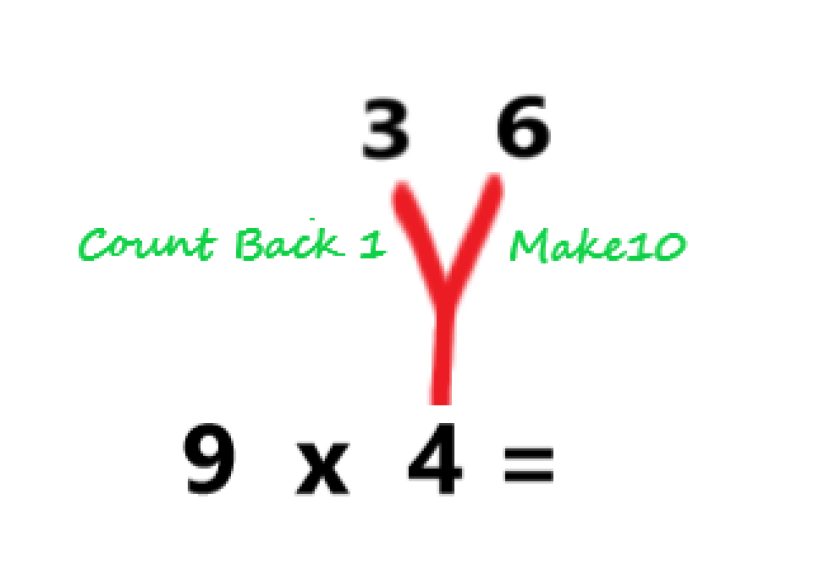
Another example: 9 × 4.
- Tens digit: 3
- Ones digit: 6 (because 3 + 6 = 9)
- So 9 × 4 = 36
A built-in “spell check” for your answer
For many 9s facts (especially 9 × 2 through 9 × 10), the digits in the answer add up to 9: 18 → 1 + 8, 27 → 2 + 7, 72 → 7 + 2, and so on.
Important note: when you go beyond 9 × 10, you’ll still see the “multiple of 9” behavior, but the digit sum might be 18, 27, etc. (For example, 9 × 12 = 108, and 1 + 0 + 8 = 9.) It’s still a handy way to catch mistakes.
Quick practice idea: Write the tens column (0 to 9) down the left side of a page, and the ones column (9 to 0) down the right side. Then “zip” them together to make the answers. It feels like a puzzle, and puzzles are basically math in a fun hat.
Way #2: Use the Finger Fold Trick (Yes, Your Hands Are Allowed)
If the 9s table had a mascot, it would be ten fingers doing the wave. The finger trick is a classic because it’s visual, physical, and fastespecially for learners who like hands-on tools.
How the finger trick works (step by step)
- Hold both hands up in front of you with fingers spread (you have 10 fingers to work with).
- Label your fingers from 1 to 10, starting with your left pinky as 1 and ending with your right pinky as 10.
- To solve 9 × N, fold down the finger numbered N.
- Count the fingers to the left of the folded finger (that’s the tens digit).
- Count the fingers to the right (that’s the ones digit).
Example: 9 × 4
Fold down finger #4.
- There are 3 fingers left of the fold → tens digit is 3
- There are 6 fingers right of the fold → ones digit is 6
- So 9 × 4 = 36
Example: 9 × 8
- Fold down finger #8
- 7 fingers left → tens digit 7
- 2 fingers right → ones digit 2
- So 9 × 8 = 72
Why it works (the no-tears explanation)
When you fold down finger N, you create two groups:
- Left side has N − 1 fingers
- Right side has 10 − N fingers
That builds the number: (N − 1) tens and (10 − N) ones. Example: N = 7 gives 6 tens and 3 ones → 63. And yes, it’s magically always correct for 9 × 1 through 9 × 10.
One honest limitation
The finger trick is best for 9 × 1 through 9 × 10 because you only have 10 fingers. (Unless you recruit a friendthen you’ve invented “group math,” which is suspiciously close to “having fun.”) For 9 × 11 and 9 × 12, use Way #3 below.
Quick practice idea: Have a learner call out random facts “9 × 6!” “9 × 3!” and answer using hands. Then switch: the learner calls the fact and the adult answers. If the adult hesitates, the learner gets to say, “Interesting… so you also live here now.”
Way #3: Use the “Ten Minus One” Strategy (9 = 10 − 1)
This is the grown-up brain strategy that kids can absolutely learn: multiplying by 9 is the same as multiplying by 10 and subtracting one group.
Here’s the rule: 9 × N = (10 × N) − N
Examples with single-digit numbers
- 9 × 6 = (10 × 6) − 6 = 60 − 6 = 54
- 9 × 3 = (10 × 3) − 3 = 30 − 3 = 27
- 9 × 8 = (10 × 8) − 8 = 80 − 8 = 72
If a learner already knows the 10s facts (and most do early on), this strategy feels like a shortcut because it is a shortcut.
Examples beyond 10 (where the hand trick taps out)
This is where Ten Minus One really shines:
- 9 × 12 = (10 × 12) − 12 = 120 − 12 = 108
- 9 × 15 = 150 − 15 = 135
- 9 × 27 = 270 − 27 = 243
Make it visual (for learners who want to “see” math)
Picture an array: 10 rows of 6 dots is 60 dots. If you remove one row of 6, you’re left with 54. That’s 9 rows of 6exactly what 9 × 6 means. This kind of visual explanation helps the strategy feel like a real idea, not a random trick.
Quick practice idea: Anytime you see 9 × N, say out loud: “Ten N is ___, minus N is ___.” Speaking the steps helps memory. Also, it makes you sound like a wizard who specializes in subtraction.
A Simple Practice Routine That Actually Sticks
Knowing three strategies is great. Keeping them in your brain on a random Tuesday is the real victory. Here’s a low-stress routine that builds 9s multiplication fact fluency without turning learning into a speed contest.
Step 1: Pick one strategy as your “home base”
For many kids, the finger trick is the easiest starting point. For others, the pattern ladder clicks instantly. Choose one as the main method for the week.
Step 2: Do a 5-minute daily “mix”
- 1 minute: Say the 9s facts in order (9, 18, 27, …, 90).
- 2 minutes: Random facts (9 × 4, 9 × 7, 9 × 3…). Use your home-base strategy.
- 2 minutes: Do the same facts using a different strategy (pattern ladder or ten-minus-one).
Step 3: Add mini-games (because brains love games)
- Dice game: Roll one die and multiply by 9. Keep score for correct answers.
- Card game: Flip a card (Ace = 1, 2–10 as usual). Multiply by 9.
- Find-the-mistake: Write three correct 9s facts and one wrong one. Learner hunts the imposter.
- Real-life math: “We have 9 stickers per sheet. If we have 6 sheets, how many stickers?”
Common 9s Mistakes (and Quick Fixes)
Mistake: Mixing up 9 × 7 and 9 × 8
Fix: Use the pattern ladder. 9 × 7 is 63, 9 × 8 is 72. The tens go up, the ones go down. If you remember one, you can rebuild the other in two seconds.
Mistake: Subtracting the wrong number in Ten Minus One
Fix: Always say the steps: “10 × N, then minus N.” If you do 10 × 8 = 80, you must subtract 8 (not 9, not 18, not your patience).
Mistake: Trying to use the finger trick for 9 × 12
Fix: Celebrate the creativity, then switch strategies. Ten Minus One was born for problems like 9 × 12.
Conclusion
Learning the 9’s on the multiplication table doesn’t have to be a memorization marathon. With the pattern ladder, the finger fold trick, and the ten-minus-one strategy, you can build speed and understanding.
Start with the method that feels easiest today, practice a little each day, and use the others as backups. That way, the 9 times table stops being “that scary one” and becomes “that one with all the cool shortcuts.” Honestly, the 9s are kind of show-offsand in this case, we’re fine with it.
Experience Corner: What Tends to Work Best in Real Life (and Why)
In real homes and classrooms, the 9 times table usually becomes “easy” in a very specific way: not all at once, but in small lightbulb moments. A learner might struggle with 9 × 6 for days, then suddenly notice that 9 × 5 is 45 and 9 × 6 is just “one more 9,” so it must be 54. That’s the brain doing what it does bestbuilding connections instead of storing isolated facts like a dusty filing cabinet.
One common experience is that kids love the finger trick… until they don’t. At first it’s empowering: “I can do 9 × 7 without help!” And that confidence matters. But after the novelty wears off, some learners start using fingers as a crutch and never transition to mental strategies. The best results often happen when the finger trick is treated like training wheels: awesome for balance, not meant to stay on the bike forever. A simple move is to let the learner answer with fingers, then immediately ask, “What pattern do you see in the answer?” That question nudges them from doing the trick to understanding the trick.
Another real-life win is attaching the 9s to something the learner already feels confident aboutusually the 10s. Many kids know that 10 × 8 is 80 without even thinking. When you show them that 9 × 8 is “80 minus 8,” you’re not introducing a brand-new skill; you’re borrowing confidence from a familiar one. In practice, this tends to reduce anxiety because it gives the learner a plan. Instead of staring at “9 × 8” like it’s a cryptic message from outer space, they can say, “Ten times eight is 80… minus eight… 72.” The fact becomes a short story with a beginning, middle, and end.
Families also report that the best practice is surprisingly short. Five minutes is often the sweet spot: long enough to rehearse and strengthen memory, short enough to avoid frustration. A typical pattern is: a quick run through the ladder (9, 18, 27…), then a handful of random facts, then one “confidence game” (dice, cards, or find-the-mistake). Consistency beats intensity. Ten minutes once a week feels productive, but five minutes a day usually works faster and with fewer dramatic sighs.
Finally, learners often improve when they’re allowed to be “the checker.” If an adult says an answer out loud and the learner uses the digit-sum check (or the pattern ladder) to verify it, the learner shifts from passive to active. That role reversal is powerful. It’s also fun. Kids love catching mistakesespecially when it’s socially acceptable. Try saying, “I think 9 × 6 is 56,” and watch how quickly the learner becomes a fact-fluency detective.
The big takeaway from these experiences: the 9 times table becomes manageable when it feels predictable. Patterns provide predictability. Strategies provide a plan. And short, frequent practice keeps it from turning into a battle. Once a learner trusts that there’s always a way forwardhands, patterns, or ten-minus-onethe 9s stop being scary and start being, dare we say it, kind of satisfying.