Table of Contents >> Show >> Hide
- Before You Start: A Few Quick Rules for Better Success
- Way #1: Propagate Christmas Cactus in Soil (The Classic, “Strong Roots” Method)
- Way #2: Propagate Christmas Cactus in Water (The “I Want to See the Roots” Method)
- Way #3: Propagate by Division (The “Instant Plant” Method)
- Troubleshooting: Common Propagation Problems (and How to Fix Them)
- Aftercare: How to Grow Your New Christmas Cactus Into a Blooming Showoff
- Quick Propagation Timeline (So You Don’t Stare at It Every Hour)
- FAQ: The Questions Everyone Asks (Usually While Holding a Cutting)
- Real-World Experiences: What Growers Learn After Propagating Christmas Cactus (About )
- Conclusion
A Christmas cactus is basically the friend who shows up to the party once a year looking fabulous, then spends the
rest of the time quietly judging your watering habits. If you’ve ever wanted more of those bright winter blooms (or
you just want a “backup copy” of a beloved heirloom plant), propagation is the move.
The good news: Christmas cactus (a type of Schlumbergera, often grouped with other “holiday cacti”) is one
of the easiest houseplants to multiply. The even better news: you can do it three different ways, depending on your
patience level and whether you like watching roots develop like a plant reality show.
Before You Start: A Few Quick Rules for Better Success
1) Pick the right time (your cactus has a calendar)
Propagation tends to work best after the plant finishes flowering, when it switches back into growth mode. Late
spring into summer is usually the sweet spot. You can propagate at other times, but it may take longer and
you’ll be more likely to deal with slow rooting or rot.
2) Choose healthy segments (no drama, no damage)
Look for firm, plump stem segments with good coloravoid limp, wrinkly, mushy, or pest-riddled pieces. If your plant
is stressed, propagation can still work, but it’s like trying to bake a cake while the oven is on fire: possible,
but not ideal.
3) Clean tools + drainage = fewer heartbreaks
Use clean scissors/pruners (or gently twist segments off at the joints) and always root in a container with drainage
if you’re using soil. Holiday cacti hate sitting in soggy mixrot is fast, rude, and totally unapologetic.
Way #1: Propagate Christmas Cactus in Soil (The Classic, “Strong Roots” Method)
Soil propagation is popular because the cutting goes straight into a rooting medium and doesn’t have to “re-learn”
life after living in water. It’s also great if you want multiple cuttings in one pot for a fuller plant.
What you’ll need
- A healthy Christmas cactus
- Clean scissors/pruners (optionaltwisting at joints works too)
- A small pot with drainage holes
- A well-draining medium (cactus/succulent mix, or a gritty blend like perlite + potting mix)
- (Optional) Rooting hormone
- (Optional) A clear plastic bag or humidity dome
Step-by-step: Soil rooting
- Take a cutting. Remove a section that’s about 2–5 stem segments long. For a fuller pot later,
take several cuttings. - Let it callus. Place the cutting somewhere dry and out of harsh sun for a day or two. This helps
the cut end seal, which can reduce rot. - Prep your pot. Fill a small pot with a lightly moistened, well-draining mix. You want “barely
damp,” not “swamp vacation.” - Plant the cutting. Insert the callused end about 1 inch deep. Firm the mix gently so the cutting
stands upright without needing a motivational speech. - Bright, indirect light. Place the pot where it gets bright light but not direct midday sun that
can scorch the segments. - Water lightly and sparingly. Keep the medium slightly moist for the first couple of weeks, then
let the top dry a bit between waterings. Overwatering is the #1 reason cuttings fail. - Check for rooting. In several weeks, gently tugif you feel resistance, roots are forming. Once
roots are established and you see new growth, treat it like a young plant.
Pro tips for soil success
- Group cuttings: Plant 3–5 cuttings in one small pot for a fuller-looking plant faster.
- Skip fertilizer at first: Wait until you see new growth. Feeding an unrooted cutting is like
serving dinner to someone who hasn’t arrived yet. - Humidity helps (sometimes): If your air is very dry, loosely tent a clear bag over the pot. Just
don’t seal it tightlystale, wet air invites fungus.
Way #2: Propagate Christmas Cactus in Water (The “I Want to See the Roots” Method)
Water propagation is satisfying because you can literally watch roots appear. It’s also handy if you’re new to
propagating and want visible proof that something is happening. The tradeoff: water roots can be a bit delicate when
you move the cutting to soil, so the transition step matters.
What you’ll need
- A healthy cutting (2–5 segments)
- A small glass/jar
- Clean water
- (Optional) Plastic wrap + a slit to hold the cutting upright
Step-by-step: Water rooting
- Take and callus the cutting. Just like the soil method, let it sit out for about 1–2 days so the
base can dry slightly. - Add a small amount of water. Use only enough water so the bottom of the cutting is barely in
contact with it (or just above it, depending on how you suspend it). You’re encouraging rootsnot hosting a pool
party. - Bright, indirect light. Place the jar in a bright spot out of direct sun.
- Refresh the water. Change the water every few days (or at least weekly) to keep it fresh and
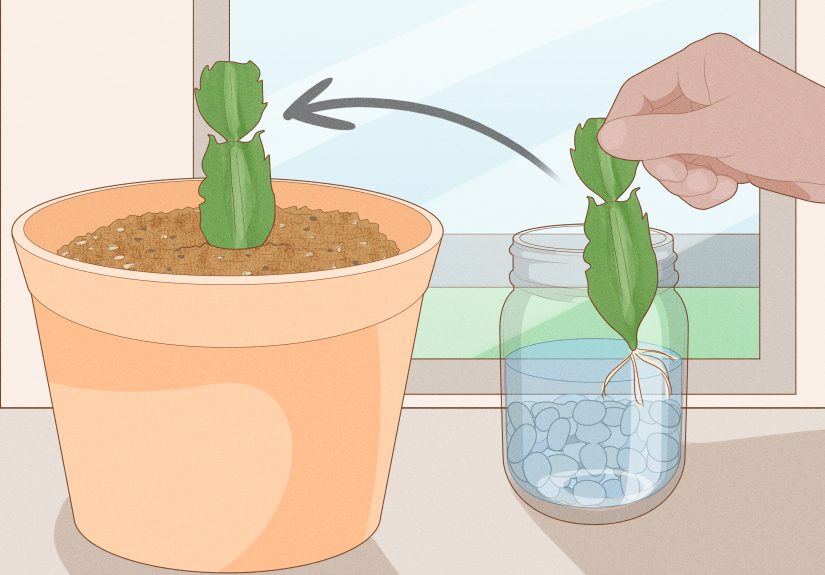
reduce bacteria buildup. - Wait for roots. Roots can take several weeks. When they’re roughly an inch long (or you have a
small cluster), you’re ready to pot up. - Transition to soil gently. Plant the cutting into a well-draining mix, keep it lightly moist for
the first 1–2 weeks, then shift toward the usual “water when the top dries” routine.
When water propagation makes the most sense
- You’re propagating in a very dry home and soil dries too quickly.
- You want a visual “progress bar” (roots!) for peace of mind.
- You’re sharing cuttings with friends and want to show them what “ready to pot” looks like.
Way #3: Propagate by Division (The “Instant Plant” Method)
If your Christmas cactus is huge, crowded, or has multiple distinct clumps, division can give you an immediate new
plantroots and all. This works best when you’re already repotting, typically after flowering.
What you’ll need
- A mature, multi-stemmed Christmas cactus (ideally pot-bound or crowded)
- A clean knife (sometimes optional) and clean hands
- Fresh, well-draining potting mix
- New pots with drainage holes
Step-by-step: Division
- Remove the plant from its pot. Tip it out gently and loosen the root ball with your fingers.
- Find natural separations. Look for sections where stems emerge from separate “crowns” or where the
root mass naturally splits. - Separate carefully. Gently tease the roots apart. If roots are tightly tangled, you may need to
cut between sections with a clean knife. Aim for divisions that each have healthy stems and a solid root portion. - Repot each division. Place each new section into a slightly snug pot (too large holds too much
moisture). Fill around it with a well-draining mix. - Water lightly. Give a small drink to settle the mix, then let it dry a bit before watering again.
Recently disturbed roots are more prone to rot if kept constantly wet.
Division is best when…
- Your plant is overcrowded and drying out too fast between waterings (root-bound).
- You see obvious clumps that can be separated without destroying the root system.
- You want a larger “new plant” right away rather than starting from a small cutting.
Troubleshooting: Common Propagation Problems (and How to Fix Them)
Problem: The cutting turns mushy
That’s usually rot from too much moisture, not enough airflow, or planting before the cut end sealed. Remove the
healthy part above the mushy area, re-callus, and restart in a drier, grittier mix.
Problem: The cutting shrivels and wrinkles
Mild wrinkling can happen while roots form, but heavy shriveling suggests dehydration. Increase humidity slightly,
move it out of hot direct sun, and water lightly (soil method) without soaking the pot.
Problem: No roots after weeks
Check temperature (warm, not hot), light (bright indirect), and moisture (lightly moist, never soggy). Also make
sure you used a healthy, younger segmentolder, woody pieces can be slower to root.
Problem: Roots formed in water, but it struggles in soil
Water roots can be tender. Use an airy mix, keep it slightly moist for the first 1–2 weeks, and avoid strong sun
while it adapts. Think “gentle transition,” not “new apartment on moving day with no boxes labeled.”
Aftercare: How to Grow Your New Christmas Cactus Into a Blooming Showoff
- Light: Bright, indirect light is ideal. A little morning sun can be fine; harsh afternoon sun can
scorch. - Water: Water when the top portion of the mix dries. Holiday cacti prefer even moisture during
growth, but never waterlogged soil. - Soil: Aim for a well-draining potting mixmany growers use cactus/succulent mixes or amend
standard mix with perlite for extra air. - Feeding: Once established, a diluted balanced houseplant fertilizer during the growing season can
help (especially summer). Skip feeding if the plant is stressed or freshly rooted. - Pinching for fullness: When new growth appears, gently pinch tips to encourage branchingmore
branches often mean more blooms later.
Quick Propagation Timeline (So You Don’t Stare at It Every Hour)
- Day 0: Take cuttings (or divide during repotting).
- Day 1–2: Let cut ends callus (cuttings).
- Week 1–2: Keep conditions stable: bright indirect light, light moisture, good airflow.
- Week 4: Many cuttings begin to show resistance when gently tugged.
- Week 6–8: Root systems are often established enough to pot up (if started in perlite/sand/water).
- After rooting: New growth is your green light to treat it like a young plant.
FAQ: The Questions Everyone Asks (Usually While Holding a Cutting)
How many segments should a cutting have?
Usually 2–5 segments works well. Shorter pieces can root, but they may dry out more easily; longer pieces can be a
bit heavier and wobble unless supported.
Do I need rooting hormone?
Not required. It can speed things up a little, but the real MVPs are callusing, drainage, and not overwatering.
Can I propagate in winter?
You can, but it’s often slower because the plant is blooming or resting. If you’re trying to preserve a plant (like
an heirloom that’s declining), go aheadjust be extra careful with moisture and keep expectations realistic.
How do I get a fuller plant faster?
Plant multiple cuttings in one pot. It’s the propagation version of “don’t arrive alone to the party.”
Real-World Experiences: What Growers Learn After Propagating Christmas Cactus (About )
If you ask a group of plant people about propagating Christmas cactus, you’ll notice a theme: confidence rises
dramatically the second time around. The first round is usually filled with questions like “Is this wrinkling normal?”
and “How long is too long to stare at a jar of water?” Here are a few common real-world lessons growers shareplus
some practical examples of how those lessons play out.
Experience #1: The “Heirloom Insurance Policy”
Many people inherit a Christmas cactus that’s older than their favorite sweater. When an heirloom plant starts
looking tireddroopy segments, weird bald spots, or a pot that dries out instantlyexperienced growers often take
several cuttings right away. The goal isn’t to replace the original; it’s to create a backup while the mother plant
recovers. A common approach is to root 6–10 small cuttings in two pots: one as a “primary backup” and another as a
“just in case the cat commits property crime” backup. The emotional comfort of having a second plant is real, and it
also makes it easier to experiment with better soil, improved light, and a gentler watering routine for the original.
Experience #2: The “Gift Pot” That Turns Into a Tradition
Christmas cactus is one of the few houseplants that naturally wants to become a holiday gift. Growers often root
multiple cuttings in a single pot months ahead of time so the plant looks full and intentionallike you planned it,
not like you panic-propagated it the night before a visit. A very common pattern: someone starts with soil rooting
in late spring, pots up by midsummer, pinches tips once or twice for branching, and by the next holiday season they
have a compact plant that looks like it belongs in a decorative cachepot. People also learn quickly to label
varieties (especially if they have different bloom colors), because once you’re propagating three pots at once,
“I’m pretty sure this is the pink one” becomes a lie you tell yourself.
Experience #3: The Water-Rooting “Aha” Moment (and the Transition Reality Check)
Water propagation gives instant feedback: you see roots, you feel successful, you consider starting a tiny root
documentary. But growers also notice that the transition to soil is where the cutting can sulk. The best “aha”
moment is realizing that potting mix matters even more after water rooting. People who succeed consistently tend to
use an extra-airy mix (for example, a succulent mix boosted with perlite) and keep it lightly moist for a short
adjustment periodthen they back off. In other words, they treat it like a young plant learning a new routine,
rather than flooding it out of excitement.
Experience #4: Patience Beats “Helpful” Overwatering
The most repeated lesson is also the least exciting: don’t overwater. Many growers admit their first failed cutting
didn’t die from neglectit died from love. Once people adopt a “lightly moist, never soggy” mindset and prioritize
drainage, success rates climb fast. The plant isn’t asking for constant attention. It’s asking for conditions stable
enough to quietly do its job.
Conclusion
Propagating Christmas cactus is one of the most satisfying low-effort, high-reward plant projects you can do at home.
If you want the strongest, simplest path, go with soil rooting. If you love visual progress (or
you’re teaching someone), try water rootingjust transition gently to soil later. And if you’ve got
a massive, crowded plant, division can give you an instant new Christmas cactus with roots already
onboard.
Pick the method that matches your style, keep things bright and well-drained, and remember: the cutting doesn’t need
a motivational speech. It needs time.


![A Beginner's Guide to WordPress Block Patterns [+ Insights from WCEU Speaker Sean Blakeley]](https://gearxtop.com/wp-content/uploads/2026/03/a-beginners-guide-to-wordpress-block-patterns-insights-from-wceu-speaker-sean-blakeley-zZYF6DMk-thumb.jpg)