Table of Contents >> Show >> Hide
- Why Electron Configurations Matter
- The Three Rules You Need Before the Four Methods
- Way 1: Write the Full Electron Configuration
- Way 2: Use Noble-Gas Shorthand
- Way 3: Draw Orbital Box Diagrams
- Way 4: Use the Periodic Table as a Shortcut Map
- Common Exceptions and Mistakes
- A Quick Cheat Sheet for Writing Electron Configurations
- Conclusion
- Experiences from the Electron Configuration Trenches
Writing electron configurations can feel like trying to seat invisible guests at a wedding where half the tables are alphabetized, the other half are ranked by energy, and one cousin named chromium refuses to follow the seating chart. But once you understand the logic behind electron filling, the whole thing becomes much less mysterious and a lot more useful.
Electron configurations tell you how electrons are arranged in an atom’s orbitals. That matters because electron arrangement helps explain reactivity, bonding, periodic trends, magnetism, and why some elements behave like perfect angels while others act like chemistry class drama. If you can write an electron configuration correctly, you are not just memorizing a formula. You are reading the atomic blueprint of an element.
In this guide, you will learn four practical ways to write electron configurations: the full configuration method, noble-gas shorthand, orbital box diagrams, and the periodic-table shortcut. Along the way, we will tackle the rules, walk through examples, and point out the classic traps that ambush students every semester.
Why Electron Configurations Matter
At first glance, electron configuration notation looks like chemistry’s attempt to turn typing into cardio: 1s2 2s2 2p6 3s2 3p4. But those symbols tell a story. They show which shells and subshells contain electrons, which electrons are valence electrons, and how likely an atom is to form bonds, gain electrons, lose electrons, or sit quietly like neon and judge everyone else.
If you know an element’s electron configuration, you can often predict its family behavior on the periodic table. Elements in the same group tend to share similar valence-electron patterns, which is why sodium and potassium act alike, and why fluorine and chlorine are both wildly enthusiastic about grabbing an extra electron.
The Three Rules You Need Before the Four Methods
1. Aufbau Principle
The Aufbau principle says electrons fill the lowest-energy orbitals first. Think of it as atomic bargain hunting: electrons take the cheaper seats before moving into premium sections. The usual filling order begins like this:
1s → 2s → 2p → 3s → 3p → 4s → 3d → 4p → 5s → 4d → 5p → 6s → 4f → 5d → 6p → 7s → 5f → 6d → 7p
2. Pauli Exclusion Principle
The Pauli exclusion principle says that no two electrons in the same atom can have the same set of four quantum numbers. In everyday class language, that means an orbital can hold a maximum of two electrons, and those two must have opposite spins.
3. Hund’s Rule
Hund’s rule says that when orbitals of equal energy are available, electrons occupy them singly before pairing up. Electrons would rather spread out first, like students claiming separate seats on the first day of class.
Way 1: Write the Full Electron Configuration
This is the most direct method and the best one for learning. You start with the atomic number, which tells you how many electrons a neutral atom has. Then you place those electrons into orbitals following the filling order.
How to do it
- Find the element’s atomic number.
- Write orbitals in the correct filling order.
- Add electrons as superscripts.
- Stop when the total number of electrons matches the atomic number.
Example: Sulfur
Sulfur has atomic number 16, so a neutral sulfur atom has 16 electrons.
Sulfur: 1s2 2s2 2p6 3s2 3p4
Check the math: 2 + 2 + 6 + 2 + 4 = 16. No missing electrons. No stowaways. We move on.
Example: Calcium
Calcium has atomic number 20, so it has 20 electrons.
Calcium: 1s2 2s2 2p6 3s2 3p6 4s2
The full method is excellent because it forces you to understand orbital order. It is also the easiest method to grade, which is probably why chemistry teachers remain emotionally committed to it.
Way 2: Use Noble-Gas Shorthand
If the full configuration is the long novel, noble-gas shorthand is the movie adaptation. Same plot, fewer pages.
In this method, you replace the inner-core electrons with the symbol of the nearest previous noble gas in brackets. Then you write only the remaining outer configuration.
How to do it
- Find the noble gas that comes before the element.
- Write that noble gas in brackets.
- Add the remaining electrons after the bracket.
Example: Iron
Iron has atomic number 26. The previous noble gas is argon, which accounts for 18 electrons.
Iron: [Ar] 4s2 3d6
That is much shorter than writing all 26 electrons from scratch. It also highlights the valence and near-valence electrons, which are often the ones that matter most in chemical behavior.
Example: Bromine
Bromine has atomic number 35. The previous noble gas is argon.
Bromine: [Ar] 4s2 3d10 4p5
Noble-gas notation is one of the most common ways to write electron configurations in chemistry courses because it is cleaner, faster, and easier to read. It is the atomic equivalent of saying “I live near Chicago” instead of reciting every highway exit that got you there.
Way 3: Draw Orbital Box Diagrams
Sometimes the superscripts are not enough. If you want to see how electrons distribute within individual orbitals, orbital box diagrams are the best method. This approach is especially useful for applying Hund’s rule and spotting unpaired electrons.
How to do it
- Draw a box for each orbital.
- Use arrows to represent electrons.
- Put one electron in each equal-energy orbital before pairing.
- Use opposite spins for paired electrons.
Example: Nitrogen
Nitrogen has 7 electrons: 1s2 2s2 2p3
Orbital diagram:
Each of the three 2p orbitals gets one electron before any pairing happens. That is Hund’s rule in action.
Example: Oxygen
Oxygen has 8 electrons: 1s2 2s2 2p4
One 2p orbital now has a pair, while the other two still hold single electrons. This kind of diagram makes electron spin and pairing much easier to visualize than plain notation does.
Box diagrams are also helpful when explaining magnetism. Atoms with unpaired electrons are often paramagnetic, while atoms with all electrons paired are generally diamagnetic. Translation: those lonely electrons actually matter.
Way 4: Use the Periodic Table as a Shortcut Map
This is the fastest practical method once you understand the layout of the periodic table. The periodic table is not just a list of elements. It is a visual map of electron filling.
The block system
- s-block: 2 columns wide
- p-block: 6 columns wide
- d-block: 10 columns wide
- f-block: 14 columns wide
As you move across a period, electrons are added to the corresponding subshell. The width of each block tells you how many electrons that subshell can hold.
Example: Selenium
Selenium has atomic number 34. Using the periodic table, you can trace the path through the blocks:
1s2 2s2 2p6 3s2 3p6 4s2 3d10 4p4
Or in shorthand:
Selenium: [Ar] 4s2 3d10 4p4
This method works beautifully for most main-group elements and transition metals. It is also the easiest way to estimate valence electrons and identify an element’s block quickly. For very heavy elements, however, official ground-state configurations can get trickier, so it is smart to verify unusual cases with a trusted reference table.
Common Exceptions and Mistakes
Now for the part where chemistry reminds you that rules are real, but nature still reserves the right to be annoying.
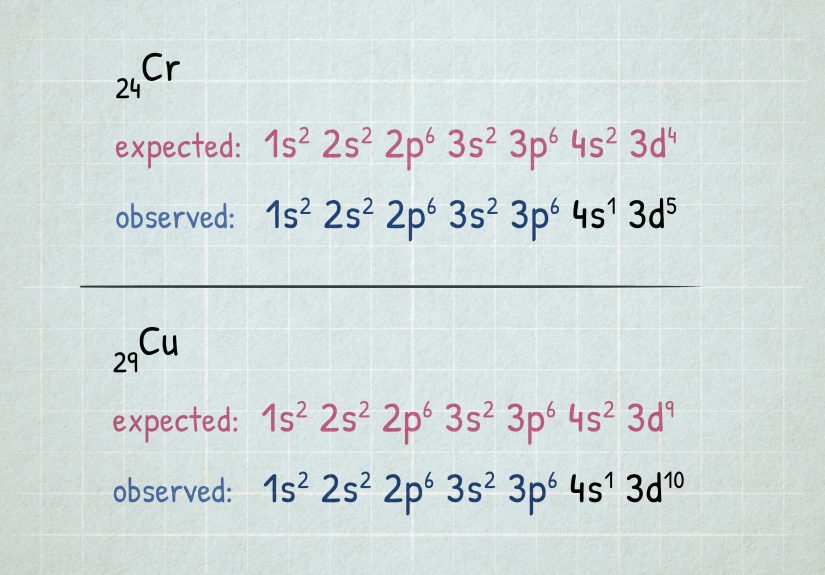
Chromium and Copper
Two of the most famous exceptions are chromium and copper.
Chromium: [Ar] 4s1 3d5
Copper: [Ar] 4s1 3d10
If you followed the simple filling order blindly, you might expect chromium to be [Ar] 4s2 3d4 and copper to be [Ar] 4s2 3d9. But half-filled and fully filled d subshells can be more stable, so one electron shifts over. Chemistry loves efficiency, but it also enjoys plot twists.
The 4s and 3d confusion
For neutral atoms, the 4s orbital is filled before 3d in standard introductory notation. But when transition metals form positive ions, electrons are usually removed from 4s before 3d. That detail confuses nearly everyone at least once, so if it confused you too, congratulations on being normal.
Three mistakes students make all the time
- Using atomic mass instead of atomic number. Electron count comes from the atomic number.
- Ignoring Hund’s rule. Do not pair electrons early in equal-energy orbitals.
- Skipping the order of filling. The orbitals are not filled in simple numerical order.
A Quick Cheat Sheet for Writing Electron Configurations
- Start with the atomic number.
- Use the filling order: 1s, 2s, 2p, 3s, 3p, 4s, 3d, 4p, and so on.
- Remember orbital capacities: s = 2, p = 6, d = 10, f = 14.
- Apply Pauli: max two electrons per orbital, opposite spins.
- Apply Hund: spread out first within equal-energy orbitals.
- Use noble-gas shorthand to shorten long configurations.
- Watch for exceptions like chromium and copper.
Conclusion
If you want to write electron configurations for atoms of any element, you do not need superpowers, a wall-sized poster, or a dramatic soundtrack. You just need a reliable method. The full electron configuration teaches the logic. Noble-gas shorthand makes the notation efficient. Orbital box diagrams help you visualize spins and pairing. And the periodic-table shortcut turns the entire chart into a roadmap.
Once these four methods click, electron configurations stop looking like random code and start behaving like what they really are: a compact description of how atoms are built. Learn the pattern, practice a few examples, and suddenly the periodic table starts feeling a lot less like a poster and a lot more like a system you can actually read.
Experiences from the Electron Configuration Trenches
Anyone who has learned electron configurations remembers the first moment of mild panic. You stare at something like 1s2 2s2 2p6 3s2 3p5 and wonder whether chemistry secretly became a subway map while you were getting a snack. That reaction is normal. In fact, one of the most common experiences students describe is that electron configuration looks impossible for about twenty minutes and then suddenly becomes weirdly satisfying.
The breakthrough usually happens when the notation stops being a string of symbols and starts being a seating plan. Once learners realize that each number is an energy level, each letter is a subshell, and each superscript is just a headcount, the whole topic becomes much more approachable. It is not random. It is organized. Fussy, yes. Dramatic in the case of chromium, absolutely. But organized.
Another common experience is overconfidence right after learning the basics. This is the stage where someone writes sodium correctly, gets magnesium right, and decides they have mastered the atom. Then iron shows up. Or copper. Or a box diagram with three p orbitals and a teacher who insists that arrows matter. That is usually the moment students realize electron configuration is less like memorizing a password and more like learning grammar. You can fake it for a while, but eventually the details matter.
Students also tend to have one favorite method. Some people love full configurations because they feel thorough and orderly. These are the same people who probably label folders and keep neat handwriting. Others immediately fall in love with noble-gas shorthand because it cuts the clutter and gets to the point. Then there are visual learners who finally relax when orbital box diagrams appear, because arrows in boxes make more sense than superscripts floating in space. And of course there are shortcut lovers who use the periodic table like a tactical map and can work out configurations by tracing blocks with the confidence of a general planning a campaign.
Teachers see a pattern too. The students who improve fastest are not always the ones who memorize the most. They are often the ones who practice the structure repeatedly with small examples. Hydrogen, carbon, oxygen, sodium, calcium, iron. A few each day. Over time, the filling order starts to feel familiar. The capacities of s, p, d, and f begin to stick. The noble gases become landmarks instead of trivia questions. What started as an alien code slowly turns into a language.
There is also a surprisingly satisfying moment that happens when electron configurations connect to real chemical behavior. Suddenly chlorine’s eagerness to gain one electron makes sense. Neon’s calm indifference makes sense. Transition metals having multiple oxidation states starts to make more sense. That is when students stop asking, “Will this be on the test?” and start realizing that electron configurations are one of the reasons the periodic table behaves so elegantly in the first place.
And yes, nearly everyone makes the same mistakes. Forgetting that the atomic number gives the electron count. Pairing p electrons too early. Writing orbitals in numerical order instead of energy order. Mixing up 4s and 3d. These are not signs that someone is bad at chemistry. They are signs that the person is learning a system with rules, exceptions, and enough fine print to keep textbooks in business.
In the end, the experience of learning electron configurations is usually the same story: confusion, pattern recognition, small victories, one dramatic argument with chromium, and then a satisfying sense that atoms are not quite as chaotic as they first appeared. Once that happens, the notation stops looking scary. It starts looking useful. And that is the moment chemistry gets a lot more fun.