Table of Contents >> Show >> Hide
- Quick checklist: the 8 space-shrinking mistakes
- Mistake #1: A jumbled layout with no “plan” (just vibes)
- Mistake #2: Letting dark corners swallow the space
- Mistake #3: Keeping everything at ground level
- Mistake #4: Designing for one season (and ignoring the “off months”)
- Mistake #5: Straight, obvious paths that make the garden feel “over with” immediately
- Mistake #6: Hardscape overload (too much paving, too many materials, too busy)
- Mistake #7: Color choices that push the walls in (too hot, too loud, too contrasty)
- Mistake #8: Scattered “single plants” and tiny pots everywhere (instead of cohesive groupings)
- Wrap-up: What makes a small garden feel big (without adding a single square foot)
- Real-World Experiences: of Small-Garden Lessons People Actually Learn
A small garden is like a studio apartment: it can be charming, efficient, and surprisingly luxurious… or it can feel like
you’re living inside a closet with a fern. The difference usually isn’t “more space.” It’s smarter design.
The good news: you don’t need to bulldoze anything, buy a fountain the size of a hot tub, or learn Latin plant names just
to make your outdoor space feel bigger. Most “tiny garden problems” come down to a handful of common design mistakes that
visually shrink the spaceand they’re fixable with practical, weekend-friendly changes.
Below are eight mistakes that quietly make small gardens feel cramped, plus what to do insteadusing real, field-tested
design principles (and a little humor) so your garden can feel airy, layered, and intentional.
Quick checklist: the 8 space-shrinking mistakes
- Messy, unplanned layout (aka “I put things where they fit”)
- Dark corners and shadowy dead zones
- Everything stays at ground level
- Planning for one season only
- Paths that are straight, short, and instantly “read”
- Hardscape overload (too much paving, too many materials, too busy)
- Color choices that visually push walls inward
- Scattered single plants and tiny pots instead of cohesive groupings
Mistake #1: A jumbled layout with no “plan” (just vibes)
Why it makes your garden feel smaller
In small spaces, randomness reads as clutter. When your seating, containers, edging, and plant beds all compete for
attention, the eye has nowhere to restso the space feels busy and tight. Think of it like a junk drawer, but outdoors
and with mosquitoes.
Make it feel bigger instead
Give your garden a simple structure. That doesn’t mean rigid or boringit means intentional. Pick one main “shape” for
the layout (a rectangle, an L-shape, a gentle curve) and build around it. Even a tiny garden benefits from clear zones:
a spot to sit, a spot to plant, a spot to move through.
- Choose one primary function: coffee nook, container kitchen garden, pet-friendly hangout, etc.
- Define zones with repetition: same paver type, same edging material, repeated planters.
- Use one focal point: a small tree, a statement planter, a trellis, or a water bowl.
Example: If you have a 10×12 patio garden, try a narrow planting strip along one side, a compact bistro set, and a
vertical trellis at the back corner. One clean layout beats five “cute ideas” fighting to the death.
Mistake #2: Letting dark corners swallow the space
Why it makes your garden feel smaller
Dark corners act like visual dead ends. When the edges fade into shadow, your garden feels boxed inespecially if fences,
sheds, or dense shrubs already create a “wall” effect.
Make it feel bigger instead
Brighten the perimeter and lift the eye. You’re not trying to turn your yard into a runway, but you do want to remove the
“black hole” effect.
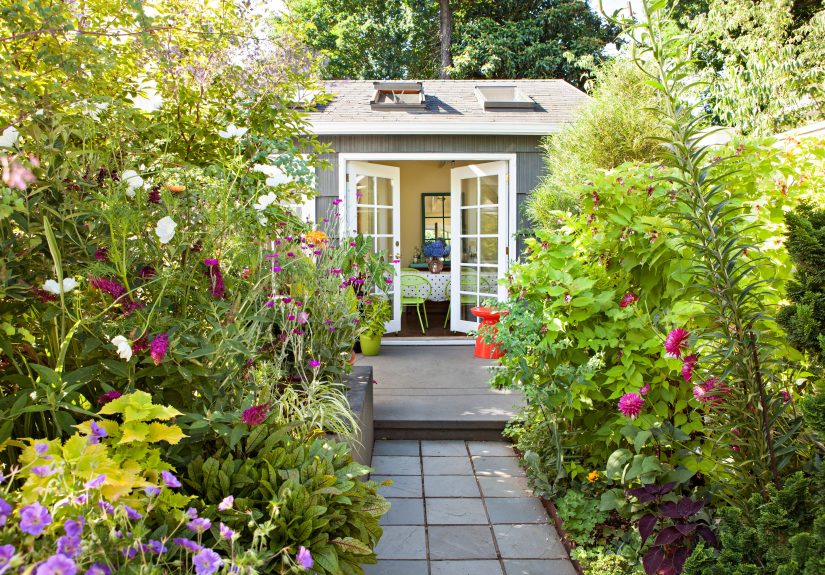
- Use lighter foliage: variegated plants, silver leaves, chartreuse accents, or pale blooms.
- Add a reflective element: a small outdoor mirror, a glazed pot, or a light-colored wall panel.
- Layer lighting: warm string lights above + path lights or small uplights below.
Small trick, big payoff: place one light-toned container (cream, pale gray, terracotta) in the darkest corner and plant
it with bright foliage. It becomes an instant “anchor,” and the corner stops feeling like the edge of the universe.
Mistake #3: Keeping everything at ground level
Why it makes your garden feel smaller
Flat gardens look shorter, shallower, and more crowdedeven when you’ve left open space. If all your plants hover around
knee height, the scene reads like a carpet. A nice carpet… but still a carpet.
Make it feel bigger instead
Go vertical and think in layers. When you add height, you create depth. The eye travels up and around, and suddenly the
garden feels like a “room” instead of a strip.
- Add one vertical feature: trellis, arbor, obelisk, or wall-mounted planters.
- Use a small tree or tall shrub: something airy, not bulkythink multi-stem or columnar forms.
- Layer plant heights: low groundcovers, mid-height perennials, taller accents in the back or corners.
Example: In a narrow side yard, a trellis with climbing jasmine or clematis + two tall planters flanking a bench makes the
space feel taller and more intentionallike a tiny courtyard instead of a hallway.
Mistake #4: Designing for one season (and ignoring the “off months”)
Why it makes your garden feel smaller
If your garden looks amazing for eight weeks and then turns into a sad collection of sticks, the space can feel emptier
and smaller most of the year. The visual “architecture” disappears.
Make it feel bigger instead
Build a year-round backbone. You want something attractive happening in every seasonflowers are the fun part, but
structure is what keeps a small space from feeling bare.
- Evergreen framework: a couple of compact evergreens or structural grasses.
- Multi-season performers: plants with interesting foliage, berries, seed heads, or winter texture.
- Hardworking containers: swap seasonal “topper” plants while keeping the same planters for unity.
Example: Use two matching containers year-round. In spring: bulbs + pansies. Summer: herbs + trailing blooms. Fall:
mums + ornamental cabbage. Winter: evergreen boughs and pinecones. Same planters, new outfits.
Mistake #5: Straight, obvious paths that make the garden feel “over with” immediately
Why it makes your garden feel smaller
A straight shot from Point A to Point B tells your brain, “That’s it.” In a small garden, that quick visual read can make
the space feel shorter than it islike watching a movie that ends after the opening credits.
Make it feel bigger instead
Add gentle curves, angles, or a hint of mystery. You don’t need a maze. You just need a reason for the eye (and feet) to
explore.
- Try a curved stepping-stone line instead of a straight strip.
- Use diagonal lines in a small patio or walkway to visually widen the space.
- Partially conceal something (a planter, sculpture, or tall grass) so the garden “unfolds.”
Example: In a tiny backyard, angle your seating slightly and place a tall planter near (not on) the corner. The corner
recedes, the line of sight changes, and the garden feels deeper.
Mistake #6: Hardscape overload (too much paving, too many materials, too busy)
Why it makes your garden feel smaller
Small gardens can’t “carry” visual chaos the way big gardens can. If you mix three paver styles, two gravel colors, and a
border that looks like it was designed by a committee of raccoons, the space reads as chopped up and cluttered.
Make it feel bigger instead
Simplify. Fewer materials, bigger visual fields, cleaner lines. A small garden feels larger when surfaces look continuous.
- Limit hardscape materials: pick one main surface + one accent, max.
- Go larger (carefully): large-format pavers can reduce visual “grid noise.”
- Soften edges: let plants spill slightly over borders to blur lines.
Example: Replace five different pots on five different saucers with two large planters and one small accent pot. Suddenly
you have “design,” not “inventory.”
Mistake #7: Color choices that push the walls in (too hot, too loud, too contrasty)
Why it makes your garden feel smaller
Warm, intense colors (think lots of red, orange, hot pink) advance toward the eye. That can be gorgeousbut in a small
garden, it can make boundaries feel closer. High contrast (white fence + dark furniture + neon flowers) can also chop the
space into hard visual blocks.
Make it feel bigger instead
Use color strategicallyespecially near boundaries.
- Lean cooler at the back: blues, purples, soft whites, and silvery foliage can visually recede.
- Repeat a restrained palette: fewer colors, used in bigger groupings, feels calmer and larger.
- Soften boundaries: paint fences in a muted tone and layer plants in front to blur edges.
Example: Keep hot colors (like red salvia) closer to seating where you want energy, and place cooler tones (like lavender,
catmint, blue fescue) toward the far edge to extend perceived depth.
Mistake #8: Scattered “single plants” and tiny pots everywhere (instead of cohesive groupings)
Why it makes your garden feel smaller
Lots of little, disconnected plantings create visual clutter. Your eye keeps stopping and starting, which makes the space
feel chopped up. It’s the landscaping equivalent of opening 14 browser tabs and forgetting why you’re there.
Make it feel bigger instead
Group plants in drifts, repeat shapes, and scale containers properly. Cohesion is a small garden’s secret weapon.
- Plant in groups of 3–5+ of the same variety (or at least the same color/texture).
- Repeat “signature plants” in multiple spots to create rhythm and flow.
- Choose fewer, larger containers rather than many small ones.
Example: Instead of one boxwood here, one boxwood there, one boxwood over by the hose… create a single cluster that reads
as a designed mass. Add one contrasting texture (like ornamental grass) and you’ve got a composed scene.
Wrap-up: What makes a small garden feel big (without adding a single square foot)
The big theme across all eight mistakes is this: small gardens need clarity. Clear layout, clear lighting,
clear layers, clear paths, and clear groupings. When the eye can travel smoothlyand has something worth traveling tothe
garden feels open, deep, and surprisingly expansive.
If you want the fastest “wow” upgrade, start with one change that creates structure (a trellis, a focal-point planter, a
defined seating zone) and one change that reduces visual noise (fewer pots, fewer materials, tighter palette). Those two
moves alone can make a small garden feel like it grew up overnight.
Real-World Experiences: of Small-Garden Lessons People Actually Learn
Small gardens have a funny way of teaching design lessons quicklybecause there’s nowhere for mistakes to hide. Here are
a few real-life patterns that show up again and again in compact yards, patios, and balcony gardens, and how gardeners
typically fix them once they’ve lived with the space for a season.
1) “I bought more plants… and somehow my garden feels smaller now.”
This is the classic small-garden trap: you start with open space, then add “just one more” plant every weekend. Within a
month, you’ve created a botanical traffic jam. What people usually discover is that the garden doesn’t need more plantsit
needs stronger groupings. When they swap twelve small pots for three larger ones, the garden suddenly looks calmer,
cleaner, and more intentional. The funny part? They often end up growing the same number of plantsjust arranged in a way
that reads as a designed collection instead of a plant rescue mission.
2) “My seating area is cute, but it feels cramped and nobody uses it.”
In tight spaces, furniture size and placement matter more than style. People often pick pieces that are slightly too deep
or bulky (because they look cozy in the store), then wedge them against a wall or fence. The result is a pinched walkway
and a seating area that feels like it’s blocking the entire garden. The fix tends to be surprisingly simple: smaller-scale
furniture, one multi-purpose bench, or built-in seating that shares space with planters. Once the flow improves, the garden
feels bigger because you can move through it without doing the sideways crab-walk.
3) “The garden looks great in summer, but in the rest of the year it feels empty.”
Many small gardens are designed like a firework: impressive for a moment, then gone. After the first off-season, people
realize they need a year-round “skeleton”evergreen structure, winter texture, or containers that stay in place even when
the seasonal color changes. Once they add one compact evergreen, a structural grass, or a climbing vine that keeps its form,
the garden stops feeling like it disappears every few months. Even a simple trickkeeping two matching planters year-round
and rotating what’s insidecreates visual stability that makes the whole space feel more finished.
4) “My fence feels like it’s closing in on me.”
In small yards, a tall fence can feel like a wallbecause it is one. People often try to solve it by adding more privacy
screens (which, ironically, creates more wall). The more satisfying fix is usually to soften and blur the boundary:
a trellis with climbers, layered planting that partially hides the fence, or a fence color that visually recedes. Once the
fence becomes “background,” attention returns to the plants and the focal point, and the garden feels deeper. It’s the same
psychological effect as decluttering a countertop: the room didn’t change size, but your brain stops screaming “crowded!”
The shared takeaway from these experiences is refreshingly hopeful: most small gardens don’t need more spacethey need
better editing. When you simplify the layout, brighten the edges, add vertical layers, and group plants with purpose, a
“small” garden can feel like a thoughtfully designed outdoor room you actually want to live in.