Table of Contents >> Show >> Hide
- Why a lying-down resistance band workout works so well
- What you’ll need
- Safety + setup (so the band doesn’t “fight back”)
- How hard should this feel?
- The 20-minute lying-down resistance band workout
- Progressions (how to keep improving without buying a whole gym)
- How to fit this into a week (simple and realistic)
- FAQ: Quick answers that save you a scroll
- Experiences from the floor: what this workout feels like in real life (and why it sticks)
- Conclusion
Some days, “getting a workout in” sounds great in theory… right up until you remember you also have to stand up and do things. The good news: you can build real strength with resistance bands without balancing, jumping, or negotiating with gravity like it’s your landlord. This 20-minute resistance band workout is designed to be done mostly on the floorlying on your back, your side, or your stomachso it’s low-impact, joint-friendly, and surprisingly spicy.
Resistance bands aren’t just oversized office supplies with big fitness dreams. Because band tension increases as the band stretches, your muscles work hardest near the end of the range of motionan efficient way to train strength at home with minimal equipment. And when you’re lying down, you can focus on form, core control, and smooth reps instead of wobbling like a baby giraffe.
Why a lying-down resistance band workout works so well
1) It’s low-impact but still strength-focused
Lying down removes a lot of balance demands and reduces joint pounding, but you can still challenge major muscle groups with smart band setup. That means it’s a solid option for beginners, people easing back into training, or anyone who just wants a “no excuses” band workout on the floor.
2) It teaches core control (without a single crunchy sit-up)
Floor-based moves make it easier to feel whether you’re keeping your ribs stacked, pelvis steady, and lower back supported. Translation: your core learns to stabilize while your arms and legs moveexactly what you want for everyday life and better lifting mechanics.
3) It’s wildly portable
A resistance band set can live in a drawer, a suitcase, or that mysterious chair in your bedroom that holds “clothes that aren’t dirty yet.” If you can find a patch of floor, you can train.
What you’ll need
- One long resistance band (tube with handles or flat band works)
- One mini loop band (optional but great for hips/glutes)
- A mat or towel (optional, but your spine may send a thank-you note)
- Optional door anchor (helpful for pulling moves, but not required)
- A timer (phone timer is perfect)
Safety + setup (so the band doesn’t “fight back”)
Before you start, do a 10-second band check. Run your hands along it and look for thin spots, tears, cracks, or sticky areas. If it looks suspicious, retire itbands are cheaper than urgent care.
- Control the return: Never let the band snap back. Move like you’re returning a fragile library book.
- Anchor carefully: If you use a door anchor, tug-test it before each set and keep the door closed/locked.
- Wear shoes if you tend to slip: Especially for foot-anchored moves.
- Pain rule: Muscle burn is normal; sharp pain, numbness, or joint pain is not. Modify or stop if anything feels “wrong.”
How hard should this feel?
Aim for “challenging but controlled.” On a 1–10 effort scale, think about a 7: you can keep perfect form, but you’re glad the timer is counting down. If you finish every interval feeling like you could deliver a TED Talk, use more tension. If your form falls apart at 15 seconds, lighten the band or shorten the range of motion.
The 20-minute lying-down resistance band workout
Format: 3-minute warm-up + 2 rounds of 6 moves (40s work / 20s rest) + 2-minute finisher + 3-minute cool-down.
3-minute warm-up (on your back)
- 360° Breathing (45s): One hand on belly, one on ribs. Inhale through the nose, exhale long and slow.
- Pelvic tilts (45s): Gently flatten low back into the floor, then release to neutral.
- Glute squeezes (30s): Squeeze, release. No hip lift yetjust wake the glutes up.
- Ankle pumps + circles (60s): Great for circulation and “I’ve been sitting all day” legs.
Main circuit (2 rounds)
Do each exercise for 40 seconds, rest 20 seconds, then move on. Complete all 6 exercises, rest 45 seconds, then repeat for Round 2.
1) Banded Glute Bridge (mini band)
Targets: glutes, hamstrings, core
Lie on your back, knees bent, feet flat. Place a mini band just above your knees. Brace your core (ribs down), press knees gently out into the band, and lift hips until your body makes a straight line from shoulders to knees. Lower slowly.
- Form cue: Think “hips up,” not “lower back up.” Keep ribs from flaring.
- Make it easier: Remove the mini band or reduce range of motion.
- Make it harder: Hold 2 seconds at the top or do alternating “march” bridges.
2) Supine Resistance Band Chest Press (long band)
Targets: chest, triceps, shoulders
Wrap the band behind your upper back (across shoulder blades), hold ends/handles with elbows bent near the floor. Press hands toward the ceiling until arms extend, then return with control.
- Form cue: Keep shoulders down, not shrugged up toward your ears.
- Make it easier: Use less tension or press one arm at a time.
- Make it harder: “Choke up” on the band (shorten it) or slow the lowering phase.
3) Supine Resistance Band Row (long band, feet anchor)
Targets: upper back, lats, biceps, posture muscles
Stay on your back with knees bent, loop the band around the mid-foot area (or both feet), hold ends/handles. Pull elbows down toward the floor and slightly toward your ribs, squeezing shoulder blades together. Return slowly.
- Form cue: Imagine pinching a pencil between your shoulder bladesno neck tension.
- Make it easier: Use a lighter band or row one arm at a time.
- Make it harder: Increase tension by shortening the band or extending legs more.
4) Dead Bug (banded “anti-extension” option)
Targets: deep core, hip flexors, coordination
Start in a tabletop position: on your back, knees over hips, arms up. Keep your low back gently pressed into the floor. Extend the opposite arm and leg away from you, then return and switch sides.
Optional band upgrade: Hold a band above your chest with light tension (or hold the band ends anchored under your hands) and keep arms steady while legs move. The goal is core stability, not chaos.
- Form cue: Move slow enough that your lower back never pops off the floor.
- Make it easier: Only move legs (keep arms still) or shorten the leg extension.
- Make it harder: Add band tension or slow the rep to a 3-second reach.
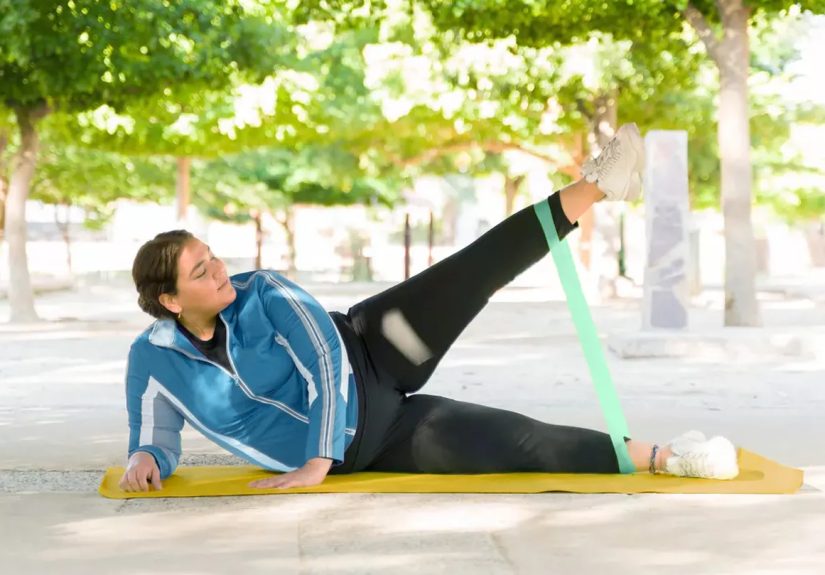
5) Side-Lying Clamshell (mini band)
Targets: glute medius (hip stability), outer hips
Lie on your side with hips stacked, knees bent about 90°. Place mini band above knees. Keep feet together and lift the top knee like opening a clam, then lower slowlyno rolling backward.
- Form cue: Your hips stay stacked like pancakes, not sliding off the plate.
- Make it easier: Remove the band or reduce the lift.
- Make it harder: Pause 2 seconds at the top or add a small hip lift (advanced).
6) Prone Hamstring Curl (long band or mini band)
Targets: hamstrings, glutes
Lie on your stomach, legs extended. With a mini band, loop it around both ankles (or use a long band anchored low behind you and looped to one ankle). Bend knees to curl heels toward your glutes, then lower with control.
- Form cue: Keep hips heavy on the matdon’t let your low back take over.
- Make it easier: Do one leg at a time, smaller range.
- Make it harder: Add a 1-second squeeze at the top of each curl.
2-minute finisher: “Core + Chest combo”
Set a timer for 2 minutes. Alternate these two moves every 20 seconds (3 rounds each):
- Band Chest Press Pulses (20s): Small controlled presses near the top range.
- Hollow Hold Prep (20s): On your back, knees bent, ribs down, brace core; lift head/shoulders slightly if comfortable.
If your neck complains, keep head down and focus on bracing. Your abs should do the work, not your face.
3-minute cool-down (still lying down)
- Figure-4 stretch (60s each side): Glutes/hips.
- Chest opener (60s): Arms out like a “T” on the floor, breathe slowly.
Progressions (how to keep improving without buying a whole gym)
Option A: Add tension
Shorten the band by gripping closer to the center, double it over, or choose a stronger resistance. Small changes add up fast.
Option B: Add time or tempo
Keep the same resistance but slow your reps (especially on the lowering phase), add pauses, or increase work intervals to 45 seconds.
Option C: Add a third round (when ready)
If 2 rounds starts feeling “cute,” add a third round and keep the finisher. That turns this into a 26–28 minute session without changing exercises.
How to fit this into a week (simple and realistic)
- 2 days/week: Do this workout as written (great baseline for muscle-strengthening consistency).
- 3 days/week: Alternate this routine with a walking day or a mobility day.
- 4 days/week: Do this twice, plus 2 cardio days (brisk walk, cycling, swimminganything you’ll actually do).
FAQ: Quick answers that save you a scroll
Is a lying-down resistance band workout good for beginners?
Yes. Being on the floor reduces balance demands, makes it easier to learn proper bracing, and helps you move with control. Start with lighter resistance and shorter ranges of motion.
Will this build muscle?
If you use enough resistance and train consistently, bands can absolutely support strength and muscle gains. The key is progressive overload: gradually increase tension, time under tension, or total work over weeks.
What if I have knee, back, or shoulder issues?
Modify exercises, shorten ranges, and keep pain out of the equation. If you’re managing an injury or a medical condition, check with a qualified clinician or trainer for personalization.
Experiences from the floor: what this workout feels like in real life (and why it sticks)
The first time I tried a “lying down resistance band workout,” I assumed it would feel like the fitness equivalent of sending an email from bed: technically productive, emotionally suspicious. Then the mini band met my glutes, and my glutes filed a formal complaint.
The most surprising part? Lying down makes it easier to tell when you’re cheating. Standing workouts can hide a lotmomentum, shifting weight, turning every rep into a weird little dance. On the floor, your body has fewer places to “borrow” effort from. If your core isn’t braced during dead bugs, you’ll feel your low back arch. If you’re shrugging during chest presses, your neck will volunteer itself as the main character. The floor is honest. Rude, but honest.
I’ve also found it’s the easiest workout to do on chaotic days. There’s no “setup tax” of driving somewhere, changing clothes, psyching up, or locating that one matching dumbbell that disappeared into the void. You roll out a mat, grab a band, and you’re in business. The barrier to entry is so low it’s basically tripping hazard height.
Traveling? This routine shines. Hotel gyms can be a coin flip: sometimes you get a treadmill and a mysterious cable machine, and sometimes you get one yoga mat that looks like it survived a decade-long music festival. Bands take up almost no space, and the lying-down format works in tight rooms. I’ve done glute bridges next to a suitcase like it was my training partner. (It did not spot me. Rude.)
Another real-world win: recovery days. When my legs feel heavy or my joints feel cranky, I can still train without impact. The band lets me dial resistance up or down instantly, and the floor-based positions reduce the “wobble factor” that can make workouts feel less safe when you’re tired. The result is a session that feels more like “practice good movement” than “punish your body.”
And honestly? The mental piece matters. There’s something comforting about a routine that doesn’t require perfect conditions. You can do it in pajamas. You can do it while your laundry runs. You can do it while you wait for your motivation to show up, because motivation is famously late to everything. Over time, that consistency adds up. A 20-minute resistance band workout you actually repeat will beat a 60-minute masterpiece you do once and then ghost like a bad date.
If you’re someone who’s felt intimidated by “serious” strength training, this is a friendly doorway. If you’re already experienced, it’s a great add-on day for core, glutes, and posture work. Either way, it proves the point: you don’t have to be upright to make progress. Sometimes the strongest thing you can do is lie down… on purpose… with a plan.
Conclusion
This 20-minute resistance band workout you can do lying down is simple, scalable, and sneaky-effective. You’ll train glutes, hamstrings, chest, upper back, and core with low-impact movements that prioritize control and form. Start with lighter resistance, focus on smooth reps, and progress by increasing tension or time under tension. Most importantly: keep it doable. Consistency is the secret ingredientand unlike protein powder, you don’t have to drink it.