Table of Contents >> Show >> Hide
- What Roulette Really Is (And Why It’s So Addictive to the Brain)
- The Wheel Variations That Change Everything
- Inside vs. Outside Bets: Same House Edge, Different Feel
- The House Edge: Roulette’s Quiet “Cover Charge”
- French Rules: When Zero Is Less Rude
- The “Advanced” Part: Understanding Volatility (Not Chasing It)
- Common “Systems” (And What They Actually Do)
- If You Want Skill, Build a Simulator (Seriously)
- How to “Test Your Luck” Without Letting Luck Test You
- Conclusion: The Real “Advanced” Roulette Advantage
- Extra: of Experiences Around “Advanced Roulette Game: Test Your Luck”
Quick note before we spin any metaphors: Roulette is an adult, age-restricted form of gambling in many places. If you’re not of legal gambling age where you live, keep this as a math-and-psychology read (or a free simulation project). No real money requiredjust curiosity.
Roulette looks simple: a wheel, a ball, a satisfying clack-clack-clack, and a table layout that resembles a fancy spreadsheet designed by someone who really loved rectangles. But “simple” doesn’t mean “easy.” In fact, roulette is one of the best games for learning the difference between:
- Probability (what can happen),
- Expected value (what tends to happen over time), and
- Human psychology (why we still think the wheel is “due”).
This article is your “advanced” guide in the best way: not a magic system, not a get-rich scheme, and definitely not a “trust me bro” strategy. Instead, you’ll get a clear, practical understanding of roulette’s mechanics, odds, and common trapsso when you “test your luck,” you’re testing it with your eyes open.
What Roulette Really Is (And Why It’s So Addictive to the Brain)
Roulette is a banked game: you’re not playing against other playersyou’re playing against the house. The wheel contains numbered pockets (typically 1–36) plus one or more green pockets (the zeroes). The table offers many ways to bet: on a single number, a group of numbers, or broad categories like red/black.
So why do people love it? Because roulette has three irresistible ingredients:
- Immediate feedback: every spin resolves quickly.
- Pattern-friendly visuals: red/black streaks and number grids invite your brain to “find signals.”
- Near-50/50 bets: outside bets feel “almost fair,” which is the point.
The Wheel Variations That Change Everything
Roulette isn’t one gameit’s a family of games that share a name. The biggest difference is how many green pockets the wheel has. Those green pockets are the house’s secret sauce.
European Roulette (Single-Zero)
37 pockets: 1–36 plus a single 0. This version has a lower built-in house advantage than the double-zero wheel, because there’s only one “extra” pocket beyond the 36-number layout.
American Roulette (Double-Zero)
38 pockets: 1–36 plus 0 and 00. That extra green pocket may look small, but mathematically it’s a big deal: it increases the house edge on standard bets.
Triple-Zero / Specialty Wheels
39 pockets (or other variations) add even more green. The math is not subtle: more zeros generally means worse long-term value for players. If roulette were a sandwich, zeros are the “extra mayo” you didn’t ask for, and the house is the one holding the napkins.
Inside vs. Outside Bets: Same House Edge, Different Feel
Roulette bets are often grouped into two types:
Outside Bets (Broader Coverage)
These cover lots of outcomes and usually pay smaller amounts. Common examples include:
- Red/Black (pays 1:1)
- Odd/Even (pays 1:1)
- High/Low (pays 1:1)
- Dozens (1–12, 13–24, 25–36; pays 2:1)
- Columns (pays 2:1)
Outside bets feel “safer” because you win more often. But “win more often” is not the same thing as “win more money.”
Inside Bets (Narrow Coverage)
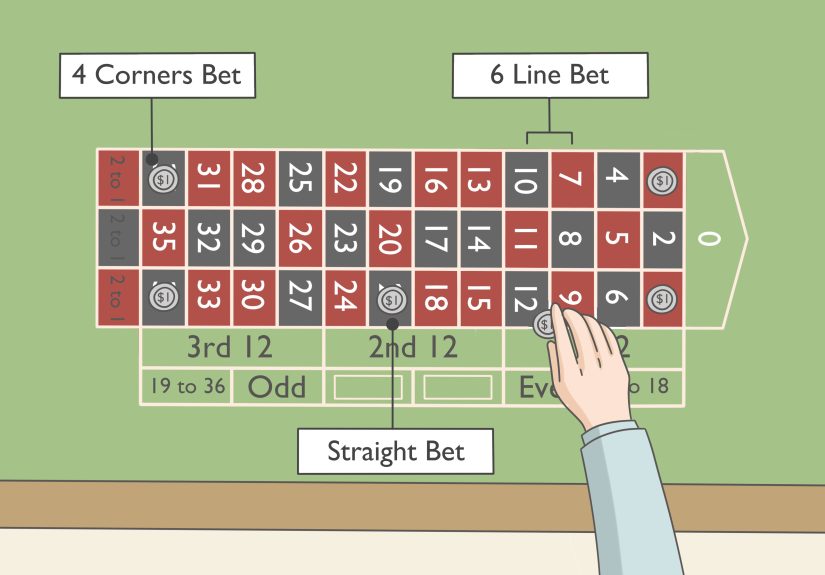
These cover fewer numbers and pay more when they hit. Examples include:
- Straight-up (one number; pays 35:1)
- Split (two numbers; pays 17:1)
- Street (three numbers; pays 11:1)
- Corner (four numbers; pays 8:1)
- Six-line (six numbers; pays 5:1)
Inside bets are higher volatility: fewer wins, bigger spikes when you do win. If outside bets are a steady jog, inside bets are parkour.
The House Edge: Roulette’s Quiet “Cover Charge”
The most important “advanced” roulette concept is also the least exciting to sell on a billboard: expected value.
Here’s the core idea: roulette payouts are designed as if there were only 36 outcomesbut the wheel has 37 (single-zero) or 38 (double-zero). That mismatch is the house edge.
A Clean Expected Value Example (European Wheel)
Imagine a $10 bet on red in single-zero roulette:
- There are 18 red numbers, 18 black numbers, and 1 green zero.
- Probability of winning = 18/37
- Probability of losing = 19/37 (18 black + the zero)
- Payout is 1:1 (win $10 profit, or lose $10)
Expected value per spin:
EV = (18/37 × +$10) + (19/37 × −$10)
EV = (180 − 190) / 37
EV ≈ −$0.27 per $10 bet
That −$0.27 is not a prophecy for the next spinit’s a long-run average. In other words: roulette doesn’t “take your money every spin.” It takes a small statistical fee over time, and it’s perfectly happy to refund you some excitement along the way.
French Rules: When Zero Is Less Rude
Some single-zero games use special rules on even-money bets (like red/black) when the ball lands on zero:
- La Partage: you lose only half your even-money bet when zero hits.
- En Prison: your even-money bet is “imprisoned” for the next spin; if you win next, you get your stake back (details vary by house rules).
These rules don’t make roulette a beatable skill gamebut they can reduce the house edge on even-money bets compared with standard single-zero rules. Think of it as the wheel saying, “Sorry about the zero… here’s a consolation prize.”
The “Advanced” Part: Understanding Volatility (Not Chasing It)
If roulette had a personality test, it would score high on drama. The wheel produces streaks naturallyeven when everything is fair. That’s what randomness looks like in real life.
Why Streaks Happen Without Meaning
Red can hit five times in a row. Black can hit eight times in a row. A single number can show up twice in ten spins. Your brain will scream, “PATTERN!” The math will calmly respond, “Normal.”
One of roulette’s biggest psychological traps is the gambler’s fallacy: the belief that a random outcome is “due” because the opposite outcome has been happening a lot lately.
In roulette terms, it sounds like:
- “It’s been black foreverred has to be next.”
- “This table is hot; I should keep pressing.”
- “That number hasn’t shown up all night; it’s overdue.”
The wheel doesn’t have a memory. It doesn’t feel embarrassment about being repetitive. It just spins.
Common “Systems” (And What They Actually Do)
Let’s talk about betting systemscarefully. Not to promote them, but to explain why they’re so tempting and why they don’t change the underlying math.
Martingale (Doubling After Losses)
This is the classic: after each loss on an even-money bet, double the next bet until you win, then reset. On paper, it looks like you can “guarantee” a small profit. In practice, three things break it:
- Table limits (you can’t double forever).
- Finite bankrolls (your wallet is not an infinite math symbol).
- Zero (the green pocket laughs politely and takes your chips).
What Martingale really does is trade many small wins for the risk of one very large loss. It changes the shape of outcomes (volatility), not the expected value.
D’Alembert / Fibonacci / “Smoother” Progressions
These systems adjust bets more gently. That can make sessions feel less explosivebut again, they do not change the wheel’s probabilities. They mainly change pacing and emotional experience.
“Hot Numbers” Tracking
Tracking outcomes can be fun as a hobby. But unless the wheel is physically biased (which reputable operations work hard to prevent), past spins don’t improve predictions. Your spreadsheet may be beautiful; the wheel remains indifferent.
If You Want Skill, Build a Simulator (Seriously)
Here’s the safest and most genuinely “advanced” roulette move: treat roulette as a probability lab.
A Simple Simulation Challenge
- Generate random results from 0–36 (single-zero) or 0–37 (double-zero).
- Track how often red/black wins over 100 spins, 1,000 spins, and 10,000 spins.
- Track your “bankroll” using fixed bet sizes.
- Compare your results to the expected house edge.
Two cool things happen when you do this:
- You start respecting sample size (because 30 spins can look wildly “rigged”).
- You learn that “luck” is often just variance wearing a costume.
How to “Test Your Luck” Without Letting Luck Test You
If you’re an adult who chooses to gamble legally, the healthiest mindset is to treat roulette like buying a movie ticket. You’re paying for entertainment, not investing in a guaranteed return.
Responsible Play Checklist (Adult/Legal-Age Context)
- Set a time limit before you start.
- Set a money limit you can afford to lose (no rent money, no “I’ll fix it later” money).
- Don’t chase losseschasing is how short sessions become long regrets.
- Take breaks (your brain makes worse decisions when emotional or tired).
- Know the game’s edge so you’re not negotiating with fantasy.
And if you’re not of legal age: keep it as a simulation, a math project, or a critical-thinking exercise. The wheel will still teach you plentyno casino required.
Conclusion: The Real “Advanced” Roulette Advantage
Roulette’s biggest lesson is that random doesn’t feel random. Streaks happen. Patterns appear. Your brain writes stories. The math shrugs.
The “advanced” advantage isn’t picking magic numbers or outsmarting a spinning wheel. It’s understanding:
- how wheel types change the house edge,
- how different bets change volatility,
- how expected value quietly governs the long run, and
- how your own psychology can be the biggest variable at the table.
So yestest your luck. But test your thinking, too. Luck loves an audience, and the best audience is someone who knows what they’re watching.
Extra: of Experiences Around “Advanced Roulette Game: Test Your Luck”
Ask ten people what roulette “feels like,” and you’ll get ten versions of the same story: it starts calm, gets spicy fast, and ends with someone saying, “Okay but hear me out…” as if the wheel is about to accept a heartfelt apology and start behaving.
Experience #1: The Streak That Hijacks the Room. One of the most common roulette moments is watching a color runblack-black-blackuntil the vibe shifts. People begin leaning in, like they’re listening to a song building toward a chorus. Some will confidently declare that red is “due,” others will jump on the streak because it feels “hot.” What’s fascinating is that the wheel hasn’t changed at all. The only thing that changed is the room’s confidence. Roulette does that: it turns a normal statistical streak into a social event.
Experience #2: The “Almost” Win That Feels Like a Win. Roulette is a masterclass in near-misses. You pick a number, it lands right next to it, and your brain reacts like it was personally targeted. “I was so close!” you’ll think. But mathematically, “next to it” is not closer than any other non-winning pocket. Emotionally, though? It’s practically a handshake. That near-miss feeling is part of why roulette can be so grippingand why it’s smart to treat it as entertainment, not a plan.
Experience #3: The Spreadsheet Phase. Many people go through a “data era.” They track spins, note clusters, circle repeating numbers, and convince themselves they’re doing advanced analysis. And honestly? As a hobby, it can be fun. The advanced lesson arrives when you realize your tracker is mainly tracking variance. Thirty spins can look like destiny. Three hundred spins can look like a conspiracy. Ten thousand spins finally starts looking like probability class. The experience is humbling in the best way: it trains you to respect sample size and question your instincts.
Experience #4: The Calm Exit (The Rare Flex). The most underrated roulette experience is leaving while you still feel neutral. Not angry, not euphoric, not trying to “get even,” not trying to “press the heater.” Just… done. That’s the advanced move. Whether it’s a real table (for legal-age adults) or a free simulator (for everyone else), the skill is knowing when your emotions are starting to steer. Roulette doesn’t punish mistakes instantlyit often rewards them briefly. The calm exit is how you keep the game from turning into a mood.
Experience #5: Turning Roulette Into a Learning Game. If you approach roulette as a simulation challenge“How often do streaks happen in 500 spins?” “What does a 2.7% edge look like over time?”the experience becomes surprisingly satisfying. You stop arguing with randomness and start observing it. Suddenly, “test your luck” becomes “test your assumptions,” and that’s a much better deal than hoping the wheel will develop a conscience.
In the end, roulette experiences are less about the ball and more about the brain. The wheel spins. The math stays steady. The real fireworks happen in the stories we tell ourselves between spins.