Table of Contents >> Show >> Hide
- What Counts as an “Ancient Weapon”?
- Materials and Technology: The Real Story Behind the “Deadly” Part
- Iconic Ancient Weapons and Why They Worked
- Weapons as Culture: Power, Ritual, and Identity
- How We Know What We Know: Archaeology, Wear Marks, and Careful Experiments
- Myths About Ancient Weapons That Refuse to Retire
- Ancient Weapons in U.S. Museums You Can Visit
- Conclusion: What Ancient Weapons Still Teach Us
- Experiences: Getting Close to Ancient Weapons (Without Becoming a Villain)
Ancient weapons are one of the quickest ways to time-travel without violating any laws of physics. One minute you’re staring at a corroded blade behind museum glass; the next, you’re imagining the hands that forged it, the tactics it enabled, and the social status it quietly screamed. (Because yessometimes a sword was less “battle tool” and more “Bronze Age luxury watch.”)
This guide explores the world of ancient weaponshow they evolved from stone and wood to bronze and iron, why some designs lasted for thousands of years, and what these objects reveal about technology, culture, and conflict. Along the way, we’ll separate movie myths from archaeological reality, with specific examples you’ll actually recognize.
What Counts as an “Ancient Weapon”?
“Ancient” isn’t a single calendar dateit’s a broad historical zone. In weapon terms, people usually mean everything from early hunting and fighting tools (think spears and clubs) through the great metal ages (Bronze and Iron) and into early classical and late-antique periods. For a museum visitor, it’s basically: “If it looks like it belongs in a chariot scene, a legion formation, or a temple relief… it qualifies.”
Also, a friendly reminder: many ancient weapons began as tools. A sharp edge that cuts reeds can also cut leather. A hunting spear can become a battlefield spear. Humans are excellent at multitaskingsometimes for noble reasons, sometimes for extremely un-chill reasons.
Materials and Technology: The Real Story Behind the “Deadly” Part
Stone, bone, and wood: the original starter kit
Before metal entered the chat, early humans relied on what was available: stone for cutting edges, bone and antler for points, and wood for shafts and clubs. The earliest “weapons” often look like improved versions of hunting gearprojectile points, sharpened stakes, and heavy blunt objects designed to concentrate force.
Museums and research programs use stone tool evidence and wear analysis to reconstruct how early tools were made and used.[1]
The big innovation here isn’t just “sharp thing go poke.” It’s design thinking: hafting (attaching a point to a shaft), balancing, grip, and repeatability. That’s the beginning of weapon “systems,” not just objects.
Bronze: the first true arms race
Bronze changed everything because it could be cast into consistent shapes. Instead of one good stone point and a prayer, you could produce multiple similar blades, repair them, and standardize equipment. Bronze weapons show up across major ancient societies, and the Bronze Age is often described as the first period when metal tools and weapons became widespread.[2]
Here’s the plot twist: bronze isn’t always ideal for long, thin blades. A bronze sword can be effective, but it has limits. Some long Bronze Age swords appear to have been better for thrusting than sustained cutting, because bronze can deform more than later iron/steel in certain designs.[3]
Archaeologists don’t just guessresearchers have run controlled experiments and reconstructions to test how bronze swords were used, and what kinds of marks repeated contact would leave on blades.[4]
Iron and early steel: tougher edges, new tactics
Iron didn’t instantly replace bronze everywhere at the same time. The transition varied by region, but iron eventually became dominant for many weapons because it could produce more robust blades and points at scale (once smelting and smithing knowledge spread). Many histories place the early Iron Age beginning around the end of the second millennium BCE in parts of the Near East and southeastern Europe, with later transitions elsewhere.[5]
The practical outcome: more durable edges, more options for shape and reinforcement, and a growing relationship between offense (weapons) and defense (armor). When armor improved, weapons adapted. When weapons adapted, armor responded. Humans basically invented an ancient version of “software updates,” but with more hammering.
Iconic Ancient Weapons and Why They Worked
Spears and pikes: the undefeated champions of practicality
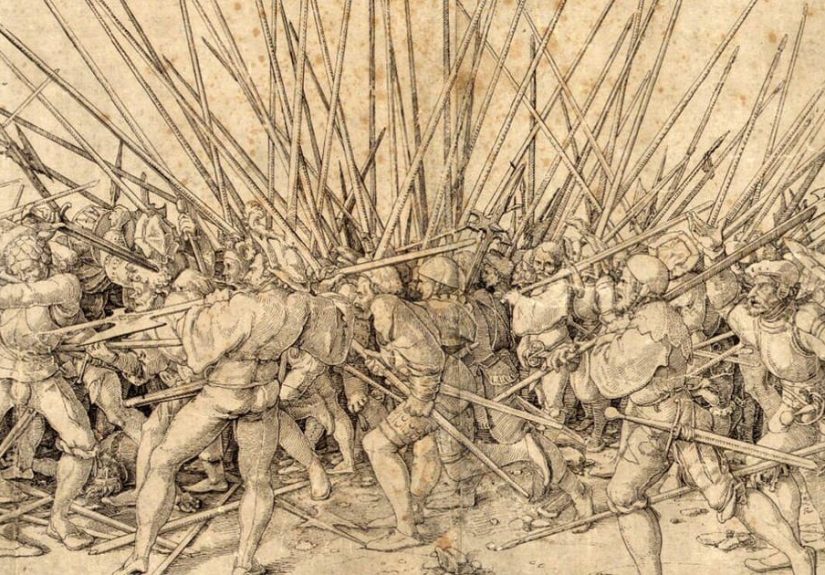
If ancient warfare had a most valuable player, it would often be the spear. Spears are relatively straightforward to make, provide excellent reach, and work in formation. They can thrust, keep distance, and force an opponent to deal with a pointy problem before they can reach you.
Many armies across the ancient Mediterranean relied heavily on spearsGreek-style infantry formations are the famous example, but the spear shows up everywhere because physics is universal. Long weapons are a cheat code for distance management.
Swords: sidearms, status symbols, and “Plan B”
Swords get the spotlight because they photograph well and look heroic. But historically, swords often functioned as sidearms: personal weapons used when formations broke, when space was tight, or when a spear wasn’t ideal.
Consider the Roman gladius: short, optimized for close formation work, and designed for control in cramped conditions. Compare that to curved blades in other regions that favored slashing mechanics, or earlier sickle-shaped swords that evolved alongside bronze casting traditions.[3]
The deeper story is social: swords frequently appear in burials and offerings. That suggests identity and rank, not just utility. A sword could be “proof of role,” not merely “tool of job.”
Axes, maces, and clubs: when armor starts to matter
Blunt-force weapons are ancient for a simple reason: you can’t “parry” gravity. Clubs and maces concentrate impact; axes combine chopping force with a focused edge. As defensive gear improved, societies experimented with shapes that could dent, break, or bypass protection.
Military histories often describe a back-and-forth between helmets and impact weapons, with design changes responding to real protection needs and real battlefield constraints.[6]
Ranged weapons: bows, slings, and spear-throwers
Ancient ranged weapons weren’t just about distancethey were about control. A projectile changes the fight by forcing movement, breaking formations, and creating pressure before hand-to-hand contact.
Bows vary widely by region and materials. Composite bows (built from layered materials) are famous across parts of Eurasia for packing power into compact designs. Slings are deceptively simple: a strip of material and a stone can become a high-velocity projectile system.
Then there’s the atlatl (spear-thrower), a brilliant leverage tool that extends the throwing arm and can significantly increase projectile speed and range. It appears in many parts of the world and is described by U.S. National Park Service educational materials as a major early “weapon system.”[7]
Shields and armor: the quiet heroes
It’s hard to appreciate ancient armor because movies treat it like background texture. In real life, shields and body protection shape what weapons can do. If a shield is large and durable, thrusting and formation work become more effective. If armor is heavy, mobility changes. If protection is expensive, only certain groups can field itcreating “warrior classes” in some societies.
Scholarly summaries of ancient military technology emphasize how defensive equipment design is constrained by the human body, weight, and costand how that pushes constant innovation.[6]
Weapons as Culture: Power, Ritual, and Identity
Ancient weapons weren’t only built for battle. They also served as symbolsof authority, adulthood, elite status, or divine favor. This is one reason weapons appear in graves, hoards, and ceremonial contexts.
Museum exhibitions regularly highlight weapons and armor as part of social hierarchy: objects that signaled “who gets to be protected” and “who gets to carry the shiny pointy thing.” For example, the Field Museum has featured Bronze Age weapons and armor as evidence for emerging warrior elites and changing power structures.[8]
Even when a weapon was functional, decoration mattered. Engraving, inlay, and unusual materials can indicate that an item’s role included display, diplomacy, or ritualnot just combat.
How We Know What We Know: Archaeology, Wear Marks, and Careful Experiments
Clues from repairs, damage patterns, and context
Archaeology isn’t just “find object, label object.” Context matters: where it was found, what it was found with, and what traces it carries. Damage on a blade, repairs on a hilt, or repeated edge wear can indicate repeated use. Placement in a burial can indicate symbolic meaning.
Researchers have used staged reconstructions (carefully controlled, with modern safety practices) to see how sword-to-sword contact marks bronze, helping interpret real artifacts found in European Bronze Age contexts.[4]
Museum collections as living research labs
Major U.S. museums don’t just display ancient arms; they study them. The Metropolitan Museum of Art’s Arms and Armor department, for instance, explicitly frames arms and armor as culturally vital objects across thousands of yearsused in conquest and defense, but also in ceremony and pageantry.[9]
And collections aren’t limited to one region. Smithsonian collections include documented weapon objects (like swords) tied to specific acquisition histories, which supports further scholarly study and public education.[10]
Myths About Ancient Weapons That Refuse to Retire
Myth 1: “Bronze swords were just ceremonial.”
Some were ceremonial. Many weren’t. The evidence includes use-related wear and modern experimental work that reproduces plausible contact marks. Bronze is not “useless”it’s a material with design constraints and trade-offs, and ancient craftspeople were not clueless about how to work within those limits.[4]
Myth 2: “Swords were the main weapon in ancient battles.”
Swords are famous. Spears are common. Many armies relied heavily on spears and other pole weapons because reach and formation tactics matter. Swords often function as backup weapons, personal sidearms, or elite symbolsdepending on the time and place.
Myth 3: “Ancient ranged weapons were basically toys.”
Ancient ranged technology can be remarkably effective. Educational materials on the atlatl describe it as a leverage-based system capable of high projectile speed and long range.[7] Add bows and slings, and you get battlefield tools that can shape outcomes long before close combat begins.
Ancient Weapons in U.S. Museums You Can Visit
If you want the quickest “aha” moment, see ancient weapons in person. Photographs flatten scale and texture; museum viewing restores both.
- The Metropolitan Museum of Art (New York City): extensive arms and armor holdings and research framing weapons as both functional and ceremonial objects.[9]
- Smithsonian museums (Washington, D.C.): multiple collections include weapons and related artifacts, including documented atlatl objects in the National Museum of the American Indian collections database.[11]
- The Field Museum (Chicago): exhibitions have highlighted Bronze Age weapons and armor as evidence for shifting power and the rise of warrior elites.[8]
- Art Institute of Chicago: an arms and armor classification in its collection database supports deeper browsing for historical arms and protection gear.[12]
- University collections (Yale, Harvard, Penn Museum): study collections and object databases (like spearheads and blades) can be browsed online, often with dimensions and provenance notes that reveal how scholars document ancient material culture.[13]
Conclusion: What Ancient Weapons Still Teach Us
The story of ancient weapons is really a story of human choices under constraint: limited materials, uneven resources, evolving tactics, and social structures that decide who gets trained, equipped, and celebrated. Weapons also reveal the non-battle side of historyritual, symbolism, identity, and craftsmanship.
When you look at an ancient spearhead or sword, you’re seeing more than a tool. You’re seeing a technology shaped by societyand a society shaped by technology. It’s not always a comfortable lesson, but it’s a real one.
Experiences: Getting Close to Ancient Weapons (Without Becoming a Villain)
Reading about ancient weapons is fascinating, but experiencing themsafely and legallyturns abstract history into something you can actually feel in your brain. Not “feel” like swinging a sharp object around (please don’t), but feel in the sense of scale, weight, and engineering logic.
Start with museum-viewing “technique.” The next time you’re in a gallery, try a slow look: first, stand far enough back to see the whole outline. Is the weapon optimized for reach (long shaft, narrow point), for close control (short blade, thick spine), or for impact (heavy head, short handle)? Then step closer and look for the tiny cluesrivets, repair points, reinforced edges, decorative patterns. Those details are basically the ancient world’s version of a product review: “This design worked well enough to copy,” or “This was special enough to show off.”
Use exhibits to notice what movies don’t show. Museums often display weapons beside armor, shields, and related equipment. That pairing is the point. A sword alone is dramatic, but a sword next to a shield explains tactics. A spearhead next to a helmet explains why blunt weapons evolve. You start seeing weapons as part of a system, not as a lone hero prop.
Try “history by mechanism.” Some of the best learning happens when you focus on one simple physics idea: leverage, edge alignment, or center of mass. The atlatl is a great example because it’s basically leverage made visiblean elegant tool that extends the throwing arm to change speed and range. Educational programs and demonstrations (often at museums, parks, or archaeology events) can make these principles click without turning the experience into anything unsafe.[7]
Look for replicas and hands-on programs. Many institutions use replica objects for education because real artifacts are fragile (and because nobody wants to be “the person who dropped the 2,500-year-old thing”). Replicas let you understand grip size, balance, and how a design sits in the handinformation you simply can’t get from a photo. If a program is offered, stick to supervised, age-appropriate activities and follow all rules. The goal is historical understanding, not “trying to be a warrior.”
Explore digital collections like a detective. If you can’t travel, museum databases are surprisingly addictive. Object pages often include measurements, materials, dates, and excavation or acquisition notes. When you read a listing for a spearhead and see its dimensions, you can imagine how it would be mounted and what kind of reach it might create in a formation. When you see repeated shapes across different regions, you learn a deeper truth: humans converge on similar solutions when faced with similar problems.
And yestalk about the ethics. Ancient weapons represent human creativity and craftsmanship, but they also represent harm. A mature way to engage is to hold both truths at once: admire the engineering while acknowledging the cost. Museums increasingly frame arms and armor as cultural objects used in defense, conquest, and ceremony, which helps keep the conversation honest rather than glamorized.[9]
The best “experience” with ancient weapons is leaving with sharper questions than you arrived with: Why did a society prioritize this design? Who had access to it? What resources did it require? How did it shape power? If you walk out thinking, “Okay, history is complicatedand also kind of brilliant,” you did it right.