Table of Contents >> Show >> Hide
- Camp Charlie, in One Breath (Okay, Two)
- The Site: Eight Acres, One Genius Decision
- Two Gables, One Camp: The Massing Strategy
- Materials That Behave Like Good Neighbors
- Spaces That Change With the Weather (Because They’re Supposed To)
- Room-by-Room: What Goes Where (and Why It Feels Right)
- Design Details Worth Stealing (Legally, Emotionally, Metaphorically)
- Why Camp Charlie Works: “Vernacular” Without the Costume
- Lessons for Your Own “Camp” (Even If It’s Just a Backyard Studio)
- FAQ (Because Google Loves a Helpful House)
- Conclusion: A Retreat That Doesn’t Try Too Hard (and That’s the Point)
- Experience Section (Extra ~): Walking Camp Charlie Like an Architect
Some weekend houses try to be “a rustic escape” the way a scented candle tries to be “a mountain.”
Camp Charlie doesn’t bother with that. It’s the real deal: a modern retreat that borrows the
plainspoken DNA of Midwestern farm buildingsgable roofs, long shed-like volumes, honest materials
then quietly upgrades the experience with daylight, long views, and a few architectural mic drops.
Designed by Chicago-based Wheeler Kearns Architects, Camp Charlie sits on rolling Indiana
farmland and manages that rare trick: it feels humble and dramatic at the same time. It’s not a
showboat. It’s not trying to be a museum piece. It’s just extremely good at being a place where you
can read, cook, paint, nap, host friends, and watch weather do its thingwithout the house throwing
a tantrum about it.
Camp Charlie, in One Breath (Okay, Two)
- What it is: A second home + artist’s studio/retreat with a strong indoor–outdoor life.
- Where it lives: Rural Indiana (often described as Northwest Indiana farm country; near South Bend).
- Signature move: Two long gable-roofed volumes connected by a boardwalk-like entry and a linking hall.
- Signature vibe: Modern-barn simplicity with glassy communal spaces and tucked-away private zones.
- Signature materials: Red-painted/stained wood siding, steel structure, concrete floors, warm plywood ceilings.
The Site: Eight Acres, One Genius Decision
Camp Charlie’s biggest flex isn’t a fancy stair or a sculptural roofline. It’s the siting.
Instead of parking the house smack in the middle of the meadow (where it would hog the view and
turn the landscape into “background”), the design strategy pushes the buildings to the edge of the
property. The result is wonderfully counterintuitive: by getting out of the way, the house makes
the land feel even larger.
That choice does two practical things. First, it preserves the best part of a rural parcelthe open
fieldfor actual use (walks, games, late-afternoon wandering with a mug you pretend is “tea” but is
definitely not). Second, it stretches sightlines. When the long façade looks out across the meadow,
the view reads as endless. The house becomes a viewing instrument, not a monument.
Two Gables, One Camp: The Massing Strategy
The “Sliding Bars” Trick (Simple Shape, Smarter Plan)
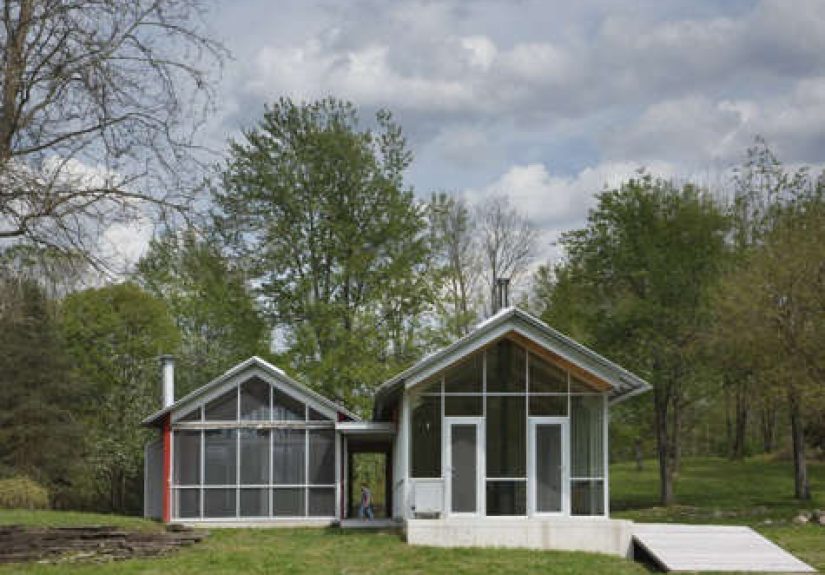
The project is composed of two narrow gable-roofed volumesthink of them as two long “bars” that
slide past each other slightly. That small offset is doing a lot of work: it creates moments for
windows on multiple sides, carves out sheltered exterior zones, and makes the overall composition
feel like it grew out of the site rather than being dropped onto it.
Programmatically, splitting the retreat into two volumes is also a lifestyle win. One bar can stay
calm and quiet (sleeping, bathing, recharging), while the other is free to be loud (cooking, hosting,
running in and out with muddy boots, making art, building the kind of fire that makes you feel like
you could survive the 1800s for at least twelve minutes).
The Floating Boardwalk Entry: A Ramp That Acts Like a Story
The entry sequence is a standout: a “floating” boardwalk that reads like a modern echo of
barn loading ramps. Instead of a conventional front stoop, the approach rolls up from the ground,
connects the volumes, then carries you back out toward the landscape. It’s a circulation move that
feels both practical and poeticlike the house is saying, “Welcome. Now go look at the field.”
This is one of those architectural gestures that’s deceptively calm. It’s not there to impress
Instagram. It’s there to make your body understand the place: long horizon, low building, big sky.
The boardwalk literally choreographs that relationship.
Materials That Behave Like Good Neighbors
Red Siding That Doesn’t Apologize
Camp Charlie leans into a barn-red identity without becoming a theme park version of rural life.
The wood siding is painted/stained a deep red that feels familiar in farm country, then used in a
crisp, modern way. Better still, the siding continues from the exterior into the interior in key
areasan inside-out move that blurs boundaries and makes the buildings feel like one continuous
sheltering skin.
That continuity matters because the architecture is all about calm confidence. When the same
material language wraps in and out, you don’t get a jarring “now you are inside the Important
Architecture.” You just feel held by a consistent palette.
Steel Bones, Light Touch
Inside, steel members and ties do the structural heavy liftingoften visibly. In gable-roof spaces,
steel ties help counter the outward thrust that gable roofs naturally want to create, especially in
rooms with big glazing on multiple sides. The payoff isn’t only engineering; it’s rhythm. Those
repeated members establish a beat across the ceiling, turning structure into architecture (and
architecture into a surprisingly soothing metronome).
There’s also a quiet elegance in how the steel is detailedbolted, tied, and expressed with
clarity. It’s the kind of detail that makes architects lean in and say, “Okay, yes, show me that
connection,” while non-architects just feel that the room makes sense.
Concrete Floors + Warm Wood Above: The Comfort Sandwich
The floors are concretedurable, practical, great for a retreat where life happens. Add radiant
heat and you get the winter upgrade: the house can be glassy and open without feeling like a fancy
refrigerator. Overhead, plywood and wood ceilings bring warmth and tactility, and in places those
ceilings extend outward under the eaves, reinforcing the long directionality of the view. That move
is subtle but powerful: the ceiling becomes a visual arrow pointing you into the landscape.
Spaces That Change With the Weather (Because They’re Supposed To)
One of Camp Charlie’s most lovable traits is how it behaves seasonally. In warmer months, large
openings and sliding doors allow the house to live like a pavilion: breezes, porch fires, meals that
migrate outside, and long conversations that start at the table and end somewhere near the horizon.
In colder months, the architecture tightens up. Portions of the porch can be sealed off, and the
retreat “closes” like a well-made jacket.
This kind of flexibility is a hallmark of truly good retreat design. A weekend house shouldn’t be
one fixed pose. It should be a set of modesopen, tucked, social, quietso it can match real life
instead of forcing you to live like a catalog spread.
Room-by-Room: What Goes Where (and Why It Feels Right)
The two-volume plan isn’t just a diagram. It’s a lived-in logic. One volume houses the primary
living spaces: a combined kitchen and living area that leans into glass and long meadow views, plus
a master suite tucked behind so it can be private without being isolated.
The sibling volume holds the supporting castgarage, guest room, guest bathplus a more casual
gathering zone that can act as a screened porch with a fireplace. This gives guests a sense of
independence (always nice) and gives the owners the freedom to host without feeling like their
toothbrush is now a community toothbrush.
Details reinforce the plan’s clarity. In the kitchen, elements are designed to multitask: an island
that becomes a dining table, built-in storage that keeps the space visually calm, and cabinetry that
can extend and morphso the architecture and the furniture feel like one continuous system rather
than a pile of unrelated objects.
Design Details Worth Stealing (Legally, Emotionally, Metaphorically)
-
Put the building on the edge. If you have land, protect the best parts by letting
the house hug a boundary. You’ll gain bigger views and more usable landscape. -
Split the program. Two volumes can be cheaper to build than one complex volume,
and they’re often more pleasant to live in: loud side vs quiet side, guest side vs owner side. -
Make an entry sequence, not just a door. The boardwalk approach makes arrival a
small ritualone that constantly reconnects you to the site. -
Use one bold exterior color with restraint. Barn red works here because the forms
stay simple and the details stay crisp. -
Let structure create rhythm. Exposed ties and frames can do more than hold up a
roofthey can make a large space feel measured and cozy. -
Pair hard-wearing floors with warm ceilings. Concrete below, wood above: durable,
comfortable, and quietly beautiful.
Why Camp Charlie Works: “Vernacular” Without the Costume
Plenty of “modern farmhouse” projects borrow farmhouse shapes but forget the farmhouse mindset.
Farm buildings are efficient. They use straightforward forms and repeatable construction. They
prioritize weathering well. Camp Charlie gets that. The architecture is modern, but the logic is
vernacular: simple volumes, clear structure, modest palette, and spaces organized around real
activities.
And then there’s the emotional layer. Wheeler Kearns is known for an approach that centers the
client’s purpose and the lived experience of space. Camp Charlie feels like that philosophy made
physical: it’s not trying to be everything; it’s trying to be exactly what it needs to bean easy,
flexible, light-filled place for retreat, creativity, and company.
Lessons for Your Own “Camp” (Even If It’s Just a Backyard Studio)
1) Start with the land, not the Pinterest board
Camp Charlie’s siting reminds us that architecture doesn’t begin with a façade. It begins with
a walk: where the wind comes from, where the long view opens, where the trees protect you, where
the sun lands at 6 p.m. A great retreat is basically a partnership with the site.
2) Design for seasons, not for photos
Sliding doors, screened porches, radiant floorsthese are not luxury add-ons. They’re comfort
strategies. If your retreat has multiple modes, you’ll use it more months of the year, and it will
feel like a real extension of life rather than a fair-weather prop.
3) Keep the form simple; spend your “complexity budget” on a few key moves
Camp Charlie doesn’t scatter its attention. It commits to a strong diagram (two gables + connecting
sequence) and a disciplined palette. Then it puts the craft where it counts: structure, thresholds,
and how spaces meet the landscape.
FAQ (Because Google Loves a Helpful House)
Where is Camp Charlie?
Camp Charlie is located in Indiana and is often associated with northern Indiana farm country near
South Bendclose enough for a Chicago weekend escape without needing snacks for an epic road trip.
What makes Camp Charlie “modern barn” architecture?
The project borrows barn-like fundamentalsgable roofs, long volumes, simple claddingthen modernizes
them with large glazing, crisp detailing, and an interior strategy that’s about light, views, and
flexible living.
Why split the retreat into two buildings?
Splitting the program creates natural zoning (social vs private, owner vs guest, clean vs muddy),
improves cross-ventilation and daylight opportunities, and can make construction simpler and more
modular.
Conclusion: A Retreat That Doesn’t Try Too Hard (and That’s the Point)
Camp Charlie is a reminder that the best architecture isn’t always the loudest. Sometimes it’s the
project that listens hardestto the land, to the seasons, to the daily rituals of living and making.
Two simple gables, a boardwalk that doubles as a landscape handshake, a palette that’s tough and warm,
and spaces that open and close like breathing. It’s modern, yesbut it’s also deeply, comfortably
human.
Experience Section (Extra ~): Walking Camp Charlie Like an Architect
If you ever get the chance to visit a place like Camp Charlie, do yourself a favor: don’t rush it.
This isn’t a “walk in, snap a photo, walk out” kind of retreat. It’s a “let your shoulders drop”
kind of retreat. The first thing you notice isn’t a detail; it’s the horizon. The house is placed
so the meadow feels like it’s doing the decorating. Architecture here is less about “look at me”
and more about “look at that.”
Approaching the entry, the boardwalk has this quietly theatrical quality. It’s not grand, but it is
intentional. Your body follows the line. You feel the length. You understandwithout anyone needing
to explain itthat the project is going to be about directionality and view. The boardwalk also
feels practical in the best way, like something a farmer would recognize as useful, even if they
wouldn’t call it “a circulation gesture” unless they secretly had an architecture degree.
Step inside and the communal space does that Glass House thingwalls that nearly disappear, daylight
that seems to arrive from everywhere at once, and an immediate awareness of weather. A cloud passes?
The room changes mood. Late afternoon sun shows up? The interior warms like it’s blushing. It’s the
kind of space that makes you stop talking mid-sentence, not because you’re being dramatic, but because
the view is legitimately distracting. (Your friends will forgive you. Probably.)
What’s surprisingly comforting is how the structure keeps the room from feeling too vast. The rhythm
of frames, mullions, and ties gives your eye something to hold onto. Big views can sometimes feel
like visual free-fall; here, the architecture gives you a gentle gridenough order to feel cozy, not
enough to feel boxed in. That balance is hard, and Camp Charlie makes it look easy, which is the
architectural equivalent of casually dunking a basketball in jeans.
Then there’s the material experience. Concrete underfoot says, “Yes, you can come in with wet shoes.”
Wood above says, “Also, you are loved.” The red siding wrapping inward is especially memorable: it
makes the boundary between outside and inside feel less like a hard stop and more like a thickened
threshold. You’re always aware of the landscape, but you’re not exposed to it. You’re sheltered in a
way that feels earned, not sealed off.
The screened porch/fireplace zone is where you understand the project’s social intelligence. It’s the
place that says, “Stay longer.” In shoulder seasons, you can sit with a fire and feel like you’re
outside without committing to full meteorological chaos. And when the weather turns, the building can
close down and become snug without losing its connection to the meadow. The house doesn’t fight the
climate; it negotiates with itpolitely, firmly, and with great manners.
Leaving, you notice something you didn’t notice upon arrival: how little the architecture demanded
attention from you. That’s not a knock. That’s the compliment. Camp Charlie is confident enough to let
the land be the hero, and generous enough to make everyday lifecooking, reading, making, restingfeel
like the whole point. Which, honestly, is what a retreat should be.