Table of Contents >> Show >> Hide
- Quick comparison: the “tell me in 60 seconds” table
- What Make: found: print quality is a tie, so the “winner” is lifestyle
- Bambu Lab H2D: the premium powerhouse that wants to be your mini factory
- 1) Size and capacity: the “yes, it fits… if your desk signs a waiver” printer
- 2) Dual hotend: less waste, more options, fewer “filament confetti” moments
- 3) Laser + cutting modules: cool feature, but ask yourself what you really need
- 4) Materials and enclosure: built for “serious plastic,” not just pretty PLA
- 5) Software feel: polished, guided, and aggressively convenient
- Prusa CORE One: the reliable workhorse that wants you to own it for years
- 1) The Prusa formula, re-engineered into a CoreXY enclosure
- 2) Nextruder + load cell: perfect first layers without “Z-offset therapy”
- 3) The enclosure design: clever, practical… and a bit “DIY chic” up close
- 4) Workflow and ecosystem: PrusaSlicer comfort + Easy Print convenience
- 5) Repairability and long-term ownership: Prusa’s identity, still intact
- Multi-material printing: where your time and filament go to… vanish
- Privacy, offline comfort, and “who owns my workflow?”
- So… which one should you buy?
- The Make: verdict in plain English
- Workshop experiences (extra): what it’s like living with H2D vs CORE One
- Unboxing and setup: “one box” vs “eight boxes and a life choice”
- Calibration time: the hidden cost nobody budgets for
- Noise and “presence”: the printer as a roommate
- Multi-material reality: convenience vs cleanup vs space
- Software comfort: do you want a cockpit or a car with autopilot?
- The honest punchline
- SEO tags (JSON)
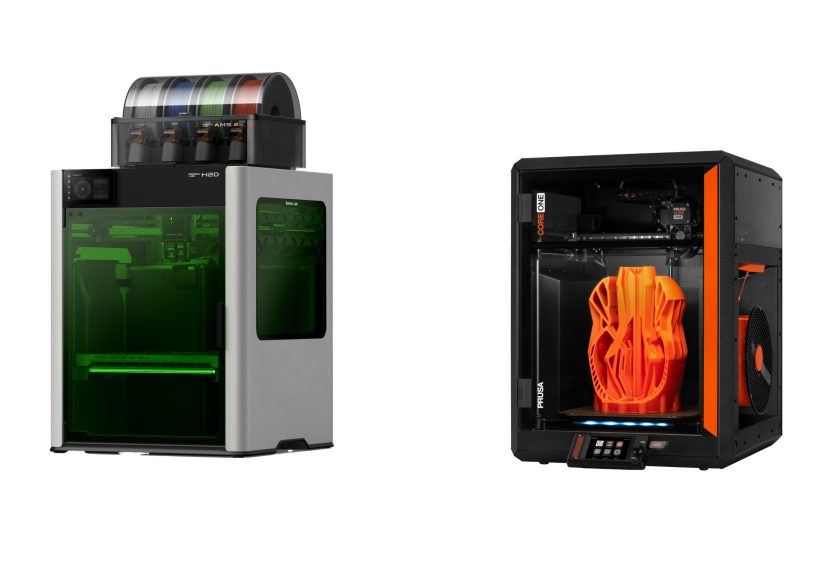
Two flagship enclosed CoreXY printers walk into a workshop. One shows up looking like it was designed by a minimalist who irons their T-shirts.
The other arrives with a “you can fix me with a screwdriver” vibe and a lifelong commitment to gummy bears (more on that later).
That’s the current showdown between the Bambu Lab H2D and the Prusa CORE Onetwo machines so good at print quality that,
as Make: put it, you almost have to judge them on everything except print quality.
This head-to-head is built from real-world reviews and hands-on reporting across the maker ecosystem, with the Make: comparison as the anchor.
I’ll break down what matters mostsize, speed, multi-material behavior, software workflow, privacy/offline comfort, and the “daily life” realities
like noise, maintenance, and how often you’ll want to yell “WHO MOVED MY ALLEN KEYS?”
Quick comparison: the “tell me in 60 seconds” table
| Category | Bambu Lab H2D | Prusa CORE One |
|---|---|---|
| Price (as tested in Make:) | $1,999 (printer) / $2,899 (Laser Full Combo) | $949 (kit) / $1,199 (assembled) |
| Build volume | 350×320×325mm (single) / 300×320×325mm (dual) | ~250×220×270mm |
| Core strength | Big-volume, premium “craft factory” vibes; dual hotend reduces waste | Prusa reliability + thoughtful maintenance design; strong slicer ecosystem |
| Multi-material approach | AMS ecosystem + dual hotend options | PrusaSlicer + MMU3 option; strong upgrade/repair path |
| Enclosure + heat strategy | Fully enclosed + active chamber heating (high-temp friendly) | Enclosed + chamber managed via venting/bed heat (engineered for practicality) |
| Workflow feel | Very “appliance-like” polish; strong automation | Comfortable, modder-friendly, ecosystem-first |
| Best for | Serious makers, small businesses, big parts, integrated laser/cutting curiosity | Long-term owners, tinkerers, schools, people who value repairability & offline comfort |
Note: Prices move around with bundles, regional tax/VAT, and retail availability. The “as tested” pricing above matches the referenced reviews.
What Make: found: print quality is a tie, so the “winner” is lifestyle
Make: ran classic benchmark models and found both machines handled the test suite almost flawlesslyso the deciding factors become everything
around the print: usability, UI, physical design, maintenance, privacy comfort, and how the ecosystem fits your workflow.
That’s good news, because “both are great” is the best kind of problem (the kind you solve by printing a trophy for yourself).
Bambu Lab H2D: the premium powerhouse that wants to be your mini factory
1) Size and capacity: the “yes, it fits… if your desk signs a waiver” printer
The H2D is Bambu’s larger-format flagship in this matchup, with a headline build volume around 350×320×325mm (single nozzle) and a reduced
footprint when running dual nozzle jobs. That extra volume matters in real use: helmet-scale cosplay pieces, big enclosures, jigs, organizers,
and functional prototypes that you’d rather not slice into six parts like a sad pizza.
The flip side is physical reality: larger machines mean more mass, more space, and usually more noise. Make: explicitly notes you should be ready
for how much space (and weight) the H2D brings to the party.
2) Dual hotend: less waste, more options, fewer “filament confetti” moments
If you’ve ever watched a multi-color print generate a modern art sculpture made entirely of purge waste, you’ll appreciate what Bambu is trying to do here.
Reviewers highlight the H2D’s dual hotend as a major upgrade that can reduce material wasteespecially when you use one side for supports
or a dedicated material. This isn’t just “nice,” it’s money: less wasted filament, less time purging, and less cleanup that looks like a spaghetti crime scene.
3) Laser + cutting modules: cool feature, but ask yourself what you really need
The optional 10W or 40W laser modules (plus cutting functions like a drag knife) are part of the H2D’s big pitch: one footprint, multiple fabrication modes.
In practice, reviewers love that it’s surprisingly easy to use, but Make: also raises a very reasonable buying philosophy:
if you truly want laser work, a dedicated laser machine may still make more senseespecially if you’ll do a lot of cutting/engraving.
Translation: The H2D’s laser is a superpower, but it doesn’t automatically replace a purpose-built laser cutter in a workshop that lives and breathes laser work.
4) Materials and enclosure: built for “serious plastic,” not just pretty PLA
Between enclosure design and high-temperature capability, the H2D is positioned for more demanding materials.
For makers printing ABS/ASA/engineering plastics regularly, a more controlled chamber can be the difference between “beautiful part”
and “potato chip shaped disappointment.”
5) Software feel: polished, guided, and aggressively convenient
Bambu’s software experience tends to prioritize “it just works” flow: syncing printer/AMS, guided setup, and a highly visual workflow.
Review coverage notes ongoing improvements to Bambu Studio and strong automation across calibration and printing.
If your ideal relationship with a 3D printer is “I press Print and then go live my life,” the H2D is very much courting you.
Prusa CORE One: the reliable workhorse that wants you to own it for years
1) The Prusa formula, re-engineered into a CoreXY enclosure
The CORE One is Prusa taking lessons from its own lineup and the broader market shift toward fast CoreXY machines.
Make: describes it like a mash-up of Prusa’s MK4 + XL + enclosure thinking: CoreXY motion, Prusa’s familiar approach to user experience,
and an integrated enclosure designed to be cohesive rather than a bulky add-on.
2) Nextruder + load cell: perfect first layers without “Z-offset therapy”
One of the most praised Prusa qualities is first-layer consistency. Make: highlights the Nextruder’s load cell approach as a big reason prints feel
“effortless,” because the machine can handle leveling and nozzle offset behaviors without demanding you become a part-time calibration monk.
3) The enclosure design: clever, practical… and a bit “DIY chic” up close
The CORE One integrates the enclosure with the frame and does some genuinely smart things: spool placement that doesn’t feel like an afterthought,
reduced interior volume to heat less air, and a design that favors maintenance and modding.
But Make: also calls out a real tradeoff: compared to the H2D’s premium “finished product” feel, the CORE One’s sheet metal + acrylic approach can
look less polished at close range (small gaps at seams, plastic rivets, and manual vent louvers). It’s functional and effectivejust not as “luxury appliance.”
4) Workflow and ecosystem: PrusaSlicer comfort + Easy Print convenience
If you’ve used PrusaSlicer for years (or any slicer inspired by it), the CORE One feels familiar in the best way:
profiles, materials, and a UI designed for long-term ownership. Make: also points to Easy Print for Printables
a streamlined “click → cloud slice → send to printer” flow aimed at convenience for the majority of users.
If you love tuning settings, you’ll still have full control. If you don’t, you can skip the fiddly bits and just print.
5) Repairability and long-term ownership: Prusa’s identity, still intact
Prusa leans hard into “this is your machine, and you can maintain it.” Reviews emphasize the CORE One’s maintenance-friendly design approach,
the ability to buy it as a kit, and the broader tradition of upgrade paths and long-term support.
If you’re the type who keeps a printer for years (and enjoys upgrading it like a beloved project car), this matters.
Multi-material printing: where your time and filament go to… vanish
Bambu’s approach: AMS convenience + dual hotend strategies
Bambu’s AMS ecosystem is designed for “press button, receive multi-color object.”
It’s convenient, but typical AMS-style multi-color printing can generate purge waste.
The H2D’s dual hotend is specifically praised for reducing waste compared to single-nozzle approachesespecially for support strategies and certain multi-material jobs.
Prusa’s approach: MMU3 can be surprisingly efficient, but it wants space
A key data point from Tom’s Hardware: in a five-color test print run on both machines, the CORE One finished faster and wasted less filament than the H2D
in that particular setup. That’s not a universal law of physicsprofiles and models matterbut it’s a strong signal that Prusa’s multi-material route
can compete on efficiency.
The tradeoff is physical: the MMU system can require more external space and a more manual loading routine. If your shop is compact,
“multi-material sprawl” may be the deciding factor more than print quality.
Privacy, offline comfort, and “who owns my workflow?”
This category matters more than people admit. Not everyone wants their printer experience tied to accounts, cloud dependencies,
or unclear telemetry expectationsespecially schools, labs, print farms, and small businesses with IP concerns.
Make: notes feeling more privacy comfort with Prusa’s ecosystem. Meanwhile, coverage around Bambu has included discussion of third-party software/mod policies
and LAN/offline modes evolving over time. The practical takeaway: if offline-first printing and long-term ecosystem transparency are top priorities,
Prusa tends to feel like the safer emotional bet. If you’re fine with a more appliance-like ecosystem in exchange for polish and automation,
Bambu’s approach may be worth it.
So… which one should you buy?
Choose the Bambu Lab H2D if you want:
- More build volume for big functional parts, props, jigs, or production batches.
- Premium fit-and-finish and a guided “easy mode” workflow that’s still powerful.
- Dual hotend benefits to reduce waste and expand material/support strategies.
- Optional laser/cutting because you genuinely want multi-process capability in one footprint.
Choose the Prusa CORE One if you want:
- Long-term ownership confidence: maintainable design, kit option, and the Prusa support tradition.
- PrusaSlicer comfort and a mature ecosystem that feels like it was built for years of use.
- Strong first-layer automation with the load-cell-driven “effortless” behavior reviewers love.
- More offline/privacy comfort as a top-level buying factor.
The Make: verdict in plain English
Make: essentially lands on the most honest conclusion possible: both machines are excellent, and the choice becomes personal.
The H2D wins on polish and optional extra functionality; the CORE One wins on comfort, familiarity, and a sense of privacy and long-term ownership.
And because both companies are now fully aware the other exists (like rival superheroes who keep “accidentally” running into each other),
the next few years should be a golden age for buyers.
Workshop experiences (extra): what it’s like living with H2D vs CORE One
Let’s talk about the stuff that never fits neatly into a spec sheetthe day-to-day experiences that make you either love your printer… or quietly list it on
Marketplace at 2:00 a.m. with the caption “barely used, too powerful for me, my loss your gain.”
Unboxing and setup: “one box” vs “eight boxes and a life choice”
With the CORE One, the experience tends to feel like classic Prusa: thoughtful packaging, clear expectations, and a workflow designed for people who might actually
enjoy knowing how the machine is put together. If you buy the kit, you’ll spend time buildingbut the upside is you’ll understand the machine’s anatomy like a mechanic
who can hear a weird noise and say, “Oh, that’s just the thingy near the whatchamacallit.” If you buy it assembled, you still get a setup experience that’s more
practical than flashy.
The H2D, on the other hand, can arrive like a small-scale manufacturing event. Review coverage describes multiple boxes and lots of gearespecially if you go with
the more deluxe configurations. That’s not a bad thing (free accessories are fun), but it does mean you’ll want space to stage everything while you get organized.
The emotional arc often goes: excitement → mild overwhelm → “okay, where do I put all of this?” → satisfaction once the system starts doing its magic.
Calibration time: the hidden cost nobody budgets for
Both printers are strong on automation, but they can “pay” for that convenience up front. For example, the H2D’s dual nozzle design can require a more involved initial
self-check and calibration routine. The good news is it’s hands-free; the realistic news is you might be staring at a progress bar thinking,
“So THIS is what patience training looks like.” It’s not usually a recurring burdenmore like the onboarding ceremony you complete in exchange for future reliability.
On the Prusa side, the load-cell-driven first layer experience is one of the most frequently praised quality-of-life wins. You don’t feel like you’re constantly
negotiating Z-offsets or babysitting the first layer like it’s a toddler with finger paints. That reduces stress, whichno jokemakes you print more often,
because the machine feels welcoming instead of intimidating.
Noise and “presence”: the printer as a roommate
If you print in a home office or shared space, noise is a relationship issue. The CORE One is often described as very quiet for its class, with the kind of sound profile
that fades into the backgroundmore “soft hum” than “robotic drum solo.” That matters when your printer shares a wall with a sleeping baby, a Zoom call,
or a spouse who believes the house should not sound like a Star Wars droid repair bay.
The H2D can feel louder and more “present,” partly because it’s bigger and partly because it’s doing more. Some makers don’t care (headphones exist).
But if you’re sensitive to noise, or you’re printing near where you work, the CORE One’s quieter personality can genuinely change your happiness level.
Multi-material reality: convenience vs cleanup vs space
Multi-color and multi-material printing is the dream… until you meet the reality: waste, time, and “where do I put all these spools?”
Bambu’s AMS approach is famously convenient, and the H2D’s dual hotend strategy aims to reduce waste compared to more traditional single-nozzle multi-color routines.
In practice, you’ll likely enjoy how integrated the workflow feelsespecially if you want a setup where the machine does the fussy stuff for you.
Prusa’s MMU world can be more “manual but dependable,” and some tests show it can be efficient on both time and waste for certain prints.
The tradeoff is footprint: the MMU ecosystem can sprawl, with spools and buffers taking up real estate next to the printer.
If your workshop is compact, this becomes a surprisingly emotional issue. You start by saying “I’ll organize it later,”
and then you wake up one day living inside a filament exhibit.
Software comfort: do you want a cockpit or a car with autopilot?
The H2D experience leans toward “polished appliance” energy: the system tries to guide you, prevent mistakes, and keep things smooth.
That’s great when you want to crank out products for a small business or you don’t want to spend your weekends tuning profiles.
It’s also great when you’re learningbecause success early on builds confidence fast.
The CORE One leans toward “maker-friendly tool” energy: it’s modern, but it still feels like it expects you might want to understand what’s happening.
The PrusaSlicer ecosystem is comfortable, predictable, and widely respected. And when you run into problems, the culture around Prusa ownership tends to make
troubleshooting feel like a solvable puzzle instead of a black-box mystery.
The honest punchline
If your goal is the smoothest, most premium “push-button production” vibeespecially with bigger prints and optional extra fabrication modesthe H2D is very hard to ignore.
If your goal is a long-term, repairable, confidence-building machine that feels like a workshop companion (not a locked-down gadget), the CORE One is incredibly easy to love.
Either way, you’re not buying a printer so much as you’re choosing a printing lifestyle. Pick the one you’ll actually enjoy living with.