Table of Contents >> Show >> Hide
- Why a beach house expandable dining table makes so much sense
- What gives it that true beach-house look?
- How to choose the right size
- Details that separate a good table from a regrettable one
- Best materials for coastal living
- How to style the table so it feels coastal but current
- Is it worth the investment?
- Shopping checklist before you buy
- Final thoughts
- Experience: Living With a Beach House Expandable Dining Table
A beach house expandable dining table is the kind of furniture piece that quietly does everything. It hosts Tuesday-night fish tacos, Saturday pancake marathons, and that one cousin who always “just drops by” with three extra people. It also has a bigger job than a regular dining table: it has to look breezy and beautiful and be ready to stretch when the guest list suddenly behaves like a tide chart.
That is exactly why this style has become such a smart pick for coastal homes, vacation properties, and everyday houses that want a little salt-air charm without committing to a full-on seashell explosion. The best versions combine relaxed beach-house character with practical engineering. They feel casual, but not sloppy. Refined, but not fussy. In other words, they say, “Yes, we serve grilled shrimp,” not, “Welcome to my aggressively themed lighthouse museum.”
If you are shopping for one, styling one, or trying to decide whether it deserves a permanent place in your dining room, here is what really matters.
Why a beach house expandable dining table makes so much sense
Beach houses are built for gathering. Even when they are not large, they tend to function like magnets for people. Friends drift in from the patio. Family members come inside sandy, hungry, and somehow carrying twice as many beach bags as seems physically possible. An expandable dining table solves the central coastal-home problem: how to keep a room feeling open and airy most of the time while still making space for a crowd when needed.
That flexibility is the magic. Closed, the table can preserve walkways and keep a dining area from feeling heavy. Open, it becomes a holiday-ready command center for seafood boils, charcuterie boards, puzzles, laptops, and conversations that start with “remember that summer when…” and end two hours later with dessert.
Many of today’s expandable dining tables are designed to grow from everyday sizes into entertaining sizes with surprisingly little drama. That matters in a beach setting, where rooms often work hard and square footage is too valuable to waste on furniture that only shines three weekends a year.
What gives it that true beach-house look?
The phrase “beach house” can go wrong in a hurry. One minute you are imagining relaxed elegance; the next minute you are staring at rope knots, anchor motifs, and enough navy stripes to launch a small marina. A better approach is modern coastal style: clean lines, light finishes, organic textures, and a palette that feels borrowed from sand, driftwood, sea glass, and cloudy skies.
1. Light, natural-looking wood
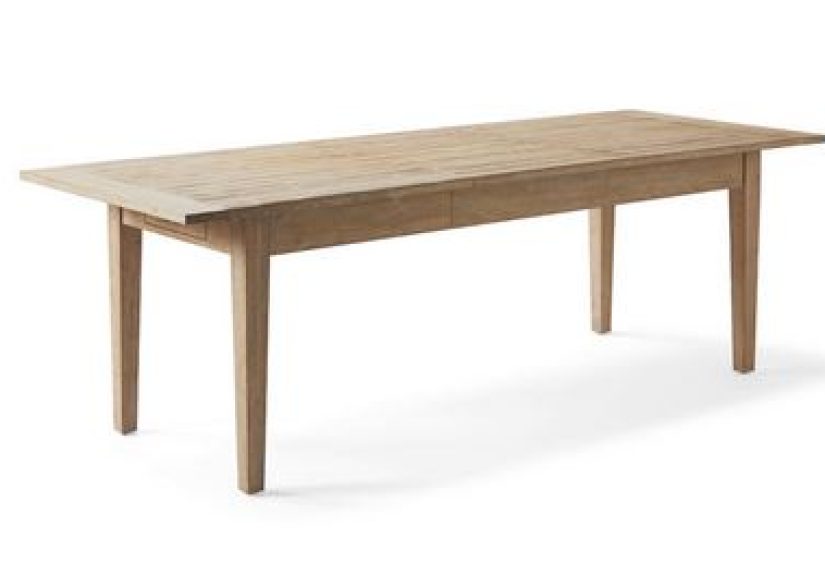
A beach house expandable dining table often looks best in finishes like sun-bleached pine, saltwashed oak, whitewashed wood, natural oak, or soft weathered brown. These tones reflect light beautifully and keep the room from feeling dense. They also play nicely with the coastal design formula of relaxed neutrals, woven textures, and breathable fabrics.
2. Clean lines over heavy ornament
Coastal style has moved away from overtly themed décor and toward simpler silhouettes. Tapered legs, plank tops, gentle curves, and understated profiles feel fresher than bulky carved bases or heavily distressed finishes. The result is calmer, more grown-up, and much easier to mix with other styles like farmhouse, cottage, transitional, and even a little quiet luxury.
3. Texture that feels like nature, not a souvenir shop
The right table does not need to scream “beach.” It just needs the right supporting cast. Think linen slipcovered chairs, rattan or wicker accents, jute rugs, woven pendant lights, matte ceramics, and simple glassware in watery tones. Texture does the storytelling here. It whispers. It does not wear a captain’s hat.
How to choose the right size
This is where beauty meets math, and math always wins. A stunning table that blocks traffic or leaves your guests elbow-checking each other over crab cakes is not a success story.
General length guidelines
As a starting point, many designers and furniture retailers follow a practical rule of thumb: a table around 48 inches long generally suits four people, 60 to 72 inches often suits six, around 80 to 87 inches works for eight, 92 to 108 inches can seat ten, and around 120 inches can handle twelve in the right room. That does not mean you should pack people in like sardines at a seafood shack, but it gives you a useful baseline.
For beach-house living, expandable formats are especially appealing because common models often start around 60 to 80 inches for daily use and then extend to 80, 96, 104, 108, or even 120 inches for entertaining. In plain English: you can keep the room easy and breathable until it is time to feed the entire summer rental crew.
Rectangular, round, or oval?
Rectangular tables are the classic choice, especially for open dining rooms and long, narrow spaces. They look grounded and generous, and they pair well with benches or mixed seating.
Round tables are excellent for conversation and can make a compact room feel more fluid. A round table with a leaf is especially clever in smaller homes because it softens traffic flow when closed and still expands for guests.
Oval tables are the underrated darlings of coastal design. They feel graceful, improve movement in tighter spaces, and often deliver the softness of a round table with the seating capacity of a rectangular one.
Do not forget clearance
A dining room should not require acrobatic training. Leave enough space for chairs to pull out comfortably and for people to walk around the table without muttering under their breath. In a beach house, where coolers, tote bags, and children with damp towels may also pass through, generous circulation matters even more.
Details that separate a good table from a regrettable one
Not all expandable tables are created equal. Some glide open like a dream. Others behave like they were designed during a family argument. Before buying, pay attention to the details that affect how the table lives day to day.
The extension mechanism
Some tables use drop-in leaves, while others have self-storing or butterfly leaves. Neither is automatically better. A drop-in leaf can create a clean, elegant top and often feels more traditional. A self-storing mechanism is convenient if you do not want to hunt through closets every Thanksgiving wondering where the leaf went. The real test is ease: if one person cannot reasonably understand how it works, the romance may wear off quickly.
The finish
Beach-house furniture has to survive real life: humidity, salty air, sunscreen hands, condensation rings, and enthusiastic meals involving citrus, butter, and maybe a dramatic splash of rosé. A multi-step finish, wire-brushed texture, or sealed wood surface can help hide wear and support easier maintenance. Ask about samples, review care instructions, and inspect whether the finish looks consistent and durable rather than thin and fragile.
The construction
Look for solid craftsmanship, stable legs, smooth joinery, and hardware that feels substantial. A coastal table may look relaxed, but it should not wobble like it just got off a fishing boat. If drawers are part of the design, they should open smoothly and feel purposeful, not like a decorative afterthought.
Best materials for coastal living
Wood remains the leading choice for a beach house expandable dining table because it delivers warmth, texture, and timelessness. Oak is especially popular for its visible grain and versatile finish options. Pine has that casual, cottage-like charm people love in coastal interiors. Veneered construction can also be practical when done well, offering a stable surface and a more accessible price point on some designs.
That said, the coast is not always kind to furniture. Wood naturally responds to humidity changes by swelling and shrinking. In a beach environment, that means stable indoor conditions matter. If your house sits near the water or stays closed up for stretches of time, keep indoor humidity in a healthy range, use air conditioning or a dehumidifier when necessary, and wipe up spills promptly. Felt pads under chairs, gentle cleaners, and coasters are not glamorous, but neither is crying over a cloudy finish.
If you want a lower-maintenance look, mixed-material tables with sealed tops or highly durable finishes can also work, but they should still feel visually light. A beach house table should anchor the room without making it feel like gravity has increased.
How to style the table so it feels coastal but current
Keep the palette easy
Start with whites, creams, sandy beiges, weathered taupes, pale woods, and soft blue or green accents. This creates the airy base that coastal spaces do so well. You do not need a room full of color to suggest the ocean. One ceramic bowl in sea-glass blue can do more than twelve decorative starfish ever could.
Layer natural textures
Use woven placemats, linen napkins, cane-back chairs, and a jute or flatweave rug. Texture adds warmth without visual clutter, which is especially important in rooms dominated by light finishes.
Choose the right rug
If you place a rug beneath an expandable table, size it for the table when fully extended, not when closed. This is one of the easiest mistakes to make and one of the most annoying to live with. In many rooms, an 8×10 rug works well for a table seating six, while a 9×12 or 10×14 may be better for a table that expands to seat eight or more.
Mix chairs thoughtfully
A beach-house table looks especially charming with a mix of host chairs, side chairs, or a bench on one side. The trick is to keep the materials related, not identical. White slipcovered chairs with a light oak table? Lovely. Rattan end chairs with simple upholstered sides? Also lovely. Six unrelated chairs from six unrelated life choices? Maybe less lovely.
Is it worth the investment?
For many homeowners, yes. A beach house expandable dining table earns its keep because it solves both aesthetic and practical problems at once. It can make a room feel relaxed and polished every day while still adapting to the way people actually live and entertain.
It is particularly worthwhile if your dining area is multifunctional. In many coastal homes, the dining table doubles as a board-game arena, work-from-home station, shell-sorting headquarters, homework desk, and unofficial snack bar. An expandable version gives you flexibility without requiring a second oversized table or a backup folding setup that always feels a little like a community center.
The best value comes from choosing a piece with timeless lines instead of trend-driven gimmicks. A good coastal table should still look right if you swap out the rug, repaint the walls, or decide next summer that you are emotionally ready for less blue.
Shopping checklist before you buy
- Measure the room with the table both closed and extended.
- Check the seating capacity in real terms, not just optimistic marketing.
- Ask whether the leaf stores inside the table or separately.
- Review finish and care instructions, especially for homes in humid climates.
- Request wood swatches if available.
- Confirm delivery path measurements for long or heavy tables.
- Think about the chair style and rug size before the table arrives.
A little prep saves a lot of grief. Nobody wants a gorgeous table that cannot make it through the front door or fit under the pendant light without creating a visual hostage situation.
Final thoughts
A beach house expandable dining table is one of those rare furniture pieces that feels both romantic and sensible. It brings warmth, texture, and a relaxed coastal mood into a room, but it also performs. It opens for holidays, shrinks for weekdays, and helps a home feel ready for whatever the season brings. That balance is what makes it so appealing.
Choose one with a light natural finish, a shape that suits your floor plan, and an extension system you will not dread using. Style it with restraint, maintain it with common sense, and let the table do what beach-house furniture should always do: make life feel easier, lighter, and a little more inviting.
Experience: Living With a Beach House Expandable Dining Table
Living with a beach house expandable dining table changes the rhythm of a home in ways that are easy to underestimate until you actually have one. At first, it seems like a design decision. You choose the finish, pick the chairs, maybe spend an unreasonable amount of time debating whether the room wants a woven pendant or a cleaner linen shade. Then people start using the table, and that is when you realize it is less a piece of furniture and more the social headquarters of the house.
On ordinary days, the table sits in its smaller form, looking calm and collected. It does not bully the room. It leaves space to move, lets sunlight bounce around, and makes the dining area feel relaxed rather than overly formal. Morning coffee lands there. Grocery lists appear. Someone drops a paperback on one end, someone else charges a laptop at the other, and somehow it all still looks intentional because the table has that easy coastal quality that forgives real life.
Then guests arrive, and the table reveals its secret talent. Suddenly it is larger, more generous, more useful. You can set out grilled fish, corn salad, a stack of plates, and still have room for the cousin who insists on bringing an extra dessert “just in case.” In a beach house, this matters because entertaining is rarely rigid. It is often casual, last-minute, and slightly sandy. The expandable table meets that energy beautifully. It says yes to more people without making the room feel permanently crowded the rest of the week.
There is also something emotionally nice about the ritual of extending it. Pulling out the leaf becomes a little signal that something fun is about to happen. It means company, birthdays, card games, lobster rolls, or a holiday meal with a view of the water. It turns a practical mechanism into a small domestic ceremony, which is a surprisingly charming trick for a table to pull off.
The coastal styling helps, too. A light wood top tends to hide daily dust better than darker glossy finishes, and it looks better in natural light from basically every angle. Add linen napkins, a bowl of citrus, maybe a few woven placemats, and the whole room feels pulled together without trying too hard. That is the real luxury of this kind of table: it looks polished even when life around it is casual.
Of course, there are lessons. You learn quickly that coasters are not optional if cold drinks are involved. You become weirdly protective about sunscreen hands. You start noticing humidity shifts and keeping the room better ventilated. But these are not dealbreakers. They are just part of owning a beautiful wood piece in a lived-in coastal environment.
In the end, the experience is less about the mechanism and more about the mood it creates. A beach house expandable dining table invites people to stay a little longer. It makes spontaneous dinners easier, holiday hosting less stressful, and everyday meals feel slightly more special. For a home near the coast, or a home that simply wants that breezy, gathered-around-the-table feeling, it is hard to think of a piece that works harder or wears its charm more effortlessly.