Table of Contents >> Show >> Hide
- What Is a Candle Oscillator, Exactly?
- Why Candle Flames Start “Dancing” in the First Place
- How a Maker Turned Fire Into a Clock
- The Science Behind Sensing a Flame
- Why the Flame Looks Yellow, Flickery, and Alive
- Will a Candle Oscillator Replace Quartz? Absolutely Not. That Is Not the Point.
- Practical Takeaways for Curious Readers
- Workbench Experiences: What This Kind of Project Feels Like in Real Life
- Conclusion
Some inventions whisper, “I am practical.” Others kick open the lab door, wave a tiny flame around, and yell, “I am magnificent.” The candle oscillator belongs squarely in the second camp. At first glance, it sounds like a joke dreamed up by a sleep-deprived engineer with a box of tea lights and too much optimism. But it is very real, very clever, and surprisingly scientific. In the hands of curious makers, grouped candle flames can behave like a rhythmic system, flickering with enough regularity to act as a kind of natural time signal.
That is the deliciously weird heart of the story. A candle is usually the opposite of a precision instrument. It drips. It wobbles. It smells nice if you are lucky and like a regrettable fruit salad if you are not. Yet when several candles are arranged just right, the flames can begin to oscillate together. One maker project turned that behavior into a functional clock source, sensing the flame motion and dividing it down into a 1 Hz blink. In other words, fire became a timekeeper. Quartz crystals everywhere were understandably offended.
What Is a Candle Oscillator, Exactly?
In plain English, a candle oscillator is a setup where candle flames produce a repeating pattern that can be measured like any other oscillation. In electronics, an oscillator is simply something that repeats in a regular cycle and can be used as a reference. Quartz crystals are the celebrities of this world, but they do not own the concept. If a system repeats predictably enough, it can serve as a time base.
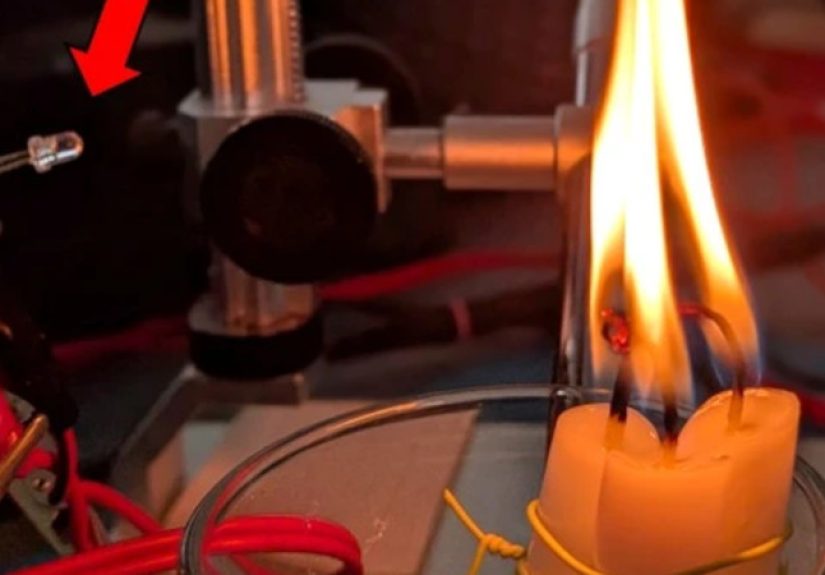
That is what makes the candle-flame project so charming. Instead of using a crystal, the builder used a bundle of three candles whose flames naturally flickered at roughly 9.9 to 10 Hz. That repeating motion was detected, cleaned up with signal processing, and divided down to create a 1 Hz output. The result was not just a science demo. It was a working proof that even a flame can play the role of a clock source when the physics line up just right.
The important distinction is this: a single candle in ordinary room air is usually not a stable oscillator. A grouped set of candles, however, can begin to act like a coupled system. That shift from cozy ambiance to accidental laboratory instrument is what makes the topic so much fun.
Why Candle Flames Start “Dancing” in the First Place
Combustion Is More Organized Than It Looks
A candle may look simple, but it is running a surprisingly elegant combustion loop. Heat melts wax near the wick. The liquid wax climbs the wick by capillary action. The heat then vaporizes that wax, and the wax vapor reacts with oxygen in the air. That reaction creates more heat, which melts more wax, and the cycle keeps going. It is a tidy little chemical economy with zero patience for bad wick design.
When the flame is in balance, the result is a steady teardrop-shaped burn. That steady shape depends heavily on buoyant convection. Hot air rises, fresh air moves in, and the flame stretches upward. The wick matters too. It acts like a fuel pump, controlling how much wax reaches the flame. Too much fuel and the candle can flare and soot. Too little, and the flame weakens or sputters. So yes, your candle wick has performance anxiety.
Three Candles Are Where the Plot Thickens
Modern candles are generally designed not to flicker wildly. That is good for homes, terrible for chaotic-romance lighting, and fascinating for science. When several candles are brought close together, their flames begin interacting through heat transfer, airflow, and the local supply of oxygen. Instead of behaving like separate little flames, they can start acting like a coupled system.
Researchers studying candle-flame oscillations have found that these grouped flames can synchronize. At short separation distances, the oscillations tend to lock in phase. At larger separations, anti-phase behavior can appear, meaning one bundle peaks while the other dips. The frequency also is not carved into stone tablets. It can shift with confinement, bundle geometry, oxygen concentration, and other environmental conditions. That is one reason this phenomenon is scientifically rich even if it is not exactly ready to replace your smartwatch.
So when people say the candle oscillator “heats things up,” they are not just being cute. The oscillation really emerges from the way heat, convection, fuel delivery, and flame coupling interact.
How a Maker Turned Fire Into a Clock
The version that drew so much attention came from a maker project that used a three-candle bundle as the oscillating source. The observed flicker was around 9.9 Hz, which is already weird enough to make an engineer grin. But the smarter move was how that signal got turned into something usable.
One path involved optical sensing with a phototransistor, which detected the flame’s brightness changes. Another approach used capacitive sensing with a simple wire and a small CH32 microcontroller. The flame’s motion altered the sensed electrical behavior enough for the system to detect the oscillation, apply filtering, identify zero crossings, and generate a divided output. That cleaned-up signal then drove a 1 Hz LED blink, creating a practical visual clock tick from a source that is, again, literally on fire.
This is the part where the project stops being a novelty and starts teaching real engineering lessons. The builder was not worshipping the flame as a magical object. The flame was just the front end of a measurement problem. Once the oscillation was sensed, it became a signal-processing task: filter noise, detect periodic motion, normalize the frequency, and output a useful rhythm. The romance of fire met the cold professionalism of firmware.
The Science Behind Sensing a Flame
If you are wondering how a wire can “notice” a flame, the short version is that flames are not just decorative blobs of glowing air. Ordinary flames are weakly ionized gases. They contain charged species produced during combustion, and electric fields can influence flame behavior. NASA’s combustion research has explored how electric fields interact with flames through charge carriers created by chemi-ionization, affecting things like flame shape, soot behavior, and stability.
That does not mean your scented candle is secretly a lightning bolt. It means flames have measurable electrical properties, and clever people can exploit those properties for sensing. In the candle-clock project, the capacitive approach made the setup delightfully spare. No elaborate optics. No giant lab rig. Just a wire, a microcontroller, signal processing, and the confidence to treat a candle like a sensor target instead of a holiday centerpiece.
There is also something poetic about the whole thing. The same physical behavior that makes fire look lively and unpredictable is the very thing that lets an electronic system lock onto it. The chaos is not total chaos. Hidden inside it is pattern.
Why the Flame Looks Yellow, Flickery, and Alive
Part of the visual drama comes from flame color and structure. A candle flame is not one uniform blob. Different regions have different temperatures and chemistry. The yellow part we associate with classic candlelight comes largely from glowing soot particles, while the lower blue region reflects different combustion conditions near the base. In normal gravity, buoyant convection helps create the familiar teardrop shape and carries soot upward, contributing to the yellow appearance.
That is also why the flame can look so expressive. Disturb the airflow, alter the fuel balance, or change how nearby flames interact, and you change the flame’s behavior. Flicker is not just mood lighting. It is a visible sign that the burn is being modulated by real physical processes.
Science education projects like candle carousels show this beautifully. Heat from candles creates rising air and forces on angled blades, turning heat flow into motion. A candle oscillator works differently, but the family resemblance is obvious: candle systems are deeply shaped by heat, airflow, and geometry. Give the physics a stage, and the stage performs.
Will a Candle Oscillator Replace Quartz? Absolutely Not. That Is Not the Point.
Let us be fair to quartz for a moment. Conventional electronic instruments use crystal oscillators for a reason. They are compact, stable, and boring in the most useful possible way. A candle oscillator, by contrast, depends on a flame that is sensitive to drafts, wick condition, fuel supply, spacing, and environmental changes. Research on candle-flame oscillations shows that oxygen concentration and confinement can shift the behavior, and practical candle guidance makes clear that wick length and airflow strongly affect flame stability.
So no, nobody is designing the next GPS satellite around a vanilla bean candle and a dream. But replacement is not the right measure of value here. The candle oscillator matters because it makes a profound engineering idea easy to see: if a system repeats, and you can sense it well enough, you can build timing around it.
It also reminds us that physical computing does not have to start with silicon. Sometimes it starts with watching a familiar object behave in an unfamiliar way. The lesson is bigger than the gadget. Good engineering often begins with noticing that “ordinary” things are not nearly as ordinary as they look.
Practical Takeaways for Curious Readers
If you are fascinated by this idea, there are a few takeaways worth keeping. First, candles are excellent teaching tools for combustion, convection, and coupled oscillation. Second, open flames are terrible roommates for carelessness. Candle safety basics matter: trim the wick to about a quarter inch, keep candles on a stable heat-resistant surface, avoid drafts, keep them away from anything flammable, and do not bunch them together casually just because grouped flames look cool. Standard candle guidance also recommends spacing grouped candles apart to prevent flaring and unwanted drafts.
Third, the most interesting part of a project like this is not the “wow” factor. It is the translation layer between physics and measurement. The flame oscillates. A sensor detects it. Firmware filters it. Logic divides it. An output makes it useful. That is the real story. The candle is the headline. The engineering is the article.
Workbench Experiences: What This Kind of Project Feels Like in Real Life
One reason the candle oscillator grabs people so quickly is that it does not feel like a normal electronics project. Most bench work begins with tidy assumptions: stable supply, predictable parts, controllable signals. A candle laughs at those assumptions in a tiny yellow voice. The experience of working with one is half experiment, half negotiation. You light the candles, expect instant magic, and instead spend a few minutes learning humility. The flame needs to stabilize. The room needs to settle down. The spacing matters. The wick condition matters. Even your own movement near the setup can change what you see.
That first moment when the grouped flames start behaving as one system is unforgettable. Instead of three unrelated little lights, you begin to see a shared rhythm. The flames seem to breathe together. It is the sort of thing that makes you lean in and immediately regret leaning in because, yes, that is still open flame and your eyebrows deserve a long future. But visually, it is wonderful. The oscillation is not just data. It is visible. You are watching physics perform its own live demo.
Then comes the engineering side of the experience, which is a different kind of satisfying. You watch a sensor trace settle into a pattern and realize the weird thing is not just in your imagination. There is a real signal there. A noisy one, maybe. A temperamental one, definitely. But real. If you are using optical sensing, you feel like you are eavesdropping on the flame’s brightness. If you are using capacitive sensing, the setup feels even more delightfully improbable, like you are detecting a campfire’s mood with a paperclip and confidence.
There is also a classic maker-project emotional arc here. The beginning feels theatrical. The middle feels stubborn. The end feels earned. You fuss with placement, chase false readings, question your life choices, and finally get a stable blink that proves the system is doing what you hoped. That 1 Hz output is not just an LED flashing. It is a small victory over messiness. You have taken something ancient, warm, and physically unruly and made it cooperate with digital logic for at least a little while.
And that is why projects like this stick with people. They reconnect electronics with the physical world in a very direct way. You smell the wax. You feel the heat. You see the flame. You hear the tiny room sounds that suddenly matter because airflow matters. The whole setup reminds you that engineering is not always abstract. Sometimes it is immediate, sensory, and slightly ridiculous in the best possible way. A candle oscillator does not just tell you something about fire. It tells you something about curiosity: that many of the best ideas begin when someone looks at a familiar object and asks, “Okay, but what else can this do?”
Conclusion
The candle oscillator is a perfect example of science being both serious and delightfully odd. At one level, it is a combustion-and-synchronization story: wax, wick, oxygen, convection, and coupled flames producing a measurable rhythm. At another, it is an instrumentation story: sensing a natural oscillation, filtering it, and using it as a time reference. And at the human level, it is simply fun. It takes one of the oldest technologies on Earth and invites it into a conversation with microcontrollers and signal processing.
That is why the idea lands so well. It is not trying to outdo modern electronics. It is reminding us that the world is full of signals hiding in plain sight. Even a candle, that humble veteran of birthdays, blackouts, and overconfident dinner parties, can become a clock if you ask the right questions.
Note: This article is for educational purposes. Any hands-on experiment involving grouped candles or open flames should be done with strict fire safety, appropriate supervision, and excellent ventilation.