Table of Contents >> Show >> Hide
- What Are These “Spy Ships,” Exactly?
- Why Chinese Spy Ships Keep Showing Up
- From Hawaii to Australia: A Repeating Pattern
- Why This Matters More Than It Looks
- How the U.S. and Allies Are Responding
- The Bigger Strategic Picture
- Not a Shooting War, But Not Nothing Either
- What the Experience Feels Like on the Water
- Conclusion
There is a certain kind of naval drama that never looks dramatic on the surface. No missiles fly. No one yells into a megaphone. Nothing explodes. Instead, a gray hull appears on the horizon, keeps a polite distance, and quietly turns itself into the most unwelcome guest at the maritime party. That is the basic story behind Chinese spy ships shadowing the United States and its allies.
These vessels usually do not charge into an exercise area waving flags and villain music. They linger just outside the most sensitive zones, watch carefully, listen even more carefully, and collect what modern militaries treasure most: information. For Beijing, that means signals, radar emissions, communications patterns, operating routines, and clues about how allied navies work together. For Washington and its partners, it means every major drill now comes with a second audience that did not buy a ticket but still found a very good seat.
The headline may sound like a cold-war throwback, but the issue is very current. Chinese intelligence-gathering ships have repeatedly shown up around major exercises involving the United States, Australia, Japan, the Philippines, India, and other partners. The pattern has become so familiar that in some cases allied officials now talk about it the way people talk about summer mosquitoes: annoying, predictable, and never truly gone.
What Are These “Spy Ships,” Exactly?
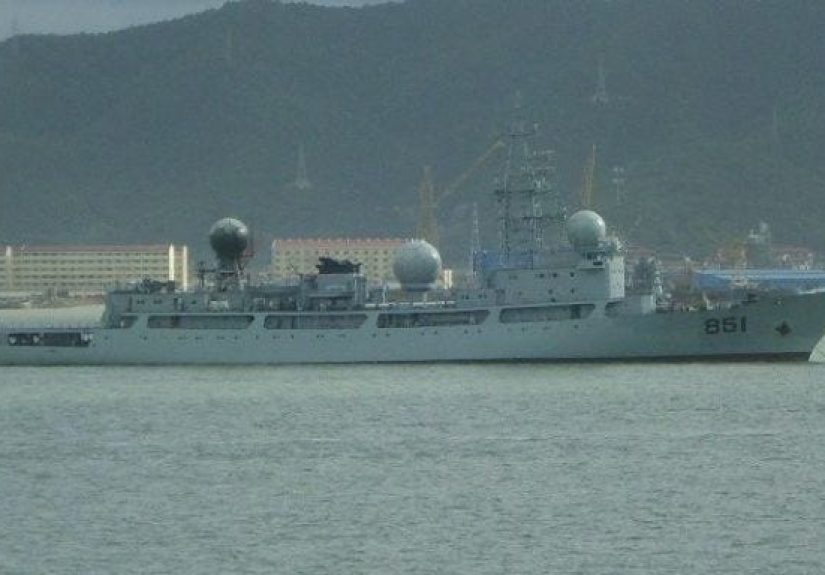
When people say “Chinese spy ships,” they are usually talking about surveillance or intelligence-collection vessels operated by the People’s Liberation Army Navy. Many are associated with the Dongdiao-class, a family of auxiliary general intelligence ships built to gather electronic intelligence and monitor military activity at sea.
That sounds technical because it is technical. These ships are not just floating binoculars. They are designed to collect signals intelligence, track radar behavior, monitor communications, and study how ships, aircraft, and missile systems operate during training. If a multinational drill is a rehearsal, then a spy ship is trying to sneak a look at the script, the stage directions, and the lighting cues.
Exercises are especially attractive targets because they compress valuable information into a short period of time. Multiple navies, air forces, and marine units operate together. Advanced systems get tested. Command relationships get practiced. New tactics appear. And because drills are meant to sharpen readiness, they often reveal what countries consider most important in a real crisis. That is gold for any intelligence service.
Why Chinese Spy Ships Keep Showing Up
The answer is simple: because it works. Beijing gains insight into American and allied operations while also making a political point. Every time one of these ships appears near a multinational exercise, China sends a message that it intends to watch the watchers and contest the idea that the Indo-Pacific belongs to any single security bloc.
There is also a strategic irony here that analysts never tire of pointing out. China has long objected to some foreign military activities near its own coast, especially American surveillance operations in waters and airspace close to Chinese territory. Yet Chinese surveillance ships regularly rely on the same principles of international access when they monitor exercises near Hawaii, Australia, Japan, or the Philippines. In plain English: freedom of navigation is apparently excellent when China is the one doing the navigating.
That contradiction matters because it reveals how Beijing uses law, diplomacy, and maritime presence selectively. Chinese officials can criticize U.S. surveillance near China while defending Chinese surveillance near U.S. allies as normal activity in international waters. From a legal perspective, much of this shadowing is not inherently unlawful. From a strategic perspective, it is absolutely intentional.
From Hawaii to Australia: A Repeating Pattern
RIMPAC and the Hawaiian Lesson
One of the clearest examples came during the Rim of the Pacific exercise, or RIMPAC, the world’s largest international maritime drill. Chinese surveillance ships appeared near Hawaii during past editions of the exercise, including high-profile instances that underscored Beijing’s willingness to monitor even a major U.S.-led event in the central Pacific.
That was not a one-off curiosity. It established a template. Chinese vessels could operate in international waters, stay outside the most restricted areas, and still vacuum up useful data. The message was almost cheeky: if the United States can observe China near the Chinese coast, China can observe the United States near Hawaii. That argument may be strategically irritating to Washington, but it is part of Beijing’s broader playbook.
Talisman Sabre and Australia’s Front-Row Seat
If RIMPAC demonstrated the concept, Australia’s Talisman Sabre exercise turned it into a habit. Chinese surveillance ships have repeatedly shadowed this large U.S.-Australian war game, which has grown into one of the most important allied exercises in the region. Officials in Canberra have at times openly said they expected Chinese spy ships to show up, which is about as close as military professionals get to saying, “Yes, the usual neighbor is peeking over the fence again.”
That expectation itself is revealing. It shows allied militaries no longer treat the presence of Chinese intelligence ships as a surprise. Instead, they plan around them. Exercises proceed, but operational security measures tighten. Emissions control becomes more important. Sensitive demonstrations may be adjusted. Crews know they are not only training for one another; they are also being studied by a very interested foreign observer.
The South China Sea and the Philippines
The shadowing is even more politically charged in the South China Sea, where Chinese naval, coast guard, and maritime militia activity overlaps with territorial disputes and alliance commitments. U.S.-Philippine patrols and drills have drawn close Chinese observation, and allied operations near contested features frequently unfold with Chinese ships nearby.
That turns surveillance into more than intelligence collection. It becomes a form of signaling and pressure. When Chinese ships watch Philippine, American, or other allied vessels during maneuvers, the message is not only “we are learning from you.” It is also “we are present, we are contesting your comfort, and we want everyone in the region to see it.”
This is why maritime shadowing fits so neatly into the gray zone: activity that is aggressive and coercive, but usually falls below the threshold of open conflict. No one wants to overreact to a ship in international waters. But no serious navy ignores one either.
Why This Matters More Than It Looks
At first glance, a surveillance ship tailing an exercise may seem like a nuisance rather than a crisis. That would be a mistake. Modern warfare depends heavily on data, networks, sensors, and the ability to understand how an opponent fights. Intelligence collected during exercises can help a rival map command structures, identify radar signatures, study coordination habits, and refine targeting or countermeasure plans.
Think of it this way: an exercise is where a military shows how its muscles connect. A spy ship is trying to memorize the tendons.
This matters even more for alliances, because multinational drills reveal something no single-nation deployment can: interoperability. How quickly can U.S. and Australian forces share information? How do Japanese and Philippine units coordinate with American assets? Which ships or aircraft tend to occupy which roles? What communications patterns suggest command priorities? These are not glamorous questions for movie posters, but they are exactly the kinds of details that shape deterrence and war planning.
There is also a psychological effect. When a Chinese surveillance ship appears during an exercise, it reminds participating countries that the competition is not theoretical. The Indo-Pacific is not a policy paper. It is crowded water, watched water, and increasingly contested water.
How the U.S. and Allies Are Responding
Washington and its partners are not standing still. One major response has been to deepen maritime domain awareness, the broad effort to track activity at sea more effectively and share that information across countries. The United States, Japan, Australia, India, the Philippines, and others have all emphasized better data-sharing, surveillance networks, and joint monitoring.
That phrase, maritime domain awareness, can sound like something invented by a committee that loves acronyms and beige conference rooms. But it is actually central to the problem. If China can track allied movements, then allies want to improve their own ability to track Chinese ships, aircraft, coast guard cutters, and gray-zone actors. In other words, if the ocean has become a giant chessboard, everybody wants a better overhead camera.
Another response is simply doing more together. Larger and more frequent exercises make it harder for China to intimidate any single country. When U.S., Japanese, Australian, Philippine, and other partner forces train side by side, they build familiarity that cannot be improvised during a crisis. The drills are not only about practicing combat tasks. They are also about making collective presence visible.
Allies are also becoming more transparent about Chinese monitoring. Publicly acknowledging shadowing behavior helps blunt any mystique around it. The goal is to show domestic and regional audiences that allied militaries see these ships, understand what they are doing, and are not easily rattled. Strategic calm is part of deterrence too.
The Bigger Strategic Picture
Chinese spy ships are just one piece of a wider pattern in the Indo-Pacific. Beijing is expanding naval operations farther from home, operating more persistently near Japan, around Taiwan, in the South China Sea, and into the broader Pacific. Surveillance ships, coast guard vessels, research ships, and maritime militia all contribute to a layered approach that mixes information collection, presence, and pressure.
That broader pattern explains why allied officials often treat shadowing as a symptom of a larger challenge rather than as an isolated irritation. China is not merely curious. It is shaping the environment. Each monitored drill, each close observation, and each carefully timed deployment contributes to a wider contest over who can operate where, with whom, and under what kind of pressure.
The answer from the U.S. and its allies has increasingly been networked deterrence: more combined training, more access agreements, more logistical integration, more intelligence-sharing, and more public coordination. The point is not to eliminate Chinese surveillance entirely, because that is unrealistic. The point is to make surveillance less useful, intimidation less effective, and allied cooperation more resilient.
Not a Shooting War, But Not Nothing Either
The temptation in headlines like this is to swing between extremes. Either “it’s just a ship at sea, calm down,” or “this is the opening act of World War III.” Neither approach is very helpful.
The more accurate view is that Chinese spy ships represent a steady, disciplined, and strategically meaningful form of competition. They usually operate below the threshold that would justify dramatic retaliation. But they are not harmless scenery. They gather intelligence, shape perceptions, test responses, and reinforce China’s claim to be an unavoidable military presence around U.S. allies and partners.
That is why every appearance matters. Not because one ship alone changes the balance of power, but because repetition normalizes pressure. A pattern that happens often enough starts to define the regional security environment. And that is exactly the game Beijing appears to be playing.
What the Experience Feels Like on the Water
To understand this issue fully, it helps to imagine the experience from the decks and operations rooms of the people being watched. For sailors, pilots, and commanders, a Chinese surveillance ship on the horizon is not an abstract policy problem. It is a daily fact that changes the mood of the exercise.
At sea, routine matters. Watches rotate. Briefings happen. Helicopters launch. Ships refuel, maneuver, and communicate. Then someone notes a foreign surveillance vessel nearby, and the atmosphere shifts just a little. Nobody panics. Professional crews are trained for this. But everyone becomes sharper. Words over the radio are measured more carefully. Movements are checked twice. People know that even ordinary-looking activity may be logged, analyzed, and compared later by a rival military.
For operators in combat information centers, the experience is part chess match, part endurance test. They track the shadowing ship’s course, speed, and relative position. They ask whether it is merely observing or trying to influence behavior. They think about what emissions are visible, what signatures are exposed, and what lessons the other side may be collecting. It is not glamorous. There is no orchestral soundtrack. There are screens, reports, coffee, and a lot of disciplined concentration.
For commanders, the experience is even more layered. They have to keep the exercise on track, protect sensitive information, reassure allies, and avoid creating an unnecessary incident. That is a delicate balancing act. Overreact, and China gets to paint the allies as unstable. Underreact, and the ship gains easier access to useful information. The job is to project calm without becoming careless, which sounds simple until you try doing it in a crowded sea with cameras, diplomats, and strategic consequences all lurking nearby.
Allied crews often describe these moments as reminders that exercises are no longer sealed training events. They are live demonstrations conducted under observation. An Australian, Japanese, Philippine, or American sailor may begin the day focused on seamanship or air defense drills and end it thinking about geopolitics, because geopolitics has sailed into view at 15 knots.
There is also a human side on shore. Families reading the news may see the phrase “Chinese spy ship” and imagine immediate danger. Defense officials, by contrast, often talk in measured terms because they know the difference between surveillance and attack. But for local communities near bases, ports, or exercise areas, these episodes can still feel personal. They signal that their region is no longer a distant backdrop to great-power competition. It is part of the stage.
In that sense, the experience of being shadowed is not really about one ship. It is about living in a security environment where observation, signaling, deterrence, and rivalry all happen at once. It is quiet pressure. It is professional tension. It is the realization that the Indo-Pacific contest is being written not only in summits and speeches, but also in long days at sea where one crew trains and another crew watches.
And perhaps that is the most important experience of all: understanding that modern competition often looks less like a battle scene and more like a staring contest with radar.
Conclusion
Chinese spy ships shadowing the U.S. and its allies are not random appearances or maritime sightseeing tours gone terribly off course. They are part of a repeatable strategy: collect intelligence, signal presence, test allied reactions, and remind the region that Beijing intends to be physically and politically present wherever major security activity unfolds.
For the United States and its partners, the answer is not melodrama. It is discipline. Better operational security. Better maritime domain awareness. Better coordination. Better exercises. And above all, a stronger network of allies that can keep training, keep sailing, and keep signaling back that intimidation is not the same thing as control.
That may not be as flashy as a movie trailer. But in real maritime competition, boring professionalism is often exactly what keeps the peace.