Table of Contents >> Show >> Hide
A telescope does not usually become a folk hero. Most scientific instruments are lucky if they get a grant, a plaque, and maybe a mildly flattering paragraph in a university brochure. Arecibo was different. It was enormous, iconic, weirdly cinematic, and scientifically priceless. For decades, the Arecibo Observatory in Puerto Rico was not just a giant dish in a tropical sinkhole. It was a discovery machine, a cosmic eavesdropper, a planetary radar powerhouse, and a place where astronomy, atmospheric science, and pure human curiosity all shook hands.
So when damage to Arecibo spiraled into catastrophe, astronomy did not simply lose a tool. It lost a one-of-one instrument. The 2020 cable failures and collapse of the 305-meter telescope left behind more than twisted steel and a shattered platform. They left a scientific gap that still has not been cleanly filled. In a field packed with dazzling observatories, Arecibo had a rare talent: it could do jobs that were not easy to hand off to anybody else. That is why the damage to Arecibo still feels less like a retirement and more like a missing chapter in modern astronomy.
Why Arecibo Was Never Just a Big Dish
Calling Arecibo “a radio telescope” is technically correct in the same way calling New York “a place with some buildings” is technically correct. Yes, it was a radio telescope. It was also a radar observatory, an ionospheric research facility, an education center, and a symbol of Puerto Rican scientific importance. That combination mattered.
The observatory’s famous 305-meter fixed spherical reflector made it one of the most powerful instruments of its kind ever built. Long before superlatives became social media bait, Arecibo earned them honestly. It was designed to probe the upper atmosphere, but it quickly proved itself indispensable for radio astronomy and solar system radar studies. In other words, Arecibo was not a specialist with one trick. It was the kind of overachiever that makes the rest of the group project nervous.
Three scientific worlds under one roof
Arecibo supported three major research areas: radio astronomy, space and atmospheric sciences, and planetary radar. That mix is a huge part of why its loss still stings. It could study pulsars and galaxies, investigate the ionosphere above Earth, and bounce radar signals off planets and asteroids. Most observatories make their reputation in one lane. Arecibo was out there driving all three at once.
Its radar capabilities were especially important. Arecibo could transmit powerful signals, then collect the faint echoes returning from worlds and rocks millions of miles away. That made it essential for mapping near-Earth asteroids, refining their orbits, and studying surfaces that optical telescopes could only admire from a distance. When an asteroid had everyone reaching for the collective stress ball, Arecibo often helped turn panic into precision.
What Actually Happened to Arecibo in 2020
The short version is brutal: cables failed, engineers realized the telescope was no longer safe to repair, and before a controlled decommissioning could happen, the structure collapsed. The longer version is even sadder because it involves warning signs, engineering uncertainty, and the slow realization that a legend was running out of luck.
From warning signs to collapse
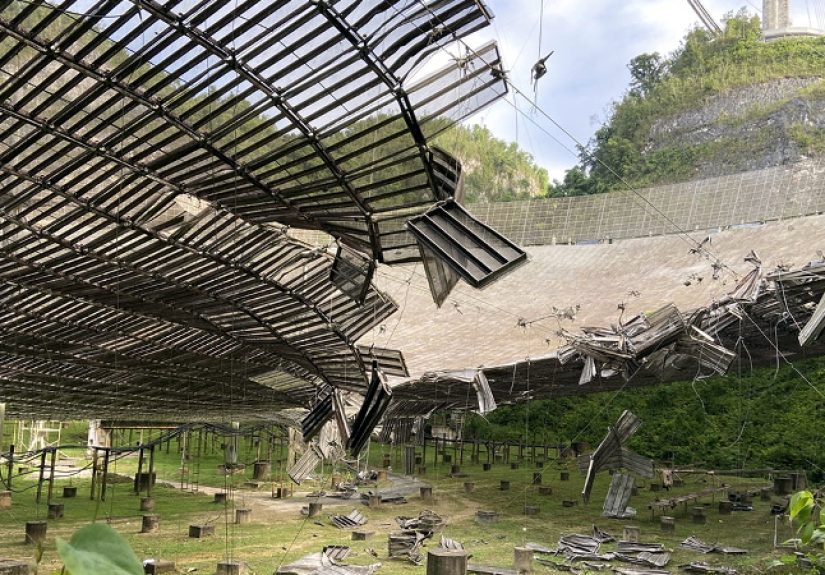
On August 10, 2020, one of Arecibo’s auxiliary cables detached and tore a huge gash in the dish. That was already a serious alarm bell, not the cute kind you tap before dinner, but the kind that tells you the building itself may be plotting against physics. Then, on November 6, a main cable failed. At that point, engineering assessments concluded the 305-meter telescope was in danger of catastrophic failure and could not be safely repaired. Plans began for decommissioning.
But the telescope never made it to a controlled goodbye. On December 1, 2020, the instrument platform fell into the dish. The collapse destroyed the telescope and damaged surrounding facilities. Thankfully, no one was injured. That fact remains the one bright line in a very dark story.
Later analyses added technical clarity to the heartbreak. A 2024 National Academies report concluded that the root cause of the collapse was accelerated long-term zinc creep in the telescope’s cable sockets. That may sound like the sort of phrase only an engineer and a metallurgist could love, but it matters because it explains why the failure was so unusual and so difficult to foresee. The committee also traced a 39-month failure sequence beginning after Hurricane Maria in 2017, when structural distress and cable slippage should have drawn even more urgent concern. In plain English: Arecibo did not die from one bad day. It died from damage, stress, and a failure mechanism that unfolded over time in a structure everyone desperately wished would hold on.
The Discoveries That Made Arecibo Legendary
If Arecibo had merely been huge, it would have been a tourist attraction with better grant applications. What made it legendary was the science. The observatory’s resume is ridiculous in the best possible way.
Pulsars, gravity, and cosmic precision
Arecibo helped transform pulsar astronomy. Its sensitivity made it especially good at detecting the rapid, clock-like radio pulses from neutron stars. That work led to the discovery of the first binary pulsar, a system that became one of the most important laboratories for testing Einstein’s theory of general relativity. The discovery ultimately helped confirm the existence of gravitational waves long before LIGO made those ripples famous on front pages.
Arecibo also remained vital to pulsar timing for decades. That matters because pulsars are not just exotic celestial lighthouses; they are precision tools for measuring the universe. In modern astrophysics, they help researchers study extreme matter, test gravity, and even listen for a background hum of low-frequency gravitational waves. Remove a telescope that excelled at this work, and the field does not collapse, but it definitely loses one of its sharpest ears.
First exoplanets, before exoplanets were cool
Today, exoplanets are practically their own entertainment genre. We have hot Jupiters, super-Earths, mini-Neptunes, and enough artist’s renderings to wallpaper the Moon. But one of the earliest and most important milestones in exoplanet science came through Arecibo: the first known planets discovered around a pulsar. That was a landmark moment in astronomy, and Arecibo was right in the middle of it.
The lesson was profound. Planets were not rare oddities tucked into a few tidy systems. They were part of a bigger cosmic story. Arecibo helped crack that door open.
Venus, Mercury, and the radar revolution
Arecibo’s planetary radar work was equally remarkable. Before spacecraft delivered full glamour shots, Arecibo provided much of the pre-Magellan knowledge of Venus by peering through the planet’s cloud cover with radar. It also helped establish Mercury’s rotation rate and investigated ice deposits in permanently shadowed craters near Mercury’s poles. That is the kind of science that changes textbooks, not just conference slides.
And then there were asteroids. Arecibo’s radar observations could refine orbital calculations, reveal shapes, estimate spin states, and provide critical information for planetary defense. In an era where “space rock” sounds like a movie title until one comes uncomfortably close to Earth, that capability was not academic decoration. It was practical science with consequences.
Fast radio bursts and the strange new sky
Arecibo also helped push astronomy into newer mysteries. It played a key role in the discovery of the first repeating fast radio burst, a finding that changed how astronomers thought about these violent, millisecond-long flashes. Repetition meant at least some FRBs were not one-and-done cataclysms. Suddenly the field had a new puzzle, a new population of sources, and a lot less certainty. Which, for astronomers, is basically catnip.
Even better, follow-up work tied repeating FRBs to galaxies beyond our own, helping turn a speculative phenomenon into a real branch of astrophysical research. Once again, Arecibo did what it often did best: it took the strange and made it scientifically actionable.
Why the Loss Still Matters
A fair question is this: astronomy has other observatories, so why call Arecibo’s loss a gaping hole? Because replacement is not just about owning another large telescope. It is about restoring a very specific set of capabilities, sensitivities, frequencies, radar power, sky coverage, and research culture. That is much harder.
No perfect substitute exists
China’s FAST is now the giant that captures many of the “largest radio telescope” headlines, and it is an extraordinary facility. But FAST is not a drop-in replacement for Arecibo in every scientific role, especially in planetary radar, where transmission power and operational context matter. Goldstone remains crucial for radar observations of asteroids, but the combination Arecibo once offered was unique. In fact, recent NASA analysis on asteroid 2024 YR4 noted that if Arecibo had still been operating, it likely could have gathered radar images that would have removed the object from the risk list earlier. That is not nostalgia talking. That is a modern example of capability loss.
Green Bank can absorb some science, particularly in radio astronomy and pulsar work, and future upgrades may help broaden what ground-based facilities can do. But science redistribution is not the same thing as science replacement. Some projects become slower. Some become harder. Some become impossible in the same form. And some simply lose the advantage of having a famously powerful telescope in Puerto Rico that scientists knew how to use brilliantly.
A cultural and educational loss, too
The damage to Arecibo also punched a hole in something less measurable but just as real: scientific identity. For Puerto Rico, the observatory was a landmark of advanced research and international collaboration. For students, it was proof that world-class science could happen close to home. For the broader public, it was one of those rare facilities that made astronomy feel tactile. It sat in the landscape like a piece of science fiction that happened to be real.
The site is now moving forward in a different form through Arecibo C3, a center focused on STEM education, computational skills, and community engagement. That is worthwhile and important. It extends the observatory’s public mission and honors its legacy. But it does not erase the scientific absence left by the 305-meter telescope. Education can preserve meaning. It cannot replace lost radar echoes from an incoming asteroid.
Could Astronomy Ever Get That Hole Back?
Maybe, but not cheaply, not quickly, and not by wishing very hard at the night sky. Rebuilding an Arecibo-class capability would require funding, political will, engineering ambition, and a scientific consensus that the investment would pay off across multiple fields. That is a tall order even before you add inflation, logistics, and the reality that giant science facilities compete with many other urgent priorities.
Still, the case is not absurd. Arecibo proved the value of a multi-use observatory that could support radio astronomy, upper-atmosphere research, and planetary defense. In a future where tracking hazardous asteroids matters more, not less, the argument for restoring high-end planetary radar capability may grow stronger. The scientific community is very good at adapting. It is less good at pretending irreplaceable tools were no big deal.
And that is the real point. The damage to Arecibo was not just the loss of a famous telescope from old documentaries and movie scenes. It was the loss of a scientific advantage built over decades. Astronomy can move forward, and it will. But it moves forward carrying a gap where one of its most versatile giants used to stand.
The Human Experience of Losing Arecibo
There is a technical story about Arecibo, and then there is the emotional one. The technical story is made of cables, zinc sockets, load calculations, hurricane damage, safety factors, and post-failure reports thick enough to stop a door. The emotional story is simpler. People loved the place.
For astronomers, engineers, students, and science fans, Arecibo had the strange power that only a few scientific institutions ever achieve: it felt personal. People who worked there often described it less like a machine and more like a living chapter of their own lives. Careers began there. Collaborations were born there. First discoveries, first late nights, first successful observations, and first giant bouts of scientific panic all happened there. The observatory was a workplace, yes, but it was also a rite of passage.
For Puerto Rico, Arecibo represented more than astronomy. It was a statement that world-class research could be rooted on the island, not imported from somewhere else with a lot of lanyards and a polished brochure. It showed students that science was not always something happening far away in California, Massachusetts, or a movie version of outer space. It was happening there, in the karst hills, with real instruments and real data and real careers attached.
That is why the collapse was so painful to watch. It was not just spectacular destruction. It was a public ending to something that had shaped identity and aspiration. When the platform fell into the dish, many people were not mourning a piece of hardware. They were mourning possibility, memory, and continuity.
Even for people who never visited, Arecibo had a mythic quality. It appeared in documentaries, news stories, books, and pop culture, but it never felt fake. It looked unbelievable while doing serious work. It was one of those rare places that reminded the public that science can be both useful and awe-inspiring at the same time. It searched for pulsars, mapped planets, studied asteroids, and sent a famous message toward the stars. That is a ridiculously good biography for any observatory.
The experience of losing Arecibo also changed how many scientists talk about infrastructure. It was a reminder that great discoveries depend on maintenance, monitoring, funding, and the very unglamorous art of not letting essential facilities age into crisis. Science likes to celebrate breakthroughs, but Arecibo’s story showed how easily neglect, delay, and underestimated risk can hollow out a world-class capability.
And yet the feeling surrounding Arecibo is not only grief. There is also loyalty. People continue to write about it, teach its history, preserve its data, and build educational programs at the site because they understand that the observatory’s legacy is larger than its collapse. In that sense, Arecibo still works on us. It still teaches humility, wonder, and the inconvenient truth that some tools are so good, so distinctive, and so culturally important that when they disappear, the loss echoes far beyond the crater.
That is the human experience of Arecibo in one sentence: it made people feel that the universe was both reachable and worth reaching for. Losing that feeling would be the real disaster. Fortunately, that part of Arecibo has not collapsed at all.
Conclusion
Damage to Arecibo left a genuine hole in astronomy because Arecibo was never just famous; it was useful in rare and overlapping ways. It excelled at pulsar science, planetary radar, atmospheric research, and public inspiration. Its discoveries helped verify gravitational theory, expand exoplanet science, reveal new behavior in fast radio bursts, and sharpen humanity’s view of nearby worlds and potentially hazardous asteroids.
The observatory’s collapse was the end of a giant instrument, but not the end of the lesson it leaves behind. Great science depends on bold ideas, yes, but it also depends on keeping extraordinary facilities alive, healthy, and respected before the warning signs become an obituary. Arecibo once listened to the universe with unmatched force. Today, astronomy still feels the silence where that listening used to happen.