Table of Contents >> Show >> Hide
- The Short Answer: Yes, They Read It. No, They Do Not Read It Like You Do.
- What “Reading Their Own Email” Actually Means
- Why CEOs Still Care About Email in Big Companies
- Big Examples That Answer the Question Better Than Theory Ever Could
- The Catch: CEOs Should Not Manage by Inbox
- What Founders, Sales Teams, and Operators Should Learn From This
- So, Do CEOs of Big Companies Actually Read Their Own Email?
- Experience Notes: What This Looks Like in the Real World
- Conclusion
- SEO Tags
There is a magical stage in career development where normal people start imagining CEOs as mythological creatures. They do not walk; they “circulate.” They do not type; they “dictate.” They do not check email; surely a battalion of assistants, chiefs of staff, and mysterious headset-wearing gatekeepers handle that while the CEO stares thoughtfully at a revenue dashboard.
Nice theory. Great for movies. Not how it usually works.
The real answer to the question, “Do CEOs of big companies actually read their own email?” is: yes, often more than you think. But they do not read it the way most people imagine. They are not lounging around with an empty inbox, sipping espresso, waiting for your “just circling back” note to brighten their day. They are scanning for signal, delegating noise, triaging urgency, and paying special attention to messages tied to customers, revenue, risk, culture, hiring, and strategy.
In other words, the CEO inbox is not a democracy. It is a battlefield with filters.
The Short Answer: Yes, They Read It. No, They Do Not Read It Like You Do.
One of the biggest myths in executive communication is that large-company CEOs are totally detached from email. The truth is more interesting. Many senior executives still treat email as one of the fastest ways to stay close to reality. Meetings are curated. Dashboards are delayed. Reports are polished until all the rough edges are gone. Email, by contrast, often carries raw signal.
That is precisely why CEO email habits still matter in an age of chat apps, internal collaboration tools, AI summaries, and way too many “quick syncs.” For many top leaders, email remains the place where customer pain shows up first, employee frustration leaks through, product bugs become impossible to ignore, and a great opportunity occasionally lands without permission.
So yes, many big-company CEOs do read their own inboxes. They just do it selectively, strategically, and often with support.
What “Reading Their Own Email” Actually Means
When founders or operators ask this question, they are usually imagining only two possibilities. Either the CEO personally reads and replies to every message, or an assistant screens everything and the CEO sees almost nothing. Real life sits in the messy middle.
In practice, reading their own email can mean several different things:
1. They personally review high-priority messages
Most CEOs want direct visibility into certain categories: customer escalations, board communications, investor notes, legal or reputational risks, talent issues, key sales opportunities, and internal updates from trusted lieutenants. Those usually get read.
2. They skim a lot and reply to a little
Reading is not the same as crafting a five-paragraph response. Plenty of executives scan subject lines, first sentences, or summaries, then forward, flag, or reply with a short instruction. Sometimes the response is thoughtful. Sometimes it is one line. Sometimes it is the corporate equivalent of a smoke alarm.
3. They rely on assistants to prioritize, not replace judgment
Executive assistants and chiefs of staff often help route messages, protect time, and reduce junk. That does not necessarily mean the CEO is absent from the inbox. It usually means the CEO is trying not to drown in it.
4. They use email as a listening tool
Some leaders do not love email, but they respect what it reveals. A direct note from a customer or employee can cut through the sanitizing effect of hierarchy. That is gold in a large organization.
Why CEOs Still Care About Email in Big Companies
If email is so annoying, why do so many top executives still cling to it like a Wi-Fi password at an airport?
Because email does four things unusually well.
It preserves context
Email creates a searchable trail. Unlike hallway chatter or disappearing chat threads, it keeps the original ask, the timestamp, the people involved, and the attached evidence in one place. For a CEO juggling decisions across product, sales, hiring, finance, and customer success, that matters.
It works asynchronously
Executives operate across time zones, teams, and nonstop interruptions. Email lets them process information when they have a usable slice of attention. That is often more realistic than taking another meeting.
It bypasses bureaucracy
A customer can write to the CEO. An employee can escalate a concern. A founder can pitch a partnership. Email is not perfectly open, but it is still one of the least ceremonial channels in business.
It reveals what formal systems miss
Metrics tell you what happened. Email often tells you why people are upset, confused, or ready to leave. That is why some CEOs still regard inboxes as messy but useful ground truth.
Big Examples That Answer the Question Better Than Theory Ever Could
Tim Cook: High Volume, Real Reading
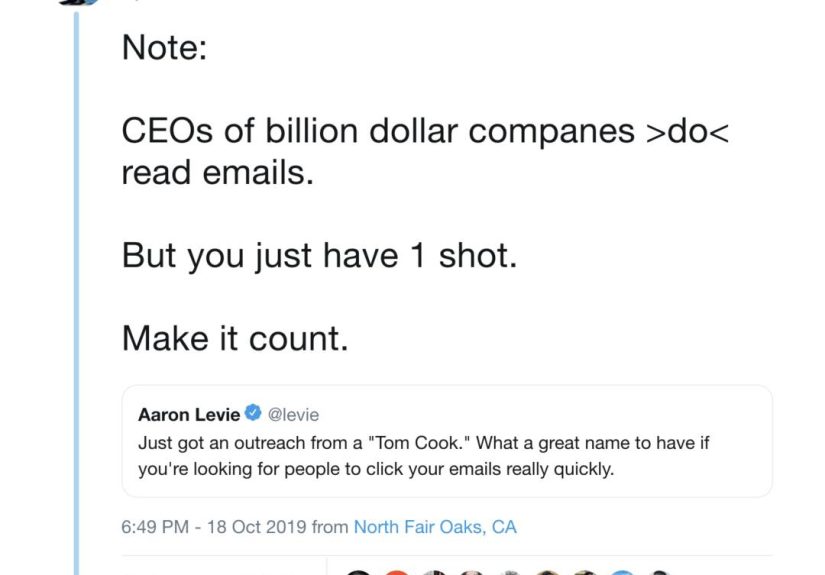
Apple CEO Tim Cook has said he receives hundreds of emails a day and reads the majority of them. That detail matters because it crushes the fantasy that public-company CEOs are sealed off from their inboxes. Cook’s approach suggests something important: even at enormous scale, some leaders still want unfiltered customer and external input.
That does not mean he is leisurely replying to everything before breakfast like some kind of caffeinated email monk. It means he sees value in staying close to the stream.
Jeff Bezos: The Inbox as a Customer Alarm System
Jeff Bezos made the executive-email myth even harder to sustain. He became famous for forwarding customer complaints to the relevant team with a single character: a question mark. That tiny symbol carried the emotional force of a thousand-slide deck.
The point was not literary elegance. The point was that the CEO was reading enough of the incoming customer signal to use email as a forcing function. At Amazon, email was not just communication. It was accountability with punctuation.
Jensen Huang: Brevity or Regret
Nvidia CEO Jensen Huang is known for favoring brutally concise emails. Reports from former employees describe messages that are short, direct, and allergic to fluff. That tells us two things. First, the CEO is reading email. Second, he expects people to earn that attention.
If you are wondering whether executives read emails, Huang’s example gives a useful answer: yes, but you had better get to the point before line seven.
Mark Cuban: Inbox Over Meetings
Mark Cuban has described processing hundreds of emails a day and preferring that to long, boring meetings. Whether or not that sounds like your personal heaven, it reinforces the same pattern. Many top operators do not see email as outdated. They see it as faster, more searchable, more flexible, and often less wasteful than another calendar ambush.
The SaaStr View: Even Very Busy Executives Still Read Their Own Email
The SaaStr perspective lands because it is grounded in what happens after acquisition and inside big operating environments. The answer there is refreshingly plain: top leaders often do read and answer their own email, even when they have assistants and large teams. That rings true because email remains one of the easiest ways for a CEO to stay close to real issues without waiting for a polished meeting memo.
The Catch: CEOs Should Not Manage by Inbox
Now for the inconvenient truth. Just because CEOs read email does not mean email is always good for them.
Research and executive commentary over the years have made the same point: email can become a dangerous time sink. It interrupts deep work, extends the workday, and drags leaders into operational weeds that should be handled elsewhere. A CEO who spends all day reacting to incoming messages can look busy while slowly becoming less strategic.
This is where the real distinction lives. Strong CEOs do not ignore email. They control the role email plays. They build rules. They delegate routing. They separate signal from spam. They use concise replies. They avoid turning every note into a committee meeting with punctuation.
So yes, the best leaders read email. But no, the best leaders do not let email run the company.
What Founders, Sales Teams, and Operators Should Learn From This
If you are trying to reach a CEO, this topic is not just trivia. It changes how you should write.
Write for triage, not admiration
The CEO does not need to be impressed by your vocabulary. They need to understand the issue fast. Your subject line and first sentence do most of the work.
Lead with value or urgency
Executives are more likely to read messages tied to customers, revenue, risk, hiring, or a specific opportunity. “Wanted to introduce myself” is weak. “Three enterprise customers are blocked by the same onboarding issue” gets attention.
Be concise without being cryptic
Short does not mean vague. A good CEO email is clear, concrete, and easy to route. Think less “just checking in” and more “here is the problem, here is the impact, here is the decision needed.”
Do not confuse access with entitlement
Yes, the CEO may read your email. No, that does not mean they owe you a custom essay in return. Sometimes the win is that they saw it, forwarded it, and triggered action.
Use email when the issue deserves durable context
Some matters belong in chat. Some need a meeting. But if the message involves accountability, history, an attachment, or a decision trail, email still has teeth.
So, Do CEOs of Big Companies Actually Read Their Own Email?
Yes. Many do. Often personally. Often selectively. Almost never romantically.
The better answer is this: big-company CEOs still read email because it gives them something they cannot fully outsourcesignal. The best ones use their inbox to stay close to customers, spot problems early, and keep the organization honest. The worst ones get trapped in reply-all purgatory and start managing by whatever dinged last.
If you are a founder, manager, or salesperson, the lesson is simple. Do not assume the CEO is unreachable. Also do not assume they are lounging around waiting for your masterpiece. Write better. Get to the point faster. Bring actual value. And remember that in a senior executive’s inbox, clarity beats charisma more often than people want to admit.
Or, put differently: yes, the CEO may read your email. That is the good news. The bad news is that your subject line now has to do cardio.
Experience Notes: What This Looks Like in the Real World
Across startups and large organizations, the lived experience around executive inboxes is surprisingly consistent. People imagine a fortress. What they usually find is a funnel.
A customer writes directly to the CEO after support fails to solve a serious issue. The CEO may not draft a heartfelt response personally, but the message gets seen, forwarded, and suddenly three directors are in a thread trying to understand why a paying customer had to escalate that far. To the customer, it feels like magic. Inside the company, it feels more like an alarm bell with Wi-Fi.
An employee sends a concise note about a recurring product bug, a broken internal process, or a manager problem that nobody wants to acknowledge. If the email is specific and credible, it has a decent chance of being read. Not because CEOs have endless spare time, but because good leaders know that organizations get filtered as they grow. Email becomes one of the last places where ugly truth can still slip through wearing plain clothes.
There is also the opposite experience: the terrible email that should never have been sent. Long introduction. No point until paragraph four. Vague request for “15 minutes to connect.” Zero evidence that the sender understands the company, the CEO, or the problem being solved. Those messages do not fail because CEOs are too important. They fail because nobody, at any level, enjoys reading a fog bank.
Then there is the internal executive experience. Many leaders read their own inbox not because they are obsessed with email, but because they are suspicious of sanitized information. In meetings, people summarize. In dashboards, people compress. In presentations, people edit until the edges disappear. Email often arrives with the edges intact. It still has confusion, urgency, customer language, and sometimes the emotional weather of the business. That can be unpleasant, but it is useful.
Another common experience is that assistants do not replace executive judgment; they protect it. A strong executive assistant can route scheduling clutter, surface priority items, and keep the CEO from spending half the day buried in nonsense. But when something involves customers, reputation, hiring, press, board matters, or a major decision, many CEOs still want eyes on it themselves. That is not control freak behavior. Usually, it is risk management.
And finally, there is the experience almost everyone underestimates: sometimes the CEO reads the email and does not reply, but action still happens. The sender assumes the note vanished into a black hole. Meanwhile, the message was forwarded, discussed, assigned, and turned into work. In executive communication, silence does not always mean invisibility. Sometimes it means the machine already started moving.
That is why the question matters. Not because executives are secretly living in Gmail all day, but because email remains one of the few channels where signal can travel from the edge of the company to the center with surprisingly little makeup on. Messy? Absolutely. Old-school? A little. Still powerful? More than most people think.
Conclusion
The modern CEO inbox is not a museum piece. It is still one of the most important leadership tools in business when used well. Big-company CEOs may have assistants, filters, summaries, and systems, but many still read enough of their own email to stay close to customers, catch risk early, and avoid becoming prisoners of polished reporting. The real takeaway is not whether they read email. It is why they still do.
If you are writing to a CEO, remember this: the inbox is crowded, but it is not closed. Relevance gets read. Specificity gets forwarded. Brevity gets rewarded. And fluff gets what fluff has always deserved: a quiet trip to the graveyard of unread messages.