Table of Contents >> Show >> Hide
- Why Resume Format Matters More Than Most People Think
- 1. Reverse-Chronological Resume
- 2. Functional Resume
- 3. Combination or Hybrid Resume
- 4. Targeted Resume
- 5. Federal Resume
- 6. Graphic or Infographic Resume
- 7. Mini Resume or Networking Resume
- How to Choose the Right Resume Type
- Resume Mistakes That Hurt Every Format
- Final Thoughts
- Experience-Based Lessons About Different Types of Resumes
- SEO Metadata
If resumes had a family reunion, things would get awkward fast. The reverse-chronological resume would show up early with a color-coded folder. The functional resume would arrive late, insist that “skills are what really matter,” and refuse to discuss employment gaps. The hybrid resume would try to keep everyone calm. And the graphic resume? It would sweep in wearing excellent shoes and a little too much confidence.
In real life, different types of resumes exist for one reason: not every job seeker has the same story. A recent graduate, a career changer, a federal applicant, and a senior designer should not all be using the exact same template and hoping for the best. The smartest move is choosing the resume format that highlights your strengths, minimizes distractions, and matches how employers actually review applications.
In this guide, you’ll learn the main resume types, when to use each one, when to avoid it, and what each format looks like in practice. You’ll also see examples, common mistakes, and practical advice for choosing the best resume format for your job search without turning your document into a chaotic scrapbook of bullet points and false optimism.
Why Resume Format Matters More Than Most People Think
A resume is not just a list of jobs. It is a marketing document, a first impression, and sometimes your only chance to persuade a recruiter to keep reading. That means structure matters. The order of your sections, the way you present experience, and the balance between skills and work history all affect how quickly someone understands your value.
Resume format also matters because many employers use applicant tracking systems, or ATS, to scan resumes before a human sees them. So while a rainbow pie chart showing your “communication energy” may be emotionally bold, it is not always technologically wise. In many industries, a clean and readable layout beats visual drama every time.
1. Reverse-Chronological Resume
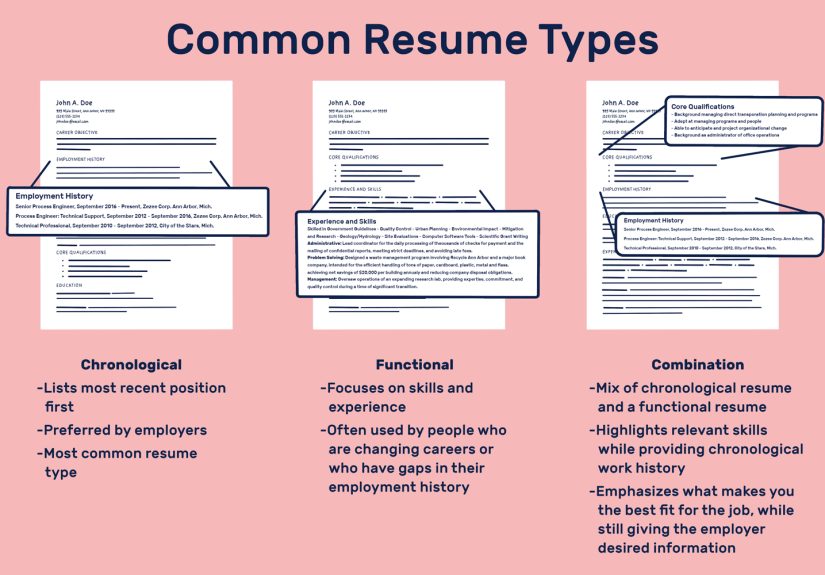
The reverse-chronological resume is the most common type of resume and, for many job seekers, the safest choice. It lists your most recent experience first and works backward from there. Employers like it because it makes your career path easy to follow, and recruiters can quickly see your latest job title, responsibilities, and growth.
Best for
Use this format if you have a solid work history, steady career progression, or recent experience that directly matches the role you want. It is especially strong for traditional industries like business, healthcare, education, operations, and marketing.
Not ideal for
This format can be less helpful if you have major employment gaps, very little experience, or a dramatic career change that makes your old job titles look unrelated to your target role.
Example
Why it works: This format puts recent, relevant experience front and center. If your career tells a logical story, let it talk.
2. Functional Resume
A functional resume focuses on skills instead of a detailed work timeline. Instead of leading with job titles, it groups experience under categories such as project management, customer service, sales, data analysis, or technical skills.
This can be useful for people whose strongest qualification is what they can do rather than where they did it. That includes career changers, people re-entering the workforce, freelancers with mixed projects, and candidates with unconventional backgrounds.
Best for
Choose a functional resume if you want to spotlight transferable skills, downplay unrelated job titles, or frame your experience around ability rather than chronology.
Not ideal for
Some recruiters are suspicious of pure functional resumes because they can hide dates, gaps, or weak work history. They can also be harder for ATS software to interpret if the document is too creative or if work history is barely included.
Example
Why it works: This layout lets skills lead the conversation. Just make sure your work history still appears somewhere, so the resume does not feel like it entered witness protection.
3. Combination or Hybrid Resume
The combination resume, also called a hybrid resume, blends the best parts of the reverse-chronological and functional formats. It begins with a strong skills or qualifications section, then follows with a traditional work history section.
For many candidates, this is the sweet spot. You get to highlight your strongest abilities first while still giving employers the timeline they expect. That is why a hybrid resume often works well for mid-career professionals, career changers with relevant transferable skills, and applicants with a strong skill set plus a decent employment history.
Best for
Use a hybrid resume when you want to emphasize skills without hiding your experience. It is a smart option for professionals moving into leadership, pivoting industries, or applying for roles where both technical skills and work history matter.
Example
Why it works: A hybrid resume gives employers the “what you can do” and the “where you did it” without forcing them to choose.
4. Targeted Resume
A targeted resume is not a completely separate design so much as a strategy. It is a customized resume built for one specific job. You revise your summary, skills, keywords, and bullet points so the document closely matches the position description.
This is one of the most effective approaches in modern job searching. Instead of sending one generic resume to 50 openings and praying to the hiring gods, you tailor your content to reflect the employer’s needs.
Best for
Everyone, honestly. If you are serious about a role, a targeted resume usually performs better than a generic one.
Example
Imagine you are applying for a project coordinator role. Your general resume says:
Your targeted resume says:
Same basic idea. Much better fit. Less vague. More keyword-rich. More likely to survive ATS screening and impress a recruiter.
5. Federal Resume
A federal resume is its own creature. It is not simply a corporate resume wearing a government tie. Federal job applications often require more detailed information, stricter formatting, and closer alignment with the language in the vacancy announcement.
For federal roles, applicants may need to include detailed work descriptions, hours worked per week, employer information, specialized skills, and specific qualifications tied to the posting. In other words, this is not the time for minimalist poetry.
Best for
Use a federal resume when applying through USAJOBS or for other federal government roles. Follow the announcement carefully, because federal resume expectations are different from private-sector resumes.
Example
Important note: Federal resumes must follow current agency guidance. Always read the job announcement and use official tools when recommended.
6. Graphic or Infographic Resume
A graphic resume uses visual design elements such as icons, color blocks, charts, or custom layouts. In the right context, it can help a candidate showcase design sensibility and personal branding. In the wrong context, it can look like a brunch menu.
This style is most appropriate for design-heavy or brand-conscious fields such as graphic design, art direction, marketing design, or some media roles. Even then, many candidates pair a graphic resume with a plain-text ATS-friendly version.
Best for
Creative professionals who are also submitting a portfolio and understand the expectations of the industry.
Not ideal for
Most corporate, healthcare, legal, education, finance, or government roles. Also risky for online applications if the design interferes with ATS readability.
Example
A graphic designer might use a two-column layout with a portfolio link, software skills, selected campaigns, and brand systems experience. A financial analyst should probably not.
7. Mini Resume or Networking Resume
A mini resume is a short version of your resume, usually a brief summary of qualifications rather than a full document. Think of it as the espresso shot of professional branding: small, concentrated, and surprisingly powerful when used correctly.
Mini resumes are handy at networking events, career fairs, speaking engagements, and introductions where a full one- or two-page resume would be too much. They are not usually a replacement for a formal application resume, but they can open doors.
Best for
Networking, quick introductions, career fairs, and personal branding handouts.
Example
Why it works: It gives people a fast snapshot of your value. Think business card, but with ambition.
How to Choose the Right Resume Type
If you are stuck, use this rule of thumb:
- Choose reverse-chronological if your experience is solid, recent, and relevant.
- Choose functional if your skills matter more than your timeline and you need to soften gaps or unrelated roles.
- Choose hybrid if you want flexibility and a balance between skills and work history.
- Choose targeted if you are applying seriously to a specific opening and want the best match.
- Choose federal if the role is in the federal government and requires a specialized application format.
- Choose graphic only if design is part of the job and you also have an ATS-friendly version.
- Choose a mini resume for networking, not as your primary job application document.
If you still cannot decide, start with a reverse-chronological or hybrid resume. Those two formats cover most professional situations without causing recruiters to squint suspiciously.
Resume Mistakes That Hurt Every Format
Even the best resume type can fail if the execution is sloppy. Here are mistakes that weaken almost every format:
- Using vague phrases like “responsible for” instead of action-driven accomplishments
- Failing to tailor keywords to the job description
- Hiding important information in text boxes, graphics, or headers
- Writing paragraphs that look like tiny walls of despair
- Listing duties instead of results
- Forgetting metrics, examples, or evidence of impact
- Choosing style over readability
A strong resume should be clear, concise, relevant, and easy to scan. If it looks beautiful but says very little, that is not branding. That is decoration.
Final Thoughts
The best resume is not the fanciest one or the one with the trendiest template. It is the one that makes your value obvious, quickly. Different types of resumes exist because careers are messy, nonlinear, and wonderfully inconvenient. Your format should help employers understand your story, not make them solve a puzzle.
For most people, the reverse-chronological or hybrid resume will be the strongest option. Functional resumes can work in the right situation. Targeted resumes are almost always worth the effort. Federal resumes follow their own rules. Graphic resumes belong in specific creative settings. And mini resumes are excellent sidekicks for networking.
So choose the format that fits your goals, tailor it to the job, keep it readable, and make your accomplishments impossible to miss. That way, your resume can do what it is supposed to do: earn attention, not sympathy.
Experience-Based Lessons About Different Types of Resumes
One of the most useful truths about resumes is that people usually figure out the “right” format only after using the wrong one first. A recent graduate may send out a reverse-chronological resume that looks thin because there is not much formal work history yet. Then, after a few quiet weeks and one deeply humbling afternoon of self-reflection, that same person realizes a hybrid resume works better because it lets internships, projects, software tools, and leadership roles show up before the sparse job history.
Career changers often learn a similar lesson. Someone moving from teaching into corporate training, or from retail into customer success, may begin with a traditional work-history-first resume and wonder why employers are not calling. The problem is not always lack of ability. It is often presentation. Once they shift to a combination format and lead with transferable strengths like training, communication, onboarding, documentation, coaching, or conflict resolution, the story suddenly makes sense to hiring managers.
There is also a common experience among professionals who try to make their resume “stand out” with too much design. They add icons, charts, sidebars, fancy fonts, and enough visual flair to make the document look like it should be framed. Then the interviews do not come. Later, they rebuild the same content into a clean ATS-friendly layout with standard headings and measurable achievements, and the response improves. Painful? Yes. Educational? Also yes.
Another experience many job seekers report is that writing a targeted resume feels annoying at first and effective soon after. It takes extra effort to revise the summary, edit the skills section, and align bullet points to the job description. But once candidates start doing it consistently, they often notice a better match between the jobs they apply for and the interviews they receive. The resume stops sounding generic and starts sounding hired-adjacent.
Even seasoned professionals learn that resume type is not a permanent identity. The format that worked five years ago may not be the one that works now. A rising manager may outgrow a basic chronological layout and benefit from a hybrid format that highlights leadership, strategic planning, and cross-functional wins. A designer may keep both a polished visual resume and a simpler version for online applications. A federal applicant may need a completely separate document from the one used in the private sector.
The big lesson is simple: resume writing is not about loyalty to a template. It is about choosing the format that makes your strengths easiest to understand. The more honestly you match the resume type to your real career story, the more persuasive the document becomes.