Table of Contents >> Show >> Hide
Some dinners try way too hard. This one? It shows up wearing a crisp white shirt, makes you laugh, and somehow
smells like you have your life together. Dijon pork chops with apple salad is that kind of meal:
juicy, savory chops with a tangy mustard edge, plus a bright, crunchy salad that tastes like fall decided to be
charming instead of chaotic.
You’ll get the best of all worlds in one plate: golden-browned pork (the “main character”), a quick Dijon pan sauce
(the “supportive best friend”), and a snappy apple salad (the “I drink water and have hobbies” vibe). It’s weeknight
friendly, dinner-party worthy, andbonusdoesn’t require a culinary degree or a pep talk.
Why Dijon + Pork + Apples Works (a Love Story in Three Ingredients)
Pork chops are naturally mild, which is basically them saying, “Please give me a flavor buddy.” Dijon mustard is
that buddy: sharp, tangy, and built to cling. Apples add sweet-tart crunch that wakes everything up, while vinegar
in the salad dressing cuts through richness so your fork keeps going back for “one more bite” (famous last words).
The magic is contrast: warm vs. cold, savory vs. crisp, creamy sauce vs. crunchy salad. It’s the culinary version of
wearing a leather jacket over a soft sweaterbalanced, confident, and suspiciously photogenic.
Ingredients That Actually Matter
Pork chops: thickness is your insurance policy
Choose chops about 1 inch thick if you can. Thin chops cook fast, surebut they also overcook fast.
Bone-in tends to stay juicier and adds flavor, while boneless is easier to slice and serve. Either works; just adjust
cooking time and use a thermometer.
Dijon mustard: the blazer of condiments
Dijon brings tang and depth without screaming for attention. Pairing it with a little whole-grain mustard adds texture
and mild heat. A touch of honey smooths the edges so the sauce tastes rounded, not like it’s trying to win a debate.
The apple salad crew: crisp, bright, and a little fancy
You want apples that stay crunchy: Fuji, Honeycrisp, Gala, or similar. Add peppery greens like arugula
(or watercress), plus celery and radish for snap. Toasted pecans bring richness; blue cheese adds a salty, creamy bite
that makes the salad feel like it has a tiny tuxedo on.
Recipe: Dijon Pork Chops with Apple Salad
Serves: 4 | Prep: ~20 minutes | Cook: ~20 minutes
Ingredients
- For the pork chops
- 4 pork chops, about 1 inch thick (bone-in or boneless)
- 1 teaspoon kosher salt (plus more to taste)
- 1/2 teaspoon black pepper
- 1 teaspoon chopped fresh thyme (or 1/2 teaspoon dried)
- 1 tablespoon neutral oil (avocado, canola, grapeseed)
- 1 tablespoon butter (optional, for extra gloss)
- 2 tablespoons Dijon mustard
- 1 tablespoon whole-grain mustard
- 1 to 2 teaspoons honey
- 1/2 cup chicken stock (or apple cider for a sweeter note)
- 1 to 2 tablespoons apple cider vinegar (for brightness)
- 2 tablespoons cream or crème fraîche (optional, for creamy Dijon sauce)
- For the apple salad
- 3 packed cups arugula or watercress
- 1 crisp apple (Fuji/Honeycrisp/Gala), thinly sliced
- 1 cup thinly sliced celery
- 1/2 cup thinly sliced radishes
- 1/2 cup toasted pecans, roughly chopped
- 1/4 cup crumbled blue cheese (optional but highly persuasive)
- 3 tablespoons olive oil
- 3 tablespoons apple cider vinegar
- 1 tablespoon honey
- Salt and pepper to taste
- Optional: squeeze of lemon (helps apples stay bright)
Step-by-step directions
1) Season the chops like you mean it
Pat chops dry (dry surface = better browning). Season both sides with salt, pepper, and thyme. If you have
10 minutes, let them sit at room temp while you prep the saladless chill means more even cooking.
2) Make the Dijon glaze (quick and bossy)
In a small bowl, stir together Dijon mustard, whole-grain mustard, and honey. Set aside. This is your flavor
“paint,” and yes, you will be artistically brushing meat. You contain multitudes.
3) Sear for color, then finish gently
Heat a large skillet (cast iron is great) over medium-high heat. Add oil. When it shimmers, lay in the chops and
sear until deeply browned, about 2–4 minutes per side depending on thickness. Don’t shuffle them aroundlet the pan
do its job.
Lower heat to medium. Brush the tops with some Dijon glaze, flip, brush the second side, and cook until the thickest
part reaches 145°F, then rest the chops for 3 minutes. (A thermometer is the only kitchen tool
that prevents both dry pork and emotional damage.)
4) Build a fast pan sauce (aka “the skillet encore”)
Move the chops to a plate and tent loosely with foil. Keep the skillet on medium heat. Pour in chicken stock (or apple
cider) and scrape up the browned bitsthose are flavor confetti. Simmer 1–2 minutes.
Whisk in a spoonful of the Dijon glaze plus 1–2 tablespoons cider vinegar. For a creamy Dijon sauce, whisk in cream or
crème fraîche and simmer briefly until glossy. Taste and adjust: more mustard for bite, more honey for warmth, more
vinegar for zing.
5) Toss the apple salad right before serving
In a large bowl, whisk olive oil, cider vinegar, honey, salt, and pepper. Add arugula, apple slices, celery, and radish.
Toss quickly. Fold in pecans and blue cheese last so they don’t get bullied by the greens. If you’re prepping ahead,
wait to dress until the last minute.
6) Plate like a pro (without acting like one)
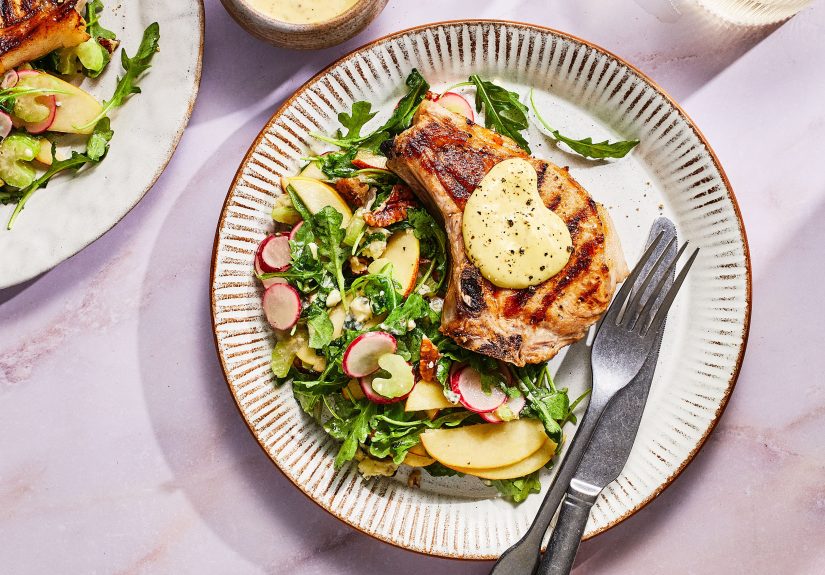
Spoon Dijon pan sauce onto plates, set pork chops on top, and pile apple salad alongside. The warm-cool contrast is the point.
Serve immediately while the salad is snappy and the pork is still living its best juicy life.
Tips for Juicy, Not-Sad Pork Chops
- Use a thermometer. Pork chops are lean and go from “perfect” to “why is it so chewy?” fast.
- Don’t skip the rest. Resting lets juices redistribute so they stay in the meat instead of fleeing onto your plate.
- Go thicker when possible. A 1-inch chop is forgiving; a thin chop is basically a timed exam.
- Dry surface = better sear. Pat dry before seasoning so you get browning instead of steaming.
- Fond is flavor. Those browned bits in the pan are the backbone of your Dijon saucescrape them up with pride.
Variations and Smart Swaps
Make it dairy-free
Skip the cream and blue cheese. The Dijon pan sauce can still be silky with a little extra butter (or olive oil) and
a splash of stock. Add sliced avocado to the salad for richness if you want.
Go grilled
Grill the chops and brush with Dijon glaze near the end so it doesn’t burn. Serve with the apple salad and a quick
mustard vinaigrette as your “sauce” situation.
Change the salad personality
- More crunch: add shaved fennel or cabbage.
- More sweet: toss in dried cranberries or thin pear slices.
- More savory: swap pecans for toasted walnuts or add crispy bacon (because of course).
- Different cheese: feta for tang, goat cheese for creamy drama, or none at all.
Turn it into a meal-prep hero
Cook extra chops, slice cold, and pack with undressed salad components. Bring dressing in a small container so your
greens don’t turn into a soggy apology by lunchtime.
What to Serve with Dijon Pork Chops and Apple Salad
The salad is bright, so pairing it with something cozy is ideal:
- Roasted potatoes or sweet potatoes (the sauce will find them)
- Wild rice or herbed brown rice
- Buttery mashed potatoes (classic for a reason)
- Simple roasted Brussels sprouts or green beans
- Crusty bread to mop up Dijon pan sauce (zero shame)
Storage and Make-Ahead Notes
Store leftover pork chops in an airtight container for up to 3–4 days. Reheat gentlylow heat in a skillet with a
splash of stock is kinder than blasting them in the microwave. Keep salad components separate and dress right before
serving. Apples can be sliced ahead if tossed with a little lemon juice.
Conclusion
Dijon pork chops with apple salad hits that rare sweet spot: it feels special, tastes balanced, and still fits into
real-life schedules. The mustard gives the pork a confident, savory punch; the apple salad brings brightness and crunch;
and together they make a dinner that reads “effort” without requiring you to cancel your entire evening.
If you take only one thing from this recipe, let it be this: cook by temperature, not by vibes. Everything elsemustard
intensity, apple variety, cheese choicescan be customized to your exact level of enthusiasm and/or pantry reality.
Real-Kitchen Experiences (the extra you’ll relate to)
The first time most people make this, one of two things happens: either the salad steals the show, or the sauce does.
That’s not a problemit’s a feature. On some nights, you’ll crave the crisp snap of apples and celery like you’re a
woodland creature with excellent taste. On other nights, you’ll look at that Dijon pan sauce and think, “I should
probably bottle this and sell it to fund my future vacation.”
A very normal moment: you slice the apple, turn around for one second, and half the slices mysteriously “disappear.”
That’s called “chef tax,” and it’s legally binding in most households. If you want the salad to look extra pretty,
slice the apple thin and fan it out on top like you’re styling a magazine shoot. If you want it to be extra practical,
chop it into matchsticks and move on with your life. Both versions taste great; only one version requires tweezers.
Another real-life note: arugula is dramatic. It wilts if you dress it too early, it clings to the bowl like it pays rent,
and it absolutely will end up on your sleeve if you’re wearing something black. If you’re serving guests, toss the salad
at the last second and keep the dressing separate until you’re ready. If it’s just you (or you and someone you trust),
toss whenever, eat whenever, and call it “rustic.”
Pork chop doneness is where kitchens get emotional. Someone inevitably says, “Is it done?” while staring at the meat like
it owes them money. This is why the thermometer is the MVP. When you pull at 145°F and rest, you get pork that’s juicy,
tender, and maybe faintly pinktotally fine. If you grew up with pork cooked into a different geological era, this can
feel surprising at first, but it’s the difference between “I need water” and “Wow, that’s actually tender.”
The sauce is also a great place to practice “taste and adjust” without fear. Too sharp? Add a whisper more honey.
Too sweet? Add a splash of vinegar. Too thick? Loosen with stock. Too thin? Simmer for a minute. Worst case, you still
have flavorful pork and a crunchy salad. Best case, you’ve accidentally made a sauce worth dragging bread through in a
way that would impress your ancestors.
Finally: this meal has range. It works for a Tuesday when you’re tired, and it works for a Saturday when you want dinner
to feel a little elevated. If you ever need a “looks fancy, cooks easy” recipe in your back pocket, this is the one.
Just don’t be surprised if people start requesting itbecause once Dijon, pork, and apples meet, they don’t really like
being separated again.