Table of Contents >> Show >> Hide
- Why Drawing Can Help Anxiety (Even If You “Can’t Draw”)
- Drawing vs. Art Therapy: What’s the Difference?
- Quick Start: A 3-Minute Setup That Makes Drawing Feel Easier
- Easy Drawing Exercises for Anxiety (2–10 Minutes)
- Exercise 1: The 60-Second Scribble + Breath Reset
- Exercise 2: Continuous-Line Drawing (No Lifting Allowed)
- Exercise 3: Blind Contour (The Anxiety Humility Workout)
- Exercise 4: Zentangle-Inspired Pattern Tiles
- Exercise 5: Mandala Lite (No Geometry Degree Required)
- Exercise 6: “Name the Worry” Creature Sketch
- Exercise 7: The 5-4-3-2-1 Sketch (Grounding in Pictures)
- Exercise 8: Emotion Weather Report
- Make Drawing a Habit (Without Turning It Into Homework)
- Troubleshooting: If Anxiety Turns Drawing Into a Performance Review
- When to Get Extra Support
- Real-World Experiences (Extra): What Drawing for Anxiety Often Feels Like
- Final Thoughts
Anxiety is basically your brain’s overachieving intern: it means well, but it keeps slapping “URGENT” stickers on everythingemails, texts, the future, that one awkward thing you said in 2019. Drawing can’t magically delete stressors, but it can give your nervous system a calmer task to do right now. And the best part? You don’t need talent. You just need a pen, a surface, and permission to make imperfect marks like a normal human.
This guide breaks down why drawing for anxiety works, how it’s different from formal art therapy, and a bunch of easy, low-pressure exercises you can use in 2–10 minutes. Think of it as a “reset button” you can keep in your backpack, desk drawer, or phone case (okay, maybe not literally in your phone caseink is messy).
Why Drawing Can Help Anxiety (Even If You “Can’t Draw”)
When you’re anxious, your body often acts like it’s preparing for a dramatic chase scenefaster heart rate, tense muscles, racing thoughts, shallow breathing. Drawing is one of those deceptively simple anxiety coping skills that can interrupt that loop, because it’s physical, focused, and sensory.
1) It slows your body’s stress rhythm
Making art has been linked with stress reduction in research settingsincluding studies where people showed lower levels of cortisol (a hormone commonly associated with stress) after a short art-making session. That doesn’t mean doodling is a cure, but it supports a useful idea: creative activity can nudge your body toward “safer” mode.
2) It anchors attention in the present moment
Anxiety loves time travel: it drags you into “what if” futures and “should’ve” pasts. Drawing is naturally present-focused. Your attention shifts to line, pressure, texture, shape, repetition. This is similar to mindfulness in a practical, non-ceremonial wayno incense required, no special sitting posture, no pretending you don’t have homework or a job.
3) It turns blurry feelings into something you can see
Sometimes you can’t name what you feelyour body just says “nope.” Drawing externalizes emotion. You can sketch a tight coil, a thundercloud, a jagged scribble ball, or a tiny anxious gremlin wearing a tie. Once a feeling is on paper, it often becomes less overwhelming because it’s no longer everywhere at once.
4) It gives you small, real control (which anxiety usually steals)
Anxiety can make you feel powerless. Drawing is a micro-choice machine: choose a shape, repeat a pattern, shade a corner, add a border. Tiny choices add up to a clear outcome. That sense of “I did a thing” mattersespecially on days when your brain is trying to convince you that you can’t do anything at all.
Drawing vs. Art Therapy: What’s the Difference?
Let’s clear up a common mix-up: drawing for anxiety (self-guided) and art therapy (with a trained professional) overlap, but they’re not identical.
Art therapy is a mental health service
Art therapy is typically guided by a credentialed art therapist who uses creative processes to support mental health goalslike managing anxiety symptoms, processing emotions, building coping tools, or improving self-esteem. It can be especially helpful if anxiety is tied to trauma, chronic illness, major life transitions, or intense emotional shutdown.
Self-guided drawing is a coping tool you can use anytime
When you draw on your own, you’re not “doing therapy wrong.” You’re using a proven-friendly concept: focused creative activity can support emotional regulation and stress relief. If you want, you can combine it with other grounding techniqueslike slow breathing, body scans, or a quick walk. If not, you can just draw a potato with legs and call it self-care. (That’s still valid.)
Quick Start: A 3-Minute Setup That Makes Drawing Feel Easier
If you want drawing to help anxiety, the goal is not to produce a masterpiece. The goal is to shift your state. Try this three-minute setup:
- Pick your tool: pencil, pen, marker, highlighter, crayonwhatever feels easiest. Bonus points for anything that glides smoothly.
- Pick your surface: notebook, scrap paper, index card, digital tablet. Smaller is often better because it feels less “serious.”
- Set a tiny timer: 2–5 minutes. Anxiety is more willing to cooperate when it knows there’s an exit.
- Decide your rule: “No erasing.” Or “Only circles.” Or “I’m allowed to make ugly art.” Simple rules reduce decision overload.
Now you’re ready for the fun part: drawing like a person, not a printer.
Easy Drawing Exercises for Anxiety (2–10 Minutes)
These exercises are designed for stress relief, grounding, and calming anxious thoughts. Pick one. Don’t overthink it. Overthinking is literally what we’re trying to take a break from.
Exercise 1: The 60-Second Scribble + Breath Reset
Time: 1–2 minutes
- Put your pen on the paper and scribble without lifting it for 30–60 seconds.
- Match the scribble to your breath: inhale as the line travels outward, exhale as it loops back.
- Slow the line down for the last 10 seconds.
Why it helps: It’s repetitive, physical, and attention-grabbingperfect for interrupting rumination.
Exercise 2: Continuous-Line Drawing (No Lifting Allowed)
Time: 3–5 minutes
- Choose a simple object near you (mug, shoe, plant, your hand).
- Draw it without lifting your pen. One unbroken line the whole time.
- If you “mess up,” keep going. The rule is the point.
Why it helps: It forces your brain into the present. Also, perfectionism gets gently roasted by the rules (as it should).
Exercise 3: Blind Contour (The Anxiety Humility Workout)
Time: 5 minutes
- Look at your object. Don’t look at the paper.
- Slowly trace the edges with your eyes while your hand draws what you see.
- When you’re done, look down and laugh kindly. Blind contour drawings are almost always chaotic. That’s the charm.
Why it helps: It’s impossible to judge in real time, which turns down self-criticism and turns up curiosity.
Exercise 4: Zentangle-Inspired Pattern Tiles
Time: 5–10 minutes
- Draw a square or rectangle (a “tile”).
- Divide it into 3–6 sections with wavy or straight lines.
- Fill each section with a simple repeating pattern: dots, stripes, loops, scales, checkerboard, spirals.
Why it helps: Repetition is soothing. Patterns are predictable. Anxiety hates predictability because it can’t catastrophize a spiral as easily.
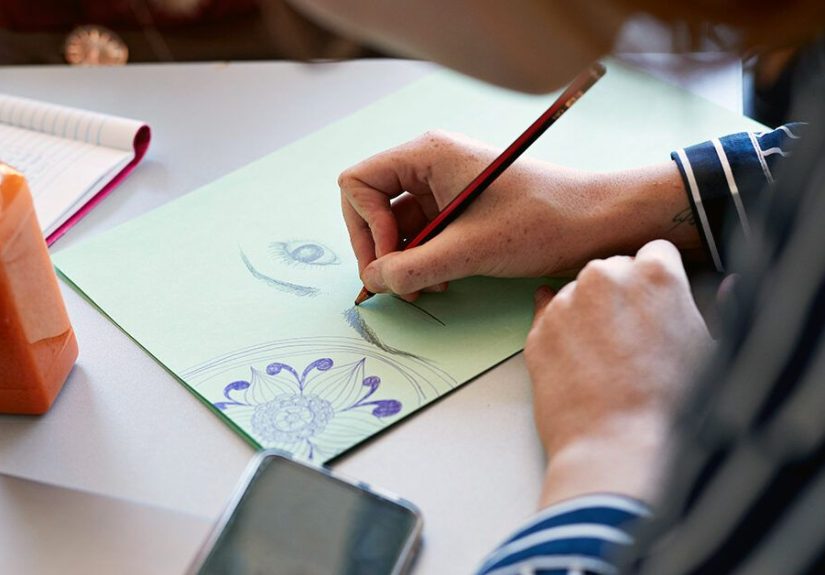
Exercise 5: Mandala Lite (No Geometry Degree Required)
Time: 5–10 minutes
- Trace a circle (cup rim, tape roll, or freehand “circle-ish” is fine).
- Draw a smaller circle inside it.
- Add simple shapes around the center: petals, triangles, scallops, rays, little moons.
- Shade or color one ring at a time.
Why it helps: Circular, symmetrical designs encourage focus and can feel meditative, similar to mindful coloring.
Exercise 6: “Name the Worry” Creature Sketch
Time: 5 minutes
- Draw your anxiety as a creature. Give it a body shape that matches the feeling (spiky? squishy? tiny but loud?).
- Label what it says (short phrases only): “What if I fail?” “They’ll judge me.” “Something bad will happen.”
- On the other side of the page, draw your “wise helper” (could be a calm version of you, a dog in a sweater, a superhero grandma).
- Write a calmer response next to the helper: “I can handle steps.” “I’ve done hard things before.”
Why it helps: Externalizing anxious thoughts creates distance, making it easier to challenge them or respond with compassion.
Exercise 7: The 5-4-3-2-1 Sketch (Grounding in Pictures)
Time: 5 minutes
- Draw 5 quick icons of things you can see.
- Draw 4 icons of things you can feel (hoodie fabric, chair, phone, floor).
- Draw 3 icons of things you can hear.
- Draw 2 icons of things you can smell.
- Draw 1 icon of something you can taste (or want to tastemint gum counts).
Why it helps: Grounding techniques pull attention from panic loops back into the body and environment.
Exercise 8: Emotion Weather Report
Time: 3–7 minutes
- Draw a simple weather scene that matches your mood: drizzle, wind, thick fog, sunny breaks, lightning.
- Add a “forecast” in one sentence: “Stormy now, clearing later.”
- Optional: draw a tiny umbrella labeled “coping skills” and add 2–3 tools you can use today (walk, music, talking to someone, snack + water).
Why it helps: It frames feelings as temporary conditions, not permanent truths.
Make Drawing a Habit (Without Turning It Into Homework)
Consistency matters more than intensity. You don’t need an hour. You need a repeatable ritual.
- Use “micro-sessions”: 2 minutes before school/work, 3 minutes after a stressful message, 5 minutes before bed.
- Track the before/after: Write a quick rating: “Anxiety 7/10 → 5/10.” Over time, you’ll notice patterns.
- Keep an “easy kit”: One pen + small notebook. If setup is annoying, your brain will bail.
- Pair it with a cue: After brushing teeth, right after lunch, or whenever you sit down at your desk.
- Lower the stakes: Use scrap paper. The more “precious” the sketchbook, the louder perfectionism gets.
Troubleshooting: If Anxiety Turns Drawing Into a Performance Review
If you start thinking, “This looks terrible,” congratulationsyou have a human brain. Try these fixes:
- Switch to patterns: Dots, stripes, grids, spirals. Patterns are calming and harder to “fail.”
- Use constraints: Only circles. Only squares. One line. One minute. Constraints reduce decision fatigue.
- Change materials: A marker feels different than a pencil. A gel pen glides. Sensory novelty can help.
- Make it intentionally silly: Draw the worst drawing on purpose. Anxiety hates it when you stop taking its drama seriously.
When to Get Extra Support
Drawing is a helpful tool, but it’s not a substitute for professional careespecially if anxiety is frequent, intense, or interfering with daily life (sleep, school, friendships, work, appetite, or concentration). If your anxiety is “running the show,” consider talking to a trusted adult, a healthcare provider, or a mental health professional. A therapist can help you build a full plan (think: coping skills, thought tools, and support systems), and an art therapist can combine creative work with clinical guidance.
Gentle reminder: Getting help isn’t “failing.” It’s upgrading your support teamlike adding a coach when you’ve been trying to play every position alone.
Real-World Experiences (Extra): What Drawing for Anxiety Often Feels Like
People describe drawing for anxiety in ways that sound surprisingly similar, even when their lives look totally different. The common theme isn’t “I became an artist.” It’s “my brain got quieter for a minute, and that mattered.” Here are some relatable, real-life-style experiences that capture what many people report (without pretending one method works the same for everyone):
1) The student brain spiral. You sit down to study and your mind starts running a highlight reel of everything that could go wrong: the test, the grade, the future, the universe. A two-minute scribble feels almost too simplelike trying to stop a hurricane with a Post-it note. But once the pen starts moving, something shifts. Your attention has a job: follow the line, breathe, fill a corner with loops. After a few minutes, the panic isn’t magically gone, but it’s no longer at a full-volume 10. It’s more like a 6, and you can think in complete sentences again. That’s a win.
2) The “I can’t shut off my thoughts” evening. At night, anxiety loves to schedule a meeting. The agenda: “Let’s review every conversation you had today.” Drawing patternslittle tiles of stripes, dots, and scallopscan feel like giving that restless energy a lane to run in. The repetition becomes soothing, almost like counting breaths, except you’re producing something visible. Some people notice their shoulders drop while they shade. Others find they sleep a bit better because their mind got a transition ritual instead of a sudden “Okay, sleep now” command (which anxiety absolutely ignores).
3) The overwhelmed caregiver or busy-parent moment. When you’re responsible for other people, your nervous system can stay on high alert. A quick “emotion weather report” helps because it doesn’t demand a perfect explanationjust an honest picture. You draw fog with a small break of sunlight, then write: “Heavy today, but not hopeless.” That one sentence can be grounding. It’s not therapy in a full clinical sense, but it’s emotional clarity. And clarity makes coping easier.
4) The perfectionism trap (and the weird freedom of ‘bad’ art). Some people start drawing for stress relief and immediately feel worse because the inner critic shows up like a cranky art teacher. The solution that often helps most is counterintuitive: make “bad art” on purpose. Use one line. Draw with your non-dominant hand. Do blind contour. When the result looks hilariously unpolished, the pressure collapses. A lot of folks describe this as unexpectedly freeinglike their nervous system finally got permission to stop performing and just exist.
5) The “I didn’t know what I was feeling” breakthrough. Anxiety can be vague: dread without a clear reason. Drawing can give that dread a shape. Maybe it becomes a tight knot. Maybe it becomes jagged lightning. Once it’s on paper, you can do a second step: add what you need. Draw space around the knot. Add a calming border. Shade gently instead of aggressively. The act of changing the drawing can mirror emotional regulationsmall, kind adjustments instead of fighting yourself.
In short: drawing doesn’t have to be deep, symbolic, or Instagram-worthy to be effective. The most useful “art” for anxiety is the kind you actually domessy, quick, private, and repeatable. If it helps you return to your day with even 5% more steadiness, it’s doing its job.
Final Thoughts
Drawing for anxiety is a practical, low-cost way to calm your body, focus your mind, and express what’s hard to say out loud. Keep it simple. Keep it small. And remember: the goal isn’t to create impressive artit’s to create a calmer moment. If you want, those calmer moments can add up.