Table of Contents >> Show >> Hide
- What Is the Documentary, and Why Is Everyone Talking About It?
- Meet the Unexpected Narrator: The Ex-Husband as the Audience’s “Moral Thermometer”
- What He Said (and Why It Hit Like a Plot Twist)
- The Business Reality Behind the Shock Headlines
- Documentary Ethics: When “Access” Is Also a Responsibility
- The Backlash, the Debate, and the Bigger Cultural Fight
- So… Is the Quote Supportive, Ironic, or Something Else?
- Quick FAQs (Because Google Loves a Straight Answer)
- Conclusion: The Internet Wants a Villain, but the Documentary Offers a Mirror
- +: Experiences People Share When a Partner’s Career Becomes a Public Spectacle
There are two kinds of documentary cameos: the ones that quietly fill in the timeline, and the ones that make the internet clutch its pearls so hard it invents new fingerprints. The ex-husband interview in 1000 Men and Me: The Bonnie Blue Story lands squarely in camp two—because it doesn’t come with the expected soundtrack of judgment, regret, or a dramatic door slam. It comes with something closer to professional admiration.
And that’s where the headline-friendly quote comes in. “He must be well proud” is a very British way of saying: the person who supposedly has the most reason to be upset is… not doing that. Instead, he talks about strategy, audience, and why her approach is different. Whether you read that as supportive, complicated, transactional, or all of the above depends on what you bring into the room when you hit play.
This piece unpacks what’s actually being said, why people care so much, and what this says about modern fame—especially when a relationship becomes part of the brand. (We’ll keep it non-graphic and focused on media, business, and culture.)
What Is the Documentary, and Why Is Everyone Talking About It?
1000 Men and Me: The Bonnie Blue Story is a Channel 4 documentary centered on Bonnie Blue (reported as the stage name of Tia Billinger), a controversial adult content creator whose career is built on attention, shock value, and a direct-to-fan business model. The film frames a big question that’s basically the entire internet in one sentence: is this empowerment, exploitation, or a messy mix that doesn’t fit neat labels?
Documentaries like this don’t just show what happened—they show what a culture does with what happened. They capture the opinions people already have, then crank up the volume by putting them next to a human face. In this case, the documentary reportedly includes family perspectives and behind-the-scenes access that turns Bonnie Blue from a headline into a character you can’t scroll past.
Meet the Unexpected Narrator: The Ex-Husband as the Audience’s “Moral Thermometer”
When a public figure is polarizing, viewers instinctively look for a shortcut: What does someone close to them say when the cameras are on? Friends, parents, partners—they become stand-ins for the audience. If they seem calm, the internet assumes the story must be more complicated than a one-note villain arc.
That’s why the ex-husband matters here. He’s not just “a person from her past.” He’s positioned as a witness to the behind-the-scenes version of fame: the planning, the labor, the backlash, the money, the emotional hangover, the logistics. In a creator economy, a spouse can be a partner in the romantic sense and a partner in the small-business sense—sometimes in the same hour.
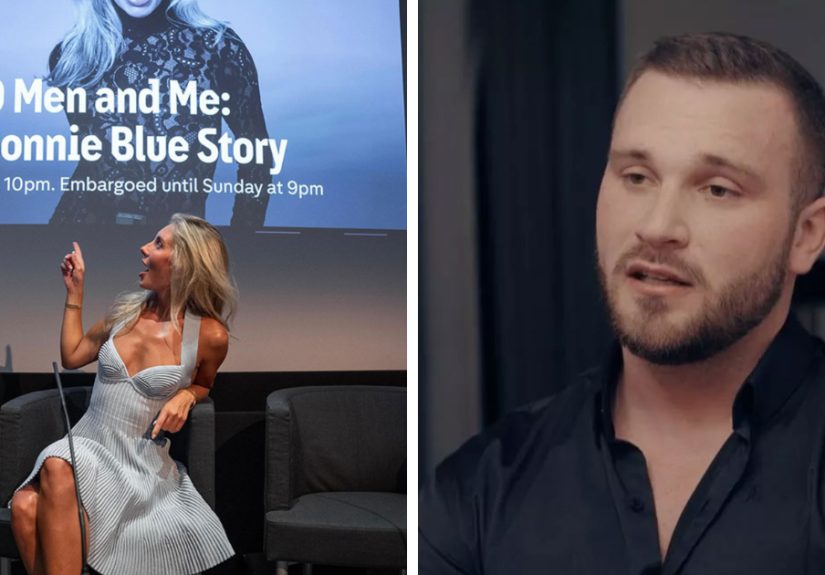
The documentary reportedly features Oliver (also known as Ollie) Davidson speaking on-camera about her work and their relationship. And instead of an “I tried to stop her” storyline, viewers get something closer to: I understand the product.
What He Said (and Why It Hit Like a Plot Twist)
In the documentary interview as reported by multiple outlets, Davidson describes Bonnie Blue’s appeal as being rooted in accessibility and fan connection rather than the traditional distance associated with mainstream adult entertainment. He emphasizes that her model feels like a shift in how audiences engage—more direct, more participatory, and more built around the creator as the center of the experience.
That alone would raise eyebrows, but it gets more layered: reports also indicate that he helped in the early days—supporting her work, being paid in an employee-like role, and assisting with events—and that, even after separating, the relationship remained on workable terms. In other words, the marriage may have ended (or begun ending), but the operational connection didn’t necessarily vanish overnight.
If you’re thinking, “So is he proud, or is this a business partnership wearing a wedding ring?” —congratulations, you are watching the same documentary everyone else is, just with your critical thinking turned on.
The Business Reality Behind the Shock Headlines
To understand why an ex-spouse might talk like a marketing analyst, you have to understand how modern creator platforms work. Subscription-based creator businesses can be wildly profitable for a small number of top earners, but they’re also famously unstable: platform rules can change, public sentiment can flip, and attention can be as loyal as a cat offered two different dinner bowls.
U.S. reporting on the creator economy has highlighted a few consistent themes:
- Platform dependency: creators often build on rented land, where policies and enforcement can shift quickly.
- Revenue splits: platforms typically take a percentage, and creators shoulder most production costs and risk.
- Tax and business complexity: many creators function like independent contractors running mini media companies.
- Always-on labor: audience growth can reward extremes, constant posting, and relentless engagement.
In that context, it’s not shocking that a spouse might become camera operator, scheduler, travel coordinator, editor, handler of chaos, and occasional emotional firefighter. It’s also not shocking that after a split, those roles might unwind slowly—especially if the work is still generating income and the boundaries are, at least on paper, agreed upon.
Documentary Ethics: When “Access” Is Also a Responsibility
The more access a documentary gets, the bigger the ethical homework assignment becomes. Producers have to balance public interest with participant welfare, especially when a subject is facing intense online scrutiny. Responsible documentary standards often emphasize informed consent, ongoing communication about risk, and care around how vulnerable moments are filmed and presented.
That matters here because the documentary isn’t arriving in a neutral environment. It’s landing in a world where moral outrage travels faster than context, and where a single clip can be reposted, mocked, and misrepresented thousands of times before breakfast. When an ex-spouse speaks on camera, it can humanize—or it can become ammunition, depending on the edit and the audience.
The Backlash, the Debate, and the Bigger Cultural Fight
The public argument around Bonnie Blue tends to split into two loud camps: one frames her as a calculating entrepreneur pushing boundaries for profit; the other frames her as a symbol of something darker about how the internet monetizes sexuality, attention, and extremes.
The documentary reportedly leans into that tension rather than resolving it, which is honestly the only honest approach. If you were hoping for a neat bow, the internet does not ship neat bows. It ships hot takes in bulk.
Beyond personal opinions, the controversy has also raised practical questions about distribution, warnings, and audience access—especially in a media landscape where “age gate” sometimes means “click here to confirm you are totally, definitely an adult.” The louder the outrage, the more the documentary becomes a proxy battle about regulation, platform responsibility, and what broadcasters owe viewers when the subject matter is adult and polarizing.
So… Is the Quote Supportive, Ironic, or Something Else?
The phrase “well proud” hits because it sounds like a simple verdict. But if you listen to the substance (as reported), it’s less about cheering and more about recognizing effectiveness. He isn’t saying, “I love every decision.” He’s saying, “I understand how this works.”
That nuance is easy to miss in a headline, but it’s the entire story: modern fame isn’t just morality; it’s logistics, incentives, and a feedback loop of attention. An ex-spouse can feel pride in someone’s discipline or ambition while also feeling grief about what the same career did to their relationship. Humans are messy. Documentaries are basically just high-definition proof.
Quick FAQs (Because Google Loves a Straight Answer)
What is 1000 Men and Me: The Bonnie Blue Story?
It’s a Channel 4 documentary about adult content creator Bonnie Blue that follows her public notoriety and explores the debate around her work, fame, and cultural impact.
Who is the ex-husband speaking in the documentary?
Reports identify him as Oliver (Ollie) Davidson, who appears on camera discussing their relationship and his perspective on her career.
Why did his comments become such a big deal?
Because audiences often expect an ex-partner to condemn a controversial career choice. Instead, his remarks (as reported) focus on how her model differs from traditional industry dynamics and why it resonates with fans—which complicates the usual narrative.
Is this story really about one couple?
Not entirely. It’s also about the creator economy, the way platforms monetize attention, how documentaries shape public judgment, and why relationships are increasingly dragged into the spotlight when someone becomes a brand.
Conclusion: The Internet Wants a Villain, but the Documentary Offers a Mirror
The most interesting part of this story isn’t the headline quote—it’s what the quote reveals about how fame works now. A modern creator career can turn romance into operations, privacy into content, and personal history into a talking point for strangers. When an ex-husband speaks calmly about a polarizing job, it doesn’t end the debate. It just forces the audience to admit the uncomfortable truth: sometimes the people closest to the story don’t fit the storyline we wanted.
+: Experiences People Share When a Partner’s Career Becomes a Public Spectacle
When viewers hear an ex-spouse sound composed on camera, the first reaction is often suspicion: “How can he be so chill?” But people who have lived adjacent to high-visibility careers—whether in entertainment, sports, politics, or the broader creator economy—often describe a pattern that looks less like a soap opera and more like a workplace reality. It’s not always dramatic. It’s often just… exhausting.
One common experience is the slow transformation of a relationship into a production schedule. At first, it can feel supportive: you help with lighting, you proofread captions, you offer feedback on a thumbnail, you hold a camera for a few minutes. Then the “few minutes” becomes a regular role. Eventually you’re not just dating a person—you’re dating a calendar, an inbox, and an audience that never sleeps. Couples in creator businesses often talk about how the lines blur until you realize you haven’t had a conversation that didn’t involve metrics in weeks.
Another common experience is learning that public opinion isn’t interested in nuance. If the creator is loved, the partner becomes a prop in a fairy tale. If the creator is hated, the partner becomes a witness in a courtroom that exists only on social media. People describe feeling like they’re constantly being cast in roles they didn’t audition for: the enabler, the victim, the mastermind, the clout-chaser, the saint. And the weirdest part? Sometimes strangers will argue about your emotions more confidently than you can identify them yourself.
There’s also the practical side nobody posts about because it isn’t glamorous: sorting travel logistics, managing security concerns, navigating platform policy shifts, dealing with harassment, and protecting family members from being pulled into the blast radius. Partners of public figures frequently describe doing “invisible labor”: the work that makes the visible work possible. When a relationship ends, that invisible labor doesn’t always stop instantly. If you shared a home, a business, or a workflow, separation can look less like a breakup montage and more like a gradual untangling.
Documentaries add a special layer to all of this. People who’ve been filmed often describe the strange sensation of being both real and edited. You might say one sentence that felt ordinary, only to watch it become the emotional centerpiece of a scene. Or you might share something vulnerable and later wonder whether you were protected or simply captured. Even with good intentions, documentary crews change the energy in a room: conversations become performances, and silence becomes suspicious. It can take a relationship that is already under stress and make it feel like it’s happening under stadium lights.
Finally, there’s the emotional aftercare. When a couple’s private life becomes public entertainment, people describe grieving in public without wanting to. You can be heartbroken and still respect your former partner’s ambition. You can be angry and still recognize their work ethic. You can be relieved it’s over and still miss the person under the headlines. That’s why the “well proud” moment lands so hard: it doesn’t give the audience the clean emotional label they were hoping to stick on the story. It reminds us that real relationships rarely behave like internet narratives—because real life doesn’t care what performs well.