Table of Contents >> Show >> Hide
- Step 1: Make Sure You’re Chasing the Right License (General vs. Building vs. Residential)
- Step 2: Confirm You Meet the Non-Negotiables (Age + Basic Eligibility)
- Step 3: Understand Florida’s Experience Standard (It’s Not Just “I’ve Worked Construction”)
- Step 4: Choose Your Qualification Path (Experience Only vs. Education Mix)
- Step 5: Build Your Documentation File Like a Pro (Because Florida Will)
- Step 6: Apply to Take the Florida Contractor Exams (Don’t Skip This Sequence)
- Step 7: Study Like You’re About to Run a Business (Because You Are)
- Step 8: Pass the Three Required Division I Exams (And Know What You’re Walking Into)
- Step 9: Set Up Your Business the Right Way (Before You Start Signing Big Contracts)
- Step 10: Meet Florida’s Financial Responsibility and Stability Requirements
- Step 11: Complete Fingerprints and Background Screening
- Step 12: Get the Required Insurance (And Don’t Guess the Coverage Amounts)
- Step 13: Submit Your CGC Application to DBPR and Stay “License-Ready”
- Experiences That Match the Journey (The Part Nobody Puts on the Application)
- Conclusion
If you’ve ever looked at a jobsite and thought, “I could run this whole circus,” congratulationsyou may already have the correct temperament to become a general contractor in Florida. (A sense of humor helps. So does a spreadsheet. And coffee. A lot of coffee.)
In Florida, you don’t just wake up one day and declare yourself a “general contractor” like it’s a personality type. If you want to legally contract for large projects statewide, you’ll typically be aiming for a Certified General Contractor license (often abbreviated CGC). That license is regulated through the Florida Department of Business and Professional Regulation (DBPR) and the Construction Industry Licensing Board (CILB), and it comes with very specific experience, exam, financial, and insurance requirements.
This guide walks you through the real processstep by stepso you can move from “I’m thinking about it” to “I’m pulling permits.”
Step 1: Make Sure You’re Chasing the Right License (General vs. Building vs. Residential)
Florida offers multiple contractor license categories, and “general contractor” isn’t just a cool titleit’s a defined scope. A Certified General Contractor can work on virtually any type of building and project (including commercial). By contrast, a Certified Building Contractor or Certified Residential Contractor has a more limited scope.
Certified vs. registered: the statewide difference that matters
Florida also distinguishes between certified contractors (statewide practice) and registered contractors (limited to the local jurisdictions where they’ve met local competency requirements). If your goal is to work anywhere in Florida without re-qualifying locally, you’re looking for a certified license.
Quick example: If you’re planning to build a small commercial tenant build-out in Tampa this year and a multi-family project in Orlando next year, statewide certification is the cleanest path. If you only plan to work in one county and already hold a local competency card there, registration can be an optionbut it’s not the same as certification.
Step 2: Confirm You Meet the Non-Negotiables (Age + Basic Eligibility)
Before you invest time and money, confirm you can meet the baseline requirements. In Florida, contractor applicants must be at least 18 years old. You’ll also need to be able to pass a background check and provide required documentation (more on that below).
Reality check: Florida licensing isn’t designed to block hardworking peopleit’s designed to ensure the person signing contracts and pulling permits can be held accountable. Be prepared to disclose and document your history honestly.
Step 3: Understand Florida’s Experience Standard (It’s Not Just “I’ve Worked Construction”)
Florida doesn’t accept vague experience like “I’ve been around job sites for years.” The state focuses on verifiable, lawfully acquired experience under proper supervision, tied to the category you’re applying for.
What “active/proven experience” means for General Contractors
For General (and Building) contractor certification, Florida defines qualifying experience as commercial construction experience across multiple structural areasand it excludes certain limited-use structures and exempt work.
The “four stories” requirement (yes, really)
For the General Contractor classification, you’ll generally need proof of at least one year of qualifying experience on structures not less than four stories in height. That’s one of the biggest “surprise” requirements for applicants who have strong residential backgrounds but limited mid-rise exposure.
Practical tip: If your career has been primarily residential, start seeking superintendent/assistant superintendent roles (or long-term subcontractor leadership roles) on mid-rise projects noweven before you apply.
Step 4: Choose Your Qualification Path (Experience Only vs. Education Mix)
Florida commonly allows applicants to qualify through a combination of experience and education, depending on the route you’re using and what you can document. In general, there are pathways based on:
- Documented construction experience, including supervisory responsibility, or
- A qualifying degree (for example, certain building construction, architecture, or engineering degrees), plus experience.
Example pathway: If you have a four-year degree in building construction or civil engineering and several years working under a licensed contractor, you may have a more straightforward documentation package than someone qualifying through experience alone. Either way, Florida still expects proof, not vibes.
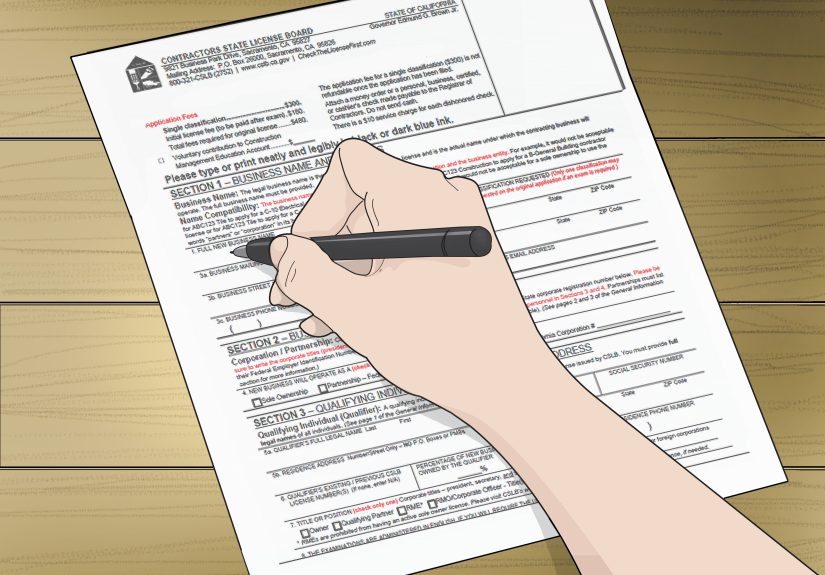
Step 5: Build Your Documentation File Like a Pro (Because Florida Will)
Think of your application like a jobsite closeout binder: if you can’t document it, it doesn’t exist. Start collecting:
- Employment history and role descriptions (especially supervisory duties)
- Project lists with addresses, project type, and your responsibilities
- Proof of lawful experience (who you worked under and their licensure category)
- Education transcripts (if qualifying through education)
Pro move: Write a one-page “experience summary” for yourself that maps your work history to Florida’s experience expectations (commercial areas, structural scope, supervisory time, and the four-story requirement). It helps you spot gaps early.
Step 6: Apply to Take the Florida Contractor Exams (Don’t Skip This Sequence)
For certified licensure, Florida requires you to pass the appropriate state examinations. For most construction categories, candidates apply to sit for exams through the state’s exam registration process, and once approved, schedule computer-based tests at authorized testing centers.
Know the “four-year clock”
Florida’s construction exam process includes a critical timing rule: you generally must pass all required parts within a set window (commonly referenced as four years). That means you don’t want to pass one part, disappear for three years, and then try to finish the rest under pressure.
Step 7: Study Like You’re About to Run a Business (Because You Are)
Florida’s general contractor exams are not “can you swing a hammer” tests. They cover real contractor responsibilities: contract administration, project management, and business/finance. The content is the stuff that can make or break your companycash flow, compliance, planning, risk, and decision-making.
A realistic study plan
- Weeks 1–2: Gather reference materials, outline your schedule, take a diagnostic practice test.
- Weeks 3–6: Deep study by topic (contracts, scheduling, estimating, finance, safety).
- Weeks 7–8: Practice exams + targeted review on weak areas.
Tip from the field: Many candidates underestimate Business & Finance because it sounds “generic.” It isn’t. Treat it like a real pre-construction budget meetingseriously.
Step 8: Pass the Three Required Division I Exams (And Know What You’re Walking Into)
General Contractors are considered Division I contractors in Florida, and Division I categories (General, Building, Residential) require three exams:
- Business & Finance
- Contract Administration
- Project Management
These are computer-based exams. The Candidate Information Booklet includes time limits, question counts, and scoring rules. Florida generally sets the minimum passing score at 70% (and scores are not rounded).
Test-day tip: Don’t just aim to “pass.” Aim to be the contractor who understands why the answer is rightbecause the exam is basically a preview of what your clients, subs, and inspectors will expect you to know.
Step 9: Set Up Your Business the Right Way (Before You Start Signing Big Contracts)
Even if you’re applying as an individual, you’ll likely be operating through a business entity sooner rather than later. Consider your structure (LLC, corporation, etc.) and do the administrative basics:
- Register your entity with the Florida Division of Corporations (Sunbiz)
- Get an EIN from the IRS (if needed for your business setup)
- Register with the Florida Department of Revenue if you’ll have tax obligations (varies by business activity)
- Open a dedicated business bank account (not optional if you want clean books)
Why this matters: Licensing is only part of becoming a real general contractor. Running a compliant business is the other halfand it’s the half that keeps you out of the “my buddy said it was fine” danger zone.
Step 10: Meet Florida’s Financial Responsibility and Stability Requirements
Florida requires construction contractor applicants to demonstrate they are financially responsible and financially stable before a license is issued. In practice, this means you should be prepared to submit credit reports and show:
- No unsatisfied liens or judgments against you (or the company you intend to qualify)
- A qualifying credit score (Florida commonly references a 660 FICO-derived score)
If your credit score is under 660
Florida’s published requirements indicate that applicants under the 660 threshold must complete a board-approved 14-hour financial responsibility course. Plan for this early so it doesn’t become the last-minute obstacle between you and approval.
Pro tip: Don’t wait until you’re ready to submit the application to check your credit. Pull reports early, address errors, and document resolutionsbecause paperwork delays are a special kind of heartbreak.
Step 11: Complete Fingerprints and Background Screening
Licensing applications commonly require fingerprints for a background check. Follow the instructions exactly (approved vendors, correct forms, correct timing). If you’ve ever had your fingerprints rejected for low quality, you know this step can be annoyingly real.
Common mistake: Submitting prints too early, too late, or through the wrong channel. Read the checklist and do it preciselythis is not the moment to freestyle.
Step 12: Get the Required Insurance (And Don’t Guess the Coverage Amounts)
Florida requires contractors to maintain specific insurance coverage. For a Certified General Contractor, the published minimums commonly include:
- General liability insurance: $300,000 per occurrence
- Property damage insurance: $50,000
Workers’ compensation
Florida licensing materials also require proof of workers’ compensation coverage or an exemption where allowed. Construction has its own workers’ comp rules, so treat this as a compliance topic, not a checkbox.
Practical advice: Work with an insurance agent who regularly insures Florida contractors. Tell them you’re applying for CGC licensure and ask them to quote to the state’s minimums (and discuss whether higher limits make sense for your project types).
Step 13: Submit Your CGC Application to DBPR and Stay “License-Ready”
Once your exams, experience, financial documentation, fingerprints, and insurance are lined up, you can submit your application package through the DBPR process for the Construction Industry Licensing Board.
Use the checklist like it’s your foreman
Florida provides application checklists for contractor categories. Use them. They’re basically the state saying, “Here’s exactly what we will ask you forplease don’t make this weird.”
After approval: your license is a living responsibility
Getting licensed isn’t the finish line. To keep your license active and your business healthy, expect to manage:
- Renewals (typically on a biennial cycle)
- Continuing education requirements (Florida commonly requires 14 hours per renewal cycle for construction licensees, including required topic areas)
- Ongoing insurance and workers’ comp compliance
- Permits, inspections, and local business tax/occupational requirements in the jurisdictions where you work
Contractor reality: The best general contractors aren’t just great buildersthey’re great managers of systems: schedules, paperwork, people, and risk.
Experiences That Match the Journey (The Part Nobody Puts on the Application)
Here’s what many people discover while working through these 13 steps: becoming a general contractor in Florida is less like earning a badge and more like upgrading your whole operating system.
First comes the “experience audit” moment. You’ll sit down to list your projects and realize your memory is not a legal document. That remodel you ran? Amazing workbut was it supervised under the right license category, and can you prove it? That commercial job where you managed subs? Greatbut can you describe your role clearly enough that someone who’s never met you understands it in 90 seconds? Many applicants end up calling old employers, digging through pay stubs, and trying to remember which job was the one with the slab pour in July (the one where it rained sideways, obviously).
Then there’s exam prepwhere confidence and humility meet in a parking lot. Plenty of experienced builders walk into Business & Finance thinking, “I run jobs. I know money.” Two chapters later, they’re learning the difference between markup and margin like it’s a plot twist. The upside? Once you learn it, you start seeing your business differently. You stop pricing work based on what “feels fair” and start pricing it based on what keeps your company alive when a project goes sideways (because one eventually will).
Paperwork becomes your second job. You’ll collect documents the way you collect tools: one at a time, and always the one you need is mysteriously missing. Fingerprints, credit reports, course certificates, insurance declarations pageseach one is simple until it isn’t. The best strategy is to build a “licensing folder” (digital and physical) and treat it like your jobsite binder: labeled, updated, and ready to show anyone who needs it.
The insurance step is where you start feeling like a “real” contractor. Not because insurance is fun (it is not), but because it forces you to think bigger. Liability coverage isn’t just a state requirement; it’s a reflection of the size and risk of the work you’re about to contract for. Talking with an agent about limits, exclusions, and workers’ comp rules feels like stepping into the business-owner version of adulthood.
And finally, there’s the mindset shift. Once you’re applying for CGC licensure, you’re no longer thinking like a lead carpenter or a site supervisor. You’re thinking like the person who signs the contract, owns the schedule, answers to the building department, and fixes problems when there’s no one else to call. Many new applicants say the process is stressfulbut also clarifying. It shows you exactly where your gaps are, and it pushes you to close them.
If you want the most honest “experience tip,” it’s this: don’t rush the processorganize it. A steady plan beats a frantic scramble every single time. Future-you (and your future clients) will thank you.
Conclusion
Becoming a general contractor in Florida is absolutely doablebut it’s a professional licensing process, not a casual career upgrade. If you approach it like a real project (scope, schedule, documentation, and quality control), you’ll move through the steps with far less pain and far more confidence. Build your experience intentionally, pass the exams with purpose, meet the financial and insurance requirements cleanly, and you’ll be positioned to run projects legally and profitably across the state.