Table of Contents >> Show >> Hide
Mangoes are the sweet, juicy fruits that everyone loves to indulge in, but cutting one can seem a bit intimidating if you’re not familiar with the process. Whether you’re adding mango to your morning smoothie, preparing a fruit salad, or just enjoying it on its own, learning how to cut a mango properly can make the process much easier. In this guide, we’ll walk you through six simple ways to cut a mango, including tips and tricks to help you get the most out of this tropical fruit.
1. The Classic Method: The Mango “Cheeks” Technique
The most popular method for cutting a mango is the classic cheek method. This involves slicing the mango into two large “cheeks,” cutting along the pit, and then scooping out the fruit from the skin. Here’s how to do it:
- Start by holding the mango upright, with the stem facing up.
- Identify the two flat sides of the mango. The pit runs lengthwise through the center of the fruit, so you’ll want to slice about ½ inch from the center on either side to avoid hitting the pit.
- Make vertical cuts down each side of the mango. You should now have two large pieces, or “cheeks,” and a central pit.
- Use a spoon or knife to scoop out the flesh from the cheek. For a clean finish, you can slice the mango into cubes by cutting both horizontally and vertically.
This method is quick and easy, leaving you with beautifully cut mango that’s perfect for snacking, smoothies, or desserts.
2. The Grid Method: For Diced Mango
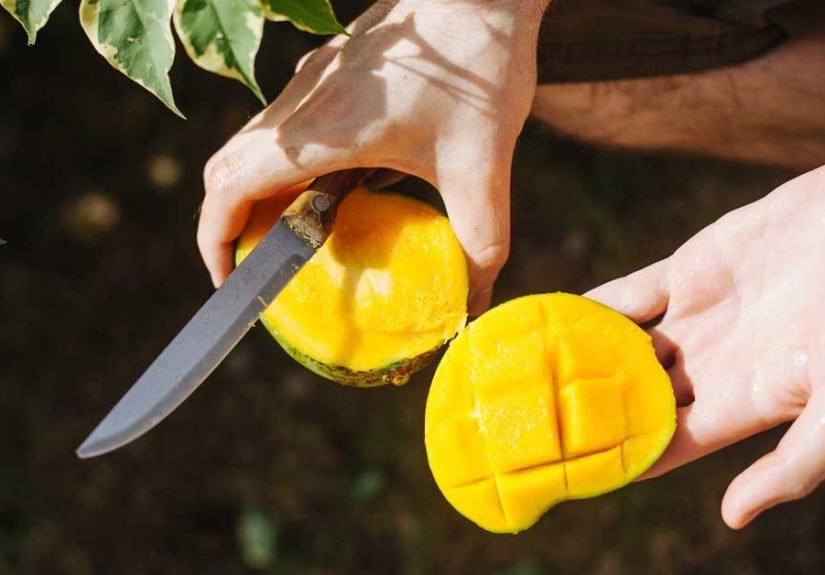
If you prefer your mango in neat cubes, the grid method is ideal. It involves cutting both vertically and horizontally into the mango flesh, creating a grid pattern that makes it easy to scoop out perfectly diced pieces. Here’s how:
- Start by following the steps in the classic method to remove the mango cheeks.
- Once you have the two cheeks, use a knife to score the flesh in a grid pattern. Make vertical cuts first, then horizontal cuts, creating a checkerboard-like pattern.
- Next, flip the mango cheek inside out by gently pushing the skin, so the cubes pop up. Then, use your knife to slice the cubes off the skin.
This method is particularly useful if you need uniform pieces for fruit salads, salsas, or garnishes.
3. The Spoon Scoop Method: For Smooth Mango
If you’re aiming for smooth, scoopable mango, the spoon scoop method is a great choice. It’s especially useful when you want to keep the mango intact in its peel and simply scoop out the flesh without any cutting. Follow these steps:
- Start with the mango cheeks, cutting them off along the pit as in the classic method.
- Once you’ve separated the two cheeks, use a spoon to scoop the mango flesh directly out of the skin. Start at one edge and move in a circular motion.
- This method is perfect if you’re planning to use the mango in a smoothie or if you want to eat it straight from the skin without cutting it into cubes.
4. The Julienne Method: For Mango Strips
The julienne method is perfect for creating thin strips of mango that are great for salads, stir-fries, or garnishes. Here’s how to do it:
- Cut off the mango cheeks as usual, making sure to avoid the pit.
- Once you have the two cheeks, slice the flesh lengthwise into long strips. You can make them as thin or thick as you like.
- After you’ve sliced the flesh, you can use these strips for a variety of dishes, from salads to summer rolls.
5. The Wedge Method: For Mango Slices
If you’re looking for traditional mango wedges, the wedge method is the best approach. Here’s how to do it:
- Cut the mango cheeks off the pit as you would in the classic method.
- Next, make several vertical cuts along the flesh of each cheek to create long wedges.
- Once you’ve made the cuts, gently pull the wedges apart and serve them up as slices.
This method is great for serving mango as a side dish, adding it to fruit platters, or enjoying it with a drizzle of lime juice and chili powder for a tangy treat.
6. The Spiral Method: For Fun Mango Twists
If you want to get a little more creative with your mango slicing, try the spiral method! This fun technique turns your mango into a spiral that’s great for serving as a garnish or a playful snack. Here’s how:
- Cut off the mango cheeks, avoiding the pit.
- Start at one end of each mango cheek and make a spiral cut, moving all the way down to the other end.
- Once you’ve made the spiral cut, you can pull the fruit apart in a continuous twist, creating a fun, edible mango ribbon.
The spiral method is perfect for impressing guests at parties or for using mango in unique ways in your cooking.
Conclusion
Learning how to cut a mango properly is the first step to fully enjoying this tropical fruit. Whether you prefer juicy wedges, neat cubes, or creative spirals, there’s a cutting method for every need. Remember, mangoes are not just for smoothies or fruit bowlsthey can be used in savory dishes like salads, salsas, and even grilling. By using these simple techniques, you’ll be able to enjoy mangoes in a variety of ways, each more delicious than the last. Don’t be intimidated by the pittake it slow and enjoy the process of getting the most out of your mango.
Now that you know how to cut a mango in six different ways, which method will you try first? Grab your mango, a sharp knife, and get slicing!
Related Experiences: Mango Cutting and Enjoyment Tips
Cutting mangoes is a skill that improves with practice. When I first started cutting mangoes, I had trouble avoiding the pit. It wasn’t until I tried the classic “cheeks” method that I really got the hang of it. Over time, I experimented with the other techniques, like the grid and spoon methods, which made it easier to get the mango flesh in the shape I wanted.
What I love most about cutting mangoes is the versatility of the fruit. One of my favorite things to do with mangoes is to use the wedges for fruit platters at family gatherings. It’s always a crowd-pleaser. I also enjoy making mango salsa with diced mango, cilantro, red onion, and a bit of lime juiceit’s perfect for tacos or grilled chicken.
Another great tip is to try mango with chili powder or salt, which brings out its natural sweetness. Pairing it with a tangy dip, like yogurt, also makes for a delicious snack. And if you’re into smoothies, a few chunks of mango blended with pineapple and coconut milk is like drinking a tropical vacation.
After learning all the cutting techniques, I can now confidently prepare mangoes for a variety of dishes, whether I want them sliced for a simple snack or diced for a complex dish. It’s become one of my go-to fruits for its ease of use and refreshing taste. No matter which method you choose, remember to enjoy the process and, most importantly, the delicious results!