Table of Contents >> Show >> Hide
- What you’ll learn
- Why angel food cake is so airy (and why it collapses)
- Ingredients that matter more than your ego
- Equipment setup (aka “the pan is the plot”)
- Step-by-step: fluffy, light angel food cake
- Troubleshooting: saving your cake (and your mood)
- Flavor ideas, toppings, and serving tips
- Storage: keeping it cloudlike
- Conclusion: your fluffy angel food cake game plan
- Extra: real-life angel food cake experiences (so you don’t cry into your sifter)
Angel food cake is basically a dessert made of optimism: egg whites, sugar, and the audacity to believe you can
turn “foam” into “sliceable cloud.” Done right, it’s tall, snowy, fluffy, and so light it feels like it should
float out of the kitchen on its own. Done wrong, it becomes a sweet, sad pancake with the personality of a damp
sponge.
This guide breaks down the real reasons angel food cake rises (and why it sometimes rage-quits), with step-by-step
instructions, pro-level troubleshooting, and a few laughsbecause if you’re separating 10–12 eggs, you deserve joy.
Why angel food cake is so airy (and why it collapses)
Angel food cake is a “foam cake.” There’s no baking powder doing the heavy lifting. The lift comes from air you
whip into egg whitesmillions of tiny bubbles held together by egg-white proteins. In the oven, those bubbles expand,
the proteins set, and the cake becomes a lofty, springy sponge.
The drama: foam is fragile. If you knock out the air (overmixing, aggressive folding, greasy tools), your cake won’t
rise. If the structure doesn’t set properly (underbaked or cooled the wrong way), it can sink. Angel food cake is
light because it’s basically engineered air… which means it can also deflate like a balloon at a toddler’s birthday party.
The two big rules
- Build a stable meringue. Clean bowl, clean whisk, no yolk, sugar added correctly, and don’t overbeat.
- Let the cake cling and cool upside down. The pan and cooling method keep the airy structure from collapsing.
Ingredients that matter more than your ego
Angel food cake is simple, which means each ingredient has nowhere to hide. This is not the time for “close enough.”
(Okay, it’s always the time for close enough. But not here.)
Egg whites: the entire foundation
- Use fresh, cleanly separated egg whites. Even a speck of yolk (fat) can prevent whipping.
-
Room temperature helps. Whites whip with more volume and stability when they’re not icy-cold.
If you forgot, let eggs sit out or warm the whole eggs briefly in a bowl of warm (not hot) water, then dry them. - Measure if you can. Many recipes call for about 1 1/2 cups of egg whites (often 10–12 large eggs).
Sugar: sweetness + structure
Sugar doesn’t just sweeten. It helps stabilize the whipped egg whites and contributes to that tender, flexible crumb.
The biggest sugar mistake is dumping it in too fastyour meringue gets grainy, unstable, or both.
- Use superfine sugar if possible. It dissolves quicker, giving you a smoother, glossier meringue.
- Add sugar gradually. Think “gentle snowfall,” not “sugar avalanche.”
Cake flour: softness insurance
Cake flour is lower in protein than all-purpose flour, which helps keep the crumb delicate and light. You can use
all-purpose in a pinch, but cake flour makes it easier to get that classic, airy texture.
Cream of tartar (or another acid): stability MVP
A small amount of acid helps egg whites whip up with better volume and stability. Cream of tartar is traditional,
but lemon juice or white vinegar can work if that’s what you’ve got.
Flavorings: keep it simple
- Vanilla is the classic.
- Almond extract adds bakery vibes (use lightly).
- Citrus zest (lemon/orange) makes it taste brighter without weighing it down.
Equipment setup (aka “the pan is the plot”)
Use the right pan: an ungreased tube pan
A standard, straight-sided tube pan (often with a removable bottom) is ideal. Don’t use a nonstick tube pan if you can
avoid itangel food cake needs to cling to the sides as it rises and while it cools. Grease or nonstick can sabotage
that climb.
- Do not grease the pan. Not the sides. Not the bottom. Not the little center tube. Zero grease.
- Skip Bundt pans. Their designs and coatings make release and proper rise much harder.
- Cooling “feet” are helpful. Many tube pans have little legs so you can invert them easily.
Other helpful tools
- Stand mixer or hand mixer (whisk attachment preferred)
- Fine-mesh sieve for sifting flour/sugar
- Rubber spatula for folding
- Instant-read thermometer (optional, but makes doneness less mystical)
- Serrated knife for slicing without crushing
Prep like a pro (it’s boring, but it works)
- Clean the bowl and whisk. Any grease can kill your volume. Wipe with a little vinegar or lemon juice if you’re serious-serious.
- Sift dry ingredients multiple times. You’re building lightness before the mixing even begins.
- Separate eggs carefully. Use three bowls: one for cracking/separating, one for whites, one for yolks. That way one broken yolk doesn’t ruin the whole batch.
Step-by-step: fluffy, light angel food cake
Below is the method used across many classic American angel food cake recipes. Ingredient amounts vary slightly by recipe,
but the technique is where the magic (and the height) lives.
1) Mix and sift the dry ingredients
-
Combine cake flour and part of your sugar (some recipes use powdered sugar here).
Sift them together at least 2–3 times. - Why? Sifting aerates and breaks up lumps, and mixing sugar with flour helps it fold in gently later.
2) Whip egg whites the smart way
- Start slow. Beat egg whites on low/medium-low until foamy. This loosens them up and sets you up for more stable bubbles.
- Add cream of tartar + salt. Once foamy, add the acid (and salt if using). Keep beating until soft peaks form.
-
Add sugar gradually. With the mixer running, add sugar slowly. Increase speed to medium-high.
Whip until you get glossy, firm peaks that stand tall but still look creamy.
Peak talk (because it matters): Soft peaks slump. Stiff peaks stand straight. For angel food cake, you want
firm peaks that look glossy and smooth. If the whites look dry, clumpy, or “styrofoamy,” they’re overbeaten and harder to fold.
3) Fold in dry ingredients without deflating
- Sift about one-third of the flour mixture over the meringue.
- Fold gently with a rubber spatula: cut down the middle, sweep along the bottom, and lift up and over.
- Repeat in 2 more additions, folding just until no dry streaks remain.
Folding is not stirring. Stirring is what you do when you want to remove all the air you spent 8 minutes whipping in.
Folding is what you do when you respect your own time.
4) Fill the pan (still ungreased!)
- Gently spoon the batter into the tube pan. Avoid dumping it from high above like you’re trying to start a batter splash zone.
- Level the top lightly with a spatula.
- Run a thin knife through the batter in a couple of circles to pop any large air pockets (optional, but helpful).
5) Bake until set, springy, and golden
Bake in a preheated oven (many recipes land around 325°F–350°F). The goal is a cake that’s deeply risen, golden,
and set enough that it won’t collapse when it cools.
- Don’t open the oven early. Sudden temperature changes can make a delicate foam cake fall.
- Doneness cues: Top is golden, cracks feel dry, and the cake springs back when lightly pressed.
- Thermometer option: Many bakers aim for an internal temperature around 206°F for a fully baked foam cake.
6) Cool upside down (yes, immediately)
This is the moment where angel food cake proves it’s both magical and petty. If you cool it right-side up, gravity compresses
the airy crumb before it finishes setting. Upside-down cooling lets gravity help keep it tall.
- Remove the pan from the oven.
- Invert it immediately. If your pan has feet, set it on those. If not, balance the center tube over a sturdy bottle.
- Let it cool completely, usually 1–2 hours. Don’t rush. Warm cake is fragile cake.
7) Release and slice like a calm, patient adult
- Once fully cool, run a thin knife around the outer edge and around the center tube.
- Lift out the removable bottom (if your pan has one) and loosen the base.
- Slice with a serrated knife using a gentle sawing motion. Pressing straight down will squish the crumb.
Troubleshooting: saving your cake (and your mood)
“My cake collapsed!”
- Underbaked: The structure didn’t set. Bake a little longer next time, and consider using a thermometer.
- Cooled right-side up: Gravity won. Invert the pan immediately next time.
- Greased or nonstick pan: The cake couldn’t cling properly. Use an ungreased, non-nonstick tube pan.
- Overfolded: Too much air lost. Fold gently and stop when streaks disappear.
“It’s dense or gummy.”
- Sugar added too fast: Grainy meringue doesn’t expand well. Add sugar slowly.
- Egg whites not whipped correctly: Too soft won’t lift; too stiff won’t fold. Aim for glossy firm peaks.
- Dry ingredients not sifted: Lumps and heavy pockets weigh it down. Sift multiple times.
“The top is sticky.”
A slightly tacky top can happen from moisture and sugar. It’s not automatically a failuremany angel food cakes feel a bit sticky
while warm. Let it cool completely, then serve with berries or a light dusting of powdered sugar.
“It stuck and tore coming out.”
- Not fully cooled: Warm cake tears. Cool completely upside down.
- Release technique: Use a thin knife and take your time. Straight-sided tube pans are easier than fancy pans.
Quick “pro” upgrades that actually help
- Pulse sugar to make it superfine if you don’t have superfine sugar.
- Weigh ingredients if you can. Foam cakes love precision.
- Fold in three additions and always sift each addition.
- Cool completely before slicingstructure keeps setting as it cools.
Flavor ideas, toppings, and serving tips
Simple flavor twists
- Lemon cloud: Add lemon zest + a tiny splash of lemon juice (don’t drown the whites).
- Almond-bakery vibe: Add 1/4 to 1/2 teaspoon almond extract with vanilla.
- Berry swirl (gentle): Serve with macerated strawberries instead of swirling heavy puree into the batter.
Toppings that match the vibe
- Fresh berries + lightly sweetened whipped cream
- Roasted strawberries for deeper flavor (and fewer watery juices)
- Chocolate drizzle (thin, not a brick of ganache)
- Greek yogurt + honey for a tangy, lighter topping
Serving tip
Angel food cake is at its best when it’s not being crushed by heavy toppings. Keep everything light, bright, and breezy
like the cake’s entire personality.
Storage: keeping it cloudlike
- Room temperature: Store covered for a couple of days for best texture.
- Freezing: Wrap slices well and freeze for longer storage; thaw at room temp.
- Avoid the fridge if possible: Refrigeration can dry out foam cakes faster. If you must refrigerate (because toppings),
store airtight and bring to room temp before serving.
Conclusion: your fluffy angel food cake game plan
If you remember nothing else, remember this: angel food cake is a relationship between air and patience. Whip a stable,
glossy meringue. Fold gently. Use an ungreased tube pan so the batter can climb. Bake until set. Cool upside down.
Then slice with a serrated knife like you’re cutting a very polite sponge.
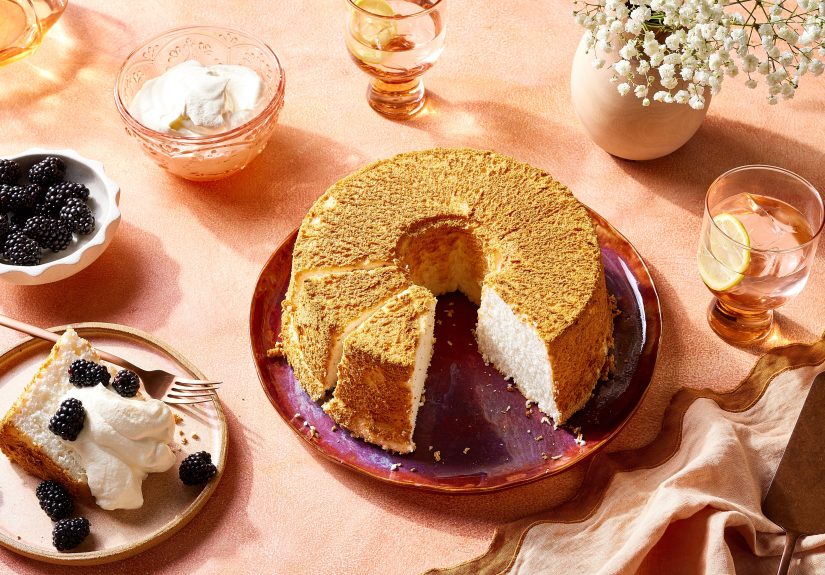
Do that, and you’ll get the kind of fluffy, light angel food cake that makes people say, “Wait… you made this?”
(And you can say, “Yes. I domesticated air.”)
Extra: real-life angel food cake experiences (so you don’t cry into your sifter)
The first time I made angel food cake, I treated it like any other cake: I greased the pan because I’m a kind person
who doesn’t want desserts to stick. Angel food cake, however, does not reward kindness. It rewards physics. The batter
slid down the sides like it was avoiding responsibility, the cake rose halfway, and when I flipped it to cool… it did
a slow-motion slump that looked suspiciously like disappointment.
Round two, I got cocky in a different direction: I decided the mixer could do everything, including solving my emotional
problems. I beat the whites until they were so stiff they looked like foam insulation. Folding flour into that was like
trying to fold a sweater into a brick. The batter fought back, the air bubbles died bravely in battle, and the final cake
had the height of a respectable loaf of bread. Not a tragedy, but not exactly “angelic.”
The breakthrough came when I started treating egg whites like tiny divas: they need the right environment, the right pacing,
and absolutely no greasy nonsense. I wiped the bowl and whisk down, separated eggs with a three-bowl system (because one yolk
slip-up should not ruin an entire afternoon), and slowed down the sugar. Adding sugar gradually felt sillylike feeding a
hamster one pellet at a timebut the meringue turned glossy and stable, which is basically the egg-white version of confidence.
Then came the iconic “cool upside down” moment. The first time you invert a cake on purpose, it feels illegal. My pan didn’t
have little feet, so I balanced it on a sturdy bottle like I was performing a circus act for baked goods. I hovered for a full
minute waiting for disaster. Nothing happened. The cake just… hung there… calmly… like it had done this a thousand times.
When I finally unmolded it after it cooled, the crumb was tall and springy, and I had the rare joy of seeing a cake that
looked like the pictures.
I also learned the practical side benefits of angel food cake: suddenly you have a dozen egg yolks, which is the universe’s way
of encouraging custards, ice cream, lemon curd, and rich pasta dough. Angel food cake doesn’t just give you dessert; it gives
you a side quest. Now it’s a small tradition in my kitchenespecially when I want something light after a heavy meal. I’ll bake
the cake, slice it with a serrated knife, pile on berries, and watch people go back for “just a little more” because the cake
barely counts in their minds. (It counts. But it counts in a happy way.)
And yes, every once in a while, something still goes slightly offmaybe a small dip in the center or a top that’s a bit sticky.
But once you understand the “why,” those hiccups stop being mysteries and start being adjustments: a little longer bake, a gentler
fold, a slower sugar stream. Angel food cake is one part recipe and one part technique, and once you’ve got the technique, you
can make it fluffy and light on purpose. Which is an extremely satisfying flex.