Table of Contents >> Show >> Hide
- Split vs. Butterfly: What’s the Difference?
- Why Butterfly a Fish in the First Place?
- Tools You’ll Want (and What’s Actually Worth Buying)
- Choose the Right Fish (Your Life Will Be Easier)
- Food Safety Setup: Keep It Cold, Keep It Clean
- Prep Step 1: Scale (If Needed)
- Prep Step 2: Gut and Trim
- Method 1: How to Split a Fish (Great for Grilling and Roasting)
- Method 2: How to Butterfly a Fish (Open Like a Book, Backbone Removed)
- Pin Bones, Rib Bones, and the “Surprise Crunch” Prevention Plan
- Common Mistakes (and the Fixes That Save Dinner)
- How to Cook a Split or Butterflied Fish (Quick Ideas)
- FAQ: The Questions People Whisper at the Fish Counter
- Experience Notes (About ): What It’s Like the First Few Times You Do This
- Conclusion: Flat Fish, Big Wins
If you’ve ever ordered a “butterflied whole fish” at a restaurant and thought, “Wow, that fish looks like it’s doing yoga”good news: you can absolutely learn to do that at home. Splitting or butterflying a fish is one of those skills that looks fancy, cooks more evenly, grills like a dream, and instantly upgrades your “I can cook” credibility.
This guide walks you through two closely related techniquessplitting and butterflyingwith clear steps, safety notes, and practical examples. We’ll keep it real, keep it clean, and keep the fish where it belongs: flat on the board, not flopping onto your socks.
Split vs. Butterfly: What’s the Difference?
People use these terms interchangeably, but here’s the simplest way to think about it:
- Splitting a fish usually means cutting it open so it lies flatteroften by cutting along the backbone and opening it up, while parts of the fish may remain attached.
- Butterflying a fish typically means opening it like a book so it lays very flat, often with the backbone removed (and sometimes the rib bones, depending on the fish and the goal).
Both techniques create a thinner, more even piece of fish that cooks faster and more consistentlyespecially useful for grilling, broiling, and roasting.
Why Butterfly a Fish in the First Place?
Because it solves problems you didn’t even know you had:
- More even cooking: The thickest part and thinnest parts cook closer to the same time.
- Better grill control: A flat fish is less likely to tear and fall through grates.
- More flavor: More surface area means more seasoning contact and more crispy bits.
- Better presentation: A whole butterflied fish shows up like, “Hello, I’m dinner and I’m gorgeous.”
Tools You’ll Want (and What’s Actually Worth Buying)
Must-haves
- Sharp knife: A flexible fillet knife is ideal, but a sharp chef’s knife can work on larger fish.
- Kitchen shears: Great for trimming fins and snipping through small bones.
- Cutting board: Non-slip if possible; put a damp towel underneath to keep it steady.
- Paper towels: Fish is slippery. Paper towels are your traction control.
Nice-to-haves
- Fish tweezers or needle-nose pliers (kitchen-only): For pin bones.
- Scaler (or the back of a knife/spoon): If the fish needs scaling.
- Disposable gloves: Optional, but helpful if you’re squeamish or want extra grip.
Choose the Right Fish (Your Life Will Be Easier)
Not every fish is equally “butterfly-friendly.” If you’re learning, pick something small-to-medium with a straightforward bone structure:
- Trout (classic practice fish)
- Branzino/sea bass (restaurant-style favorite)
- Snapper (great for grilling)
- Mackerel (oily, flavorful, fast-cooking)
Bigger fish can be butterflied toojust expect stronger bones, larger ribs, and a slightly more “wrestling match” vibe.
Freshness quick-check (because your knife skills can’t fix bad fish)
- Smell: Clean, mild, ocean-like. Not “dock in August.”
- Eyes: Clear and bright, not cloudy and sunken.
- Flesh: Firm and springy when pressed.
Food Safety Setup: Keep It Cold, Keep It Clean
Before you start cutting, set yourself up like a calm, competent adult:
- Keep fish cold: Put it back in the fridge until you’re ready to work. If your kitchen is warm, set the fish on a tray over ice.
- Separate surfaces: Use one board for fish, and wash/sanitize it after.
- Skip splashing: Instead of rinsing aggressively in the sink, pat the fish dry well and clean your workspace afterward.
Prep Step 1: Scale (If Needed)
Many whole fish come scaled, but don’t assume. If scales are present:
- Hold the fish by the tail (paper towel helps).
- Scrape from tail to head using a scaler, spoon, or the back of a knife.
- Work over the sink or inside a large bag to keep scales from redecorating your kitchen.
- Wipe the fish dry again.
Prep Step 2: Gut and Trim
If your fish is not already cleaned, you can:
- Ask the fishmonger: This is the easiest option and costs you exactly zero pride.
- Do it yourself: Remove innards, scrape the bloodline, and trim away gills if they’re still in. Then pat dry thoroughly.
Once the fish is cleaned, you’re ready to split or butterfly.
Method 1: How to Split a Fish (Great for Grilling and Roasting)
Splitting is often the “easier cousin” of butterflying. You’ll open the fish up so it lies flatter, usually by cutting along the backbone.
Step-by-step: Split along the backbone
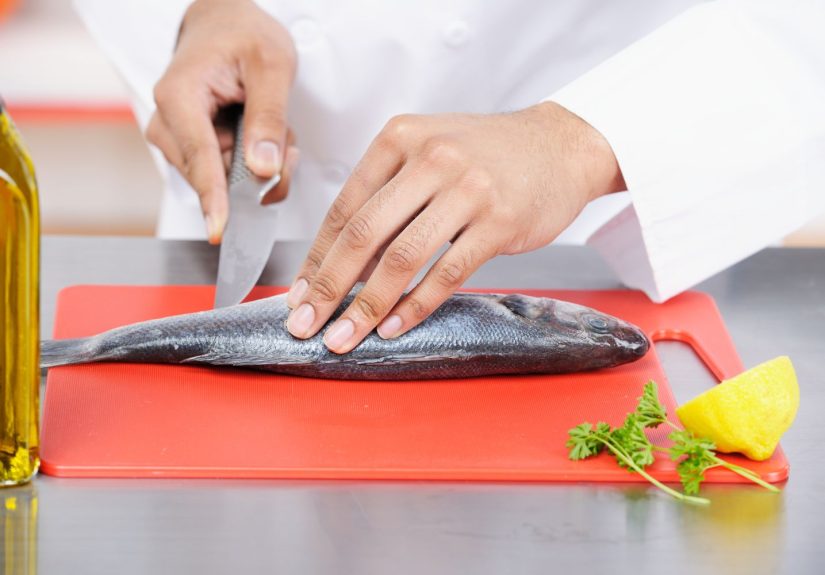
- Position the fish: Lay it on the board with the back facing up. Tail toward your dominant hand helps.
- Trim fins (optional but helpful): Use kitchen shears to snip sharp fins so they don’t snag your hands or your towel.
- Start the cut: Using the tip of your knife, make a cut alongside the backbone from tail toward the head.
- Follow the bones: Keep the blade riding against the backbonelet the skeleton guide you instead of forcing the knife.
- Repeat on the other side: Make the same cut along the other side of the backbone.
- Open it up: Gently spread the fish open so it lies flatter. If you want it even flatter, you can loosen connective tissue near the head and ribs with small, careful cuts.
When splitting is the better choice
- You want a flatter fish but don’t need to fully remove the backbone.
- You’re grilling in a basket or on foil and want fewer “delicate steps.”
- You’re practicing knife control before attempting full butterflying.
Method 2: How to Butterfly a Fish (Open Like a Book, Backbone Removed)
Butterflying is what gives you that classic “flat whole fish” look. It’s perfect for high-heat cooking and stuffing, and it makes seasoning easier because you can season the inside and outside.
Step-by-step: Butterfly a whole fish
- Position the fish: Lay the fish belly-side down if it’s already opened; otherwise, lay it with the back facing up. Pat it dry again for grip.
- Cut along one side of the spine: Starting near the tail, slide your knife along one side of the backbone toward the head. Use short strokes, keeping the blade tight to bone.
- Cut along the other side: Repeat on the opposite side of the backbone, essentially freeing it from both fillets.
- Remove the backbone: Lift it out carefully. On many fish, ribs come along for the ride; if not, you can trim rib bones away with the knife tip.
- Open and flatten: Spread the fish open like a book. Press gently with your palm (or cover with a towel and press) to help it lay flat.
- Optional: snip stubborn bits: If the fish won’t flatten, kitchen shears can help snip small bones near the collar (near the head area).
Butterfly variations you’ll see
- Backbone removed, head on: Great presentation and grill-ready.
- Backbone removed, head off: Easier handling and fits in pans.
- Ribs removed vs. ribs left in: Removing ribs makes eating easier; leaving them can help keep the fish intact during cooking.
Pin Bones, Rib Bones, and the “Surprise Crunch” Prevention Plan
Pin bones are those thin little bones that can hide in fillets and ruin someone’s otherwise peaceful dinner. Even well-prepped fish can still have a few.
How to remove pin bones
- Run your fingers lightly across the flesh to feel the tips.
- Grab each bone with tweezers or kitchen-only pliers.
- Pull gently at a slight angle, keeping your other hand on the fish to prevent tearing.
Rib bones are bigger and usually visible; you can trim them away by sliding the knife just under the rib cage, again staying close to bone so you don’t sacrifice good meat.
Common Mistakes (and the Fixes That Save Dinner)
Mistake: The knife keeps slipping
Fix: Dry the fish more than you think you need to. Then dry it again. Fish is basically nature’s slip-and-slide.
Mistake: You’re cutting through bone and shredding the flesh
Fix: Change the angle. Ride the blade against the bones instead of pushing straight down. Use short strokes, and let the skeleton be your “rail.”
Mistake: The fish won’t lay flat
Fix: You likely need to free a little connective tissue near the collar or spine area. Small cuts beat big hacks. Kitchen shears help for tiny bones.
Mistake: You removed the backbone… and half the fish came with it
Fix: You went too deep. Next time, keep the knife tip right beside the spine and use gentle strokes. With practice, you’ll feel the difference between “bone” and “not bone.”
How to Cook a Split or Butterflied Fish (Quick Ideas)
Grill (most popular for butterflied fish)
- Oil the fish lightly and oil the grates (or use a grill basket).
- Cook skin-side down first if the skin is on.
- Flip carefullywide spatulas help, and confidence helps more.
Broil (weeknight hero move)
- Line a sheet pan for easy cleanup.
- Season aggressively (salt, pepper, citrus, herbs).
- Broil until opaque and flaky, watching closelybroilers go from “perfect” to “oops” fast.
Roast (for stuffing and “dinner party energy”)
- Stuff the cavity area with herbs, lemon slices, garlic, or aromatics.
- Roast until the thickest part flakes easily.
FAQ: The Questions People Whisper at the Fish Counter
Should I ask the fishmonger to do this?
Yes. Asking is normal. It’s not cheating. It’s outsourcing. Your accountant does it all the time.
Can I butterfly a fish that’s already filleted?
You can’t butterfly a “whole fish” if it’s already separated into fillets, but you can still remove pin bones, trim rib bones, and portion it for even cooking.
Is it easier with skin on or off?
Skin-on often holds the fish together better during grilling and makes flipping less stressful. Skin-off can be easier to eat, but it’s usually more delicate.
Experience Notes (About ): What It’s Like the First Few Times You Do This
The first time you try to split or butterfly a fish at home, you’ll probably feel two emotions at once: confidence (“I watched a tutorial, I’ve got this!”) and humility (“Why is it… wiggly?”). That’s normal. Fish prep is half technique and half learning to stay calm while handling something that clearly used to have plans for the day.
A common early experience is realizing that your knife skills matter less than your setup. A slippery cutting board or a damp fish will make you feel like you’re trying to write your name on an ice cube. Once you put a damp towel under the board and pat the fish dry until it feels slightly tacky, everything suddenly behaves. The fish doesn’t “run away,” your knife tracks better, and your cuts look less like a panic sketch.
You’ll also notice that the best cuts don’t come from forcethey come from following structure. When your blade is right against the backbone, it feels like the knife is on rails. When you drift off the bone, you start sawing, and the flesh looks ragged. Most people report a “click” moment where they stop fighting the fish and start letting the skeleton guide the path. That’s when prep goes from frustrating to oddly satisfying.
Another classic first-timer moment: pin bones. You might think you removed them all, then run your fingers across the fillet and find a tiny row you missed. The good news is that pin-bone removal quickly becomes a weirdly relaxing mini-tasklike plucking eyebrows, but for dinner. The trick people learn is to pull gently at an angle while pressing the flesh down with the other hand. That prevents tearing and keeps your beautiful fillet from looking like it lost a fight.
Expect your first butterflied fish to be a little imperfect. Maybe it doesn’t lay completely flat. Maybe one side is thicker. Maybe the backbone comes out in two pieces instead of one dramatic “ta-da.” None of that ruins the meal. In fact, many home cooks notice that even a slightly messy butterfly still cooks more evenly than a fully intact fish, especially on the grill.
Over time, the experience becomes more intuitive. You’ll learn where the ribs sit on different fish, how much pressure is “enough,” and how to keep your strokes short and controlled. You’ll also develop small personal rituals: paper towels within reach, a bowl for scraps, a quick wipe of the knife every few cuts. That rhythm makes the whole process fasterand a lot less intimidating.
The best part is the confidence payoff. Once you can split or butterfly a fish, you stop seeing whole fish as “complicated” and start seeing it as “value.” It often costs less per pound, looks impressive on the plate, and tastes fresher because you’re in control from prep to pan. And yesyou will absolutely start telling people, casually, that you “butterflied a snapper last night,” as if that’s something everyone does on a Tuesday.
Conclusion: Flat Fish, Big Wins
Splitting or butterflying a fish is one of those kitchen skills that pays you back immediately: better cooking, better flavor, better presentation, and fewer “why is this part raw while that part is dry?” moments. Start with a friendly fish like trout or branzino, keep your knife sharp, keep the fish dry, and remember the golden rule: follow the bones, don’t fight them.
After a couple of tries, the process goes from intimidating to surprisingly funand you’ll wonder why you didn’t start sooner.