Table of Contents >> Show >> Hide
- Why a Letter to a Friend Still Works (Even in 2025)
- Before You Start: What You’ll Need
- How to Write a Letter to a Friend: 15 Steps
- Step 1: Decide the “why” in one sentence
- Step 2: Choose your tone (and be consistent)
- Step 3: Pick a format that won’t fight you
- Step 4: Start with the date (and optional location)
- Step 5: Use a greeting that sounds like you
- Step 6: Open with a warm hook (no throat-clearing)
- Step 7: Share your “life update” in bite-size chunks
- Step 8: Include one vivid shared memory
- Step 9: Ask questions that invite a real reply
- Step 10: Add a compliment that isn’t generic
- Step 11: If you’re writing about something hard, be clear and kind
- Step 12: Keep it readable (and very lightly edited)
- Step 13: Close with warmth and a next step
- Step 14: Choose a sign-off that matches your relationship
- Step 15: Add the finishing touches, then send it
- Example Letter to a Friend (Copy, Then Make It Yours)
- Quick Mailing Tips (So Your Letter Doesn’t Tour the Country Without Permission)
- Common Mistakes (and Easy Fixes)
- Real-Life Experiences: What Letter Writing Feels Like (and Why People Keep Doing It)
- Final Thoughts
Texts are fast. DMs are convenient. Emails are… fine (if you enjoy the emotional warmth of a spreadsheet).
But a real letter? A letter is a tiny time capsule that shows up in the mailbox like, “Surprise! I still like you in 3D.”
In this guide, you’ll learn a friendly-letter format that actually sounds like you, plus a step-by-step process
you can follow whether you’re writing to a childhood bestie, a long-distance pal, or that friend who disappeared for two months
and reappeared with one message: “guess what.”
Why a Letter to a Friend Still Works (Even in 2025)
A letter slows time down in a good way. It’s personal, intentional, andunlike a voice notedoesn’t require your friend to
listen to background traffic and your sudden snack crunch.
Letters also create a different kind of connection: they give your friend something they can keep, reread, and stash in a drawer
for the day when life gets loud. And you don’t need perfect handwriting or fancy stationery. You just need a real voice and a
little structure.
Before You Start: What You’ll Need
Pick your “letter style”
- Handwritten (maximum charm, minimum autocorrect)
- Typed and printed (clean + easy to read)
- Email-style letter (still letter-ish, especially for faraway friends)
Grab simple supplies
- Paper or stationery (even notebook paper works)
- A pen you trust (the kind that doesn’t quit mid-sentence)
- An envelope + stamp (if mailing)
- Your friend’s address (double-check itfuture you will be grateful)
How to Write a Letter to a Friend: 15 Steps
-
Step 1: Decide the “why” in one sentence
Start by naming your purpose. Are you catching up, cheering them on, apologizing, congratulating, or just saying,
“I miss your face”? A one-sentence purpose keeps the letter focused without making it feel stiff.
Picture idea: Write “Why I’m writing:” at the top to anchor your thoughts. -
Step 2: Choose your tone (and be consistent)
Friendly letters can be silly, warm, thoughtful, or all three. If you start goofy, don’t suddenly pivot into
courtroom language (“Furthermore, it has come to my attention…”). Match the vibe to your friendship.
Picture idea: A quick “tone check” note helps you stay on-brand (as a human). -
Step 3: Pick a format that won’t fight you
If handwriting makes your hand cramp after three lines, type it. If typing makes it feel too formal, handwrite it.
The best format is the one you’ll actually finish.
Picture idea: Show both optionstyped and handwrittenso readers feel allowed to choose. -
Step 4: Start with the date (and optional location)
Put the date at the top. Adding your city/state is optional, but it’s a sweet detaillike a postcard without the sand.
Example: “December 13, 2025” or “December 13, 2025 Ho Chi Minh City (thinking of you from afar).”
Picture idea: Close-up of a simple header with a date. -
Step 5: Use a greeting that sounds like you
Classic works: “Dear Maya,” “Hi Jordan,” “Hey bestie,” “To my favorite chaos coordinator,” etc.
Use a comma after the greeting. Keep it naturalthis is a friend, not a bank.
Picture idea: A mini “greeting menu” scribbled out. -
Step 6: Open with a warm hook (no throat-clearing)
Skip the slow runway. Start with what sparked the letter: a memory, a song, a photo, a headline, a random thought.
Example: “I heard that song from our road trip and instantly laughed out loud in public like a normal person.”
Picture idea: Highlight the first 1–2 sentences to show what a hook looks like. -
Step 7: Share your “life update” in bite-size chunks
Think in mini-scenes, not a giant wall of text. Two to four short paragraphs are easier to read than one mega paragraph.
If you have lots to share, use quick bullets: new job, new hobby, new obsession with air-frying everything.
Picture idea: Show readable spacingyour friend’s eyes will thank you. -
Step 8: Include one vivid shared memory
This is the magic ingredient. Pick a specific moment: where you were, what you said, what made you laugh.
Specific beats generic every time.
Picture idea: Add a photo or doodle tied to a shared memory. -
Step 9: Ask questions that invite a real reply
Avoid yes/no questions only. Try: “What’s the best part of your week lately?” or “What are you excited about next month?”
Questions are the bridge from monologue to conversation.
Picture idea: A “Questions for you” box in the margin. -
Step 10: Add a compliment that isn’t generic
“You’re awesome” is nice. “You make people feel safe and seen, even on their worst days” is unforgettable.
Name the trait, give a tiny example, and keep it honest.
Picture idea: Highlight one specific compliment line. -
Step 11: If you’re writing about something hard, be clear and kind
For apologies, grief, conflict, or sensitive topics: say what happened, take responsibility where needed,
and focus on carenot winning. A friendly letter can hold real feelings without turning into a dramatic finale.
Picture idea: Underline “clear + kind” phrases. -
Step 12: Keep it readable (and very lightly edited)
Read it once out loud. If you run out of breath, your friend will too. Fix confusing sentences, remove accidental duplicates,
and check names/dates. Don’t polish away your personalityjust remove the speed bumps.
Picture idea: Show minimal editsnot a red-ink horror movie. -
Step 13: Close with warmth and a next step
Wrap up by reinforcing connection: “I’m really proud of you,” “I miss you,” “Write back when you can,”
or “Let’s plan a call soon.” Give the letter a soft landing.
Picture idea: Show a closing that includes a gentle invitation to respond. -
Step 14: Choose a sign-off that matches your relationship
Options: “Love,” “With love,” “Warmly,” “Yours,” “Always,” “Best,” “Talk soon,” “Forever your snack dealer,” etc.
Then sign your name. If your friend would recognize you by a nickname, use it.
Picture idea: A simple sign-off list helps readers choose confidently. -
Step 15: Add the finishing touches, then send it
Optional but delightful: a P.S., a tiny doodle, a pressed leaf, a printed photo, or a short book/movie recommendation.
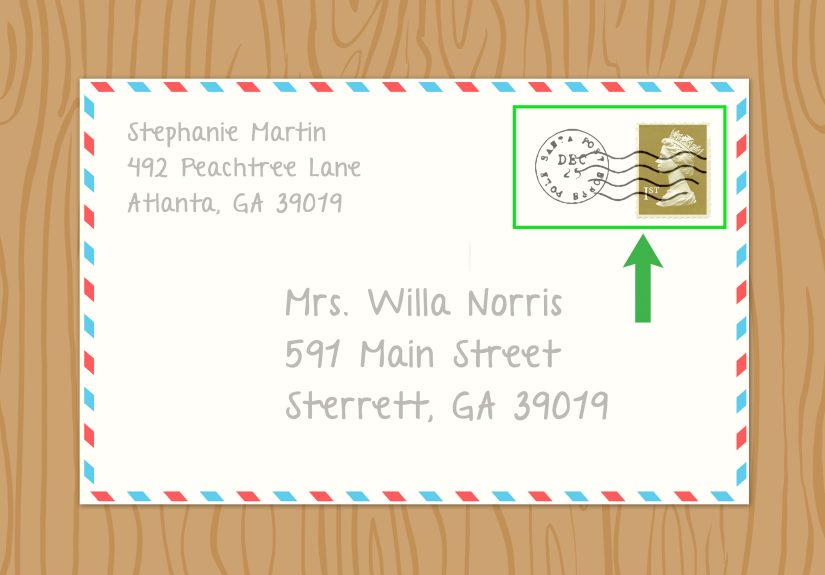
If mailing, address the envelope clearly (return address top left, recipient address centered), add a stamp, and you’re done.
Picture idea: A correctly addressed envelope with a visible stamp placement.
Example Letter to a Friend (Copy, Then Make It Yours)
December 13, 2025
Hi Sam,
I heard that ridiculous song we used to play on repeat during our “we are definitely adults” road trip, and I laughed so hard
I scared my coffee. It instantly made me think of youmostly because no one else would’ve committed that hard to singing the
background harmonies with full confidence and zero accuracy.
Life’s been busy in a mostly good way. Work has been intense, but I’m learning a lot, and I’ve finally started cooking meals
that don’t taste like “sad beige.” I also picked up a new hobbywalking without checking my phone every 12 seconds. It’s going
great. I’ve only walked into one sign so far.
How are you really doing lately? What’s been making you feel excitedor calmor even just “okay”? And what’s one small thing
you’re looking forward to next month?
I’m proud of you, always. Write back when you canno pressure, no deadlines, no guilt. Just you, whenever.
Warmly,
Alex
P.S. I still think about that diner pancake situation at least once a week. Iconic.
Quick Mailing Tips (So Your Letter Doesn’t Tour the Country Without Permission)
Envelope basics
- Return address: top left corner
- Recipient address: centered on the front
- Stamp: top right corner
Print clearly. Keep the address easy to read from arm’s length. If you’re worried about messy handwriting,
type and print a labelyour friendship won’t be disqualified for legibility.
Common Mistakes (and Easy Fixes)
Writing like you’re applying for a mortgage
Friendly letters aren’t formal reports. Use contractions. Use your natural voice. Yes, you may use an exclamation point
if your soul requires it.
Trying to cover an entire year in one letter
You don’t need a full autobiography. Pick a few highlights and one meaningful detail. More letters beats one legendary,
never-finished “master letter.”
Ending abruptly
Give your friend a soft closing: a good wish, a reminder you care, and a question or invitation that makes replying easy.
Real-Life Experiences: What Letter Writing Feels Like (and Why People Keep Doing It)
If you haven’t written a letter in a while, the first experience is usually the same: you sit down with the paper, stare at it,
and suddenly forget everything you’ve ever done in your life. You know you have memories. You know you have words. And yet the page
looks at you like, “So… who are we today?” That awkward first minute is normal. Most people find that once they write a single honest
sentencesomething like “I miss you” or “This reminded me of you”the rest comes easier, because the letter stops being a performance
and turns back into a conversation.
Another common experience: you realize how much you’ve been “updating” friends in tiny digital crumbs. A text here, a reaction emoji there,
a meme that says “this is us” with zero additional context. When you write a letter, you tend to connect the dots. You explain the story
behind the update. You describe what you felt, not just what happened. People often say this is where the magic shows upbecause the letter
becomes less about reporting and more about relating. Your friend doesn’t just learn that you got a new job; they learn what you were nervous
about, what surprised you, and what you’re quietly proud of.
Letters also show up during “in-between” seasons of friendshipwhen you haven’t talked much, but the care never left. In those moments,
a letter can feel safer than a sudden phone call, because it gives your friend time and space to receive you. A gentle line like
“No pressure to respond fast; I just wanted you to have this” can lower the emotional volume while still keeping the connection strong.
That’s why letters are popular for reconnecting after distance, grief, burnout, or big life changes. They carry warmth without demanding
immediate energy.
And then there’s the experience of receiving a lettersomething many people forget until it happens. You see your name on an envelope and
suddenly you’re ten years old again, in the best way. You open it slowly. You notice the handwriting (or the neat printed lines). You catch
small details: a little doodle, a smudge where the pen paused, a P.S. that feels like a wink. These tiny human fingerprints make the message
feel real and present. Even if the content is simple“I hope you’re okay; I’m thinking of you”it lands with more weight because it took time.
Finally, many people discover an unexpected bonus: writing letters makes them feel better, too. Putting gratitude, affection, or honest
reflection into words can be clarifying. You don’t have to force it into “deep” territorysometimes the most healing letters are the playful ones
that remind you who you are together. If you want the easiest way to start, begin with one shared moment and one genuine wish for your friend.
That’s enough. A letter doesn’t have to be perfect. It just has to be true.