Table of Contents >> Show >> Hide
If you grew up in the ’90s, there’s a good chance your first real responsibility in life
wasn’t doing your homework it was making sure your level 12 Bulbasaur didn’t faint before
Pewter City. The original 151 Pokémon are more than game sprites; they’re cultural icons,
meme fuel, and the backbone of countless fan projects that still go viral on platforms like
Bored Panda, Reddit, and Instagram today.
So I gave myself a delightfully unnecessary challenge: parody all 151 original Pokémon, in
order, starting with the first 40 Kanto classics. Think of it as a nostalgia-fueled roast
where every pocket monster gets lovingly dragged for its life choices, design quirks, and
questionable battle logic. It’s very Bored Panda meets Pokédex equal parts fan love and
tongue-in-cheek commentary.
In this article, we’ll walk through the first 40 Pokémon in order, reimagining them as
everyday characters you might meet in your group chat, your office, or that one weird corner
of the internet. Along the way, we’ll talk about why the original 151 still dominate fan art,
parody comics, and viral posts across major U.S. pop-culture sites and what it actually
feels like to commit to drawing, rewriting, and joking about an entire generation of
creatures one by one.
Why Parody the Original 151 Pokémon?
Before we dive into the first 40, it helps to understand why this specific group is such a
goldmine for parody. The original 151 from the Kanto region are the foundation of the
franchise, introduced in the late ’90s through Pokémon Red and Blue in North
America. They’re compact, iconic, and endlessly recognizable from Pikachu merch in big-box
stores to retro card reprints that still sell out in U.S. hobby shops today.
For artists and writers, that familiarity is a superpower. You don’t need to explain who
Charizard is; you just nudge the design or personality a bit and people instantly get the
joke. That’s why so many Bored Panda-style features highlight fan challenges like “draw every
Pokémon as a human” or “turn Pokémon into creepy horror monsters” the basic silhouettes
and personalities are locked into pop culture, leaving plenty of room to play.
Parody is also a great way to show affection without being overly serious. Instead of treating
the Pokédex like sacred scripture, we treat it more like a really dramatic yearbook:
everybody gets a funny caption, a slightly exaggerated personality, and a role in the weird
shared universe that is your childhood memory.
The First 40 Original Pokémon in Order, Parodied
To keep things faithful to the games, the parodies follow the official National Pokédex order.
Here’s how the first 40 Kanto Pokémon look when we drag them gently into real life.
1–9: The Starter Squad With Big Main-Character Energy
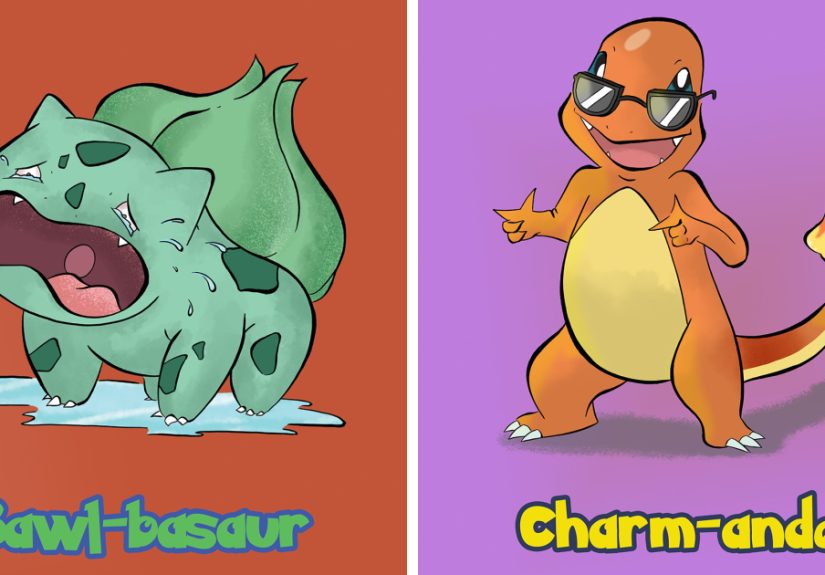
1. Bulbasaur – The plant-based introvert roommate.
Bulbasaur is that friend who insists they’re “low maintenance” but actually comes with
a built-in greenhouse. In parody form, I imagined Bulbasaur as a sleepy college student
who always carries a potted plant like an emotional support fern and somehow keeps passing
classes despite photosynthesizing through lectures.
2. Ivysaur – The glow-up in progress.
Ivysaur is the “after” picture in your fitness journey, except it’s all leg day and leaf day.
The parody version has them halfway between cute and intimidating like someone who bought
one pair of dumbbells and now won’t stop talking about “bulking season.”
3. Venusaur – Backyard BBQ boss.
Venusaur becomes that massive uncle at every family cookout who never leaves the grill.
The giant flower is now a built-in sun umbrella, and the vines are just there to pull you
closer when they say, “You’re not leaving until you try this potato salad.”
4. Charmander – The overcaffeinated intern.
Charmander’s tail flame is basically a stress meter. In parody mode, it flares every time
they get a Slack notification. The little lizard lives on energy drinks and poor life choices,
but you can’t help rooting for them.
5. Charmeleon – The edgy teenager phase.
Charmeleon is Charmander after discovering loud music and hoodies. The parody plays up the
“don’t talk to me” energy: headphones on, tail fire higher, and genuinely dangerous if you
say, “You’ll understand when you’re older.”
6. Charizard – The mid-life crisis sports car.
Charizard is that person who finally gets money and immediately buys something with wings.
In the parody, Charizard poses like a dragon influencer, breathing fire for the camera and
insisting it’s “not about the followers” while absolutely checking every notification.
7. Squirtle – Sunglasses, chaos, repeat.
Squirtle is the friend who always suggests water balloon fights and somehow never gets in
trouble. The parody leans into the Squirtle Squad legacy: tiny turtle, oversized shades,
and a vibe that screams “I did not ask for permission.”
8. Wartortle – The slightly too serious lifeguard.
With fluffy tail and ear fins, Wartortle is reimagined as a pool lifeguard who takes
whistle privileges very seriously. They’re 60% safety instructions, 40% dramatic slow-motion
walks along the edge.
9. Blastoise – Mobile water park dad.
Blastoise, with twin cannons, becomes the suburban dad who buys an overpowered pressure washer
“for the driveway” and ends up cleaning the whole neighborhood. In the parody comic, kids line
up to “ride” the jet streams while Blastoise pretends this is all very normal.
10–15: The Bug Squad and Their Dramatic Life Arcs
10. Caterpie – Tiny anxious noodle.
Caterpie is drawn as a nervous freshman who’s obviously not ready for gym class yet.
Their whole identity is “I swear I get cooler later.”
11. Metapod – Professional napper.
Metapod is someone who turned “self-care” into a lifestyle brand. The parody shows them
wrapped up in a sleeping bag cocoon with a caption: “Cannot. Will not. Do anything
until character development is complete.”
12. Butterfree – Post-glow-up social butterfly.
Butterfree is the friend who went away for a summer and came back with a whole new aesthetic.
The parody version flutters through everyone’s business, spreading support, gossip, or
pollen whichever the group chat needs.
13. Weedle – Outdoor kid covered in scrapes.
Weedle’s horn becomes a bike helmet that’s slightly too big. In the parody, Weedle is that
child who constantly climbs trees, falls out of them, and somehow keeps respawning.
14. Kakuna – “I’m not lazy, I’m transforming.”
Kakuna is reimagined as someone who wears one outfit for three days straight and insists
it’s part of a “rebrand.” Zero movement, maximum stubbornness.
15. Beedrill – HOA villain.
Beedrill becomes the terrifying neighbor who complains about your lawn at 6 a.m.
The twin stingers turn into passive-aggressive “friendly reminders,” delivered at
supersonic speed.
16–22: The Early-Route Bird and Rodent Drama
16. Pidgey – Park pigeon with a side hustle.
Pidgey is drawn like a city bird who’s seen things. They trade breadcrumbs for gossip and
know which trainer drops the best snacks.
17. Pidgeotto – Overconfident teen driver.
Pidgeotto is the version of Pidgey who just got their license and now dive-bombs everyone
at full speed. Hair (feathers) always in the wind, of course.
18. Pidgeot – Luxury airline pilot.
Pidgeot turns into a full-on commercial airline captain with immaculate hair and endless
announcements. “We’ll be landing in Kanto shortly, weather is clear, please keep your
seatbelts fastened while I demolish this opponent.”
19. Rattata – Midnight kitchen raider.
Rattata in parody becomes that roommate who eats your labeled leftovers and swears it
was “an accident.” Tiny, fast, and strangely impossible to catch.
20. Raticate – Energy drink manager.
Raticate is drawn as the stressed convenience-store manager who lives on canned caffeine,
chews on everything, and is constantly on the verge of shouting “WE OPEN AT NINE!”
21. Spearow – Angry group chat member.
Spearow’s entire personality is “all caps.” The parody shows them aggressively live-tweeting
everything that annoys them, wings flapping over a tiny phone screen.
22. Fearow – Your least favorite flight.
Fearow becomes that budget airline that always hits turbulence. Long neck, longer complaints.
The beak is basically a built-in microphone for customer service rage.
23–30: Poison, Sand, and the Nidoran Soap Opera
23. Ekans – Yoga instructor who’s too flexible.
Ekans is reimagined as a chill yoga influencer, coiled into impossible shapes while
whispering “inhale… exhale… now shed everything that no longer serves you.”
24. Arbok – The tattooed bouncer.
Arbok’s chest pattern becomes a massive tattoo. In the parody, Arbok runs security at a
nightclub, using Intimidate as a door policy if you flinch, you’re not getting in.
25. Pikachu – Overworked mascot of everything.
Pikachu is the franchise MVP and gets treated like it, especially in U.S. marketing and
merch. For parody, Pikachu is a celebrity doing endless brand deals: streaming, conventions,
cereal boxes, energy drinks, you name it. Every Thunderbolt is sponsored content.
26. Raichu – Underrated older sibling.
Raichu is drawn as the sibling who has a stable job, a 401(k), and still gets introduced as
“Pikachu’s evolution” instead of by their actual name. Their tail is now a Wi-Fi hotspot that
keeps the whole team online.
27. Sandshrew – Cozy desert burrito.
Sandshrew, with its brick pattern, becomes a living weighted blanket. Imagine a shy hedgehog
that rolls into a ball every time someone suggests a group project.
28. Sandslash – Groundskeeper with serious hardware.
Sandslash in parody is hired by every stadium to aerate the field just by walking across it.
Their claws double as gardening tools and very intense manicure inspo.
29. Nidoran♀ – Soft-spoken with hidden spikes.
Nidoran♀ is drawn as the sweet friend who always brings snacks but will absolutely clap back
if you cross a line. Tiny body, enormous boundaries.
30. Nidorina – Group chat moderator.
Nidorina becomes the one who keeps the drama in check, muting toxic energy and pinning
important messages. Still cute, but clearly in charge.
31–40: Royalty, Moonlight, and Night-Shift Icons
31. Nidoqueen – Protective team mom.
Nidoqueen is the designated driver, financial advisor, and human shield all at once.
The parody shows her carrying everyone’s stuff while casually tanking hits like it’s nothing.
32. Nidoran♂ – Loud but fragile.
Nidoran♂ is portrayed as the guy who talks tough online but immediately apologizes if you
reply with more than one sentence. Spikes outside, marshmallow inside.
33. Nidorino – Overdramatic rival.
Nidorino becomes your self-proclaimed arch-nemesis who isn’t actually competing with anyone
but themselves. Every minor inconvenience is treated like a final boss battle.
34. Nidoking – Heavy metal frontman.
Nidoking’s design already screams rock concert. In parody form, he’s performing on stage,
tail smashing amps while the horn doubles as a mic stand.
35. Clefairy – Crystals, moon water, and vibes.
Clefairy is reimagined as your astrology-obsessed friend who charges crystals in moonlight
and has a separate playlist for each Mercury retrograde.
36. Clefable – Wellness retreat CEO.
Clefable elevates Clefairy’s vibe into a full business model: guided meditations,
moon-themed merch, and a weekend retreat that somehow always sells out.
37. Vulpix – Cottage-core fox influencer.
Vulpix, with six curled tails, becomes a cozy autumn aesthetic icon. Think flannel, candles,
and a “morning in the forest” vlog series.
38. Ninetales – Ancient drama queen.
Ninetales is portrayed as a glamorous, somewhat terrifying immortal being who remembers every
slight from the last 1,000 years. The fur is always perfect. The grudges are, too.
39. Jigglypuff – Karaoke menace.
Jigglypuff is the friend who insists on “just one more song” at 2 a.m. In parody form,
they wield a microphone like a weapon and treat every nap you take as a personal insult.
40. Wigglytuff – Bouncer of the nap club.
Wigglytuff turns into a squishy but terrifying sleep enforcer, making sure everyone gets
eight hours or else. Puffy exterior, zero tolerance for bad vibes past midnight.
Why Bored Panda-Style Pokémon Parodies Keep Going Viral
You’ll find projects like this parodies, redesigns, “what if Pokémon were human,” or
“I drew them into real-life photos” all over art platforms, social media, and
Bored Panda-style features. They tend to perform incredibly well because they blend three
viral ingredients: nostalgia, novelty, and visual storytelling.
- Nostalgia: The original 151 are instantly recognizable, even to casual fans.
- Novelty: A fresh twist parody, horror, realism, or humor makes old designs feel new.
- Shareability: Short captions plus strong visuals are perfect for social feeds.
In the age of algorithm-driven feeds, these projects work because they hook both long-time
fans and curious newcomers. People who remember the games or the trading cards feel seen,
while younger audiences just enjoy the humor and art style. That blend makes
“I Parodied All 151 Original Pokémon”-type posts exactly the kind of content that
keeps resurfacing on U.S. pop-culture sites, Pinterest boards, and fan communities.
What I Learned From Parodying All 151 Original Pokémon (First 40 and Beyond)
Turning the first 40 Pokémon into a full parody series was a lot more than just drawing funny
faces and writing snarky captions. By the time you’ve reimagined Bulbasaur as a plant-parent
college student and Wigglytuff as a sleep-obsessed bouncer, a few patterns start to appear
and they say a lot about why this franchise has such staying power.
First, the designs are ridiculously adaptable. You can slide almost any Gen-1 Pokémon into a
modern human scenario office politics, online culture, wellness trends, fandom life and
it still makes sense. That adaptability is part of why the original 151 keep getting reused in
everything from mobile games to playful search easter eggs that let people “catch” all 151
right inside a browser.
Second, committing to all 151 is a masterclass in managing a long creative project. The first
few entries feel exciting and fresh you’re buzzing with ideas and visual jokes. Somewhere
around Pokémon number 27, you realize you’ve signed up to do this over and over again, and
the challenge shifts from “Can I think of something funny?” to “Can I stay consistent and keep
leveling up the ideas?”
That’s where structure helps. I started treating each group of Pokémon like a themed chapter:
starters as main-character energy, bugs as a glow-up story, early birds as a chaotic commute.
Instead of reinventing everything from scratch, I used those themes as rails. Within each
theme, there was room to improvise: one character becomes a social media addict, another
turns into a night-shift worker, another becomes a walking self-care meme.
The biggest surprise was how often the parodies turned into tiny character studies. When you
write a joke about Pikachu being an overworked mascot or Raichu being an underrated older
sibling, you’re really talking about how we treat icons and side characters in real life.
People recognized themselves, their friends, or their coworkers in these exaggerated
Pokémon-turned-humans and that’s when the comments start to fill with things like “Oh no,
I’m definitely a Metapod” or “My boss is 100% a Ninetales.”
From a practical point of view, parodying all 151 also teaches you to balance fan respect with
playful critique. You can poke fun at how fragile Rattata is or how dramatic Nidorino looks
without dunking on the source material. That balance is crucial if you want to keep the tone
light and Bored Panda-friendly: you’re not roasting to destroy; you’re roasting to bond.
Finally, working through the list in official Pokédex order adds a strangely satisfying sense
of progression. Each new parody feels like another entry in your own custom “humor Pokédex.”
By the time you clear the first 40, you’ve established a rhythm, a visual language, and a
tone that can carry you through the rest of the 151 and maybe even into later generations
if you’re brave (or chaotic) enough to keep going.
So whether you’re here for Pokémon nostalgia, for Bored Panda-style comics, or just for the
joy of watching beloved characters get gently dragged into modern life, this first batch of
40 is only the beginning. The rest of the Pokédex is waiting and every single one of those
original 151 has at least one parody version living rent-free in someone’s imagination.