Table of Contents >> Show >> Hide
- What “Land Art Mandalas” Actually Are (And Why I’m Obsessed)
- My Ground Rules: Respect the Place, Respect the Materials
- How I Build a Seasonal Mandala on a Walk
- Design Tricks That Make a Mandala Pop Without Trying Too Hard
- Season-by-Season: Materials I Look For (And What They Do Best)
- Photo Gallery: 29 Pics of Mandalas Made From a Walk’s Worth of Seasons
- Pic 1: The “First Leaf of Fall” Centerpiece
- Pic 2: Pebble Clockwork
- Pic 3: Pine Needle Halo
- Pic 4: Petal Confetti Gradient
- Pic 5: Acorn Dot Border
- Pic 6: Bark Spiral
- Pic 7: Snow-and-Stone Minimalism
- Pic 8: Seed Pod Starburst
- Pic 9: Moss Accent (In a Safe Spot)
- Pic 10: Two-Texture Yin-Yang
- Pic 11: The “All One Color” Challenge
- Pic 12: Feather as the Plot Twist
- Pic 13: Rain-Glossed Leaves
- Pic 14: Grass Weave Ring
- Pic 15: Cherry Blossom Scatter
- Pic 16: “Found on the Trail Edge” Palette
- Pic 17: Twigs as Typography
- Pic 18: Shell-and-Sand (If You’re Allowed)
- Pic 19: Ice Shard Rosette
- Pic 20: Leaf Vein “Sunburst”
- Pic 21: The “Three Materials Only” Mandala
- Pic 22: Tiny Mandala, Big Detail
- Pic 23: Giant Ring for the Wide Shot
- Pic 24: The “Edge of Light” Composition
- Pic 25: Autumn Ombré Perfection (Kind Of)
- Pic 26: Pebble Mandala on River Gravel
- Pic 27: The “Wind Collaborated” Version
- Pic 28: “After” Photo: Dispersal Moment
- Pic 29: My Hands in Frame
- Why This Tiny, Temporary Art Feels Like a Big Deal
- Common Mistakes I Made So You Don’t Have To
- Conclusion: Take Only Pictures, Leave Only…a Perfect Circle
- Field Notes: of Real-World Mandala-Making Experience
I don’t bring a canvas. I bring pockets. And possibly an emotionally supportive tote bag.
On my walks, I build mandalastemporary, circular designs made from whatever the season is casually tossing onto the ground:
maple confetti, pine needles, seed pods, pebbles, petals, and that one feather that makes you feel like nature is flirting.
They don’t last forever (sometimes they don’t even last through my sneeze), but that’s kind of the point.
If you’ve ever looked down on a trail and thought, “This leaf pile has potential,” welcome. You’re among your people.
Below is my land-artist approach to making nature mandalas: what they are, how to build them, how to do it respectfully,
and 29 “pics” worth of caption ideas you can use as a ready-made gallery.
What “Land Art Mandalas” Actually Are (And Why I’m Obsessed)
Land art (sometimes called earthworks or environmental art) is art that uses the landscape as a collaborator
instead of a backdrop. Historically, it took off in the late 1960s and 1970s, when artists started making work outside the gallery,
often in remote places, sometimes on a massive scale, and frequently with the idea that documentation (photos/film) matters as much as
the object itself.
A mandala, in its traditional roots, is a symbolic diagram used in Hindu and Buddhist practices as an aid for meditation
and ritualoften a structured cosmos in miniature. My “trail mandalas” are not religious objects and I don’t pretend they are.
I’m borrowing the geometrythe circle, the symmetry, the radiating patternand using it as a mindful design framework in nature.
The goal isn’t to mimic sacred forms; it’s to make a small, respectful, temporary artwork that nudges me to pay attention.
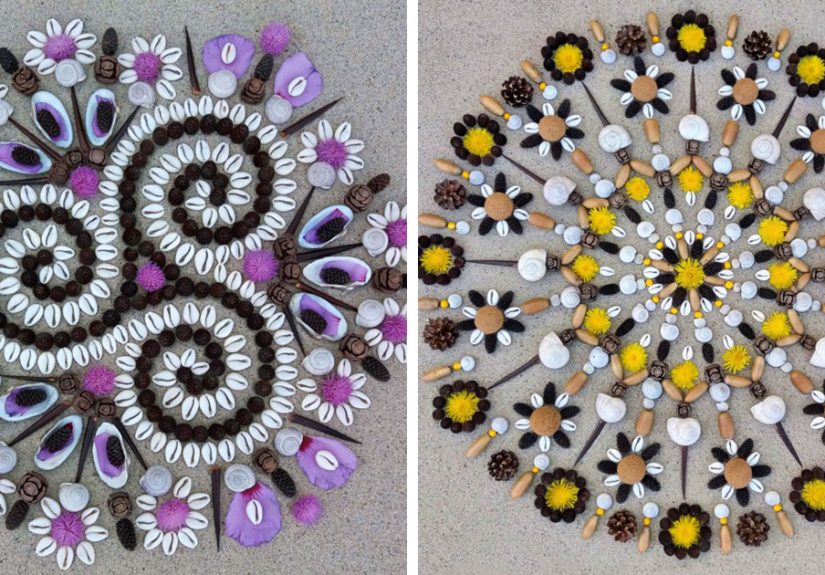
So, in plain English: a land-art mandala is a circular design made on-site with found natural materials.
It’s the artistic cousin of “arranging your fries by size,” except with leaves, and it comes with better lighting.
My Ground Rules: Respect the Place, Respect the Materials
1) “Leave What You Find” is not a suggestion
Before we talk design, we talk ethics. Many public lands (especially protected areas) expect you to leave rocks, plants,
and natural objects where you found them. That’s not anti-art; it’s pro-ecosystem.
Natural objects can be habitat, nutrients, or part of the experience for the next visitor.
My workaround is simple: I build with what’s already down (fallen leaves, shed bark, twigs on the trail edge),
I avoid stripping living plants, and I treat the finished piece like a pop-up exhibitphotograph it, then disperse it gently
so nothing becomes a permanent “structure.” If I’m somewhere with stricter rules, I don’t make one there. Period.
(My ego can survive. My mandala does not need a permit. My ego does not have a permit.)
2) Don’t feed the chaos: avoid moving things that spread pests or invasives
In some environments, moving plant material can spread seeds, fungi, or hitchhiking pests. If you’re in a sensitive area,
keep materials local and minimal. When in doubt, stay in your yard or a place where you’re allowed to handle what’s on the ground.
Art is fun. Biosecurity is not fun. Choose fun and responsible.
3) Wildlife gets the right of way
If birds are nesting nearby, if insects are actively using a patch of ground, if a place looks like a dining room for squirrels,
I move along. My art practice does not outrank anyone’s actual survival plan.
4) Safety is part of the aesthetic
I skip unknown berries, spiky plants that cause rashes, and anything that looks like it came from a “Do Not Touch” museum exhibit,
including sharp metal, glass, and mystery goo. I also avoid stacking heavy rocks in ways that can topple.
How I Build a Seasonal Mandala on a Walk
My method is equal parts design thinking and scavenger hunt. Here’s the repeatable process that keeps me from creating
“leaf chaos with delusions of grandeur.”
-
Pick a durable spot. I choose a flat, already-impacted surface (packed dirt, gravel, sand, a clearing off-trail),
not fragile plants or delicate groundcover. -
Collect a small palette. I gather from the immediate areausually 3 to 6 “materials families”:
for example, yellow leaves, red leaves, pine needles, pebbles, and seed pods. - Sort before you start. I line up materials by color, size, or texture. Sorting is not busyworksorting is the secret sauce.
-
Choose a center anchor. One standout element goes in the middle: a pine cone, a smooth stone, a flower head, a curled leaf.
The center is the “opening sentence” of the mandala. -
Build outward in rings. I place materials in repeating patterns: petals in a circle, then leaves like sun rays,
then pebbles as a dotted border. - Use symmetry, not perfection. Symmetry is calming; perfection is exhausting. I aim for balance and let the wind have an opinion.
-
Photograph it fast. The light changes, people walk by, and your best leaf will attempt an escape.
I take a few overhead shots and a couple of close-ups for texture. -
Disperse respectfully. If appropriate for the location, I gently scatter materials back where they came from.
The trail returns to being a trail, not my personal gallery.
Design Tricks That Make a Mandala Pop Without Trying Too Hard
Use contrast like you mean it
A mandala becomes instantly “photo-ready” when you pair opposites: light petals against dark soil, pale stones against pine needles,
bright leaves against wet sand. If everything is the same tone, it reads like a camouflage test.
Repeat a shape, then break it once
Repetition creates rhythmleaf, leaf, leaf, leafthen one unexpected piece (a feather, a seed pod, a different color leaf)
becomes the “plot twist.” It draws the eye without turning the whole design into a yard sale.
Think in “rings,” not “random”
Rings are a cheat code. Even a simple ring of pebbles looks intentional. Add a second ring with a new texture and suddenly you’re
“composing.” Add a third ring and people start calling you “an artist” instead of “someone arranging sticks.”
Work with scale
Big leaves on the outside, smaller pieces toward the center creates depth. Or flip it: tiny mosaic center, bold leaf rays outside.
Either way, scale changes keep the viewer moving.
Season-by-Season: Materials I Look For (And What They Do Best)
Spring: soft color, delicate drama
Spring is petals and fresh greensbeautiful, but fragile. I use petals like paint: gradients, light halos, gentle spirals.
If it’s windy, I switch to heavier anchors (small stones, damp leaves) and use petals as accents instead of the whole structure.
Summer: texture and abundance
Summer gives you grasses, seed heads, pine needles, and a ridiculous range of greens. I lean into texture: woven rings, spiky radiating lines,
and “sunburst” patterns that feel energetic. It’s the season for bold geometry.
Fall: the main character season
Autumn leaves are basically nature’s free craft store. I build ombré ringsfrom lemon yellow to orange to deep redand let leaf veins do the detailing.
Acorns and nuts make excellent “beads” for dotted borders.
Winter: minimalism with attitude
Winter mandalas are often monochrome: stones on snow, ice shards in a circle, dark bark against white ground.
The trick is pattern: repeating arcs, tight spirals, or alternating textures. Winter is where “less” becomes “wow.”
Photo Gallery: 29 Pics of Mandalas Made From a Walk’s Worth of Seasons
I can’t embed your actual photos here, but I can give you 29 “picture prompts” that function like captions.
If you’re publishing a photo-heavy post, drop your images above each caption and you’ve got a ready-made gallery structure.
Pic 1: The “First Leaf of Fall” Centerpiece
A single crimson maple leaf at the center, surrounded by a pale-yellow ring like a spotlight.
Pic 2: Pebble Clockwork
Alternating light and dark stones in repeating wedgeslike a tiny, polite gear.
Pic 3: Pine Needle Halo
A soft, fuzzy ring of pine needles with a sharp, clean stone border that screams “intentional.”
Pic 4: Petal Confetti Gradient
Pink-to-white petals fading outward like watercolor, anchored by a single seed pod.
Pic 5: Acorn Dot Border
Leaves as rays, then a dotted ring of acorns that looks like nature’s typography.
Pic 6: Bark Spiral
Curled bark strips arranged into a spiral that feels like it’s moving even when it’s not.
Pic 7: Snow-and-Stone Minimalism
Dark stones on fresh snowsimple circle, big contrast, maximum satisfaction.
Pic 8: Seed Pod Starburst
Radiating seed pods like sun rays, with a calm pebble ring holding the chaos together.
Pic 9: Moss Accent (In a Safe Spot)
Loose moss bits used sparingly as a green glowno ripping, no stripping, just what’s already down.
Pic 10: Two-Texture Yin-Yang
Half leaves, half stonesclean divide, soft curve, instant “I meant to do that.”
Pic 11: The “All One Color” Challenge
Only browns: bark, dried leaves, mud-dark stonespattern does all the talking.
Pic 12: Feather as the Plot Twist
A symmetrical leaf mandala interrupted by one featherlike the punchline to a quiet joke.
Pic 13: Rain-Glossed Leaves
Wet leaves reflecting light, arranged into concentric rings with a shiny pebble center.
Pic 14: Grass Weave Ring
Long grasses braided into a circle, then filled with tiny stones like a mosaic.
Pic 15: Cherry Blossom Scatter
Petals placed in gentle clusters, with negative space making it feel airy and calm.
Pic 16: “Found on the Trail Edge” Palette
Everything gathered without stepping off-trailproof constraints can make better art.
Pic 17: Twigs as Typography
Short sticks aligned like strokes in a fonttight, graphic, surprisingly modern.
Pic 18: Shell-and-Sand (If You’re Allowed)
Shell fragments in rings on sandsoft gradients, beach-friendly geometry.
Pic 19: Ice Shard Rosette
Thin ice pieces arranged like petalsphotograph quickly before physics changes its mind.
Pic 20: Leaf Vein “Sunburst”
Veiny leaves pointed outward, making a spiky halo like nature’s crown.
Pic 21: The “Three Materials Only” Mandala
Leaves, stones, needleslimited palette, high clarity, no visual clutter.
Pic 22: Tiny Mandala, Big Detail
Palm-sized design with micro-patternslike jewelry, but biodegradable.
Pic 23: Giant Ring for the Wide Shot
Large circle meant for a dramatic overhead photoyour shadow cameo included.
Pic 24: The “Edge of Light” Composition
Mandala half in shade, half in sunlightlighting becomes part of the design.
Pic 25: Autumn Ombré Perfection (Kind Of)
Yellow-to-orange-to-red leaf ringsslightly messy, totally beautiful.
Pic 26: Pebble Mandala on River Gravel
Subtle tonal differences in stonesquiet design that rewards close looking.
Pic 27: The “Wind Collaborated” Version
A ring partially rearranged by breezeproof impermanence has a sense of humor.
Pic 28: “After” Photo: Dispersal Moment
A shot of the mandala being gently scatteredprocess, not possession.
Pic 29: My Hands in Frame
A simple close-up: placing the last leaf, showing scale, texture, and the human behind the pattern.
Why This Tiny, Temporary Art Feels Like a Big Deal
Making nature mandalas hits a sweet spot between attention and release.
You slow down to notice color, shape, and texture. You focus on the present moment because the present moment is literally trying to blow away your design.
There’s also a well-supported idea in health and psychology research that time in nature is associated with benefits like lower stress,
improved mood, and better attention. Add a mindful, hands-on activity (gentle movement, pattern-building, sensory detail),
and you’ve basically engineered a tiny “brain reset” with leaves as the user interface.
And finally: the impermanence. Traditional mandalas can carry teachings about change and letting go.
Even in a casual, non-religious nature-art practice, the disappearing act is a feature, not a bug.
You can put care into something without needing to keep it.
Common Mistakes I Made So You Don’t Have To
- Going too big too fast: Start small. A clean 12-inch mandala beats a sloppy 6-foot panic circle.
- Ignoring the background: The ground is your canvas. If it’s busy, simplify the materials.
- Collecting first, designing later: Sort and plan rings before you commit to a pattern you can’t finish.
- Using only one texture: Mix soft and hard, matte and glossy, smooth and jagged for depth.
- Forgetting the “leave it better” mindset: Don’t trample plants, don’t block trails, and don’t leave a permanent structure.
Conclusion: Take Only Pictures, Leave Only…a Perfect Circle
A seasonal mandala is a tiny celebration of what’s happening right nowthis week’s color palette, this trail’s textures,
this weather’s mood. It’s art that doesn’t demand storage, shipping, framing, or explaining to your roommate why there’s a pine cone shrine on the table.
If you try it, start with the simplest version: one center object, one ring, one repeating pattern. Then take the photo,
say thank you to the place (silently or out loudno judgment), and let the materials go back to being part of the landscape.
You’ll walk away with a pictureand a calmer brainwithout taking anything that wasn’t yours to keep.
Field Notes: of Real-World Mandala-Making Experience
The first time I tried making a mandala on a walk, I learned an immediate truth: nature does not care about my creative vision.
I had arranged a perfect ring of dry leavesperfect symmetry, satisfying color gradient, the whole “look at me, I’m basically a forest architect” vibe
and then a gust of wind turned it into abstract expressionism in under two seconds. I remember laughing out loud because it was the most honest critique
I’ve ever received. Since then, I plan for wind the way bakers plan for ovens: it’s not optional, it’s part of the process.
If the day is breezy, I use heavier anchors (stones, seed pods, damp leaves) and keep the delicate stuffpetals, needles, fluffcloser to the center.
Another lesson: the best materials are the ones you notice, not the ones you chase. Early on, I’d hunt for “special” pieces like I was on a reality show:
“Today, we’re searching for the rare, camera-ready leaf.” That mindset made the walk feel like a scavenger race. Now, I let the trail offer a palette.
If the ground is mostly pale grasses and muted stones, I make something subtle and graphic. If autumn hands me a riot of reds and golds, I lean into the drama.
The mandala becomes a record of the walk instead of a demand I place on it.
People interactions are their own genre. Kids are usually the best: they understand instantly, then want to help, then invent rules,
then attempt to name the mandala (“This one is called ‘Sun Pizza’”). Adults either smile and keep walking or approach like they’ve discovered an ancient site.
I’ve had strangers whisper, “Is this for meditation?” and I’ve had others ask if it’s a wedding proposal. (It was not. Imagine proposing with pine needles.
Romantic, yes. Also: risky.) When I’m in a busy area, I keep designs small, off to the side, and quick to dismantle so I’m not creating a trail obstacle
or a social-media “must-stop-here” bottleneck.
The biggest shift, though, has been emotional. Mandalas taught me to enjoy the build and release the outcome.
I can spend twenty minutes placing pieces with care, take a photo, and then let the whole thing disappearby wind, by light change, by my own dispersal.
That practice leaks into the rest of life in a good way. It’s a reminder that attention is valuable even when nothing is permanent.
Some days the mandala is crisp and symmetrical; other days it’s lopsided and still meaningful because I was present for it.
On the walk back, the trail looks differentlike my eyes have been recalibrated to see pattern, color, and small beauty everywhere.