Table of Contents >> Show >> Hide
- Why Iceland’s Dogs Feel Like Part of the Landscape
- Meet the Icelandic Sheepdog: Iceland’s Native Charmer
- How to Photograph Dogs in Iceland Without Becoming a Popsicle
- My 40 Captivating Photos Of Iceland’s Canine Residents
- Dog Etiquette in Iceland: How to Be a Good Visitor (Even If You’re Not the One Barking)
- Planning Your Own “Ice and Dogs” Photo Hunt
- Extra Field Notes: of Ice-and-Dog Experiences (The Good, The Windy, and the Hilarious)
- Conclusion
Iceland sells itself with glaciers, volcanoes, waterfalls, and the kind of wind that makes you question every life choice that led you to buy a “lightweight” jacket.
But here’s the plot twist: the real locals who steal your heart aren’t always the puffins or the Icelandic horses.
Sometimes they’re dogstrotting through snowy streets like they own the place, posing beside lava fields like they’re paid influencers, and staring at you with the calm confidence of someone who knows exactly where the nearest hot dog stand is.
This is a photo-essay-style guide to Iceland’s canine residents: the fluffy farm helpers, the city-side companions, and the Icelandic Sheepdogan ancient, bright-eyed herder with a tail curled like a question mark and a personality that says, “Yes, I will be your friend. Immediately.”
Along the way, you’ll get practical tips for photographing dogs in cold weather, how to stay respectful (and warm), and 40 captions that read like a postcard written by a camera with feelings.
Why Iceland’s Dogs Feel Like Part of the Landscape
Iceland’s scenery is dramatic by default. A normal Tuesday can include black-sand beaches, steaming geothermal pools, and a mountain that looks like it was designed by a fantasy-novel cover artist.
Dogs fit into that drama surprisingly well. Thick coats, sturdy builds, and an “I’m fine, you’re the one shivering” vibe make many Icelandic dogs look perfectly at home against snow, basalt columns, and mossy lava.
There’s also a quirky historical edge to Iceland’s dog storyespecially in Reykjavík. For decades in the 20th century, dog ownership in the capital was heavily restricted and, for a long stretch, effectively banned.
Public health concerns and city-life logistics shaped those rules, and the ripple effects still show up today in how people talk about pets, public space, and what counts as “normal” in a city built for weather that changes its mind hourly.
Meet the Icelandic Sheepdog: Iceland’s Native Charmer
If Iceland had a national “goodest dog,” the Icelandic Sheepdog would be the obvious candidate. It’s Iceland’s only native dog breedan energetic, Nordic spitz-type herder that historically helped manage livestock in rugged terrain.
In modern life, it’s often a devoted companion: alert, bright, and famously friendly, with a talent for turning strangers into immediate acquaintances.
Personality and behavior you’ll actually notice in photos
The Icelandic Sheepdog’s expression tends to read as cheerful and engagedears up, eyes bright, body language that says, “What are we doing next?”
They’re also known for being vocal. That can be a feature, not a bug: a bark mid-action can add energy to a frame, especially if you catch the moment a fluffy face becomes a joyful exclamation point.
Looks that love the camera
That double coat photographs beautifully in Icelandic light, especially on overcast days when the sky acts like a giant softbox. Their tails curl over the back, their ears are expressive, and their coats often show rich color patterns that pop against snow or lava rock.
Translation: if you’re chasing “captivating,” this breed is basically a shortcut.
How to Photograph Dogs in Iceland Without Becoming a Popsicle
Dog photography is half timing, half comedy, and half bribery. Yes, that’s three halves. Welcome to the craft.
The good news: Iceland’s cold air can look crisp in photos, and moody skies can create dramatic backgrounds. The challenge is keeping your hands functional and your camera happy.
1) Plan for cold-weather camera reality
Batteries drain faster in cold temperatures. Keep spares in an inside pocket where body heat helps them stay lively. If your camera starts acting tired, swapping to a warm battery can feel like giving it coffee.
Also, protect your gear from wind-driven moisturebecause Icelandic weather loves surprise plot twists.
2) Use attention cues ethically
If you’re photographing a dog with an owner nearby, ask before using treats or toys. A squeaker can be magic, but owners may have dietary rules or training preferences.
For street moments, patience beats persuasion: watch the dog’s rhythm, then photograph when they naturally pause, look around, or trot into good light.
3) Get low, simplify backgrounds
Dogs look more heroic when you shoot closer to their eye level. Snow, black sand, and moss can become clean, minimal backdropsbasically nature’s studio.
If the scene feels busy, shift your position a few feet; Iceland’s landscapes are so bold that even small changes can give you a completely different frame.
4) Prioritize comfort and safety
Cold, wet conditions can stress animals (and humans who insist they’re “totally fine”). If a dog is shivering or seeking shelter, that’s your cue to stop.
And if you’re out walking with a dog in wintry conditions, wipe paws after exposure to road salt or de-icing chemicals when applicable.
My 40 Captivating Photos Of Iceland’s Canine Residents
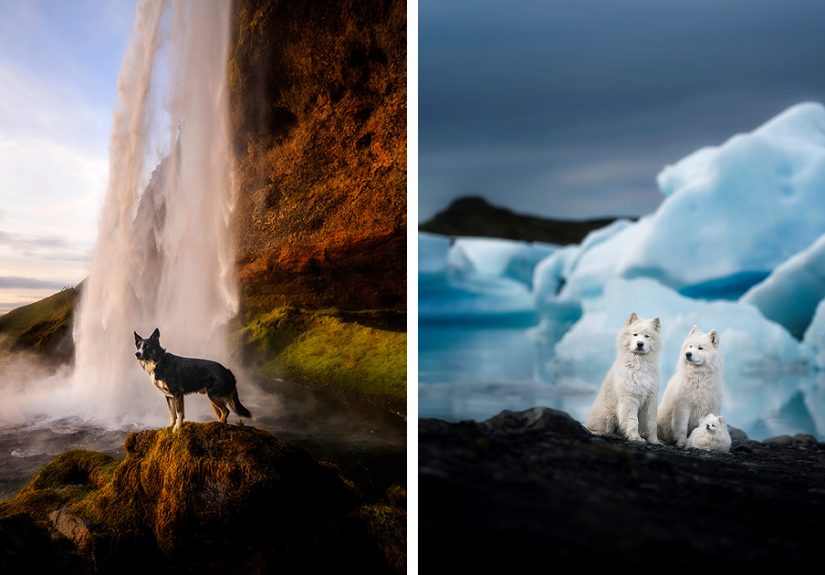
The photos below are presented as caption-storieseach one a moment that captures what it feels like to meet Iceland through its dogs: curious, resilient, hilarious, and oddly photogenic.
(If your camera roll could talk, it would probably ask for a snack.)
- Photo #1: A fluffy Icelandic Sheepdog on a snowy lane, tail curled like a cinnamon roll, looking straight into the lens as if to say, “You’re late.”
- Photo #2: Reykjavík sidewalk scene: a small city dog in a tiny coat, strutting past colorful corrugated houses like it’s on a runway.
- Photo #3: Farmyard guardian: a herding dog perched on a slight hill, watching sheep with the focus of a security camera that also enjoys belly rubs.
- Photo #4: Wind test: a dog’s fur blown sideways near the coastproof that Iceland’s breeze is not a breeze, it’s a personality.
- Photo #5: The “lava-field pause”: a dog standing on black rock, framed by moss so neon it looks edited (it’s notnature is just showing off).
- Photo #6: Golden Circle moment: a dog’s nose close to steaming ground, curiosity battling common sense. Curiosity wins.
- Photo #7: A sleepy café companion: chin on paws, eyes half closed, clearly judging the espresso culture as “acceptable.”
- Photo #8: Snow zoomies: legs blurred, ears flying, joy in motionphotographic evidence that happiness has four paws.
- Photo #9: The “I found a stick” portraitexcept the stick is basically a small tree, because Iceland doesn’t do subtle.
- Photo #10: Harbor lookout: a dog sitting near fishing boats, staring at the sea like it has very serious thoughts about fish.
- Photo #11: A shepherd’s helper: an Icelandic Sheepdog glancing back at a farmer, waiting for the next cue with eager, polite intensity.
- Photo #12: Northern light glow (the subtle kind): a twilight shot with soft green in the sky and a dog silhouette that looks like a storybook cover.
- Photo #13: Black-sand beach trot: pawprints in dark sand, white foam behind, and a dog that looks like it’s running in a music video.
- Photo #14: “Are you filming?” facehead tilt included, because Icelandic dogs apparently study charisma.
- Photo #15: A polite greeting scene: two dogs sniff, pause, and then stand side-by-side like they’re now co-hosts of the same podcast.
- Photo #16: Snow freckles: tiny ice crystals on whiskers, making the dog look older and wiser than any of us deserve.
- Photo #17: Street mural match: a dog posed in front of bright wall art, accidentally color-coordinated like it planned the whole thing.
- Photo #18: The “I heard something” alertears up, body still, eyes locked. It’s probably a snack bag from three blocks away.
- Photo #19: A cozy cabin window: dog inside, nose fogging the glass, watching snow fall like it’s binge-watching weather.
- Photo #20: Cliffside caution: dog near a viewpoint, leashed and calm, proving responsible travel can still look cinematic.
- Photo #21: The “hot spring escort”: a dog walking near a geothermal area with that confident “I know the safe path” energy.
- Photo #22: A snow-dusted tail curl captured mid-waglike a fluffy comma punctuating the sentence of the moment.
- Photo #23: Barn-door portrait: warm wood tones behind a thick-coated dog, eyes bright, expression soft and open.
- Photo #24: Rain gear reality: wet fur, determined face, and a human hand holding an umbrella that the wind is politely insulting.
- Photo #25: “Tiny dog, huge attitude”: a small companion dog staring down a gust like it owes money.
- Photo #26: Frosty paws close-up: careful framing that shows texturepads, fur, and the delicate sparkle of snow.
- Photo #27: A dog’s reflection in a puddle, doubling the drama: twice the dog, twice the mood.
- Photo #28: Fence-line guardian: a farm dog pacing the boundary, not anxiousjust proudly on duty.
- Photo #29: “Throw it again” eyes: the universal dog expression that can power small cities if converted into electricity.
- Photo #30: A dog beside stacked lava rocks, looking like it’s about to explain Icelandic geology in a calm voice.
- Photo #31: Snowy nose boop: a close-up with shallow depth of fieldcrisp nose, soft background, maximum cuteness.
- Photo #32: City park sprint: a dog chasing a ball across pale grass, with winter light making everything look gently silver.
- Photo #33: Two dogs sharing a viewpoint, both staring into the distance like they’re planning a novel together.
- Photo #34: The “windproof ears” moment: ears pinned back, eyes still smilingan Icelandic weather classic.
- Photo #35: A herding dog mid-turn: body curved, paws planted, motion frozen like choreography.
- Photo #36: Cottage doorway: a dog sitting like a host, as if to say, “Welcome. Remove your shoes. Admire my fur.”
- Photo #37: Snowflakes on eyelashes: the softest details, the kind you only notice when you slow down.
- Photo #38: A dog running along a quiet road, mountains far behindsmall subject, big world, perfect story.
- Photo #39: The “I’m done” flop: dog lying in snow, happy but exhausted, making the strongest argument for hot cocoa.
- Photo #40: Final portrait at dusk: the dog looks back over its shoulder, light fading, expression gentlelike Iceland saying goodbye through fur and eyes.
Dog Etiquette in Iceland: How to Be a Good Visitor (Even If You’re Not the One Barking)
Photographing dogs ethically is simple: respect space, respect owners, and respect the dog’s mood.
If an animal seems uncomfortable, don’t chase the shotno photo is worth stressing a living creature.
Quick etiquette checklist
- Ask first: If an owner is present, ask before photographing up close or offering treats/toys.
- Stay aware: Keep a safe distance from wildlife and sensitive areasespecially in winter conditions.
- Leash rules matter: Use a leash where required and around roads, cliffs, and high-wind viewpoints.
- Mind paws and fur: In icy urban areas, wipe paws after exposure to salt or chemicals when relevant.
- Watch the weather: Wind chill can turn “fine” into “not fine” fastshort outings can be smarter than long slogs.
Planning Your Own “Ice and Dogs” Photo Hunt
You don’t need a once-in-a-lifetime expedition to capture Iceland’s canine charm. You need a few smart habits:
keep your camera accessible, your hands warm, and your expectations realistic.
Dogs won’t pose on command just because you flew a long way. They will, however, reward patience with moments that feel unscripted and honest.
Simple ways to increase your chances of great shots
- Go where people walk: Parks, harbors, quiet neighborhoods, and scenic trails (while respecting rules) are natural dog zones.
- Chase soft light: Overcast skies can be idealless harsh contrast, more fur detail.
- Shoot sequences: Don’t hunt “the one frame.” Shoot a short burst during movement and pick the best expression later.
- Bring tiny comforts: Hand warmers, a microfiber cloth for lenses, and a dry pocket for spare batteries.
- Keep it kind: If a dog approaches you, let the moment happen. If it doesn’t, don’t force it.
Extra Field Notes: of Ice-and-Dog Experiences (The Good, The Windy, and the Hilarious)
The funniest thing about photographing dogs in Iceland is that the “hard part” isn’t always the dog. It’s the weather, the light, and your own optimism.
You start a walk thinking, “This is perfect! I’ll get a dramatic shoreline portrait!” and ten minutes later you’re learning new meanings of the word “horizontal rain.”
Meanwhile, the dog you’re hoping to photograph is thriving. Not survivingthriving. It’s trotting like it scheduled the storm for aesthetic reasons.
One of the most useful lessons is to treat every outing like a short story, not a feature film. In Iceland, conditions can shift quickly, so you learn to build a habit of capturing small moments:
the way a dog pauses before stepping onto a patch of ice, the quick glance back at its person, the little bounce when it realizes you’re about to toss something.
Those moments stack into a narrative that feels more real than a perfectly staged shot.
Another lesson is to watch the dog’s comfort before your own ambitions. Cold isn’t just “cold”; it’s cold plus wet plus wind.
You can see it when a dog’s body language changes: the playful trot becomes a faster, more purposeful walk, or the dog starts angling toward shelter.
When that happens, the best “experience” is knowing when to quitbecause the goal isn’t a heroic photo session. The goal is a good day for everyone involved.
Photographing in snow teaches you to simplify. Snow is nature’s blank canvas, and dogs become the subject instantly.
You start noticing composition basics more clearly: clean backgrounds, leading lines of pawprints, soft light on fur, and the drama of a dark nose against white space.
You also discover that Icelandic landscapes offer built-in contrastblack sand, dark rock, green mossso your frames can feel graphic and bold even without fancy editing.
There’s also something quietly moving about how dogs connect people. A friendly dog encounter can break the ice faster than your best travel joke.
When a dog looks at you with open curiosity, it invites conversation with its owner, and suddenly you’re not just “a visitor with a camera”you’re a person sharing a small moment.
That’s the real souvenir: a tiny exchange of trust, a laugh about the wind, and a photo that reminds you how warm a world can feel even when the temperature is doing its best villain impression.
In the end, “In the Land of Ice and Dogs” isn’t just about cold landscapes and cute faces. It’s about contrast: harsh weather and soft fur, wild terrain and gentle companionship,
a place that looks intimidating from afar but feels welcoming up closeespecially when a dog decides you’re worth a sniff and a stare.
If you leave Iceland with 40 dog photos, great. If you leave with one photo that makes you smile every time you see it, that’s even better.
Conclusion
Iceland’s dogs belong to the landscape in a way that feels both ordinary and magical: ordinary because they’re living their daily lives, magical because their daily lives happen beside glaciers and lava fields.
Whether you’re captivated by the Icelandic Sheepdog’s bright, friendly energy or charmed by city pups strutting through Reykjavík, one thing is consistentdogs make Iceland feel more human.
Bring warmth, patience, and respect, and you’ll come home with photos that don’t just look good. They feel like stories.