Table of Contents >> Show >> Hide
- What Is an Intercooler?
- What Is a Radiator?
- Intercooler vs Radiator: The 4 Key Differences
- Why Both Parts Usually Sit at the Front of the Vehicle
- Air-to-Air Intercooler vs Air-to-Water Intercooler
- Can a Car Have Both an Intercooler and a Radiator?
- Which One Matters More?
- Real-World Experiences: What Drivers and DIYers Usually Notice
- Final Thoughts
- SEO Tags
If you have ever looked under the hood and thought, “Wow, that front grille is basically a tiny HVAC department,” you are not entirely wrong. Modern vehicles are packed with heat exchangers, and two of the most misunderstood are the intercooler and the radiator. They look like cousins at a family reunion. They both have fins. They both live where airflow is strongest. They both fight heat. But they do very different jobs, and mixing them up is like confusing a refrigerator with an air conditioner just because both are in the cooling business.
In the simplest terms, the radiator cools the engine’s liquid coolant, while the intercooler cools compressed intake air coming from a turbocharger or supercharger. That one sentence explains the headline difference, but it barely scratches the paint. To really understand intercooler vs radiator, you need to look at what each part cools, where it fits in the system, when a vehicle needs one, and what happens when either part starts slacking off on the job.
This guide breaks down the 4 key differences between an intercooler and a radiator in plain American English, with real-world examples, practical symptoms, and enough mechanical insight to make you sound very smart at a cars-and-coffee meetup.
What Is an Intercooler?
An intercooler is a heat exchanger used on turbocharged or supercharged engines. Its job is to cool the hot, compressed air leaving the compressor before that air enters the engine. Why does that matter? Because compressed air gets hot, and hot air is less dense than cool air. Less density means less oxygen packed into the same volume, which means weaker combustion potential and a greater chance of knock under hard use.
By lowering intake air temperature, the intercooler helps the engine breathe denser air. That supports better power, more consistent performance, and improved resistance to detonation. In other words, it is the cool-headed friend who shows up after the turbo gets a little too excited.
Common intercooler types
The two most common designs are air-to-air intercoolers and air-to-water intercoolers. Air-to-air systems use outside airflow to remove heat from the charge air. Air-to-water systems use a separate coolant circuit to pull heat away more aggressively, often in tighter packaging. Performance vehicles, diesel trucks, and many boosted street cars rely on one of these designs.
What Is a Radiator?
A radiator is the main heat exchanger in a vehicle’s engine cooling system. Instead of cooling intake air, it cools the liquid coolant that has already absorbed heat from the engine block and cylinder head. The water pump circulates coolant through the engine, where combustion creates a huge amount of heat. That hot coolant then moves through the radiator, where airflow and cooling fans help dump the heat into the atmosphere.
Without a radiator, engine temperatures would shoot up fast, and your car would go from “daily driver” to “rolling science experiment” in a hurry. The radiator works with other parts like the thermostat, cooling fans, hoses, pressure cap, and water pump to keep the engine within a safe operating range.
Intercooler vs Radiator: The 4 Key Differences
1. They cool different things
This is the biggest and most important distinction. An intercooler cools air. A radiator cools liquid coolant. That means they are not competing parts, and they are not interchangeable. They may look similar from the outside because both use tubes and fins, but the fluid moving through them is different, the temperature goals are different, and the engine systems they support are different.
Think of the radiator as protecting the engine itself from overheating. Think of the intercooler as protecting the incoming air charge from becoming too hot and too thin. One helps keep the engine alive. The other helps a boosted engine make cleaner, denser, happier power.
Example: On a naturally aspirated sedan, you will find a radiator because the engine still needs coolant temperature control. But you probably will not find an intercooler because there is no turbo or supercharger compressing intake air in the first place.
2. They belong to different systems
A radiator is part of the engine cooling system. An intercooler is part of the forced-induction intake system. That difference changes everything about how each one is plumbed and how it interacts with the rest of the vehicle.
The radiator connects to hoses carrying coolant between the engine, thermostat housing, radiator core, expansion tank, and water pump. The system is sealed, pressurized, and carefully managed so coolant can absorb and reject heat efficiently.
The intercooler, by contrast, sits in the airflow path between the turbocharger or supercharger and the intake manifold. In an air-to-air setup, charge pipes route compressed air into the intercooler and then back out toward the engine. In an air-to-water setup, the intercooler still handles charge air, but it also relies on a separate cooling circuit with its own pump, heat exchanger, and fluid reservoir.
So while both are heat exchangers, they are not teammates in the same drill. They are more like different departments in the same company: one manages engine temperature, and the other manages charge-air temperature.
3. A radiator is required on liquid-cooled engines, but an intercooler is only needed in certain setups
Most modern gasoline and diesel vehicles with liquid-cooled internal combustion engines need a radiator. It is a core part of keeping the engine at proper operating temperature. No radiator, no happy engine.
An intercooler is more specialized. It is usually found on turbocharged and many supercharged engines because compression heats the intake air. If a vehicle does not compress its intake air, there is often no reason to add an intercooler. That is why you can drive millions of naturally aspirated cars your whole life and never have to think about one.
This is also why the phrase intercooler vs radiator can be a little misleading. It is not really a battle. It is more like comparing sneakers and snow boots. One is common in daily use, while the other becomes necessary in specific conditions.
For example, a turbocharged pickup may use both a radiator and an intercooler. The radiator keeps engine coolant under control while towing uphill in summer. The intercooler keeps the boosted intake charge cooler so the engine can maintain power and efficiency under load. Same vehicle, two very different jobs.
4. They fail differently and create different symptoms
When a radiator has trouble, the symptoms usually revolve around engine overheating. You may see rising coolant temperature, steam, coolant leaks, a sweet smell, a warning light, or poor heater performance. A clogged, leaking, or damaged radiator can turn a routine commute into a roadside disappointment.
When an intercooler has trouble, the symptoms are more likely to show up as lost boost, reduced power, heat soak, detonation risk, or sluggish performance. A cracked end tank, leaking coupler, or damaged intercooler core can let pressurized air escape. That means the engine gets less dense air than expected, and the turbo may work harder to hit its targets.
An overheating engine points you toward the radiator and its cooling circuit. A boosted engine that suddenly feels flat, especially under load, may point you toward the intercooler or charge piping. In short: a bad radiator makes the engine too hot, while a bad intercooler can make the intake charge too hot or too weak.
Why Both Parts Usually Sit at the Front of the Vehicle
Here is where the confusion gets understandable. Both the radiator and intercooler are often mounted near the front of the car, right behind the grille, where they can catch as much airflow as possible. They both need moving air to transfer heat efficiently. That front-end placement is not because they do the same job. It is because airflow is free, abundant, and much cheaper than magic.
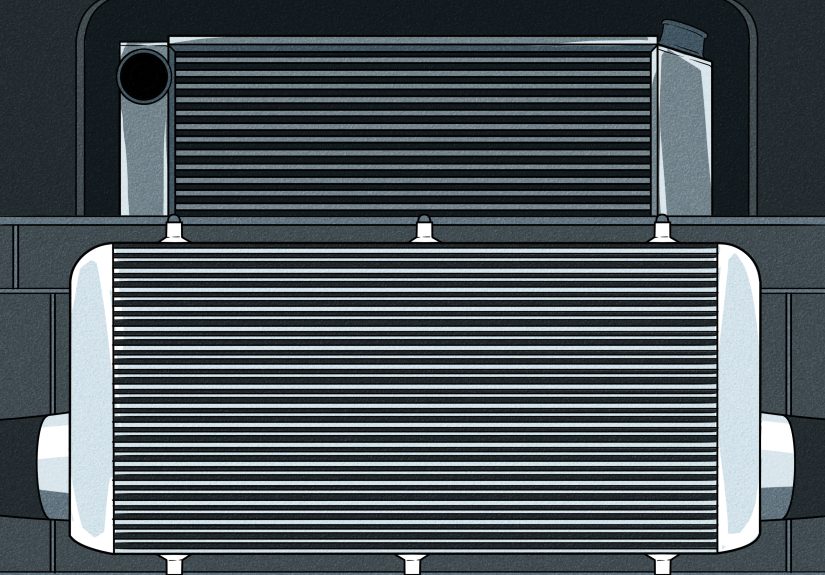
On many turbocharged vehicles, the intercooler sits ahead of the radiator. That gives the intercooler first crack at cooler outside air. The tradeoff is that anything placed in front of the radiator can influence airflow and thermal load for the components behind it. That is one reason engineers spend so much time balancing packaging, airflow, cooling performance, and pressure drop.
Air-to-Air Intercooler vs Air-to-Water Intercooler
If you are already comparing an intercooler with a radiator, it helps to understand the two main intercooler styles.
Air-to-air intercooler
This is the more common setup on street cars and trucks. Hot charge air flows through the intercooler core, and outside air passing over the fins removes heat. Air-to-air systems are generally simpler, lighter in plumbing, and easier to package on many front-engine vehicles.
Air-to-water intercooler
This design uses a liquid circuit to pull heat out of the charge air. It can be very effective and can work well when space is limited or when a shorter charge-air path is helpful. The downside is added complexity, more components, and typically more cost.
That does not make one universally better than the other. It depends on the vehicle, power goals, packaging constraints, and how the vehicle is driven. For many daily-driven cars, air-to-air is the straightforward, dependable choice. For some high-performance or tightly packaged applications, air-to-water makes a lot of sense.
Can a Car Have Both an Intercooler and a Radiator?
Absolutely. In fact, many turbocharged vehicles do. A turbocharged engine still needs its normal engine cooling system, which includes the radiator. The turbo system then adds charge-air cooling, which is where the intercooler comes in.
You may even find additional heat exchangers in modern vehicles, such as transmission coolers, oil coolers, AC condensers, battery cooling hardware in hybrids, and heat exchangers for air-to-water intercooler systems. Open the front end of a modern performance car and it starts to look like a very organized stack of thermal responsibilities.
Which One Matters More?
That is like asking whether your shoes or your brakes matter more. It depends on what problem you are trying to solve.
If the question is basic engine survival, the radiator wins. Without proper coolant temperature control, the engine can overheat and suffer major damage. If the question is boosted performance and intake temperature control, the intercooler becomes essential. A turbocharged engine can technically run without an effective intercooler in some cases, but it will usually perform worse, face higher intake temperatures, and become more vulnerable to knock and heat-related performance loss.
So the smart answer is this: the radiator is mission-critical for engine temperature management, while the intercooler is mission-critical for forced-induction efficiency and performance consistency.
Real-World Experiences: What Drivers and DIYers Usually Notice
Here is where the topic gets more interesting, because most people do not learn the difference between an intercooler and a radiator from a textbook. They learn it from a warning light, a weird power drop, or an evening spent staring at the front of the car while saying, “Well, that doesn’t look cheap.”
A common radiator-related experience starts with temperature creep. The car seems fine around town, then the gauge climbs in traffic, the fans run hard, and the heater suddenly becomes your emergency best friend. Drivers often describe it as a vehicle that feels normal until it gets stuck idling or pushed on a hot day. In many cases, the radiator is not the only suspect, but it is one of the first places technicians look because restricted fins, leaks, internal clogging, or poor coolant flow can all reduce heat rejection.
Intercooler issues feel different. Owners of turbocharged cars usually talk about a vehicle that still runs but no longer feels sharp. Maybe boost builds slower. Maybe the engine feels strong for one pull and lazy for the next. Maybe intake temperatures climb after repeated acceleration runs, and performance falls off as heat soak sets in. It is less “panic and steam” and more “where did my horsepower go?”
Truck owners towing in warm weather often notice the teamwork between both parts. The radiator keeps coolant temperatures from running away when the engine is working hard for long periods. The intercooler helps the engine keep its charge air cooler under boost so it can pull steadily instead of feeling strangled. When both systems are healthy, the vehicle feels composed. When one starts falling behind, you feel it fast.
DIY mechanics also learn that appearance can be deceiving. Many beginners assume the front-mounted aluminum core behind the grille must be the radiator. Sometimes it is. Sometimes it is the intercooler. Sometimes it is the AC condenser in front of both. This is why parts replacement by visual guess is a dangerous little hobby. Following the hoses or pipes tells the real story: coolant hoses point toward the radiator, while boost pipes lead you toward the intercooler.
Performance enthusiasts have their own version of this lesson. Someone upgrades a turbo, cranks up the boost, and wonders why the car feels amazing on one run and soft on the next. Often the stock intercooler becomes the bottleneck, not because it is broken, but because it can no longer keep charge temperatures in check under the new workload. Meanwhile, a radiator upgrade is usually discussed when the whole engine’s thermal burden rises, such as in track use, towing, or repeated hard pulls in hot climates.
The most practical takeaway from real-world experience is simple: a radiator problem usually announces itself with heat stress from the engine cooling side, while an intercooler problem usually shows up as a power, boost, or intake-temperature issue on boosted vehicles. Once you understand that pattern, diagnosing the difference becomes a lot less mysterious and a lot less likely to involve buying the wrong expensive metal rectangle.
Final Thoughts
So, intercooler vs radiator: which one is which? The radiator cools engine coolant to keep the engine from overheating. The intercooler cools compressed intake air to help turbocharged or supercharged engines make denser, safer, more consistent power. They may look similar, but they serve different systems, respond to different problems, and matter in different ways.
If you remember the four key differences, you are already ahead of most casual car conversations. One cools liquid, one cools air. One belongs to the engine cooling system, one belongs to the forced-induction system. One is nearly universal on liquid-cooled cars, one is specialized for boosted setups. And when things go wrong, the symptoms usually point in very different directions.
In other words, the radiator keeps your engine from melting down, and the intercooler keeps your boosted air charge from showing up overheated and underqualified. Both deserve respect. Only one usually gets blamed first. Such is life under the hood.