Table of Contents >> Show >> Hide
- Why German Literal Meanings Are So Much Fun
- My 12 Illustrations Of Literal Word Meanings
- 1) Handschuh (“hand shoe”) glove
- 2) Ohrwurm (“ear worm”) a catchy song stuck in your head
- 3) Kummerspeck (“grief bacon”) comfort-weight from emotional eating
- 4) Schadenfreude (“damage joy”) pleasure at someone else’s misfortune
- 5) Zeitgeist (“time spirit”) the cultural mood of an era
- 6) Weltschmerz (“world pain”) melancholy about reality not matching ideals
- 7) Luftschloss (“air castle”) a pipe dream or unrealistic fantasy
- 8) Wanderlust (“wander desire”) a strong urge to travel
- 9) Fernweh (“far pain”) longing for faraway places
- 10) Torschlusspanik (“gate-closing panic”) fear that time is running out
- 11) Dreikäsehoch (“three-cheeses-high”) a little kid
- 12) Backpfeifengesicht (“a face that begs for a slap”) an extremely irritating face
- How To “Decode” German Compounds Like a Pro
- Why These Literal Meanings Stick In Your Brain
- My Extra : The (Very Real) Experience Of Turning German Into a Sketchbook
German has a reputation for being precise, efficient, and occasionally allergic to short words. But here’s the plot twist:
that “long-word energy” is also where the comedy lives. German loves compound wordslittle Lego-bricks of meaning snapped
together into one glorious, logic-forward creation. And when you translate those compounds literally, you get phrases that
sound like they were invented by a poet who moonlights as an engineer.
In this article, I’m sharing 12 German words whose literal meanings are so vivid they practically demand
to be illustrated. I’ll break down each word, explain what it really means in everyday use, and describe the “literal” artwork
concept that pops into my head. Think of this as a mini gallery tourexcept the paintings are made of syllables.
Why German Literal Meanings Are So Much Fun
German compounds often feel like someone looked at a concept and said, “We could invent a totally new word… or we could just
describe it very honestly and glue the parts together.” The result is a language that can be surprisingly transparent:
once you learn the building blocks, you can “decode” a lot of vocabulary on sight.
Quick primer: how German compounds work (without the headache)
- They’re often written as one word. That’s why German can look like it’s speed-running Scrabble.
- The last part is the boss. In many noun compounds, the final noun is the “head” that determines the basic category
and often the grammatical gender. If the last part is “castle,” the whole thing is a kind of castleeven if it’s floating in the sky. - Sometimes there’s a linking sound. German may insert a connector (often -s-) to make pronunciation smoother.
It’s not always predictable, but it’s extremely common. - Nouns are capitalized. It makes compounds visually pop on the page, which is useful… and also slightly dramatic.
One more important note: literal translations are not always the real meaning. Some compounds are perfectly logical (“hand shoe” = glove),
while others are more poetic, cultural, or idiomatic. That tensionbetween what the pieces say and what the word meansis where the fun starts.
My 12 Illustrations Of Literal Word Meanings
Each entry below includes: the German word, the “literal” breakdown, what it actually means, and the illustration concept I’d draw if I had
a sketchbook and questionable amounts of free time.
1) Handschuh (“hand shoe”) glove
Literal breakdown: Hand (hand) + Schuh (shoe)
What it means: A glove. Straightforward, practical, and slightly hilarious when you say it slowly.
German didn’t reinvent “glove”it just rebranded the concept as footwear for your fingers.
Illustration idea: A tiny sneaker laced onto a hand, with five little toe-caps labeled “thumb,” “index,” and so on.
In the background, a confused sock holds a sign that says: “I WAS RIGHT HERE.”
Example: Zieh Handschuhe an, es ist kalt. (Put on gloves, it’s cold.)
2) Ohrwurm (“ear worm”) a catchy song stuck in your head
Literal breakdown: Ohr (ear) + Wurm (worm)
What it means: That tune that moves into your brain, rearranges the furniture, and refuses to pay rent.
English borrowed the concept directly as “earworm,” which is… honestly fair.
Illustration idea: A cute cartoon worm wearing headphones, lounging inside an ear like it’s a hammock,
holding a tiny boombox that’s blasting the chorus you didn’t ask for.
Example: Dieses Lied ist ein Ohrwurm. (This song is an earworm.)
3) Kummerspeck (“grief bacon”) comfort-weight from emotional eating
Literal breakdown: Kummer (grief/sorrow) + Speck (bacon/fat)
What it means: The extra weight that can show up when life is rough and snacks become your temporary support system.
It’s a darkly funny word, but it also captures a real human coping pattern with surprising empathy.
Illustration idea: A sad strip of bacon wearing a tiny raincoat, sitting on a bathroom scale like it’s contemplating its choices.
Nearby, a cupcake offers a supportive hug.
Example: Nach der Trennung hatte ich etwas Kummerspeck. (After the breakup I gained a bit of comfort-weight.)
4) Schadenfreude (“damage joy”) pleasure at someone else’s misfortune
Literal breakdown: Schaden (damage/harm) + Freude (joy)
What it means: That guilty little spark of delight when the person who cut you off in traffic immediately misses their exit.
It’s not your proudest emotion, but it is a recognizable onewhich is probably why this German word became popular in English too.
Illustration idea: A tiny cartoon “Joy” character holding a sign that says “I SHOULD NOT BE HERE,” standing next to a banana peel
and a toppled ego wearing a monocle.
Example: Ich schäme mich, aber ich fühlte Schadenfreude. (I’m ashamed, but I felt schadenfreude.)
5) Zeitgeist (“time spirit”) the cultural mood of an era
Literal breakdown: Zeit (time) + Geist (spirit/ghost)
What it means: The vibe of a particular moment in historythe trends, attitudes, obsessions, and unspoken rules that feel “normal”
until the decade ends and everyone collectively asks, “Why were we like that?”
Illustration idea: A friendly ghost made of calendar pages, floating over a city, sprinkling “trends” like confetti:
skinny jeans, viral dances, and the sudden urge to buy houseplants.
Example: Der Film trifft den Zeitgeist. (The movie captures the zeitgeist.)
6) Weltschmerz (“world pain”) melancholy about reality not matching ideals
Literal breakdown: Welt (world) + Schmerz (pain)
What it means: A kind of sentimental sadness or heaviness that comes from comparing how the world is with how you wish it were.
It’s big-feelings vocabularyuseful when “I’m bummed” doesn’t cover the full existential spreadsheet.
Illustration idea: The Earth wearing a tiny bandage and holding a bouquet labeled “IDEALS,” while a thoughtful person tries
to reconcile a heart-shaped map with a messy real one.
Example: Manchmal fühle ich Weltschmerz. (Sometimes I feel weltschmerz.)
7) Luftschloss (“air castle”) a pipe dream or unrealistic fantasy
Literal breakdown: Luft (air/sky) + Schloss (castle)
What it means: A dream so impractical it’s basically floating. The phrase Luftschlösser bauen
(“to build air castles”) is like saying someone is daydreaming without a plan.
Illustration idea: A gorgeous castle made of clouds with “NO PERMIT” stamped on it, supported by balloons labeled “wishful thinking.”
A little architect sits nearby drawing blueprints on fog.
Example: Er baut Luftschlösser. (He’s chasing unrealistic dreams.)
8) Wanderlust (“wander desire”) a strong urge to travel
Literal breakdown: wandern (to wander/hike) + Lust (desire/pleasure)
What it means: A restless desire to go somewhere elsepreferably somewhere with a different skyline and a pastry you can’t pronounce yet.
English adopted this word too, because apparently we also needed a single word for “I should not be looking at flight prices right now.”
Illustration idea: A suitcase with cartoon legs sprinting down a road, leaving little footprints shaped like airplane icons and mountain peaks.
Example: Im Frühling bekomme ich immer Wanderlust. (In spring I always get wanderlust.)
9) Fernweh (“far pain”) longing for faraway places
Literal breakdown: fern (far) + Weh (pain/ache)
What it means: A deep ache to be somewhere distantthe emotional opposite of homesickness (Heimweh).
It’s wanderlust’s more poetic cousin, the one who writes in a journal and stares out train windows on purpose.
Illustration idea: A heart shaped like a compass, tugged by a string toward a far horizon. The string is labeled “distance,”
and the heart looks both excited and mildly dramatic.
Example: Ich habe Fernweh. (I’m longing to go far away.)
10) Torschlusspanik (“gate-closing panic”) fear that time is running out
Literal breakdown: Tor (gate) + Schluss (closing/end) + Panik (panic)
What it means: The anxiety that opportunities are slipping away as life moves forwardcareer goals, relationships, big milestones,
“the window,” “the timeline,” all the stuff that can make your brain start speed-walking at 2 a.m.
Illustration idea: A medieval city gate swinging shut while a modern person in sneakers runs toward it holding a to-do list titled
“LIFE PLANS,” with items like “learn guitar” and “stop doomscrolling.”
Example: Mit 30 hatte sie Torschlusspanik. (At 30 she felt that “time’s-running-out” panic.)
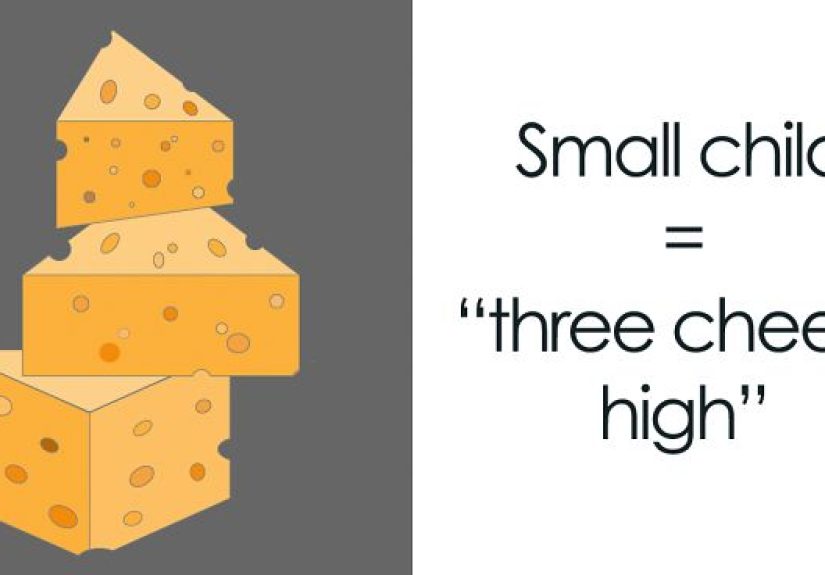
11) Dreikäsehoch (“three-cheeses-high”) a little kid
Literal breakdown: drei (three) + Käse (cheese) + hoch (high/tall)
What it means: A cute, slightly teasing way to describe a small child. It’s like measuring height in something absurdly specific
the same energy as “three apples tall,” but with more dairy.
Illustration idea: A toddler standing next to a stack of three wheels of cheese used as a height chart.
The kid proudly marks the wall with a crayon while a cheese wheel looks honored.
Example: Als Dreikäsehoch war er schon neugierig. (As a little kid, he was already curious.)
12) Backpfeifengesicht (“a face that begs for a slap”) an extremely irritating face
Literal breakdown: Backpfeife (a slap on the cheek) + Gesicht (face)
What it means: A blunt, comedic insult for someone whose expression feels unbelievably annoying. Importantly: this is a word, not a suggestion.
The humor here is the over-the-top specificity, not actual violence. Words can be spicy; hands should not be.
Illustration idea: A smug cartoon face wearing a “#1 Know-It-All” sash, while a nearby speech bubble says,
“Actually…” and an annoyed cloud hovers above. No slapsjust exaggerated eye rolls.
Example: Er hat so ein Backpfeifengesicht. (He has such a punchablesorry, “slappable”face.)
How To “Decode” German Compounds Like a Pro
Step 1: Find the final word
The last part usually tells you what kind of thing you’re dealing with. If it ends in -schloss, you’re in “castle territory.”
If it ends in -panik, you’re in “emotion territory.” That final word is your anchor.
Step 2: Look for linking bits
You’ll often see connectors like -s- that make the compound easier to pronounce. Treat them like linguistic glue.
They’re helpful, but they don’t usually change the core meaning.
Step 3: Translate literally… then translate humanly
Literal translation gives you the mental picture. Then adjust to how a speaker actually uses it. “Air castle” becomes “pipe dream.”
“Gate-closing panic” becomes “fear that time is running out.”
Step 4: Collect words in themed clusters
It’s easier to remember vocabulary when it’s grouped by vibe:
travel feelings (Wanderlust, Fernweh), big moods (Weltschmerz, Schadenfreude),
and everyday objects (Handschuh).
Why These Literal Meanings Stick In Your Brain
There’s a reason these words feel “illustratable”: they’re built for mental imagery. Cognitive science aside, your brain simply likes pictures.
A “hand shoe” is a picture. An “ear worm” is a picture. A “time ghost” floating through a decade is definitely a picture.
If you’re learning German, lean into that advantage. Make the silly drawing in your mind. The more vivid the image, the less likely you are to forget
the wordbecause your memory will be too busy laughing at the mental soundtrack worm living in your ear.
My Extra : The (Very Real) Experience Of Turning German Into a Sketchbook
The first time I tried learning German compound words, I approached them like a normal person: flashcards, repetition, mild optimism. Then I met
Handschuh. “Hand shoe.” Two ordinary words. One very funny idea. And that’s when my brain did something useful: it started
drawing the meaning without me asking. I pictured a tiny sneaker being tied onto a palm like it was late for gym class. I couldn’t unsee it. And
that, as it turns out, is the whole trick.
Once you start “seeing” the literal meaning, you begin to notice how German rewards curiosity. You’re not just memorizing vocabularyyou’re unpacking it.
I’d read a word, split it into parts, and my mind would automatically pitch a little scene. Sometimes the scene was accurate, like a cloud-castle for
Luftschloss. Sometimes it was delightfully dramatic, like a medieval gate for Torschlusspanik, even though
I was actually just thinking about a modern deadline. Either way, the image made the word feel alive instead of abstract.
I also learned quickly that the “literal drawing” approach helps you stay humble. German compounds can be transparent, but not always. A literal breakdown
might get you 70% of the way, and the last 30% is culture, context, and usage. So I started treating my illustrations like sticky notes rather than final
answers: a first impression that helps me remember, followed by a “human translation” that helps me communicate. That’s how “world pain” became “that
sentimental sadness when reality doesn’t match your ideals,” which is a mouthfulbut at least it’s a meaningful mouthful.
The funniest part was sharing these with other people. The moment you tell someone “German calls gloves ‘hand shoes,’” they don’t just understandthey react.
They laugh, they argue that socks should get the same treatment, and suddenly you’re both talking about German grammar without realizing it. Even
Schadenfreude started good conversations, mostly because everyone recognizes the feeling and immediately tries to pretend they don’t.
(“I would never… except maybe that one time…”)
Over time, the sketches became more than a learning hack. They turned into a way to appreciate the language. German isn’t “weird” or “too long”it’s
creative in a structural way. It builds meaning with parts you can point to, and that makes it friendly to learners who like patterns. Plus, it gives you
permission to be playful. If you can laugh at “ear worm,” you can remember it. If you can picture “air castle,” you can explain it. And if you can turn
vocabulary into mini cartoons, studying stops feeling like homework and starts feeling like a collection you actually want to keep adding to.