Table of Contents >> Show >> Hide
- Why Ancient Mythology Still Feels Perfect for Modern 3D Art
- The Core Idea Behind This Series
- How I Reimagined the Deities
- The Mythological Creatures Were Even More Fun
- The Modern and Surreal Twist That Holds the Whole Series Together
- Why These 24 New Pics Work as a Series Instead of Random Renders
- What Creating This Kind of 3D Mythology Taught Me
- Studio Notes: My Personal Experience Creating These 24 New Pieces
- Final Thoughts
Ancient mythology has always had excellent casting. Gods with tempers. Creatures with impossible anatomy. Heroes who make terrible life choices and then act shocked when the prophecy bites back. So when I sat down to create this new series of 24 images, I did not want to simply remake old legends in glossy 3D and call it a day. I wanted to build something stranger, sharper, and more contemporary: a visual world where ancient deities and mythological creatures feel less like museum labels and more like they just stepped out of a dream, a fashion editorial, and a slightly haunted subway station.
That approach shaped every piece in this collection. Instead of treating mythology like a dusty archive, I treated it like a living design language. A serpent becomes a cable of light. A guardian god feels part relic, part machine, part midnight fever dream. A siren stops being the version people remember from cartoons and returns to something older, darker, and more unsettling. The result is a series of 3D models that blend classical symbolism, surreal storytelling, modern textures, and a little bit of visual mischief.
If you love 3D art, mythological creatures, ancient deities, or the glorious chaos of surreal digital design, this set was made for you. And if you do not, well, there is still a chrome phoenix in here wearing the emotional energy of a luxury concept car, so I recommend staying a while.
Why Ancient Mythology Still Feels Perfect for Modern 3D Art
There is a reason ancient myths refuse to retire. They are not just stories; they are compressed symbols. Medusa is not merely a monster with snakes for hair. Anubis is not just a jackal-headed god with great posture. Dragons are not just giant reptiles with anger issues. These figures carry ideas about fear, protection, transformation, fertility, chaos, seduction, death, and rebirth. In visual terms, that makes them gold.
For a 3D artist, mythology offers something better than random fantasy design: built-in meaning. Every horn, wing, mask, claw, and halo can do narrative work. Ancient artists understood this brilliantly. Hybrid creatures appeared across cultures not because people got bored and started free-styling anatomy, but because combining forms created power. A human face on an animal body, or a beast with avian features, instantly signaled that the figure belonged to a different order of reality.
That logic still works today. Modern audiences might not know every myth in detail, but they instantly feel when a design carries symbolic weight. A deity with mirrored skin and fractured geometry reads as divine but unstable. A bird-bodied siren in a flooded train tunnel feels more mythically accurate and more disturbing than the polished mermaid stereotype. A brutalist Minotaur trapped in a maze of concrete and fluorescent light says something about modern alienation without needing a speech bubble that says, “Hello, I represent existential dread.”
That is the sweet spot I chased in these 24 new pics: old symbols, new anxieties, and visuals that feel theatrical without becoming empty spectacle.
The Core Idea Behind This Series
This project began with a simple question: What would happen if ancient deities and mythological creatures were redesigned through the lens of modern surrealism, fashion, and cinematic 3D storytelling? Not rebooted. Not turned into generic game characters. Reimagined.
I kept the original mythic DNA, but I changed the environment, materials, mood, and visual rhythm. Marble became liquid chrome. Sacred gold became neon reflections. Temple reliefs became floating panels, vapor, glass, cables, smoke, and impossible architecture. I wanted every image to feel like a collision between archaeology and dream logic.
Not Historical Reenactment, but Mythological Translation
I was not interested in strict reconstruction. That has value, of course, but this series lives somewhere else. Think of it as translation rather than replication. Ancient symbols move into a contemporary visual language and pick up new emotional tones along the way. A protective goddess can become tender and terrifying at once. A chaos dragon can feel majestic instead of merely destructive. A god associated with the underworld can look less like a villain and more like a quiet night-shift guardian of lost souls and missed connections.
That freedom let me play with contradictions, which is where surreal art gets delicious. I paired divine figures with ordinary urban elements. I exaggerated scale in ways that made creatures feel both sacred and absurd. Some of the renders are luminous and elegant; others feel like a dream you would absolutely tell your friends about over coffee and then wonder whether it means you should call your therapist.
How I Reimagined the Deities
Medusa as Beauty, Threat, and Armor
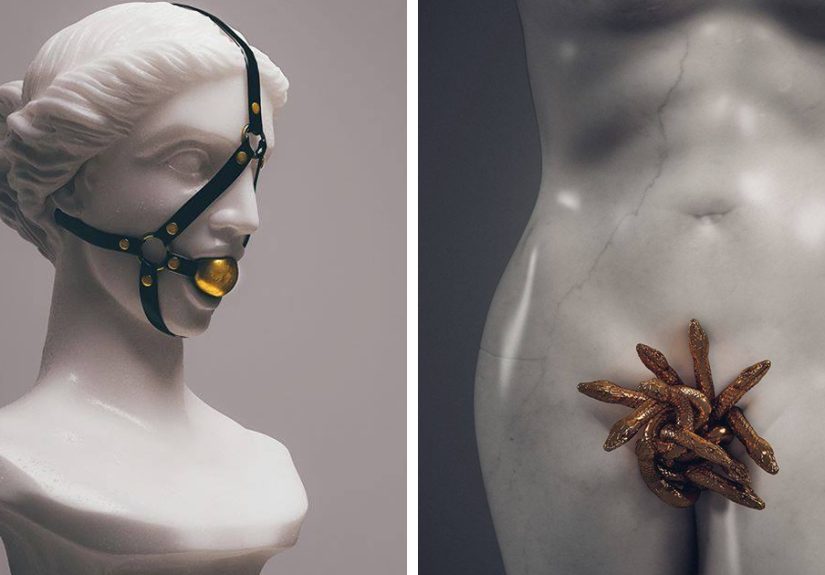
One of my favorite models in the set is a Medusa interpretation that leans into her ancient power as a protective figure rather than reducing her to a jump scare with hair problems. I designed her face with polished stone textures, reflective metallic scales, and snakes that look like a mixture of living creatures and luxury jewelry gone rogue. The pose is calm. The gaze is direct. The message is not “monster.” It is “boundary.”
That subtle shift matters. In this series, Medusa becomes a symbol of self-defense, transformation, and impossible glamour. If a nightclub and a temple had a child who read too much mythology, this would be her.
Anubis as an Urban Guide
For Anubis, I avoided the obvious “dark scary deity in a graveyard” route. Instead, I pushed him into a surreal metropolitan setting: damp pavement, floating signage, low blue light, long shadows, and a suit-like silhouette made from layered ceremonial forms. He still feels sacred, but in a way that suggests he is guiding souls through a modern underworld made of transit lines, elevators, and unanswered texts.
The fun of working with ancient Egyptian iconography is that it already understands stylization. Clean profiles, strong silhouettes, symbolic color, ritual accessories; it all adapts beautifully to 3D form development. All I had to do was meet that elegance halfway and let the materials get weird.
Taweret and Bes as Protective Oddballs
Protective deities are especially exciting in digital sculpture because they resist the clean, idealized look many artists default to. Taweret, with her composite anatomy, gave me permission to embrace bulk, texture, softness, and ferocity all at once. I designed her with a massive, grounded body, exaggerated guardian proportions, and glowing details that make her feel nurturing but not to be underestimated. Bes, meanwhile, was a gift. He already has a visual personality that feels wonderfully unruly. In 3D, that translates into a model full of expressive asymmetry, layered adornments, and a presence that feels half household spirit, half punk idol.
The Mythological Creatures Were Even More Fun
Sirens, But Closer to the Original Nightmare
Pop culture has done a serious rebrand on sirens. Many people imagine them as glamorous mermaids with suspiciously perfect hair. But older imagery gives us something stranger: bird-bodied female beings associated with danger, grief, and fatal song. That older version is far more interesting for surreal 3D art.
In my series, the siren appears in a flooded, dreamlike landscape with feather structures that blur into torn fabric and skeletal architecture. She is elegant, but not cute. The beauty is there, yet it is edged with menace. The goal was to create the feeling that she does not simply sing; she rearranges reality around her.
Dragons Across Cultures, Rebuilt for a New Visual World
Dragons are perfect for a project like this because they are one of the few mythological forms that can mean wildly different things depending on the culture. Some traditions link them to water, luck, and cosmic order. Others connect dragon-like beings to chaos, war, or primordial force. That gave me room to create more than one visual type.
One dragon in the series is long, atmospheric, and ceremonial, built from mist, lacquer, silk, and glowing linework. Another is heavier and more apocalyptic, with obsidian textures, torn wings, and a body that feels like the ruin of a storm. Same category, completely different emotional weather.
The Minotaur, Griffin, and Phoenix Get a Modern Makeover
The Minotaur became less a roaring brute and more a tragic architectural presence, almost fused with the maze itself. He stands in an environment of concrete walls, mirrored passages, and impossible scale, which turns the old labyrinth myth into something closer to a modern psychological prison.
The griffin let me play with authority and speed. I emphasized the creature’s regal front-facing structure and gave it materials that feel halfway between ceremonial metalwork and aerodynamic machinery. It looks ancient, but also like it might have a security clearance.
And the phoenix, naturally, was allowed to be dramatic. Refusing drama in a phoenix design would be like ordering sparkling water and getting upset that it sparkles. I built mine with molten interior light, translucent feathers, and a surreal bloom effect that makes it look like it is continually forming and dissolving in the same moment.
The Modern and Surreal Twist That Holds the Whole Series Together
What makes these 3D models feel contemporary is not just software, rendering, or detail density. It is the visual grammar. I borrowed from fashion photography, surreal cinema, editorial lighting, industrial design, and speculative architecture. Instead of placing the characters in predictable fantasy environments, I dropped them into spaces that feel half sacred and half urban hallucination.
That meant working with:
- Reflective materials that turn divine skin into something precious and unstable.
- Neon and low-key lighting to create an atmosphere that feels modern without flattening the myth.
- Negative space so the figures can feel iconic rather than overcrowded.
- Fashion-inspired silhouettes to make each deity or creature feel designed, not merely modeled.
- Dreamlike scale shifts because surrealism gets very boring very quickly if everyone politely obeys physics.
That last part matters more than people think. Surreal art is not just about weird objects. It is about emotional dislocation. A floating temple fragment. A giant hand emerging from black water. A crown that behaves like smoke. A hallway that loops into the rib cage of a beast. These choices tell the viewer that the image does not belong to ordinary time.
Why These 24 New Pics Work as a Series Instead of Random Renders
A strong collection needs more than isolated cool images. It needs a visual conversation between pieces. I wanted this series to move like a myth cycle rather than a folder of unrelated experiments. So even though the subjects vary, the images share a common emotional temperature: mysterious, theatrical, elegant, and just a little unhinged.
I also balanced the series carefully. Some models lean heavily into deity iconography. Others spotlight hybrid anatomy. Some are intimate portraits. Others are wide cinematic scenes. That variation keeps the viewer curious. One image asks you to admire form. The next asks you to decode symbols. The next tries to look at you in a way that says, “You should probably not have entered this room.” Variety is a lovely thing.
Most importantly, the pieces all orbit the same idea: mythology is not dead material. It is still one of the richest tools for visual storytelling in contemporary digital art. These characters can carry ancient meaning and modern emotion at the same time, which is exactly what makes them so addictive to build.
What Creating This Kind of 3D Mythology Taught Me
The biggest lesson was that mythological design becomes far more powerful when you resist the urge to over-explain it. Good myth art should leave room for interpretation. Viewers do not need a lecture in order to feel awe, discomfort, longing, or fascination. They just need enough visual clues to sense that the image belongs to an older symbolic world, even if the styling feels fresh.
I also learned that modernizing ancient deities is not about slapping futuristic props on them and hoping for the best. It is about understanding what made them resonant in the first place. Protection. Seduction. authority. fertility. chaos. renewal. Once I understood that core function, I could redesign the surface without losing the soul.
That is why this collection matters to me. It is not just a technical exercise in modeling and rendering. It is a conversation between ancient belief systems and contemporary visual culture. It is an experiment in seeing whether gods and monsters can still surprise us when they are dressed in the light, texture, and dream logic of the present day. Based on these 24 new pics, I would say yes. Enthusiastically yes.
Studio Notes: My Personal Experience Creating These 24 New Pieces
Making this series was one of those projects that started as a neat visual idea and quickly turned into a full creative obsession. At first, I thought I was just going to model a few mythological creatures, experiment with some surreal lighting, and call it a productive week. That was adorable. Very optimistic. What actually happened was that I fell headfirst into a world of symbols, ancient references, emotional textures, and late-night design decisions that felt less like ordinary work and more like decoding messages from a very stylish parallel universe.
The research stage changed everything. The more I looked into ancient deities and mythological creatures, the more I realized how visually intelligent these figures already were. They were not random fantasies. Their forms were precise. Protective gods looked protective for a reason. Hybrid monsters were built to disturb boundaries. Divine animals were loaded with meanings that still feel powerful today. Once I understood that, I stopped thinking only as a modeler and started thinking more like a storyteller and costume designer at the same time.
One of the most rewarding parts of the process was discovering how emotion could guide the technical choices. If I wanted a deity to feel distant and sacred, I gave the model more symmetry, colder materials, and cleaner negative space. If I wanted a creature to feel unstable or haunted, I introduced asymmetry, layered surfaces, odd reflections, and a background that made reality feel slightly unreliable. In other words, I spent a lot of time moving lights around and whispering, “Yes, but can this be more mysteriously alarming?”
I also loved the tension between ancient and modern design. That contrast became the heartbeat of the project. A traditional mythic silhouette paired with futuristic materials created exactly the kind of friction I wanted. It let the pieces feel respectful to the source material without becoming static or nostalgic. The images began to feel like fragments from myths that had somehow survived into another era and adapted.
Of course, there were challenges. Some concepts were too literal and died on the screen immediately. Others were visually exciting but emotionally empty. A few renders looked impressive in the most boring way possible, which is a tragedy every 3D artist knows too well. So I kept editing, stripping back, rebuilding, and asking whether each image had atmosphere, tension, and symbolic clarity. When the answer was no, back into the digital cave I went.
By the time I finished the 24-image set, I felt like I had not just built a collection of 3D models. I had built a small mythology of my own, shaped by real ancient traditions but filtered through modern surreal instincts. That is the part I am proudest of. These pieces are visually dramatic, yes, but they also feel personal. They reflect what I love most about digital art: the ability to make impossible beings feel emotionally real for a moment. And honestly, if a chrome Medusa, a ghost-lit Anubis, and an existential Minotaur can all coexist in one series, I think the project did exactly what I hoped it would do.