Table of Contents >> Show >> Hide
- The viral version: “No more WFH” meets “No more me”
- Why a new boss pulls the “five days” lever in the first place
- 1) They want collaboration, mentoring, and speed
- 2) They miss visibility (and sometimes confuse it with performance)
- 3) They’re trying to fix culture problems with geography
- 4) They feel pressure from leadership, boards, or office costs
- 5) They’re aiming for “voluntary turnover” without saying it out loud
- Why employees quit when the office becomes mandatory (especially five days)
- What the data says: five days a week is a retention gamble
- Real-world examples: when strict RTO meets real life
- How leaders can avoid triggering a resignation chain reaction
- How employees can respond (without lighting bridges on fire)
- Conclusion: five-day mandates don’t just bring people backthey sort them
- Experiences from the RTO trenches (the part nobody puts in the memo)
Picture this: a shiny new boss walks in, straightens the company logo like it’s a crooked painting, and announces, “We’re back in the office five days a week.” The room goes quiet. Not the respectful kind of quietthe kind where your coworkers suddenly develop the same facial expression as a cat being offered a bath.
And then, instead of a triumphant “culture comeback,” the boss gets something else: resignation letters. Plural. Enough that HR starts pricing bulk printer paper like it’s a commodity future.
This isn’t just internet drama. The five-days-in-office mandate has become one of the fastest ways to learn how much your employees value flexibilityand how quickly they can update their LinkedIn profiles. Let’s unpack why this happens, what the data says, and how leaders can avoid turning a “return to office” plan into a “return to recruiting” crisis.
The viral version: “No more WFH” meets “No more me”
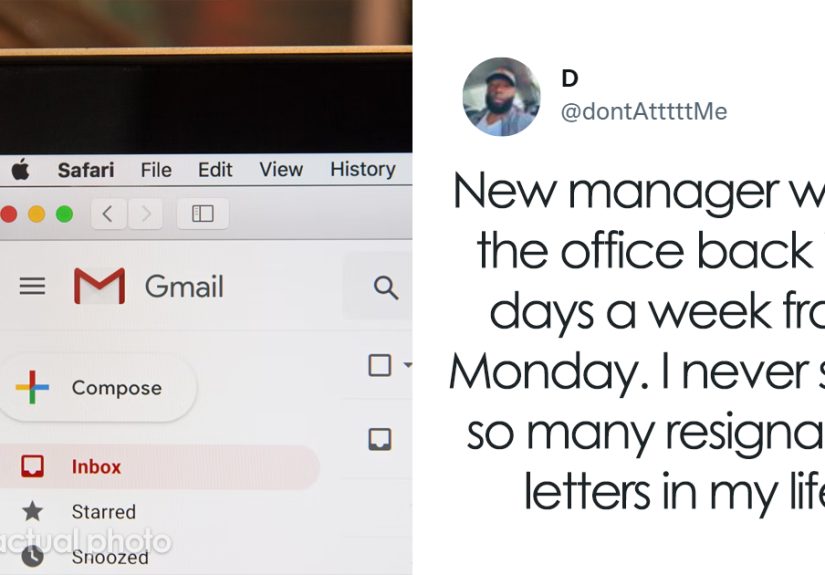
The story in the headline has made the rounds online: a new manager decides remote work is over, tells everyone to come in five days a week, and employees respond by quitting. In the viral telling, the boss expects compliance and gets a workforce evacuation instead. It’s funny in a dark waylike watching someone try to put out a grease fire with a water gun.
But that “joke” lands because it feels familiar. Remote work stopped being a temporary perk for many roles years ago. For a lot of people, it became part of the job’s valuelike salary, health insurance, or the unspoken agreement that we don’t schedule meetings at 4:59 p.m. on Fridays.
Why a new boss pulls the “five days” lever in the first place
To be fair, many leaders aren’t trying to be villains twirling mustaches in the breakroom. They usually have reasonssome thoughtful, some outdated, and some suspiciously connected to commercial real estate.
1) They want collaboration, mentoring, and speed
In-person work can be great for certain things: brainstorming, onboarding, building trust, and those quick “hey, got a second?” conversations that don’t require a calendar invite and three follow-up pings. Many leaders genuinely believe more face time means better teamwork, faster decisions, and stronger culture.
The catch: those benefits don’t automatically appear just because people share a zip code for eight hours. If the office day is mostly Zoom calls from different conference rooms, you’ve basically invented “commuting to the internet.”
2) They miss visibility (and sometimes confuse it with performance)
Some managers are more comfortable when they can see people working. It feels controllable. It feels measurable. It feels like the pre-pandemic world, when “looks busy” was occasionally treated as a job skill.
But visibility isn’t productivity. And when employees sense that the mandate is about control instead of outcomes, trust takes a hit. You can’t micromanage your way into loyalty.
3) They’re trying to fix culture problems with geography
Sometimes “We need everyone back” is a proxy for “Our culture is shaky.” Maybe engagement is down, people feel disconnected, or teams are siloed. The office becomes the symbol of togetherness.
The problem is that culture isn’t a building; it’s behavior. If communication is messy, priorities are unclear, or managers aren’t supported, forcing commutes won’t solve it. It just gives those problems a parking garage.
4) They feel pressure from leadership, boards, or office costs
Leases are expensive, and empty offices look like a bad investment. Some organizations also face external pressure (from city leaders, business partners, or stakeholders) to bring workers back downtown. In those cases, RTO can become less about how work gets done and more about making the spreadsheet look less embarrassing.
5) They’re aiming for “voluntary turnover” without saying it out loud
Here’s the spicier truth: sometimes leaders quietly hope strict RTO will push some people to quit. It’s a softer way to reduce headcountno dramatic layoffs, just a policy that “encourages” departures.
Employees aren’t clueless. When people suspect the mandate is a disguised downsizing strategy, resignations stop being surprising and start being the plan working as designed.
Why employees quit when the office becomes mandatory (especially five days)
If five-day mandates were purely about “getting back to normal,” they wouldn’t trigger such strong reactions. The resignations happen because the mandate changes people’s livesfast.
1) The commute is a pay cut (in time, money, and sanity)
A five-day commute can mean gas, tolls, parking, transit passes, lunches out, and extra childcare coverage. It also means timehours a week that used to be sleep, family, exercise, or simply not sitting in traffic thinking about every awkward thing you’ve ever said since 7th grade.
When employees do the math, some realize their “raise” from staying isn’t a raise at all. It’s a lifestyle downgrade.
2) Flexibility is now a core benefit, not a bonus
Remote and hybrid work let people handle real life: school pickups, elder care, medical appointments, and focused work without constant interruptions. For many, flexibility is what made the job sustainable.
Take that away abruptly, and you’re not just changing where people workyou’re changing whether they can work there at all.
3) One-size-fits-all policies punish the wrong people
RTO mandates can hit caregivers, people with disabilities, and employees living farther away especially hard. They also create weird fairness issues: the same job might be done remotely on one team and in-office on another, depending on leadership preferences.
When policies feel arbitrary, people don’t arguethey leave.
4) “You don’t trust us” is the message employees hear
Even if leadership doesn’t mean it that way, a strict mandate often lands like a trust reset: “We no longer believe you’re effective unless you’re in a chair we can point at.”
Once trust cracks, retention becomes fragile. And the best peoplethe ones who can get hired quicklyare usually the first to go.
What the data says: five days a week is a retention gamble
Let’s move from vibes to numbers. Multiple large surveys and workplace analyses point to the same pattern: the more rigid the policy, the higher the risk of turnover and hiring headaches.
Remote-capable workers say they’ll leave if flexibility disappears
In a nationally representative Pew Research Center survey of U.S. workers with jobs that can be done from home, nearly half said they’d be unlikely to stay at their current job if their employer no longer allowed them to work from home. That’s not a small “maybe”that’s a blinking retention warning light on the dashboard.
Pew also found that many workers with remote-capable jobs prefer hybrid arrangements rather than full-time on-site work. Translation: people aren’t necessarily anti-officethey’re anti-mandate-without-a-point.
Managers admit RTO can be used to push people out
Some employers are transparent about culture and collaboration goals. Others… less so. Research shared by BambooHR found a meaningful share of managers and executives believed layoffs happened because fewer employees quit than expected after RTO policies, and some acknowledged tracking worker activity as a goal. That lines up with why employees sometimes interpret strict RTO as “layoffs with extra steps.”
Hybrid work is still common in the real world
Official labor data also underscores that telework isn’t a niche behavior. The U.S. Bureau of Labor Statistics measures telework in the Current Population Survey, tracking how many people worked from home for pay during the reference week and how many hours they did so. The point isn’t that “everyone is remote”it’s that work has permanently diversified, and policy needs to match reality.
Office occupancy shows a comebackbut not a full rewind
Office attendance has risen from the depths of early pandemic life, but it’s not consistently at pre-2020 levels. For example, Kastle Systems’ occupancy reporting for major U.S. metros has shown weekly averages that climb and dip with hybrid patterns, with certain days (often midweek) busier than others. That “peak-day” rhythm is a clue: people will come in when it mattersespecially if the office day is designed to matter.
Real-world examples: when strict RTO meets real life
It’s one thing to argue online. It’s another when companies put five-day mandates into policy and people respond in measurable ways.
Example 1: “Come in five days… or take severance”
Some employers have effectively turned RTO into a decision point: return full-time or leave with severance. In at least one widely reported case in the media industry, hundreds of employees reportedly chose severance rather than comply with a five-days-a-week requirement. Whether you call it “alignment” or “attrition strategy,” the impact is the same: talent walks.
Example 2: “Hybrid creep” replaces the big dramatic memo
Not every company announces “five days” with trumpets. Some use a quieter approach: gradually increasing in-office expectations, tying visibility to promotions, or nudging teams back through scheduling and norms. It’s the workplace equivalent of slowly turning up the heat so nobody notices until they’re sweating.
This can reduce open revolt, but it still risks resentment if employees feel manipulated rather than respected.
Example 3: The new boss who learns the hard way
Back to our headline scenario. A new manager arrives, demands full-time office presence, and promptly discovers that flexibility was the glue holding the team together. The resignations aren’t just protest; they’re a market signal: other employers are offering what this boss is removing.
How leaders can avoid triggering a resignation chain reaction
If you’re a new boss (or any boss) considering five days in-office, here’s the blunt truth: you can do it, but you should expect consequences unless you have a strong case and a strong plan.
1) Start with the work, not the building
Which tasks truly benefit from in-person time? Onboarding? Whiteboarding? Sensitive client meetings? Certain creative work? Greatdesign office days around those outcomes.
But if the justification is “because I said so,” that’s not a strategy; that’s a power move. Power moves inspire complianceright up until they inspire quitting.
2) Make the office worth the commute
Office time should be collaboration-rich, not distraction-heavy. Group team days together. Protect focus time. Use in-person days for work that’s actually better face-to-face. Otherwise, employees will rightly ask why they’re commuting to sit in a louder chair.
3) Offer support that matches the burden
If you require more commuting, acknowledge the cost. Consider transit benefits, parking support, childcare partnerships, flexible start times, or compressed schedules where possible. Even small gestures signal respectand respect is cheaper than replacing two senior engineers.
4) Pilot first, measure honestly
Run a trial. Track productivity, engagement, customer response, and retention risk. Use surveys that employees trust (anonymous, with visible follow-through). If the data says the mandate is hurting output or driving attrition, adapt.
5) Keep flexibility where it’s earned and where it works
Many organizations land in the hybrid zone for a reason: it balances collaboration with autonomy. If your goal is mentoring, schedule mentoring. If your goal is speed, fix decision bottlenecks. Don’t use five-day attendance as a stand-in for leadership work.
How employees can respond (without lighting bridges on fire)
If you’re on the receiving end of a five-day mandate, you have optionsand you don’t have to choose between silent suffering and an email that starts with “Per my last shred of patience.”
1) Ask for the “why,” then ask for the “how”
What problem is the mandate solving? How will success be measured? If leaders can’t answer, they’re operating on vibesand you’re allowed to plan accordingly.
2) Propose a structured alternative
Instead of “I don’t wanna,” try: “Here’s a hybrid schedule that supports collaboration, includes team days, and keeps output stable.” Leaders may still say no, but you’ll learn quickly whether this is a discussion or a decree.
3) Update your Plan B quietly and professionally
If flexibility is non-negotiable for your life, start exploring roles that match your needs. The goal isn’t drama; it’s alignment. You can be firm without being scorched-earth.
Conclusion: five-day mandates don’t just bring people backthey sort them
When a new boss demands five days a week in the office, the resignations aren’t always about laziness or entitlement. They’re often about economics, caregiving realities, trust, and the simple fact that many jobs can be done well without a daily commute.
The modern workplace isn’t “office or chaos.” It’s a spectrumand the best leaders manage it intentionally. If you want people in the office, give them a reason they can feel, not just a rule they can resent. Otherwise, don’t be shocked when your big return-to-office announcement is followed by the soft sound of talent walking out the door.
Experiences from the RTO trenches (the part nobody puts in the memo)
To make this practical (and a little too real), here are common experiences people report when a five-day return-to-office policy hitsshared here as composite scenarios that reflect patterns seen across workplaces.
1) The “I was hired remote” whiplash. A project manager joins a company as a fully remote hire, builds workflows around async updates, and becomes the person who keeps cross-functional work moving. Then a new boss arrives and declares five days in-office. Suddenly the employee is doing napkin math: “If I move closer, rent jumps. If I don’t, commuting eats 10 hours a week.” The frustration isn’t just the commuteit’s the broken psychological contract. They weren’t asking for a perk; they were asking for the job they accepted. Two recruiters later, they’re gone.
2) The caregiver chessboard. A designer has childcare arranged around hybrid days. Monday and Wednesday are home days; Tuesday and Thursday are office days; Friday is flexible. It’s not glamorous, but it works. A five-day mandate forces a scramble for additional childcare coverage, and the cost wipes out the value of a recent raise. The employee tries to negotiate flexible start times, gets vague answers, and realizes the policy wasn’t built with real lives in mind. They don’t want to quitbut they also can’t afford to stay.
3) The “commute tax” reality check. An analyst who used to log on at 8:00 a.m. now spends that time in traffic. They arrive already tired, spend the day in back-to-back meetings, and get home too drained to do the deep work they used to do in the quieter hours. Their performance slips, not because they’re less capable, but because their energy budget is being spent on commuting and constant interruptions. The worst part? Leadership interprets the dip as evidence that employees need “more accountability,” which adds insult to injury. They start job hunting out of self-preservation.
4) The manager caught in the middle. A team lead doesn’t love the mandate either, but they’re told to enforce it. They spend weeks fielding questions they can’t answer, calming anxiety, and trying to keep projects on track while morale drops. One by one, strong performers resign, and the manager is left hiring replacements into a policy that’s already unpopular. Leadership calls it “growing pains.” The manager calls it “my calendar is now 70% interviews and 30% stress.” Eventually, they leave toobecause enforcing a policy you don’t believe in is its own kind of burnout.
5) The unexpected twist: some people like the office… just not the mandate. There’s also the employee who genuinely enjoys in-person workbetter focus, easier collaboration, less loneliness. But even they get annoyed when the rule is rigid. They want purposeful in-office time, not attendance for attendance’s sake. They’ll show up gladly for team workdays, workshops, and mentoring. They’ll resent showing up to sit on Zoom calls and “prove” they’re working. Their frustration is a clue: the real conflict isn’t office versus home. It’s thoughtful design versus lazy policy.
Across these experiences, the pattern is consistent: five-day mandates don’t just change a schedule. They change trust, cost, time, and quality of life. And when people feel those changes are imposed without a clear benefit, resignation stops being a threat and becomes an exit strategy.