Table of Contents >> Show >> Hide
- Why Jupiter Needs a Flyer (and Why “Just Orbit It” Isn’t Enough)
- Meet the “Jupiter Flyer” Concept: A Nuclear Ramjet in the Clouds
- Where Would It Fly? The “Goldilocks” Zone of Jupiter’s Upper Atmosphere
- What Would It Measure? The Science Payload That Earns Its Seat
- How Do You Deliver an Aircraft Into Jupiter Without Turning It Into Space Confetti?
- Why Nuclear Power? A Reality Check on Energy at Jupiter
- Surviving Jupiter’s Hazards: Radiation, Charging, Lightning, and “Why Is Everything Trying to Kill My Electronics?”
- Navigation, Autonomy, and Communications: Flying Far from Home
- What Science Becomes Possible When You Can “Just Keep Flying”
- Is the Jupiter Flyer “Real”? What It Would Take to Actually Fly
- Field Notes: Practical “Experience” Lessons That Shape a Jupiter Nuclear Flyer (Extra Detail)
- 1) Radiation Isn’t a Single ProblemIt’s a Thousand Tiny Ones
- 2) “Power” Means Electricity, Heat, and TimeAll at Once
- 3) Autonomy Is Not a Feature; It’s the Mission
- 4) Entry and Deployment Will Try to Ruin Your Day First
- 5) Expect Your “Representative” Sample to Be Unrepresentative
- 6) Communications Will Be IntermittentPlan to “Store, Then Tell”
- Conclusion
If you’ve ever looked at Jupiter and thought, “Wow, that planet is basically a lava lamp with anger issues,” you’re not alone. Jupiter’s atmosphere is a nonstop carnival of jet streams, towering storms, lightning, and cloud layers stacked like a cosmic parfait. The catch? We mostly study it from far away (orbiters) or in short, one-and-done plunges (entry probes).
So here’s the delightful (and slightly unhinged) idea: send an aircraft into Jupiter’s atmosphereone that can stay there for months, cruising from storm to storm like a meteorologist with a death wish. The real twist: solar power won’t reliably cut it deep in the Jovian clouds, and batteries would tap out fast. Enter the headline-grabber: a nuclear-powered aircraft concept, often described as a Jupiter Flyer, powered by a nuclear-heated ramjet engine.
This article breaks down the “flyer details”how it works, where it could fly, what it would measure, and why nuclear power is the not-so-secret sauce for long-duration Jovian atmosphere exploration.
Why Jupiter Needs a Flyer (and Why “Just Orbit It” Isn’t Enough)
Orbiters are fantastic at big-picture views: gravity fields, magnetospheres, global weather patterns, and gorgeous images that make your desktop background feel inadequate. But Jupiter’s atmosphere is a “you had to be there” kind of place. The chemistry, turbulence, lightning, and cloud microphysics change with location and timefast.
Entry probes provide in-situ truth… briefly. They descend along one path, in one region, during one slice of time. In fact, Jupiter has “hot spots” where the atmosphere can be unusually dry and cloud-poorso a single probe can accidentally sample a weird neighborhood and then politely disintegrate before it can apologize.
A Jupiter atmospheric flyer flips the script: it can revisit the same region, compare belt vs. zone conditions, sniff different altitudes, and chase storms like the universe’s most overqualified drone.
Meet the “Jupiter Flyer” Concept: A Nuclear Ramjet in the Clouds
The core proposal (studied under NASA’s advanced concept ecosystem) is a compact, unmanned aircraft designed to cruise continuously in Jupiter’s upper atmosphere using a nuclear ramjet approach. The headline specs commonly cited for the conceptual vehicle are surprisingly “small drone” in scale: roughly 2 meters long, about a 2-meter wingspan, and a total mass around a couple hundred kilograms. Its nominal cruise speed is around Mach 1.5yes, supersonicbecause the engine concept leans on ramjet physics.
The mission promise is what makes engineers sit up straight: months of flight, not minutes. That’s the difference between “a snapshot” and “a weather documentary series.”
How a Nuclear Ramjet Actually Works (No, It Doesn’t “Burn” Jupiter)
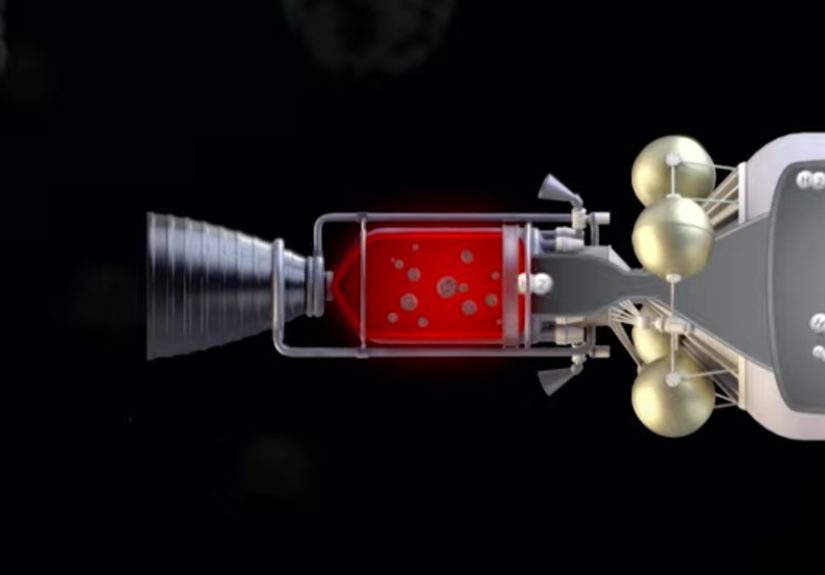
A classic air-breathing jet engine on Earth compresses incoming air, mixes it with fuel, burns it, and shoots the hot exhaust out the back. Jupiter doesn’t give you oxygen to burn. So the nuclear ramjet concept swaps combustion for something sneakier: it heats the incoming atmosphere using a compact nuclear reactor.
At a high level, the engine is elegantly simple:
- Inlet + diffuser: rams Jovian air into the engine and compresses it.
- Nuclear heat source: a small reactor core heats the compressed hydrogen/helium mix.
- Nozzle: expands the hot gas to create thrust.
In other words: Jupiter’s atmosphere becomes the “working fluid.” You don’t carry propellant for the cruise phase. The planet provides it in unlimited quantities. Jupiter is basically a gas station that never closes.
Why Mach 1.5? Because Ramjets Are Picky
Ramjets like speed because the “ram” effect helps compress the incoming gas. At low speeds, they struggle to generate enough pressure rise and efficiency. That’s why the concept leans toward supersonic cruisefast enough to make the inlet and diffuser do useful work without turning the aircraft into a permanent meteor.
Supersonic flight also helps cover serious ground. Jupiter’s storms are enormous; the Great Red Spot alone is a world-sized weather system. A flyer that can move quickly can sample boundaries, shear layers, and chemical gradients with far better spatial coverage than a drifting balloon.
Where Would It Fly? The “Goldilocks” Zone of Jupiter’s Upper Atmosphere
Jupiter’s atmosphere isn’t one uniform soup. Pressure, temperature, and cloud chemistry change dramatically with altitude. The flyer concept targets the upper atmosphere where conditions are challenging but survivable: cold temperatures, fast winds, and cloud layers made from ammonia, ammonium hydrosulfide, and deeper water-based clouds.
The operating window often discussed for these studies spans pressures from fractions of an atmosphere up to several atmospheres, intentionally covering key cloud decks and the “weather layer” where dynamics are most interesting.
Weather You Can’t Ignore: Winds, Lightning, and Turbulence
Jupiter’s winds can be extreme. Even conservative summaries put upper-atmospheric wind speeds in the tens to over a hundred meters per second range, depending on latitude. Lightning is also very real, and storms can punch vertically through layers where chemistry and cloud particles change.
In plain terms: the flyer needs to be built like a tough little lab… that also happens to be an airplane.
What Would It Measure? The Science Payload That Earns Its Seat
A persistent atmospheric aircraft is a science buffet. Instead of betting everything on one probe profile, you can measure how Jupiter behaves across space and time. A practical payload suite would likely include:
- Pressure, temperature, density sensors for atmospheric structure and stability.
- Wind measurement (multi-axis anemometry or derived from inertial + pressure data) to map jet streams and shear.
- Gas composition tools (e.g., a compact mass spectrometer) to track methane, ammonia, trace species, and isotopes.
- Cloud microphysics instruments (particle counters / nephelometers) to learn what the clouds are actually made of.
- Lightning and electrical environment sensors to connect storms to chemistry and heat transport.
- Imaging for contextbecause scientists love numbers, but everyone loves pictures.
And because Jupiter is a radiation-heavy environment, the packaging matters: instruments may be mounted in locations that simplify shielding and reduce exposure, with careful placement and “shadow shielding” strategies.
How Do You Deliver an Aircraft Into Jupiter Without Turning It Into Space Confetti?
The delivery plan is the part where aerospace engineers start speaking in calm voices and writing long emails. Jupiter arrival involves brutal entry speeds. NASA’s Galileo atmospheric probe hit Jupiter at roughly 106,000 mph and experienced crushing deceleration as it slowed and deployed parachutes for its descent. That’s the benchmark: it proves entry is possible, but it’s not exactly gentle.
A flyer concept typically uses an entry capsule to survive the initial heating and deceleration, then deploys the aircraft once conditions are right for flight. One frequently described approach is:
- Atmospheric entry inside a protective aeroshell.
- Deceleration to flight-ready conditions.
- Separation and deployment of the aircraft.
- Engine start and transition to sustained cruise in the target altitude band.
The key engineering trick is timing: you want to deploy when dynamic pressure is manageable, winds are survivable, and the aircraft can immediately establish stable flightbecause Jupiter does not do “hover and think about it.”
Why Nuclear Power? A Reality Check on Energy at Jupiter
Jupiter sits about five times farther from the Sun than Earth, which means sunlight is dramatically weaker. Solar power can workNASA’s Juno spacecraft proved that with huge arraysbut in the deeper cloud environment where an aircraft would operate, sunlight becomes less reliable, and a propulsion-hungry flyer demands far more power.
RTGs vs. Reactors: Same Family, Totally Different Job
When people hear “nuclear power in space,” many think of RTGs (radioisotope thermoelectric generators). RTGs are marvelous for long-lived electricity: they convert heat from the natural decay of plutonium-238 into steady power, and they’ve supported deep-space missions for decades.
But an RTG is like a dependable camping stove: great for keeping the lights on and instruments running. A nuclear ramjet is more like a power plant that happens to be shaped like an engine: designed to dump serious heat into a flow stream and create thrust for sustained flight. Different scale, different mission, different engineering headaches.
Alternative Concept: “Live Off the Wind”
Not every Jupiter flyer idea relies on a reactor-driven engine. Some NASA advanced concept studies explore wind-harvesting robotscraft that ride Jupiter’s winds and convert atmospheric energy into electricity and motion, potentially reaching deeper pressures for long durations.
In practice, a future Jupiter exploration campaign could mix approaches: a fast nuclear-powered aircraft for targeted sampling and storm-chasing, plus wind-driven or buoyant platforms for long-term drifting surveys.
Surviving Jupiter’s Hazards: Radiation, Charging, Lightning, and “Why Is Everything Trying to Kill My Electronics?”
Jupiter’s radiation environment is famously hostile. Spacecraft like Juno use heavy shielding strategies, including a dedicated radiation vault with titanium walls to protect critical electronics. In public mission descriptions, engineers have compared Juno’s lifetime radiation exposure to an absurd number of medical X-raysbecause sometimes the easiest way to describe Jupiter is with a metaphor that makes dentists nervous.
For an atmospheric flyer, there are several layers of defense:
- Shielded avionics core (think “mini radiation vault,” sized for an aircraft).
- Redundant computers and sensors because single points of failure are rude at Jupiter.
- Electrical/charging control to mitigate plasma and electrostatic effects.
- Lightning-aware operations (avoidance when possible, robust grounding and surge protection when not).
- Thermal management to handle frigid ambient temperatures and the heat produced by onboard systems.
And then there’s turbulence. Jupiter’s atmosphere can be violently dynamic. The autopilot needs to be fast, resilient, and comfortable making decisions without waiting for Earthbecause Earth is far away and your joystick has a 30–50 minute round-trip delay.
Navigation, Autonomy, and Communications: Flying Far from Home
A nuclear-powered Jupiter aircraft would be highly autonomous. It must maintain stability, avoid hazardous regions, manage energy and heat, and run a science schedulewithout human micromanagement.
Communication is also tricky. A flyer deep in the atmosphere may not have a clean line-of-sight to Earth. A realistic architecture would likely use a relay (an orbiter or carrier spacecraft) that passes overhead to collect data. That relay could also provide navigation updates and coordinate observations with other Jupiter missions.
What Science Becomes Possible When You Can “Just Keep Flying”
This is where the concept shines. A persistent nuclear-powered aircraft for Jupiter could:
- Map storm systems repeatedly to see how they evolve, not just how they look on arrival day.
- Sample multiple altitudes across cloud layers to connect chemistry to weather and circulation.
- Investigate lightning and its role in atmospheric mixing and trace chemistry.
- Compare belts, zones, and vortices with on-the-spot measurements instead of inference.
- Ground-truth remote sensing from orbiters (microwave, infrared, and visible observations) with in-situ data.
Think of it as the difference between watching a hurricane from space and flying a research plane through the eyewall except the hurricane is the size of continents, and your research plane is nuclear-powered and has never seen an airport.
Is the Jupiter Flyer “Real”? What It Would Take to Actually Fly
The honest answer: it’s a serious concept, not a scheduled launch. The physics are plausible, and the mission value is hugebut it would demand major engineering maturity and mission investment.
Key hurdles include:
- Reactor miniaturization and qualification for a flight engine that can operate reliably for months.
- Materials that handle high internal temperatures, cold ambient flow, and long-duration erosion.
- Entry, deployment, and transition to flight with zero chance to “reset and try again.”
- Radiation-hard avionics sized for an aircraft and protected without becoming too heavy to fly.
- Mission architecture that includes data relay, navigation support, and planetary protection planning.
The good news is that every Jupiter mission we fly teaches us more about the environment, and every advance in autonomy, thermal design, and nuclear space power makes the “flyer” idea less science-fiction and more engineering roadmap.
Field Notes: Practical “Experience” Lessons That Shape a Jupiter Nuclear Flyer (Extra Detail)
No one has flown a nuclear ramjet plane on Jupiter (yet), but we do have real-world “experience” in the form of hard lessons from space missions that faced similar enemies: radiation, distance, brutal environments, tight power budgets, and autonomy requirements. Here are the most relevant takeaways engineers repeatedly run into when turning bold concepts into hardware that survives first contact with reality.
1) Radiation Isn’t a Single ProblemIt’s a Thousand Tiny Ones
Jupiter’s radiation doesn’t just “zap” electronics; it slowly degrades materials, darkens optics, flips bits, and ages components. Juno’s approachusing a dedicated shielded vault for critical electronicsshows a pattern a Jupiter flyer would likely copy: put the brain in a protected box, route signals carefully, and assume the outside world is a particle storm with opinions. On an aircraft, this becomes a ruthless trade: more shielding means more mass, and more mass means more lift and thrust. That’s why packaging strategies (where you place instruments and avionics) can be as important as the instruments themselves.
2) “Power” Means Electricity, Heat, and TimeAll at Once
Deep-space power systems teach a humbling truth: watts are never “just watts.” Radioisotope systems are steady and reliable for decades, but they’re limited in peak output. That’s perfect for spacecraft instruments and heaters, but not for high-energy propulsion. A nuclear-powered aircraft flips the power problem: now you have plenty of heat available, but you must manage it. You need to keep avionics warm in cold ambient conditions while preventing reactor/engine components from overheating internally. Thermal control becomes the quiet hero of the missionunsexy, essential, and always the reason a schedule slips.
3) Autonomy Is Not a Feature; It’s the Mission
Flight at another planet taught us that autonomy isn’t “nice to have.” NASA’s Mars helicopter operations demonstrated how carefully you must choreograph navigation, hazard response, and fault handling when you can’t pilot in real time. A Jupiter flyer would take this further: it must survive turbulence, choose safe altitudes, handle sensor dropouts, and still keep collecting data without a human whispering encouragement from Mission Control. Practically, that means layered autonomy: fast inner-loop stability control, mid-loop navigation planning, and high-level science scheduling that can adapt when Jupiter does something Jupiter-ish (which is always).
4) Entry and Deployment Will Try to Ruin Your Day First
Galileo’s probe entry proved that you can survive Jupiter’s high-speed arrivalif your aeroshell and thermal design are uncompromising. But a flyer mission adds a new twist: you must not only survive entry, you must deploy a delicate flying vehicle and transition cleanly into controlled flight. That sequence is one of the highest-risk phases because it stacks multiple hard events back-to-back: heating, deceleration, separation, deployment, engine start, and stabilizationno intermission. Designing for this is like designing a parachute jump that ends with building a motorcycle in midair and then riding it away.
5) Expect Your “Representative” Sample to Be Unrepresentative
One of the most important lessons from Jupiter exploration is that local conditions can fool you. The Galileo probe descended into a region that turned out to be unusually dry, changing interpretations of water abundance and cloud structure. A nuclear-powered aircraft is basically an antidote to that problem: mobility lets you escape the weird patch of sky you accidentally arrived in. From an operations standpoint, this means you don’t just plan a routeyou plan a sampling strategy that intentionally targets diversity: belts, zones, storm edges, quiet regions, and repeating tracks to watch change over time.
6) Communications Will Be IntermittentPlan to “Store, Then Tell”
A flyer deep in Jupiter’s atmosphere may only have certain windows to transmit to a relay orbiter, and the relay may only have certain windows to transmit to Earth. Space missions have learned to treat data like precious cargo: buffer onboard, compress intelligently, prioritize the most valuable measurements, and don’t assume the downlink will always be there. A good Jupiter flyer would act like a careful journalist: record everything locally, send the highlights quickly, and save the full story for when the connection cooperates.
Add all that up, and the “experience” takeaway is clear: the nuclear-powered Jupiter Flyer isn’t just an engine idea. It’s a systems-engineering puzzle where propulsion, entry, autonomy, radiation protection, thermal control, and communications have to work togetherbecause on Jupiter, anything less than teamwork becomes a crater you didn’t intend to make.
Conclusion
A nuclear-powered aircraft for exploring Jupiter is one of those concepts that sounds like science fiction until you read the engineering logic: Jupiter provides unlimited working fluid, solar energy is scarce and inconsistent in the clouds, and long-duration in-situ measurements could transform our understanding of giant-planet weather and chemistry.
If we want more than snapshotsif we want time-lapse science across Jupiter’s belts, zones, lightning storms, and monster vortices then a persistent atmospheric flyer is a compelling next step. The nuclear ramjet approach is bold, technically demanding, and absolutely the kind of idea Jupiter dares us to attempt.