Table of Contents >> Show >> Hide
- Why a Hula Hoop T-Shirt Rug Is Pure Genius
- What You Need to Make an Old T-Shirt Rug on a Hula Hoop Loom
- Step-by-Step: How to Make a Hula Hoop T-Shirt Rug
- Design Ideas and Smart Color Strategies
- Where to Use Your Old T-Shirt Hula Hoop Rug
- Care, Cleaning, and Durability Tips
- Real-Life Experiences with Old T-Shirt Rugs on a Hula Hoop Loom
- Conclusion: A Cozy Rug from the Closet You Already Own
Got a stack of old T-shirts that are too sentimental to toss but too stained to wear? Grab a hula hoop, some scissors, and a little patience, because those shirts are about to become a cozy, colorful rug. The “old T-shirt rug on a hula hoop loom” project made popular on Hometalk and other DIY sites has everything crafters love: it’s cheap, eco-friendly, beginner-friendly, and just the right amount of repetitive to be oddly relaxing.
Whether you are decorating a kid’s room, softening a reading nook, or just trying to keep perfectly good fabric out of the landfill, this simple upcycling project turns basic cotton tees into a surprisingly sturdy rag rug. You don’t need to know how to knit, crochet, or weave like a pro. If you can cut straight-ish lines and go “over-under-over-under,” you’re in business.
Why a Hula Hoop T-Shirt Rug Is Pure Genius
Traditional weaving looms are amazing… and also large, expensive, and slightly intimidating. A hula hoop loom, on the other hand, costs a few dollars and lives in the toy aisle. Using a hula hoop as your loom is a clever hack that lets you create a circular rug without any special tools.
Here’s why this project has become a favorite on Hometalk-style DIY platforms and craft blogs:
- It’s eco-friendly: You’re upcycling T-shirts that might otherwise become waste.
- It’s budget-friendly: Old tees plus one hula hoop beat the price of a store-bought rug any day.
- Beginner-friendly: No crochet or knitting experience required. Kids can help with the weaving.
- Customizable: Color, size, and pattern are totally up to you.
- Portable: The “loom” is lightweight. You can work on the rug in the living room, on the porch, even outside at a picnic table.
In short, this is one of those “if I can do it, anyone can” crafts. It looks impressive, but it’s really just clever fabric recycling and simple weaving.
What You Need to Make an Old T-Shirt Rug on a Hula Hoop Loom
Exact supply lists vary from tutorial to tutorial, but most versions of the hula hoop T-shirt rug use the same core materials:
- 1 plastic hula hoop (a larger hoop gives you a larger rug; standard kid-size works well for a small accent rug).
- 8–12 old T-shirts, preferably mostly cotton. More shirts = bigger rug.
- Sharp fabric scissors or a rotary cutter and cutting mat.
- Optional: yarn or cord if you want to mix T-shirt strips with another fiber.
- Optional: needle and thread or hot glue for securing ends and backing.
- Optional: non-slip rug pad or latex caulk for grip on smooth floors.
Choose shirts that are similar weight so the rug feels even underfoot. Thick, sturdy cotton tees work best. Logos and graphics are fine; they just add to the scrappy charm.
Step-by-Step: How to Make a Hula Hoop T-Shirt Rug
Step 1: Gather and Prep Your T-Shirts
Start by sorting shirts into a color palette. You can go full rainbow, stick to neutrals, or choose two or three colors for a more intentional, modern look. If you’re nervous about the rug looking chaotic, pick one main color (like navy or gray) and use brighter tees as accents.
Wash and dry the shirts first so they’re clean and pre-shrunk. Lay each shirt flat, smoothing out wrinkles for more accurate cutting.
Step 2: Cut Shirts into Loops and Strips
You’ll create two kinds of T-shirt pieces:
- Warp loops: These run from one side of the hoop to the other like spokes on a wheel.
- Weft strips: These are woven around and around those spokes to build the rug.
To make warp loops, cut the body of one or two shirts horizontally into 1–2 inch-wide loops. Remove the hem and sleeves first, then cut across the width of the shirt so you get large fabric rings. When you stretch them gently, they’ll curl into soft tubes.
To make weft strips, cut the remaining shirts into long strips about 1–2 inches wide. You can cut in continuous spirals to make “T-shirt yarn” or cut loops and snip them open into long pieces. Stretching the strips gently will help them curl and look neater.
Step 3: Warp the Hula Hoop Loom
Flip the hula hoop onto the floor or a large table. Slip one of your T-shirt loops over the hoop and pull it across so it lies straight, dividing the circle in half. Add another loop at a right angle to create a big cross. Keep adding loops until you have an odd number of “spokes” radiating from the centeroften 11, 13, or 15.
An odd number matters because it lets your over-under weaving pattern alternate correctly as you go around the circle. Gently adjust the loops so the spokes are evenly spaced. Where the loops cross in the center, pull them snug but not so tight that the hoop bends.
Step 4: Start Weaving the Rug
Take your first weft strip and tie it securely around one of the center spokes with a small knot. This will be hidden later. Now begin weaving:
- Go over one spoke, then under the next, over the next, and so on around the circle.
- When you come back to the starting point, keep going, but gently push the woven row toward the center so it sits snugly.
- As you build layers, maintain firm but not overly tight tension. You want the rug to lie flat.
When you reach the end of a strip, overlap it with the start of a new strip and knot the ends together, or tuck one into the other. Hide these joins on the underside of the rug if possible.
Step 5: Grow, Finish, and Remove from the Hoop
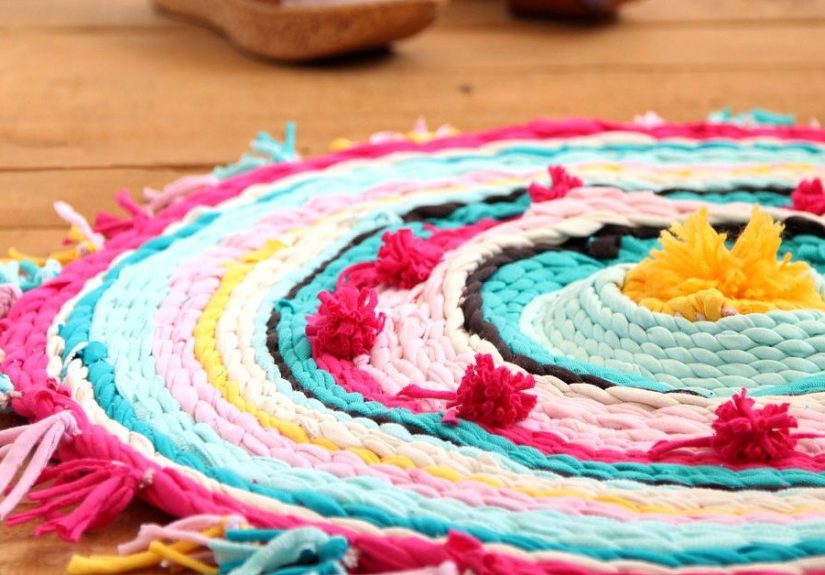
Keep weaving in a spiral, experimenting with color as the rug grows. Try:
- Several rounds of one color for thick “rings.”
- Alternating two colors every round for a spiraled stripe effect.
- Random scrappy mixes for a true rag-rug look.
When you reach the size you want (or when you run out of T-shirtswhichever comes first), it’s time to finish. To remove the rug from the hoop:
- Cut each warp loop at the outer edge of the hoop so you have pairs of loose ends.
- Remove the hoop carefully, keeping those warp ends in order.
- Tie warp ends together in pairs with double knots close to the woven edge to lock the rug in place.
Once every pair is tied, flip the rug over and trim long tails if needed. For extra security, you can add a bit of fabric glue to knots or stitch them down by hand.
Design Ideas and Smart Color Strategies
One of the most fun parts of a hula hoop T-shirt rug is playing with color. A few ideas to steal:
- Ombre fade: Start with the darkest shade in the center and work out to lighter tones. Think navy–blue–sky, or burgundy–red–pink.
- High-contrast rings: Alternate a light and dark shirt every few rows to create bold concentric circles.
- Neutrals with a pop: Use grays, whites, and blacks for most of the rug, then throw in shock strips of neon or bright colors.
- Kids’ rainbow: Use one shirt per color in ROYGBIV orderkids love the “rainbow target” look.
If you’re nervous about how the pieces will look together, lay the T-shirts out on the floor in the order you plan to use them. That quick “color rehearsal” can prevent the dreaded “muddy middle” where everything blends into a brownish blur.
Where to Use Your Old T-Shirt Hula Hoop Rug
This type of rug is soft, flexible, and surprisingly durable. Some practical spots to use it:
- Beside the bed: Warm toes, happy mornings.
- Reading corner: Add a floor cushion and fairy lights, and you’ve got a cozy nook.
- Kids’ playroom: Bright colors, soft surface, and if it gets dirty, you made it from old shirts anyway.
- Bathroom: A cotton rug feels great out of the shower (just let it dry fully between uses).
- Pet bed topper: Pets adore the cushy texture and familiar T-shirt smell.
If you plan to use the rug on a smooth surface like hardwood or tile, consider adding a non-slip rug pad underneath or dots of latex caulk on the back to keep it from sliding.
Care, Cleaning, and Durability Tips
Since your hula hoop rug is made from washable T-shirts, it’s fairly low-maintenance:
- Shake out regularly to remove dust and crumbs.
- Spot clean with mild soap and water for small spills.
- Machine wash on gentle in cold water if the rug is tightly woven and well-knotted. Put it in a large laundry bag if possible.
- Air dry flat to keep it from stretching out of shape.
Over time, some knots may loosen. It’s easy to tighten and re-knot problem areas, or even weave in a new strip if you notice a bare spot. Think of it as a living project you can maintain and tweak over the years.
Real-Life Experiences with Old T-Shirt Rugs on a Hula Hoop Loom
Reading glossy tutorials is great, but nothing beats real-world experience. Here are some honest lessons and stories that crafters often share after finishing their first hula hoop T-shirt rug.
The “This Looked Faster on Pinterest” Moment
On paper, this project sounds like an afternoon joband in some cases, it can be. But once you start cutting and weaving, you may discover it’s more of a “spread it over a weekend” craft. Cutting T-shirt strips takes time, especially if you’re aiming for a larger rug. One common experience: enthusiastic cutting at the start, followed by “why do I own so many shirts?” halfway through.
The good news is that the weaving itself can be wonderfully meditative. Many DIYers turn on a movie or an audiobook and treat it like a relaxing, hands-on break from screens. If you pace yourself, the process becomes part of the enjoyment rather than a race to the finish line.
Kids as Co-Crafters (and Color Directors)
This project is a favorite with families because kids can really participate. Younger kids can help sort shirts by color, stretch loops, and push the woven rows toward the center. Older kids can do the over-under weaving themselves once you show them the pattern.
One fun twist is letting a child be the “art director.” Put all your strips in a basket and let them choose the next color. The result might be a wild rainbow spiral, but the sense of ownership they feel when they step on “their” rug is priceless. It’s also a great sneaky way to talk about recycling and reusing materials.
What People Wish They’d Known Before Starting
- Cut wider strips than you think you need: Many first-timers start with skinny strips, only to realize the rug looks flimsy or takes forever. A 1.5–2 inch width usually gives a nice, thick texture.
- Plan for stretch: T-shirt fabric stretches. If you pull the warp spokes too tight on the hoop, the rug will pucker like a bowl. Keep tension firm but gentle.
- Use enough shirts: People often underestimate how much fabric a rug consumes. If you want anything bigger than a placemat, gather extra tees ahead of time.
- Check the back as you go: Flip the hoop occasionally to make sure knots and joins are staying neat and secure.
Turning a Rug into a Memory Project
Beyond being thrifty, these rugs can be surprisingly sentimental. Some makers use old concert T-shirts, college shirts, or kids’ outgrown clothes to weave a “memory rug.” Instead of sitting in a box, those fabrics become something you literally walk on every dayin a good way.
Imagine a rug made from baby onesies for a nursery corner, or from camp and team shirts for a teen’s room. Every time you see a stripe of a familiar color or pattern, you get a small flashback without needing to hoard stacks of clothing.
From First Rug to Full-Blown Hobby
A funny thing happens after a successful first rug: you start eyeing every old textile as “loom material.” That stretched-out dress? Yarn. Those faded leggings? Also yarn. The hula hoop loom becomes a gateway to other creative experiments, like:
- Using finger-knitted yarn as the weft for extra plushness.
- Mixing T-shirt strips with store-bought chunky yarn for texture.
- Making mini versions as chair pads, trivets, or pet mats.
For many crafters, the first hula hoop rug is a reminder that you don’t need fancy supplies to make something useful and beautiful. A handful of old T-shirts and a plastic hoop are enough to turn recycling into decorand that’s a pretty satisfying feeling.
Conclusion: A Cozy Rug from the Closet You Already Own
The “Old T-shirt Rug on a Hula Hoop Loom” project perfectly captures what modern DIY is all about: resourceful, creative, and refreshingly imperfect. It uses what you already have, teaches a simple new skill, and rewards you with something you can actually use every day.
So before you bag up those stretched-out tees for donation or the trash, consider giving them one more job. Turn them into a rug that tells the story of concerts attended, teams played on, and days lived. Your home gets a soft new landing spot, your wardrobe gets a declutter, and the planet gets a tiny break. Not bad for a pile of shirts and a hula hoop.