Table of Contents >> Show >> Hide
- Why Abandoned Britain Is So Addictive to Photograph
- Planning an Urbex Photo Trip Across Britain
- Safety and Ethics: The Non-Negotiables
- Camera Gear That Works Best in Abandoned Places
- Mastering Light, Shadow, and Composition in Derelict Spaces
- Digging into the History Behind the Ruins
- Building Your Own “18 Pics” Story Set
- Sharing Your Work Without Harming the Places
- Field Notes: What It Feels Like to Photograph Abandoned Britain
If your idea of a perfect weekend involves a camera, a torch, and a strong chance of cobwebs in your hair, welcome home. Photographing “abandoned Britain” feels like stepping onto the set of a post-apocalyptic film: crumbling Victorian asylums, mossy train stations, forgotten seaside piers, and mansions where nature is now the interior designer. It’s the kind of visual candy that Bored Panda readers devour in those moody “18 pics” galleriesonly this time, you’re the one behind the lens.
This guide walks you through how to plan and shoot a series worthy of a viral Bored Panda post, while staying safe, staying legal, and telling real stories about Britain’s ghostly architecture. We’ll talk gear, ethics, and compositionand then finish with field-style experiences so you know what it actually feels like to creep through a derelict corridor with your shutter clicking.
Why Abandoned Britain Is So Addictive to Photograph
Britain is unusually rich in photogenic decay. From derelict hospitals and empty churches to shut-down theatres and decaying seaside resorts, the country is dotted with buildings that history forgot but photographers rediscovered. Industrial decline left mills and factories idle; changes in mental-health care closed vast Victorian asylums; shifting transport routes stranded elegant train stations that now host ivy instead of commuters.
Visually, these spaces are a dream: peeling paint, broken tiles, and shafts of light cutting through smashed windows. Urbex (urban exploration) photographers often talk about the “beauty of decay,” where every collapsed ceiling or moss-covered staircase hints at the lives that once filled the building. When you sequence 18 strong imageswide shots, details, textures, and hint-of-a-story framesyou’re not just making a gallery; you’re creating a tiny visual documentary.
The Story Behind Each Frame
The best abandoned-Britain images feel like stills from a movie. A lonely wheelchair in an asylum corridor, hymn books scattered across a church floor, or a faded cinema sign above bricked-up doorseach frame invites viewers to imagine what happened five, fifty, or a hundred years ago. Great urbex photographers lean into that cinematic quality rather than just documenting rot for shock value.
Planning an Urbex Photo Trip Across Britain
Before you grab your camera and vault the nearest fence (please don’t), take time to plan. Seasoned urbex shooters will tell you that scouting matters just as much as shutter speed.
Researching Locations the Smart Way
- Start online, finish offline. Urbex blogs, photography forums, and travel features on abandoned UK sites can help you understand the kinds of places that existdisused stations, mills, asylums, librarieswithout handing you precise addresses.
- Use maps creatively. Guides to urban-exploration photography recommend scanning satellite views for old factories, sidings, and industrial estates, then checking street-view history where available.
- Look for legally visitable sites. Many former hospitals, forts, or rail sites are now managed as museums or “hidden tours.” They offer the same crumbly textures but with official access and fewer “falling through the floor” vibes.
Respecting Locals and Property Owners
Some urbex photographers approach owners to request permission and set clear rulesno geotagging, no damage, and the right to approve which images identify the property. It might feel less “punk,” but it’s far more sustainable. Your goal is to photograph history, not to become a cautionary tale on the local news.
Safety and Ethics: The Non-Negotiables
Abandoned spaces can be dangerous. Rusty nails, rotten floors, asbestos, unstable ceilingsthis is not the place to discover that your sneakers have zero grip. Multiple urbex safety guides come back to the same core principles.
Golden Safety Rules
- Never go alone. Always bring at least one trusted friend. If you twist an ankle or meet someone sketchy, you’ll be glad you did.
- Tell someone where you’re going. Text the location, rough schedule, and when you’ll check in again.
- Dress for hazards, not fashion. Think boots with good soles, long sleeves, gloves, and a dust mask if you expect mold or debris.
- Carry light. A headlamp keeps your hands free; a small torch is a good backup.
- Watch your footing. Keep eyes on the floor and the ceilingloose tiles and sagging beams are red flags.
Ethics: “Take Nothing but Photos, Leave Nothing but Footprints”
Most urbex communities fiercely defend a simple code: don’t break in, don’t steal, don’t vandalize, and don’t share exact locations publicly. The aim is to preserve these places for future explorers and to prevent them becoming magnets for theft or graffiti. In your captions and Bored-Panda-style write-ups, focus on story and atmosphere, not on giving a “how to trespass” guide.
Camera Gear That Works Best in Abandoned Places
You don’t need the latest flagship camera to photograph abandoned Britain, but the right tools do make your life easier. Urban-exploration photography guides generally recommend a flexible but lightweight kit.
The Core Kit
- Camera body: A DSLR or mirrorless camera that handles low light well is ideal. Older full-frame bodies still shine here.
- Wide-angle lens: Many urbex photographers swear by wide glass (16–35mm range) to capture entire halls, factories, or staircases in one frame.
- Tripod: Essential for long exposures and HDR bracketing; many abandoned interiors are darker than your morning mood before caffeine.
- Spare batteries and cards: No power outlets, lots of texturesyou’ll shoot more than you think.
- Light sources: A headlamp plus a small LED panel gives you flexibility to paint light into dark corners without looking like you’re summoning ghosts.
Optional but Fun Extras
- Fast prime lens: A 35mm or 50mm f/1.8 is great for moody shallow-depth-of-field shots of peeling paint or discarded objects.
- Film camera: Some urbex fans love classic black-and-white stocks like Ilford HP5+ for gritty, timeless images.
- Remote shutter release: Helpful when your tripod is balanced on uneven surfaces and you want to avoid camera shake.
Mastering Light, Shadow, and Composition in Derelict Spaces
Photographing abandoned buildings is basically a masterclass in difficult light. You’ll deal with ultra-bright windows, deep shadows, and awkward beams of sunlight hitting the one boring part of the room. Photography educators suggest embracing that challenge instead of fighting it.
Use Contrast to Your Advantage
- Bracket exposures. Many urbex shooters make multiple exposures of the same scene and blend them into HDR images to hold texture in both highlights and shadows.
- Let light tell the story. A single beam of light hitting an old pew, a stairwell, or a hospital bed can serve as your focal pointalmost like a spotlight on stage.
- Watch white balance. Mold-green walls, rusty reds, and cool daylight can trick your camera’s auto settings. Don’t be afraid to shoot RAW and correct in post.
Composing for Atmosphere, Not Just Documentation
When you’re excited by a location, the temptation is to point your camera at everything. Slow down. Guides on abandoned-place photography stress the power of simple, intentional compositions: lead the viewer’s eye with lines, frame subjects through doorways, and use negative space to emphasize emptiness.
- Look for repeating elements. Rows of broken seats in a theatre or bed frames in a ward can create rhythm in your frame.
- Include nature’s comeback. Ferns sprouting from floorboards, ivy pushing through windows, or trees growing through roofs embody the “beauty of decay” theme that audiences love.
- Add a human hint. An empty chair, a coat hook, or a forgotten sign can evoke people without showing them, which keeps the focus on atmosphere.
Digging into the History Behind the Ruins
What separates a random set of “creepy building” shots from a compelling Bored Panda feature is context. Learning the history of a site adds depth to your captions and helps you photograph more thoughtfully.
For example, many Victorian psychiatric hospitals were built with optimistic ideas about fresh air, gardens, and moral treatment, only to become overcrowded and stigmatized later. Some closed as mental-health care moved into the community, leaving huge ornate complexes behind. When you photograph their empty corridors, including details like faded signage or architectural flourishes highlights that contrast between intention and outcome.
Similarly, derelict rail stations and factories once powered Britain’s industrial might. Articles on abandoned UK buildings often emphasize how economic shifts, new routes, or globalization left these places redundant. Shooting from angles that show both grandeur and decaysay, a vast arched roof now dripping with rustlets your images hint at that rise-and-fall story.
Building Your Own “18 Pics” Story Set
Think of your final gallery like a mini-photo book, not just a random dump of images. Editors and photography instructors suggest mixing wide establishing shots, medium views, and tight details to keep viewers engaged.
Structuring the Set
- Open with a punch. Start with a strong, wide shot that defines the vibe: a grand staircase carpeted in moss, a chapel bathed in dusty light, or a courtroom frozen in time.
- Move through the space. Arrange images as if you’re guiding the viewer on a walk: outside facade, entrance, main hall, side rooms, small details.
- Sprinkle in surprises. Slip in one or two unexpected imagesa toy left on a windowsill, a vivid graffiti piece in an otherwise muted spaceto reset attention.
- End on a reflective note. Close with an image that feels like an epilogue: maybe a view from a broken window out onto the modern city, hinting at the world that moved on.
Captions with Character
Bored Panda-style captions thread the needle between informative and witty. Instead of “Hallway in old hospital,” try “Where the medicine cabinet is empty but the draft is strong.” If you know facts about the siteits age, original purpose, date of closureadd them, but keep the tone conversational and respectful.
Sharing Your Work Without Harming the Places
Once your “Photographing Abandoned Britain (18 Pics)” set is ready, it’s time to unleash it on the internet. Photography blogs and urban-exploration guides increasingly emphasize responsible sharing.
- Avoid precise locations. Consider using generic titles like “Abandoned Victorian library, England” instead of exact names, especially if the site is fragile or unsecured.
- Remove GPS data. Strip metadata before posting so your camera’s location tag doesn’t become a treasure map for vandals.
- Highlight safety and respect. Mention that you followed safety rules and didn’t damage or move anything; this sets the tone for people inspired by your work.
- Tell the human story. In blog posts or Bored Panda submissions, weave in snippets of history and reflections on how we treat old buildings today. It turns “cool ruins” into a conversation about memory and conservation.
Field Notes: What It Feels Like to Photograph Abandoned Britain
Guides are helpful, but nothing beats walking into your first abandoned British building with a camera in your hand and your heart somewhere near your throat. Consider these experiences as a mental rehearsal before you step through that half-open door.
Experience 1: The Asylum Corridor That Wouldn’t End
Imagine pulling up to a Victorian hospital on a gray morning. The outer walls are lined with boarded-up windows and tangles of ivy. You and your shooting partner follow a muddy path to a side entrance where the door no longer quite shuts. Inside, the air smells of damp plaster and old paperwork. A long corridor vanishes into shadow, doors open on either side like missing teeth.
You set up your tripod, frame the hallway, and realize your first shot is blown out at the far end and nearly black in the foreground. Remembering your prep, you bracket exposures: one for the bright doorway, one for the midtones, one for the shadows. Later, when you blend them, every flake of peeling paint and every patch of sunlight will sing. For now, you listen to the echo of your own footsteps and try not to think about horror movies.
Experience 2: The Church Where the Light Did All the Work
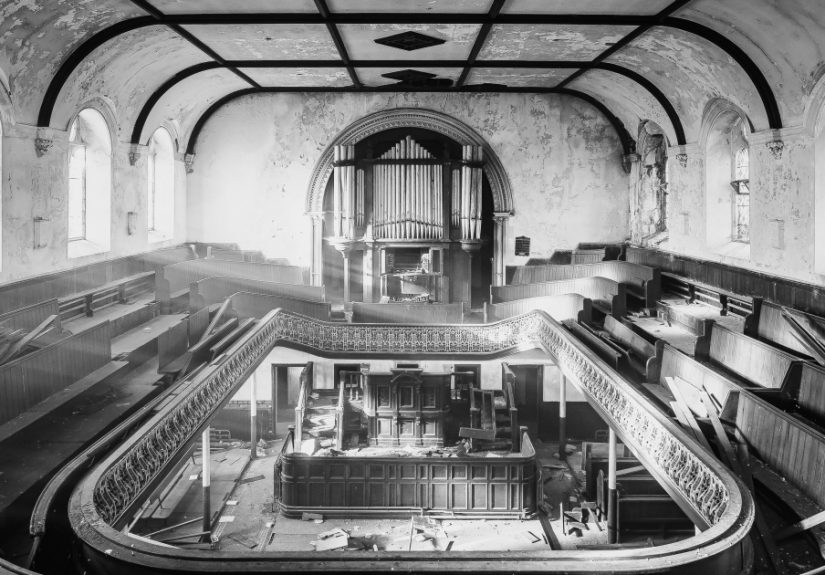
Another day, you find yourself in a derelict church somewhere in the north of England. Most of the roof is intact, but chunks of slate are missing, creating dramatic shafts of light across the empty pews. Dust hangs in the air like glitter. You switch to a wider lens, drop to a lower angle, and let the converging lines of pews lead straight to the stained-glass window, now cracked but still colorful.
Instead of overcomplicating it, you keep the composition simple: no clutter, no tilted horizon, just lines, light, and silence. A fast prime lets you shoot a detail of a hymn book left behind, its pages warped by damp. In captions you later write something like, “The congregation is gone, but the acoustics are still perfect for your inner monologue.”
Experience 3: The Train Station Reclaimed by Nature
On a rare sunny afternoon, you join a guided “hidden tour” of an abandoned Victorian train station. With a hard hat on your head and a guide watching for safety, you’re free to focus on photography instead of wondering if the floor will give way. Old signage still clings to the walls, and a colony of plants has set up shop between the tracks.
You walk to the far end of the platform and shoot back toward the main hall, using a wide-angle lens to exaggerate the curve of the roof. Then you switch to a longer focal length to isolate details: a rusted signal, a clock frozen at a random time, cracked tiles under your boots. When a shaft of sunlight illuminates a patch of greenery, you frame it tightit’s the perfect symbol of nature quietly winning.
Experience 4: Storytelling After the Shoot
Back home, you import hundreds of files and start narrowing them down. Eighteen images doesn’t sound like much until you realize how many versions you shot of that one mossy stairwell. You look for variety: different locations, different angles, different moods. Maybe you group three asylum images together, then switch to an industrial scene, then a church, then the train station. The sequence starts to feel like a slow train journey through a forgotten Britain.
As you write captions, you balance humor and respect. A collapsing ceiling is “where interior design meets gravity,” but you also note the year the building opened and why it closed. You decide not to mention the exact town, just the region. When you finally upload your “Photographing Abandoned Britain (18 Pics)” gallery, you’re sharing more than spooky aestheticsyou’re inviting people to think about what we choose to preserve, and what we let quietly fade away.
Experience 5: The Quiet Satisfaction of Doing It Right
The real reward of this kind of project isn’t just likes or upvotes (though those are nice). It’s knowing you planned carefully, stayed safe, respected each location, and walked away with images that feel honest. You didn’t move objects for drama or pry open doors that were clearly meant to stay shut. You documented places as you found them, in all their broken, beautiful complexity.
Next time you scroll through a Bored Panda gallery of abandoned Britain, you’ll see more than “cool pics.” You’ll recognize the choices behind each framethe angle, the exposure, the restraintand you’ll be itching to charge your batteries and head out for the next forgotten corner of the map.