Table of Contents >> Show >> Hide
- Carlo & Camilla, Explained (No Coronation Required)
- The Space: Industrial Bones, Couture Accessories
- The Food: Contemporary Italian That Doesn’t Need to Shout
- Drinks & Aperitivo: Where Milan’s Night Actually Begins
- Peak Milan Timing: Design Week, Fashion Week, and Regular-Life Magic
- How to Do Carlo e Camilla Like You Belong There
- Why “Raw Yet Refined” Works (And Why Milan Loves It)
- Experience Notes: What a Night at Carlo e Camilla Feels Like (About )
Milan has a special talent: it can make a slab of concrete feel like it’s wearing a perfectly tailored blazer.
It’s the city where fashion people casually debate hemlines over espresso, where design week turns “looking at a chair”
into a full-contact sport, and where dinner can be equal parts theater, craftsmanship, and delicious chaos.
If you want one place that captures Milan’s whole personalityindustrial grit with couture-level polishset your compass
toward Carlo e Camilla in Segheria. The name alone is a wink, the room is a jaw-drop, and the experience is the kind of “how is this real?”
moment you’ll replay later like a highlight reel. Think: raw warehouse bones, crystal chandeliers, communal tables, inventive Italian cooking,
and a crowd that looks like they own at least one mysterious black coat that cost more than your rent.
Carlo & Camilla, Explained (No Coronation Required)
Let’s clear up the first misconception: no, you’re not dining with British royalty. The “Carlo e Camilla” name is an ironic little nod
that fits the restaurant’s whole vibeserious craft delivered with a smirk. It’s Milan’s favorite style of humor: dry, elegant, and just
bold enough to make you wonder if you missed an inside joke. (You didn’t. The joke is: everything is a little ironic here.)
The second misconception is that “Segheria” sounds like a chic Italian word you should pretend you’ve always known. Don’t worry:
it literally points to the building’s past. The space is tied to a former sawmill/factory identity, which the restaurant leans into
instead of disguising. Milan doesn’t hide its historyit accessorizes it.
At the center of the project is a collision of disciplines that Milan adores: a serious culinary name, a creative director with an eye
for atmosphere, and a hospitality mind who knows how to make the whole machine run. The result isn’t “a restaurant with a nice interior.”
It’s a full conceptlike a runway show you can eat.
The Space: Industrial Bones, Couture Accessories
A room that refuses to choose between “warehouse” and “ballroom”
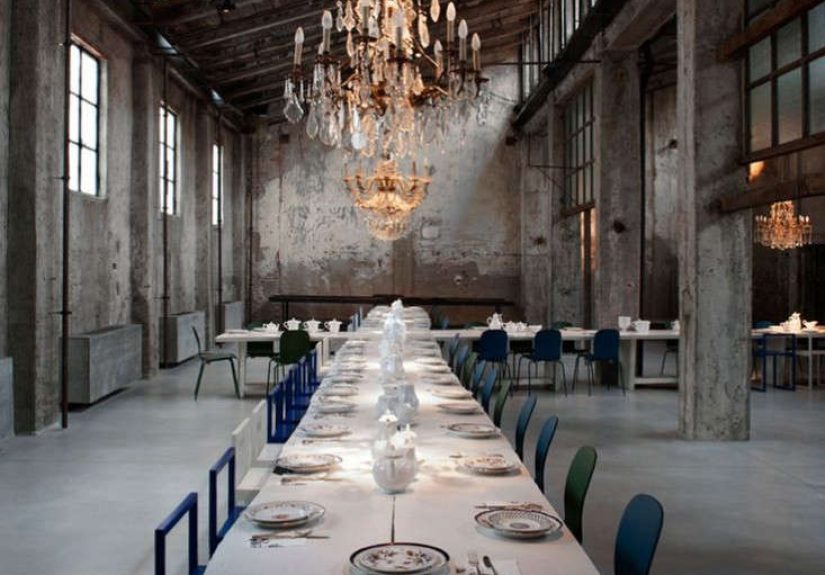
The first thing you notice is scale. The room feels lofty and sparebrick, concrete, weathered surfaceslike it could host an art installation
or a very dramatic whisper. And then your eyes go up and meet the twist: vintage-style crystal chandeliers hanging like
high-society guests who showed up to the wrong party and decided to stay anyway.
This is the restaurant’s signature move: raw yet refined. Instead of softening the industrial shell, it frames it.
The roughness becomes the backdrop for details that would normally live in a more polished settingfine tableware, curated furniture,
and lighting that feels intentionally theatrical.
The communal table: Milan’s social experiment (with better food)
The dining setup is famous for its communal, cross-shaped table arrangementan architectural “X marks the spot” that seats
roughly a large crowd (think: the size of a small wedding where you actually like the guests). It’s communal dining without the summer-camp energy.
You’re not forced to make friends, but the room quietly encourages it. Conversation travels. Laughter ricochets. Someone’s perfume becomes
a supporting character.
And here’s the genius: the communal table doesn’t just seat peopleit stages them. In Milan, the crowd is part of the design.
The table turns dinner into a living set piece: a long, elegant line of plates, glasses, and personalities under chandeliers that look like
they’ve seen things.
Chairs, tableware, and the art of the “perfect mismatch”
Milan takes its furniture seriously, so the seating matters. You’ll often see modern design chairs that feel deliberately contrasted:
crisp angles facing softer curves, light against dark, “his” versus “hers” energylike the room itself is flirting with you.
Add Richard Ginori tablewareplayful, refined, and unapologetically Italianand suddenly the industrial shell feels
like a gallery for the dinner experience.
Lighting tricks and theatrical timing
A fun detail for design nerds: the chandeliers are there for mood more than function. The “real” lighting is handled by a more technical
system overhead, giving the room a staged, cinematic feel. At night, everything gets more mysterious. Shadows do some of the decorating.
The space stops being merely “cool” and becomes almost dreamlikelike you walked into a sophisticated film scene where everyone knows
what to do with their hands except you (it’s okay; hold a glass and nod thoughtfully).
The Food: Contemporary Italian That Doesn’t Need to Shout
Ingredient-forward, modern, and unapologetically Milan
Milanese dining can be many thingsclassic, experimental, deeply regional, wildly internationalbut here the throughline is
contemporary Italian cooking with confidence. The menu has been described as rotating regularly, which keeps the experience
from becoming a museum of greatest hits. You’re not here for a frozen-in-time “signature dish” moment. You’re here for what
feels exciting right now.
Specific dish energy: familiar flavors, unexpected turns
One of the best ways to understand the kitchen’s personality is through combinations that sound like they shouldn’t workuntil they do.
Think pasta preparations that play with brightness and depth in the same bite, or dishes that use a surprising accent (citrus, coffee,
a whisper of something herbal) to tilt a classic Italian base into a more modern register. It’s Italian food that respects tradition
but isn’t afraid to remix it.
The “fine dining” feelminus the stiff collar
The room is dramatic, yes, but the goal isn’t intimidation. This is one of those places where you can eat something genuinely refined
without feeling like you’re being graded. The energy is stylish, not solemn. Artful plating shows up, but it doesn’t scream for applause.
The vibe says: “Relax. You’re in Milan. We’re all pretending this is normal.”
Drinks & Aperitivo: Where Milan’s Night Actually Begins
Cocktails that match the room’s personality
Milan runs on aperitivo culturethe sacred pre-dinner ritual where you drink something bitter, bright, or bubbly and convince yourself
you’re “just having a little something” (and then suddenly it’s midnight). Carlo e Camilla leans into that social rhythm.
Expect cocktails that aren’t afraid to be playful: modern builds, occasionally unexpected ingredients, and a presentation that feels
like it belongs under chandeliers.
Why it’s a fashion-and-art crowd magnet
The restaurant has long carried a reputation as a spot where creative Milan meetsespecially when the city is flooded with visitors for
big cultural moments. It’s the kind of place where a quick drink can turn into a long evening because the setting makes you feel like
leaving would be rude to the chandeliers.
Peak Milan Timing: Design Week, Fashion Week, and Regular-Life Magic
Salone del Mobile and the “private dinner takeover” effect
During Milan Design Week, the city becomes a beautiful scheduling problem. If you’re visiting during Salone del Mobile,
Carlo e Camilla is exactly the kind of place brands love to “borrow” for private dinners. Translation: your dream reservation may get
bumped by a furniture company with a bigger budget than your entire bloodline. The move is simple: check ahead and stay flexible.
Fashion week energy: aperitivo after the shows
During Milan Fashion Week, the restaurant’s scene reputation really shines. Editors, models, stylists, and the stylishly adjacent crowd
tend to gravitate toward places that can do double duty: a solid drink, a strong vibe, and food that doesn’t derail the next day’s schedule.
Carlo e Camilla fits that brief: dramatic enough to feel special, relaxed enough to feel doable.
How to Do Carlo e Camilla Like You Belong There
Reservations and expectations
This is not the kind of place you “wander into.” Treat it like Milan treats it: with intention. Book ahead when possible, especially if
you’re traveling during peak weeks (design/fashion season, long weekends, holiday surges). If you’re going for a drink rather than a full
meal, you may have more flexibilitybut the crowd can be unpredictable, because Milan’s social life moves in stylish waves.
What to wear: raw yet refined, but make it you
The room can handle drama. A sharp jacket, a clean silhouette, a dress that knows how to enter a roomthese all make sense here.
But don’t overthink it. Milan respects taste more than flash. The best outfit is the one that feels confident, not costume-y.
Where it sits in your Milan itinerary
Carlo e Camilla works beautifully as a “centerpiece” nightsomething you plan around. Pair it with a late-afternoon museum visit,
a stroll near the canals, or a design-focused stop if you’re in town for Salone. The point is to arrive with some curiosity left in your
tank. This place rewards attention.
Why “Raw Yet Refined” Works (And Why Milan Loves It)
Many restaurants try to be memorable by adding more: more decor, more concepts, more everything. Carlo e Camilla does something smarter:
it edits. The room keeps the industrial history visible and lets the refined details do the talking. That contrast creates tension, and tension
creates attention. Your brain stays awake because it can’t file the experience into a single category.
It also mirrors Milan itself. This is a city that can swing from centuries-old stone to hyper-modern glass in a single tram stop. It’s where
tradition and innovation don’t “blend” so much as they coexistsometimes awkwardly, often brilliantly. Carlo e Camilla is a dinner version of that
Milan thesis: beauty is better when it has an edge.
Experience Notes: What a Night at Carlo e Camilla Feels Like (About )
The entrance: the quiet buildup
The best nights in Milan don’t announce themselves with neon signage and confetti cannons. They start with a little mystery.
Carlo e Camilla has that “hidden behind a gate” feeling that makes you pause for half a second and wonder if you’ve arrived at the right place
or accidentally joined a secret society for people who collect rare ceramics. Then the door opens, and you realize: yes, you’re in the right place,
and yes, the chandeliers are already judging you (kindly).
The first look: chandeliers over concrete
When you step into the main space, the contrast hits immediately. The room is big, raw, and industriallike it could host a minimalist art show.
But the chandeliers turn it into something theatrical, like an elegant party staged in a space that once had a much noisier job.
Your eyes bounce between materials: rough walls, clean table lines, glints of crystal, curated plates. It’s visually satisfying in the same way a great
outfit is satisfying: everything is intentional, but nothing is trying too hard.
The table: communal, but not chaotic
Communal dining can go wrong in two directions: too silent (everyone pretending not to hear each other chew) or too loud (you learn a stranger’s entire
dating history before the appetizer lands). Here, the communal setup tends to feel surprisingly balanced. You have your own “bubble,” but you’re also part
of a bigger scene. It’s Milan’s version of social design: the architecture gently nudges you toward being present.
Pro tip: if you’re the kind of person who loves people-watching, you just found your happy place. The table is basically a runway, except the accessories
are wine glasses and the lighting is dramatically better than your phone camera deserves.
The pacing: dinner as an event, not a checklist
A memorable Milan dinner has rhythm. You settle in. The first sip happens. The room’s lighting makes time feel softer. Dishes arrive with a kind of calm confidence,
like the kitchen knows you’ll pay attention. You’re not trying to “optimize” dinneryou’re letting it unfold. This is the difference between eating and experiencing:
one feeds you; the other sticks in your memory.
The exit: when you realize the place changed your mood
The most satisfying part is how you leave. Not rushed, not overloaded, not exhaustedjust slightly elevated, like your brain got a mini vacation in the form of
atmosphere. That’s the real trick of “raw yet refined”: it’s not only about materials and aesthetics. It’s about how a space can make you feel more awake, more
social, and a little more glamorous than you were two hours ago.
Final bite: Carlo e Camilla in Milan works because it understands Milan’s core magic: polish is better when it has texture, and refinement lands
harder when it’s surrounded by something real.