Table of Contents >> Show >> Hide
- Why Coral & Tusk Stood Out at the New England Market
- The Brand Behind the Booth
- What Makes Coral & Tusk Different
- The 2015 Yardage Launch Was a Bigger Deal Than It Looked
- Why New England Was the Right Audience
- How Coral & Tusk Evolved Without Losing Its Soul
- How to Decorate With Coral & Tusk Without Overdoing It
- What Keeps Designers and Shoppers Coming Back
- The Experience of Coral & Tusk, From Market Table to Everyday Home
- Final Thoughts
Note: This article is formatted as body-only HTML and ends with the requested SEO metadata in JSON format.
Some brands sell home decor. Coral & Tusk sells little stitched worlds. That is a big reason the company felt so perfectly at home in Remodelista New England Market Spotlight: Coral & Tusk, where thoughtful design, craftsmanship, and a touch of wit mattered more than loud trend-chasing. When Remodelista featured the brand in connection with its first New England Market in 2015, the spotlight landed on something new: fabric by the yard. But the bigger story was not just yardage. It was the arrival of a textile company that had already figured out how to make embroidery feel both sophisticated and delightfully strange in the best possible way.
Founded by designer Stephanie Housley, Coral & Tusk built its reputation on embroidered pillows, table linens, and accessories featuring animals, plants, and tiny storybook scenes that somehow manage to be whimsical without becoming cutesy. That is not an easy line to walk. Plenty of brands try for “charming” and end up somewhere near “gift shop squirrel in a top hat.” Coral & Tusk, by contrast, has always felt more artful than gimmicky. The drawings have personality, the linen has substance, and the embroidery carries the kind of tactile depth that makes you lean in for a second look.
Why Coral & Tusk Stood Out at the New England Market
What made the original Remodelista spotlight especially interesting was timing. Coral & Tusk was already known for its signature embroidered designs with narrative characters and natural motifs, but the New England Market feature focused on a new direction: fabrics available by the yard for both trade professionals and regular shoppers. That mattered. Suddenly, the brand’s world was no longer limited to pillows and tabletop pieces. Designers and homeowners could bring Coral & Tusk into upholstery, drapery, custom cushions, and other larger interior moments.
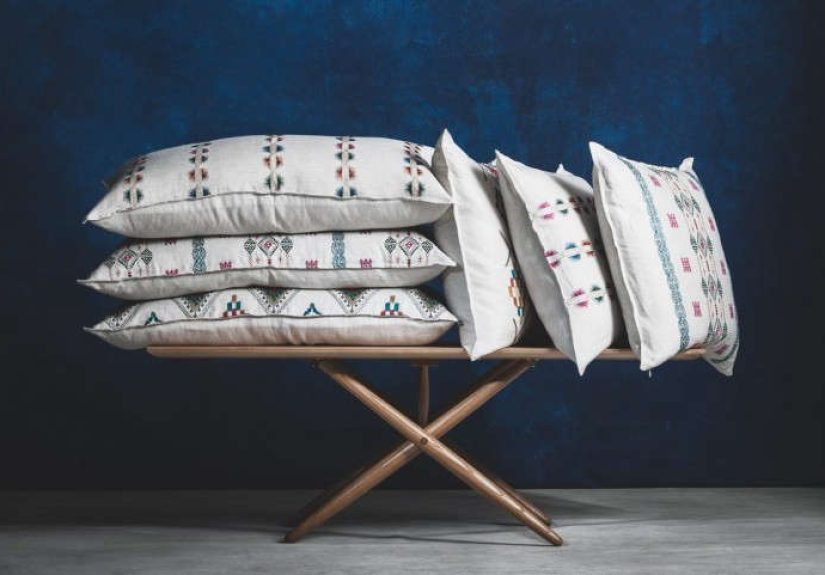
Remodelista also noted the debut of the Wayfarer collection, a more non-narrative line marked by stripes, latticework, and geometric patterns inspired by the landscapes, traditions, and crafts Housley encountered during her travels. That expansion was a smart move. It showed that Coral & Tusk could speak two design languages at once: one playful and character-driven, the other more graphic and architectural. In other words, the brand could flirt with foxes and still behave itself in a grown-up living room.
That combination made Coral & Tusk a natural fit for a market audience drawn to well-made, considered design. The New England customer has long appreciated objects that feel rooted, useful, and enduring. Coral & Tusk offered exactly that, just with more birds, mushrooms, and quietly excellent embroidery.
The Brand Behind the Booth
Stephanie Housley’s background gave the whimsy real structure
One reason Coral & Tusk never reads as flimsy fantasy is that Stephanie Housley came to it with serious textile experience. She studied textile design at RISD and spent years working as a professional interior textile designer in New York City before launching the company in 2007. The brand began with a single embroidery machine in her Brooklyn apartment, which sounds like the sort of origin story design lovers cannot resist because, frankly, it is a good one. But behind the romance was hard-earned technical knowledge about cloth, pattern, scale, and how textiles actually live in a room.
That training shows. Even Coral & Tusk’s more playful pieces tend to have control in the linework, balance in the composition, and a strong sense of placement. These are not doodles dropped onto fabric. They are designs that understand textile repeat, negative space, and how a pillow or runner needs to function when it is not being admired on Instagram.
Every design begins as a drawing
Coral & Tusk’s process still starts the old-fashioned way: with Housley’s original pencil drawings. From there, the artwork is translated stitch by stitch into embroidery files, then produced through long-standing manufacturing partners. The company’s own materials emphasize a blend of illustration, machine embroidery, and hand-finishing, and that combination helps explain the brand’s distinct feel. It is precise, but not sterile. You can still sense the hand behind the thread.
That balance is probably the secret sauce. Too much handwork can become precious. Too much machine perfection can become cold. Coral & Tusk sits in the sweet spot between the two, where skill serves imagination.
What Makes Coral & Tusk Different
It tells stories without shouting
At first glance, Coral & Tusk is easy to summarize: embroidered animals on linen. But that sells the brand short. The appeal is not just the motifs. It is the narrative quality inside them. A fox is not just a fox. It is often mid-adventure, bundled for a hike, tucked into a canoe, peeking from a pocket, or posed in a scene that hints at an entire little world beyond the frame. Even the florals and feathers feel less decorative than observant, as though they were drawn by someone who really looks at things before trying to stylize them.
That storytelling quality is part of what has kept the brand relevant across years of shifting home trends. Minimalism rose. Maximalism boomed. Grandmillennial style did its bow-covered victory lap. Through all of it, Coral & Tusk kept doing what it does best: offering pieces with personality that are not dependent on whatever algorithm declared to be the mood of the month.
The materials do a lot of heavy lifting
Coral & Tusk’s linen matters as much as its imagery. The company uses 100 percent unbleached, undyed flax linen and describes its goal as creating long-lasting products meant to be enjoyed for many years. The natural ground gives the embroidery warmth and texture, while the slight tonal variation in the fabric keeps everything from feeling overly polished. It looks lived with, even when it is brand new.
That natural quality is also part of the brand’s appeal in design-conscious homes. Fancy interiors often need an element that loosens them up. Coral & Tusk does that beautifully. A tailored room with clean-lined furniture can suddenly feel more human with one embroidered lumbar pillow or a runner that brings a little wit to the table. It is decor with manners, but also with a pulse.
The 2015 Yardage Launch Was a Bigger Deal Than It Looked
It is easy to underestimate how meaningful fabric by the yard was for Coral & Tusk. Selling finished goods is one thing. Selling yardage invites a brand into the deeper architecture of a home. It allows interior designers and adventurous homeowners to use the textile in window treatments, banquettes, headboards, and custom upholstery. That move effectively widened the stage.
It also made sense creatively. Architectural Digest had already highlighted Coral & Tusk’s collaboration with Pollack, noting how Housley’s fine-line drawings translated beautifully into playful textiles suited to upholstery and drapery. That collaboration helped prove that the brand’s embroidered language could work beyond accent pieces. The Remodelista spotlight extended that same logic into a broader shopping context: here was Coral & Tusk, not as a niche novelty, but as a serious textile player with a signature voice.
And yet the brand did not sacrifice character to become more broadly usable. The Wayfarer collection may have leaned geometric, but it still felt connected to Housley’s larger vision. That continuity matters. Plenty of companies expand and accidentally sand off the very edges that made them interesting. Coral & Tusk expanded without becoming generic, which is harder than it sounds and rarer than it should be.
Why New England Was the Right Audience
There is something especially fitting about Coral & Tusk showing up in a New England market conversation. New England interiors often thrive on contrast: utility and beauty, restraint and warmth, old bones and fresh details. Coral & Tusk slips neatly into that vocabulary. Its embroidered linens feel handcrafted enough for a historic home, but graphic enough for a cleaner, more modern interior. Its palette can read earthy and gentle, while its imagery keeps the room from becoming too serious.
That is likely why the brand feels equally convincing in a shingled coastal house, a Brooklyn brownstone, a mountain cabin, or a tailored city apartment. It does not lock itself into one regional cliché. It travels well. And for a market spotlight, that flexibility is gold. Buyers want something with identity, but they also want to imagine how it will work in different spaces. Coral & Tusk gives them both.
How Coral & Tusk Evolved Without Losing Its Soul
Over time, Coral & Tusk has expanded far beyond the early pillow-and-tea-towel impression some shoppers may still carry. Today the brand includes table linens, runners, cocktail napkins, tissue box covers, holiday ornaments, pocket pillows, fabric yardage, and more. Editorial coverage across design and lifestyle publications has continued to point out the same core strengths: the hand-drawn imagery, the nature-inspired themes, and the emotional pull of the work.
The company’s move from Brooklyn to Wyoming also seems to have deepened the connection between the designs and the natural world. House Beautiful’s look at Housley’s Wyoming cabin and Mountain Living’s coverage of her creative life both reinforce the idea that access to wildlife, open space, and changing seasons has become part of the brand’s daily rhythm. The designs still have imagination, but they also feel observant. The birds, blooms, forests, and camp scenes do not read like random motifs pulled from a trend report. They feel lived with.
Then came the 2024 book, In Stitches: The Enchanted World of Coral & Tusk, published by Rizzoli. That release mattered because it framed the brand not merely as a home decor label, but as a broader creative universe. The book showcases Housley’s artwork, process, and backstories, confirming what longtime fans already suspected: the products are only one part of the larger appeal. The real product, if we are being honest, is enchantment with a very good work ethic.
How to Decorate With Coral & Tusk Without Overdoing It
One of the nice things about Coral & Tusk is that it does not require a full themed commitment. You do not need to turn your breakfast nook into a woodland parliament or appoint a rabbit as the unofficial mayor of your guest room. A little goes a long way.
Start with one expressive piece
A single embroidered pillow can wake up a neutral sofa or reading chair. Because the linen is understated, the piece adds interest without overwhelming the room.
Use table linens to make everyday rituals feel special
Coral & Tusk’s runners and napkins are especially effective because they combine usefulness with visual delight. The table becomes more inviting, but not too precious for actual dinner.
Mix with plain textures
The brand looks best when paired with solids, natural wood, matte ceramics, vintage pieces, or simple upholstery. Give the embroidery room to breathe. It is charming, not clingy.
Think seasonally, not disposable
Holiday ornaments, autumn runners, and floral spring linens work because they still feel crafted and enduring. They do not scream one-and-done seasonal decor. They whisper it elegantly, which is a much better party trick.
What Keeps Designers and Shoppers Coming Back
In a market full of things that are either aggressively practical or aggressively whimsical, Coral & Tusk occupies a rare middle ground. It makes products that are useful, giftable, collectible, and emotionally resonant. They are tactile enough for textile lovers, graphic enough for design people, and warm enough for anyone who wants a home to feel personal rather than professionally staged.
That is the deeper reason the Remodelista New England Market Spotlight: Coral & Tusk still feels worth revisiting. It captured a moment when the brand was expanding, yes, but it also captured why the brand worked in the first place. Coral & Tusk was not chasing spectacle. It was offering intimacy, craft, and character in a design world that often forgets how appealing those qualities are.
The Experience of Coral & Tusk, From Market Table to Everyday Home
To understand Coral & Tusk fully, it helps to think beyond the product shot. Imagine walking through a design market where so many booths are trying very hard to look important. There are stern ceramics, self-conscious neutrals, and enough beige to make a cappuccino feel underdressed. Then you arrive at Coral & Tusk. The mood changes. The linens are still refined, the styling is still polished, but there is suddenly a sense of play in the air. You lean in, almost automatically. Not because the brand is loud, but because it rewards attention.
You notice the ground first: natural linen, warm and slightly irregular, the kind of fabric that looks better the closer you get. Then the stitching starts to reveal itself. A bird is not just perched; it seems to be thinking. A mushroom is not just decorative; it feels like the front door to a secret life. The embroidery catches light differently than print ever could, giving every motif a subtle relief and shadow. You do not just see the design. You feel the labor behind it. Thousands of stitches have built this tiny scene, and somehow the result still feels effortless.
That is part of the experience Coral & Tusk creates in a home as well. A pillow lands on a chair and suddenly the chair has a point of view. A runner goes down the middle of a table and ordinary breakfast begins to look slightly ceremonial, in a good way. A tea towel hanging in the kitchen turns a purely functional corner into something more companionable. The pieces do not demand a whole room makeover. They simply alter the atmosphere by degrees, which is often the smartest kind of decorating. The home still looks like yours. It just seems a little more awake.
There is also a deeply comforting quality to the brand’s humor. Coral & Tusk is playful, but never frantic. The animals are charming, yet the designs are composed. That means the pieces can live with you longer than trend-driven decor that burns bright and then embarrasses you six months later. Their charm accumulates. Guests notice them. Children often adore them. Adults do too, though they may pretend they are admiring the stitching when really they are emotionally attached to a fox in striped socks. No judgment. That fox is doing excellent work.
And perhaps that is the real experience behind the original Remodelista market spotlight. Coral & Tusk offers a way of decorating that feels both cultivated and kind. It invites curiosity instead of intimidation. It values craft without losing joy. It proves that a house can be well-designed and still have a sense of humor, that a textile can be technically impressive and still make you smile, and that embroidery, when handled by the right designer, can do more than embellish a surface. It can build a world. Once you bring one piece home, that world has a sneaky habit of expanding, one pillow, napkin, ornament, or yard of fabric at a time.
Final Thoughts
Coral & Tusk remains one of those rare design brands that feels instantly recognizable without feeling repetitive. The original Remodelista New England Market Spotlight: Coral & Tusk captured a pivotal moment in the company’s evolution, but it also highlighted something more lasting: Stephanie Housley’s ability to turn hand-drawn imagination into textiles with real decorative power. From embroidered pillows to yardage, from Brooklyn beginnings to Wyoming inspiration, Coral & Tusk has managed to grow while staying unmistakably itself. In the design world, that is no small feat. In fact, it may be the whole stitched-up miracle.