Table of Contents >> Show >> Hide
- What Is the Steppin App?
- How Steppin Works in Real Life
- Why the Idea Behind Steppin Is Smarter Than It Looks
- What Steppin Gets Right
- Where Steppin Trips Over Its Own Shoelaces
- Is It Annoying? Yes. That’s Why It Might Work
- Who Should Try Steppin?
- Final Verdict: Is Steppin Worth Downloading?
- Extra Experience: What a Walk-to-Scroll App Actually Feels Like
There are two versions of me on most weekdays. There is the ambitious, high-functioning adult who says things like, “Tonight, I’ll stretch, read ten pages, and maybe become the kind of person who drinks water on purpose.” Then there is the lizard-brain version of me who opens Instagram for “just a second” and wakes up 43 reels later watching a raccoon wash grapes in a dollhouse sink.
That second version of me is exactly the person Steppin was built for.
Steppin is a screen time control app with a gloriously annoying premise: if you want time on certain apps, you have to earn it by walking first. In other words, no steps, no scrolls. It turns your phone from an enabler into a mildly judgmental gym teacher. And honestly? That may be the energy some of us need.
This review takes a close look at what Steppin does well, where it stumbles, and whether this whole “walk before you binge Reels” concept is actually useful or just another wellness gimmick wearing cute sneakers. The short answer is that the idea is smarter than it sounds, the execution is promising, and the experience is weirdly effective when it works. The longer answer is much more interesting.
What Is the Steppin App?
Steppin is a digital wellness app designed to limit access to distracting apps until you hit a step goal. Its main pitch is simple: choose the apps that eat your attention, connect your movement data, and earn screen time through walking. By default, the system is built around a straightforward reward loop, which makes the app easy to understand even if your patience has already been wrecked by the internet.
That simplicity is a big part of its appeal. Steppin is not trying to become your therapist, your fitness coach, your life planner, and your spirit animal all at once. It does one thing: it puts a little friction between you and your favorite time-sucking apps. In the attention economy, friction is a feature, not a bug. Well, unless there are actual bugs. More on that in a minute.
Conceptually, Steppin sits at the intersection of three trends that have been gaining traction for years: screen time reduction, digital detox tools, and gamified fitness. That combination makes a lot of sense. Walking is accessible, screen time is easy to lose control of, and rewards tend to work better than vague self-loathing. Telling yourself to “have more discipline” is noble. Telling your brain, “Take 700 steps and you may have your little videos,” is often more effective.
How Steppin Works in Real Life
The Setup Is Pretty Intuitive
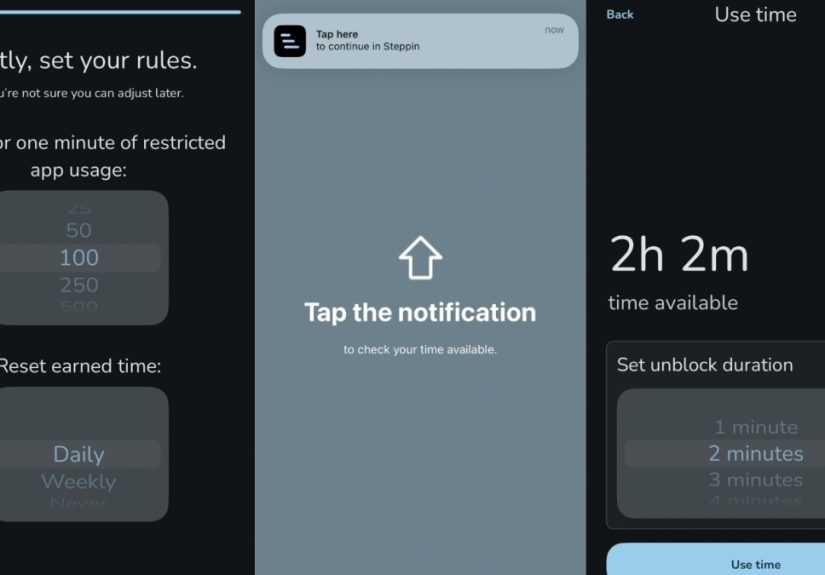
The basic flow sounds almost suspiciously reasonable. You pick which apps you want to restrict, set your rules, and let Steppin track your movement through your phone’s built-in step counter and Apple Health. The more you walk, the more time you unlock. It reframes movement as a key rather than a chore.
That tiny mental shift matters. A lot of people fail with productivity or wellness apps because the apps feel like punishment. Steppin, at least in theory, feels more like a trade. Want twenty minutes of mindless content? Cool. Go earn it with your legs. It is less “you are bad” and more “the toll road to TikTok is now cardio.”
The Reward Loop Is the Real Hook
What Steppin gets right is behavioral design. Instead of asking users to quit social media cold turkey, it introduces a condition. That is far more realistic. Most people are not trying to become woodland monks. They just want to stop losing an hour every time they unlock their phone.
And here is where the app’s logic becomes genuinely clever: walking is one of the easiest forms of exercise to start and one of the least intimidating habits to maintain. You do not need a gym membership, a kettlebell, a motivational speech, or a personality transplant. You just need shoes and a little bit of spite.
Because the barrier is low, the app can work even on bad days. You may not feel like doing a full workout. You may not feel like meal prepping, journaling, or becoming the best version of yourself. But pacing around the block for a few minutes so you can watch videos? That is a surprisingly negotiable deal.
Why the Idea Behind Steppin Is Smarter Than It Looks
At first glance, Steppin can sound like one of those modern app concepts invented by someone who says “dopamine” every six seconds. But the basic philosophy actually lines up with what we know about physical activity, screen habits, and mood.
Walking is not magic, but it is wildly underrated. It can improve mood, reduce stress, support better sleep, and help break up sedentary routines. Even brief movement breaks can feel like pressing reset on a brain that has been marinating in notifications. When you combine that with reduced passive scrolling, the app starts to look less like a gimmick and more like an elegant behavior hack.
There is also something psychologically useful about making entertainment a conscious choice again. Endless scroll platforms are built to erase stopping cues. One reel becomes 12, then 40, then suddenly the sun has set and you are emotionally invested in a stranger’s pantry restock. Steppin restores a beginning, a cost, and an end. That alone can make social media feel less hypnotic.
In other words, the app does not just reduce screen time. It changes the emotional tone of screen time. You are no longer entering the scroll in a slumped, automatic, half-awake state. You have moved first. You have interrupted the loop. You have, at minimum, convinced your body that life still exists outside your phone.
What Steppin Gets Right
1. It Makes Walking Feel Immediately Useful
A lot of wellness advice fails because the payoff feels far away. “Walk regularly for long-term cardiovascular health” is excellent advice, but it does not always beat “watch chaotic food videos right now.” Steppin shortens the reward timeline. Walk now, scroll later. Your brain understands that deal instantly.
2. It Does Not Demand Full Abstinence
Apps that try to block everything all at once often crash into reality. Steppin feels more flexible. It is not insisting that social media is evil. It is saying social media should cost something. That is a much more sustainable message for people who do not want to delete every app and move to a cabin.
3. It Adds Friction Without Becoming a Lecture
Some digital wellness tools feel unbearably preachy. Steppin’s strength is that the lesson is built into the mechanism. You do not get a long sermon about “intentional living.” You just get locked out until you move. It is direct. Slightly rude. Weirdly effective.
4. It Can Nudge You Outdoors
One underrated benefit of a walk-to-unlock app is environmental. If you end up taking your steps outside rather than marching around your kitchen like a haunted Fitbit, you may also get daylight, fresh air, and a genuine break from your feed. That is not nothing. Sometimes the best part of a digital wellness app is that it briefly makes you forget your phone exists.
Where Steppin Trips Over Its Own Shoelaces
Now for the less glamorous part. The app’s concept is stronger than its current polish.
Public user feedback suggests that while many people love the accountability, some have run into frustrating issues with the blocking feature. The biggest complaint is not philosophical. It is functional. If an app designed to enforce limits forgets to enforce limits, that is not a minor inconvenience. That is the whole job description quietly walking off the premises.
There are also complaints about feature restrictions and subscription pressure. That matters because digital wellness tools live or die on trust. Users are already asking an app to regulate behavior they do not fully trust themselves to regulate. If the experience becomes glitchy, confusing, or overly paywalled, the spell breaks fast.
And that is the paradox of tools like this: they need to be more reliable than the habits they are trying to fix. If the app is buggy, people will not say, “How human.” They will say, “Great, now both my attention span and my app blocker are broken.”
Is It Annoying? Yes. That’s Why It Might Work
One of the funniest things about Steppin is that its main value proposition is inconvenience. It is intentionally making your life a little harder so your habits can get a little better. That sounds backward, but it is exactly the point.
Convenience is wonderful until it becomes the reason you accidentally spend an hour watching strangers renovate laundry rooms. Our devices are engineered to remove effort. Steppin adds some back. Not a huge amount. Just enough to make you ask, “Do I really want this right now?” That question is more powerful than people think.
For many users, the answer will still be yes. And that is fine. The app is not there to shame your entertainment. It is there to break the automaticity of it. If you still want the Reels after your walk, enjoy your Reels. At least now you got some movement, maybe some sun, and possibly a reminder that your body is not just a vehicle for carrying your eyeballs from one screen to another.
Who Should Try Steppin?
Steppin makes the most sense for people who know exactly which apps are draining their time. If Instagram, TikTok, YouTube Shorts, X, or any other infinite-feed app has become your default background noise, this app offers a practical intervention. Not dramatic. Not monk-like. Practical.
It is also a good fit for people who respond better to external structure than internal pep talks. Some habits do not change because we suddenly become wiser. They change because we build better systems. If you have ever said, “I need something to physically stop me,” Steppin is speaking your language.
It may be less ideal for users who want a perfectly seamless experience or who have a very low tolerance for app hiccups. If reliability issues immediately make you delete an app in fury, you may want to wait for more polish. The concept is strong, but concept alone does not unlock your apps.
Final Verdict: Is Steppin Worth Downloading?
Yes, with one very important asterisk.
Steppin is one of the more interesting digital wellness ideas floating around right now because it does not just block distraction. It redirects you through movement. That is a meaningful difference. It turns screen time control into a physical ritual, and that can be surprisingly powerful for people trapped in a doomscroll-and-regret cycle.
When the app works as intended, it seems to create exactly the kind of healthy friction many people need. It can make walking feel rewarding, make scrolling feel less automatic, and turn “I should get up” into “Fine, I’ll get up because the app is holding my entertainment hostage.” That is not poetic, but it is effective.
The asterisk is execution. A habit app built on enforcement has to be dependable. If Steppin continues to refine its stability, improve trust, and make the premium structure feel fairer, it could become a standout tool in the screen time reduction space. Right now, it looks like a smart app with a genuinely useful premise that still needs a little more tightening before it becomes an easy recommendation for everybody.
Still, as a concept? It is excellent. As a behavior nudge? Better than excellent. As a way to make me walk before I binge Reels? Rude, effective, and honestly kind of brilliant.
Extra Experience: What a Walk-to-Scroll App Actually Feels Like
The strangest part of using an app like Steppin is how quickly it exposes your little screen-time rituals. You do not realize how often your thumb opens the same app automatically until that app suddenly says, “Absolutely not, go outside.” It is humbling. Not in a spiritual-awakening way. More in a “wow, I really do open Instagram every time I feel one molecule of boredom” kind of way.
At first, the experience feels mildly offensive. You reach for your usual comfort scroll while waiting for coffee, lying on the couch, avoiding a chore, pretending to check one notification, and the app blocks you. Your first reaction is not, “Thank you, wise digital guardian.” Your first reaction is, “Excuse me?” That tiny flash of resistance is actually the whole experiment. It proves there was a habit there, and habits hate being noticed.
Then comes the negotiation phase. You tell yourself you do not really need the app right now. You can just do something else. Three minutes later, you are putting on shoes because apparently you do, in fact, need to watch those Reels. This is where the app gets surprisingly funny. It turns your feed into a side quest. Suddenly your entertainment has prerequisites. You are not procrastinating anymore; you are technically training for content.
And once you are walking, something odd happens. The urgency often fades. The first hundred steps are powered by pure stubbornness. The next few hundred steps feel less transactional. Your brain unclenches a little. You notice the weather. You notice your street. You notice that being upright and in motion is actually not the worst thing that has ever happened to you. By the time you have earned your minutes, the scrolling impulse is usually less desperate and more deliberate.
That may be the app’s biggest hidden win. It does not just delay the binge. It changes the mood you bring into it. Instead of collapsing into your feed half-dazed, you arrive after movement. Sometimes you still watch the videos. Sometimes you watch fewer. Sometimes you decide the walk scratched the itch and the Reels can wait. That is a meaningful shift, especially for people who feel like their phone is always one step ahead of their intentions.
There is also a subtle emotional payoff in earning something trivial. Social media time is not exactly a noble prize, but attaching it to effort makes it feel smaller and more manageable. The app quietly turns “I lost an hour again” into “I chose ten minutes.” That change in tone matters. It replaces shame with structure. And structure, unlike guilt, is actually useful on a Tuesday afternoon.
Of course, the experience is not flawless. If the app glitches, the magic disappears fast. Nothing kills a healthy habit vibe like wondering whether your blocker is blocking, whether your earned time counted, or whether you are arguing with software instead of simply living your life. A tool like this has to feel sturdy. Otherwise, the user winds up doing more mental labor than the habit it was supposed to simplify.
But when it clicks, it clicks. The app makes movement feel relevant in the exact moments when movement is easiest to skip. It catches you in those dead zones of the day when your energy is low and your phone looks suspiciously comforting. And instead of saying “be better,” it says, “Take a walk, then do what you want.” That is a far more humane form of accountability.
If you are the kind of person who has tried timers, app blockers, productivity speeches, lockboxes, and self-imposed rules that mysteriously vanish by 9 p.m., Steppin’s approach may feel refreshingly concrete. It will not fix your whole digital life. It will not turn you into a minimalist mountain person. But it might get you off the couch, out the door, and out of your algorithm for long enough to remember that your attention is supposed to belong to you.