Table of Contents >> Show >> Hide
- What Is the Solar Gravitational Lens, Exactly?
- Why Astronomers Want This Cosmic Hack
- How the Sun-as-Telescope Would Really Work
- What Alien Life Might Look Like Through a Sun Lens
- The Engineering Problems Are Not Small. They Are Comically Large.
- Why This Could Change the Search for Life Forever
- The Human Experience of Chasing an Alien World Through the Sun
- Conclusion
The strangest telescope humans may ever build does not have a polished mirror, a giant dish, or a fancy observatory dome. It has a plasma atmosphere, nuclear fusion in the middle, and a habit of throwing solar tantrums. In other words, it is the Sun.
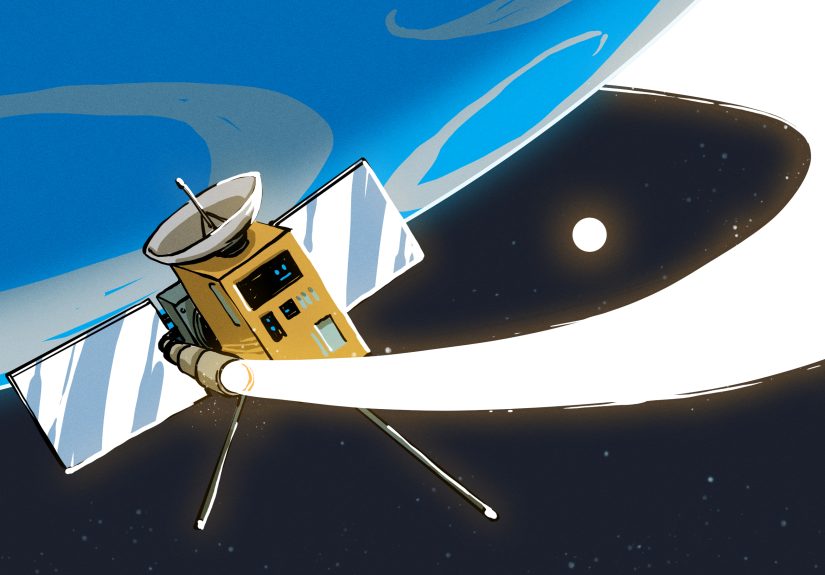
That sentence sounds like science fiction trying too hard. But the idea behind a solar gravitational lens is very real. According to general relativity, gravity bends light. When light from a distant object skims past the Sun, the Sun’s gravity warps that light and focuses it into a long line far beyond the planets. Put a spacecraft in the right place, and our star could act like the biggest natural telescope in the solar system.
Why does that matter for the search for extraterrestrial life? Because finding alien life is not just about hearing a radio ping from the cosmos and dramatically dropping a coffee mug. It is also about seeing and analyzing distant worlds directly: their atmospheres, their seasons, their cloud patterns, their oceans, and maybe one day, signs that something more than geology is going on. A solar gravitational lens could give astronomers a shot at doing something ordinary telescopes struggle with: resolving the surface of an Earth-like exoplanet in meaningful detail.
In plain English, the Sun might help us do the cosmic equivalent of switching from “tiny blurry dot” to “wait, is that a coastline?” And that is where the idea gets really wild.
What Is the Solar Gravitational Lens, Exactly?
The solar gravitational lens is not a glass lens floating in space like some giant celestial contact lens. It is an effect created by gravity itself. As light passes near the Sun, spacetime curves, and the light bends. Under the right geometry, that bending concentrates light from a distant target and creates a bright ring-like pattern known as an Einstein ring.
Here is the important detail: the usable region for this effect begins far, far away from the Sun, beyond roughly 547 astronomical units. One astronomical unit is the average distance between Earth and the Sun, so we are talking about a location more than 547 times farther from the Sun than Earth is. Voyager 1, humanity’s distance champion, is still nowhere close to that. So yes, the concept is brilliant, and yes, it also asks engineers to casually build a mission into the deep outer darkness. Easy.
It is also worth clearing up a common confusion. This is not the same thing as gravitational microlensing, the method astronomers already use to discover some exoplanets when a foreground object briefly magnifies a background star. Microlensing is usually about detection during a temporary alignment. The solar gravitational lens concept is about parking a spacecraft in the Sun’s focal region and using that geometry for imaging and spectroscopy of a selected target world.
Why Astronomers Want This Cosmic Hack
Searching for alien life is hard because Earth-like exoplanets are basically cosmic fireflies hovering next to industrial floodlights. A rocky planet is tiny, dim, and buried in the glare of its host star. Even future direct-imaging missions need staggering contrast performance to separate the planet’s faint reflected light from the star’s blaze.
That is why the solar gravitational lens is so appealing. Researchers studying the concept argue that the Sun’s gravitational focusing could provide immense brightness amplification and astonishing angular resolution. In theory, a modest telescope operating in the focal region could gather enough information to reconstruct a multi-pixel image of an Earth-like planet around a nearby star. Instead of learning that a planet exists and maybe guessing what its atmosphere contains, astronomers could begin to map continents, oceans, cloud decks, ice coverage, and seasonal changes.
This is a huge leap in the search for alien life. Most current and near-future methods focus on biosignatures in atmospheres. That means scientists study the light passing through or reflected from an exoplanet’s atmosphere and look for gases that may hint at life, such as oxygen, methane, ozone, carbon dioxide, and water vapor. But atmospheric chemistry alone can be tricky. A gas that looks exciting in one context may be misleading in another.
A solar gravitational lens could push us beyond a one-dimensional answer. It could combine atmospheric spectroscopy with actual resolved planetary information. That means not just asking, “Do we detect oxygen?” but also asking, “Do we see seasonal changes, cloud patterns, surface reflectivity, or ocean glint that make a living planet more plausible?” That is not just better data. That is a richer argument.
How the Sun-as-Telescope Would Really Work
This is the part where the concept stops sounding like a giant cosmic camera and starts sounding like a very patient data puzzle.
A spacecraft traveling to the solar gravitational lens region would not simply snap a postcard image of an alien world. The target planet’s light gets warped into an Einstein ring around the Sun. The spacecraft would need to observe that ring while blocking overwhelming solar light and accounting for noise from the solar corona. In other words, the Sun helps you magnify the target, then immediately makes the assignment difficult by being the Sun.
Researchers describe the image not as a neat photograph but as information compressed into a narrow cylindrical region in the image plane. For an Earth-like exoplanet tens of parsecs away, that projected image could be only about a kilometer or so across. The spacecraft would move through this region, sample the light carefully, and use deconvolution algorithms to reconstruct the planetary image. Think less “take picture” and more “scan a warped light ring, gather piles of photons, then run a sophisticated mathematical rescue mission.”
The spacecraft would also need a coronagraph or similar starlight suppression system to reduce glare from the Sun and its corona. This is one of the biggest technical challenges. Another is targeting. Because the focal line extends outward from the Sun in the opposite direction of the target, a mission would likely be optimized for one specific exoplanet system, at least at first. Retargeting another world is not like panning a telescope a few degrees. It is more like redesigning your cosmic commute.
What Alien Life Might Look Like Through a Sun Lens
Now we get to the fun part: what exactly could astronomers search for?
1. Atmospheric biosignatures
The first category is atmospheric chemistry. Scientists have long discussed oxygen and methane as one of the most intriguing combinations because those gases tend to react away unless something keeps replenishing them. But nature loves plot twists, so researchers are careful about false positives. Oxygen alone is not a guaranteed sign of life. Methane alone is not either. Context matters: carbon monoxide, water vapor, ultraviolet environment, surface pressure, cloud cover, and stellar type all influence interpretation.
That is why better spectroscopy matters so much. A solar gravitational lens mission could, in principle, provide high-resolution observations of an exoplanet’s atmosphere while also giving clues about the planet as a world, not just as a spectrum. This is the difference between reading a chemical receipt and actually seeing the restaurant.
2. Surface clues
If astronomers could reconstruct a detailed image, they could look for broad-scale features associated with habitability. Do we see ocean-like reflectivity? Do continents appear stable over time? Are there polar caps? Do clouds shift with seasons? Is there evidence of weather cycles? Do some regions darken and brighten in ways consistent with vegetation-like surface changes, ice melt, or dust transport?
None of these would be a silver bullet on their own. But when multiple lines of evidence point in the same direction, the case gets stronger. Alien life is unlikely to announce itself with a billboard that says, “Congrats, you found us.” It will probably show up as a layered pattern of clues.
3. Technosignatures
Then there is the even more dramatic category: signs of technology. The SETI community now treats technosignatures as a serious research area, including radio emissions, optical signals, artificial pollutants, waste heat, and other possible markers of advanced civilizations.
Could a solar gravitational lens help? In principle, maybe. In practice, astronomers need to be careful not to leap from “better images” to “alien city lights confirmed.” Some headlines love that jump because it is irresistible clickbait. But science works best when it keeps both feet on the floor. A solar gravitational lens would most plausibly improve our ability to characterize atmospheres, surfaces, and planetary changes. Technosignatures might become part of the investigation, especially if something unusual turns up, but they are not the easy mode of this story.
The Engineering Problems Are Not Small. They Are Comically Large.
If the science is elegant, the engineering is a full-contact sport.
First, the spacecraft has to get out to roughly 600 to 900 astronomical units in a reasonable time. Some NIAC-backed studies have explored using solar sails, small spacecraft swarms, or aggressive propulsion strategies to reach the region faster than conventional deep-space missions. Even optimistic mission architectures still involve long cruise times and ambitious velocity goals. Translation: this is not a weekend mission, unless your weekends last a quarter century.
Second, power becomes a major issue at those distances. Solar power fades badly in the outer solar system, so a mission would likely rely on nuclear power or other advanced systems. Third, navigation has to be incredibly precise. The spacecraft would need to hold position and scan a very narrow observing region while dealing with limited communication, long light-time delays, and extreme autonomy requirements.
Fourth, there is the corona. The Sun’s outer atmosphere is not just pretty in eclipse photos; it is noisy, bright, and deeply inconvenient for this mission. Any realistic solar gravitational lens telescope must separate the target signal from coronal background light. That demands exquisite instrument design, careful observing strategies, and image reconstruction methods that do not fall apart under real-world noise.
So no, nobody is launching this next Tuesday. But the concept has moved well beyond napkin doodles. Scientists and engineers have been developing mission architectures, optical models, noise estimates, and image reconstruction strategies to test whether this can be done with technologies already available or in active development.
Why This Could Change the Search for Life Forever
Most discussions about alien life swing between two extremes: either “we are definitely alone” or “the aliens are probably checking our Wi-Fi.” Real science lives in the less flashy middle, where evidence accumulates step by step. That is exactly why the solar gravitational lens matters.
It offers a possible path from inference to inspection. Today, astronomers often infer the nature of exoplanets from transits, radial velocity, or low-resolution spectra. Tomorrow, with more advanced direct imaging, they may identify the strongest biosignature candidates. But a telescope using the Sun as a gravitational lens could, one day, let us study one nearby habitable world in extraordinary detail.
Imagine seeing recurring cloud systems over an ocean. Imagine mapping bright polar ice. Imagine watching seasonal color shifts on landmasses. Imagine obtaining spectra from different regions of the same planet and realizing that one area looks geologically dead while another looks chemically out of equilibrium. That would not merely refine the search for life. It would revolutionize it.
And if the answer turns out to be “no life detected,” that result would still be profound. It would tell us something real about how common living worlds are, how often habitability turns into biology, and whether Earth is ordinary or weird in the most important way possible.
The Human Experience of Chasing an Alien World Through the Sun
There is also a deeply human side to this idea, and it may be the most compelling part. Searching for alien life with the Sun as a gravitational telescope is not just an engineering story or a physics story. It is an emotional story about patience, ambition, and the unusual things our species does when curiosity gets the steering wheel.
Think about what this mission would feel like for the people building it. Unlike many space missions that produce dramatic images within months or years, a solar gravitational lens mission asks teams to commit to a timescale that is almost generational. Some of the scientists who help design the optical system may not be the same people who analyze the first reconstructed maps. Graduate students could become senior researchers before the spacecraft reaches its observing region. That kind of timeline changes the psychology of exploration. It forces people to work not just for publication or prestige, but for the possibility of handing a torch to the future.
There is also the strange emotional tension of the mission itself. During launch, it would look like any other spacecraft story: countdowns, telemetry, applause, maybe a few relieved engineers trying not to cry on camera. Then the mission would disappear into a long cruise, moving farther from the Sun while somehow trying to use the Sun more effectively than any telescope in history. That contradiction alone is poetic. To see farther, we first have to go farther than we ever have.
And then there is the moment the data begins to come in. It would not be a single glamorous image file arriving like a movie prop. It would be a trickle of measurements, a growing archive of light samples, a reconstruction that improves slowly as more data accumulates. The first result might be blurry. The second might be controversial. The third might make half the astronomy community lean toward their screens and say, “Hold on. Are those cloud bands? Is that a coastline? Is that seasonal change?” The experience would not be a sudden revelation. It would be a dawning realization.
For the public, the emotional effect could be enormous. People are used to spectacular space images, but those usually show places that are empty of obvious life: nebulae, galaxies, moons, rings, storms. A resolved image of a temperate exoplanet would feel different. Even without proof of biology, just seeing a potentially habitable world as a world rather than a data point could alter our imagination. It would turn “Earth-like exoplanet” from technical jargon into something visual, almost intimate. A distant world would stop being a statistical object and start feeling like a place.
If that place showed even tentative signs of life, the experience would become even stranger. Not panic. Not instant certainty. More likely a global mix of awe, debate, skepticism, wonder, and endless awkward family-group-chat messages. But underneath the noise, there would be something profound: the realization that a species living on one small planet figured out how to use its own star as an instrument to investigate another living world.
That may be the most beautiful part of the whole concept. It is not just about finding aliens. It is about what human beings become while trying. We learn to think in centuries, to build tools for descendants, to combine math with imagination, and to aim a machine through interstellar geometry because we cannot stop asking whether anyone else is out there. That experience, even before the answer arrives, is already a sign of intelligent life.
Conclusion
Searching for alien life with the Sun as a gravitational telescope is one of the boldest ideas in modern space science. It sits at the intersection of relativity, exoplanet astronomy, mission design, data science, and good old-fashioned scientific audacity. The concept is not simple, cheap, or close at hand. But it is grounded in real physics and increasingly serious mission analysis.
If humanity ever wants more than atmospheric hints from a distant Earth-like worldif we want maps, regional spectra, seasonal changes, and a richer case for habitability or lifethe solar gravitational lens may be one of the few plausible paths. It turns our Sun from a blinding nuisance into a cosmic helper. That is a wonderfully cheeky move by science.
For now, the idea remains a future-facing mission concept. But it already does something important: it expands the scale of our ambition. It reminds us that the search for alien life is no longer limited to listening for signals or guessing from a pixel. One day, we may use the gravity of our own star to study another world closely enough to ask a sharper, older, and far more thrilling question: is that planet alive?