Table of Contents >> Show >> Hide
- Why So Many Eyes Were on Colbert
- The Mood in the Room: Grief, Gratitude, and Gallows Humor
- Unfortunately for “Big Moment” TV, the Lead Guest Was Adam Schiff
- What Else Happened on the Episode (Yes, There Were Other Guests)
- The Business Reality: “Purely Financial” Can Still Feel Personal
- The Politics Question: Timing Matters, Even If It’s Coincidence
- What This Night Said About Colbert’s Brand
- What Happens Next: The Road to May 2026
- Conclusion: The Night “Late Show” Stopped Being Just a Show
- Bonus: of “Experience” From Nights Like This (Because This Episode Was a Feeling)
There are two kinds of late-night episodes: the ones you half-watch while scrolling, and the ones that suddenly feel like a live national eventlike you should be standing for the anthem and holding a tiny foam finger that says “I’M EMOTIONALLY INVESTED.” The July 17, 2025 episode of The Late Show with Stephen Colbert was the second kind.
Not because of a blockbuster movie star. Not because a pop icon showed up wearing sunglasses indoors and speaking exclusively in haiku. But because CBS had effectively dropped a bomb on the late-night landscape: the network announced that The Late Show would end in May 2026, retiring the franchise entirely. So yesmore eyes than usual, the kind of eyes that come with push notifications, group texts, and the sudden realization that the “monologue” is now a “historical document.”
And then, after Colbert’s carefully measured announcement and a monologue aimed at his favorite pinata (Donald Trump), the show shifted into its next gear: the lead guest interview. The moment when late-night typically rewards you for showing up with a celebrity, a wild anecdote, or at minimum a charming laugh.
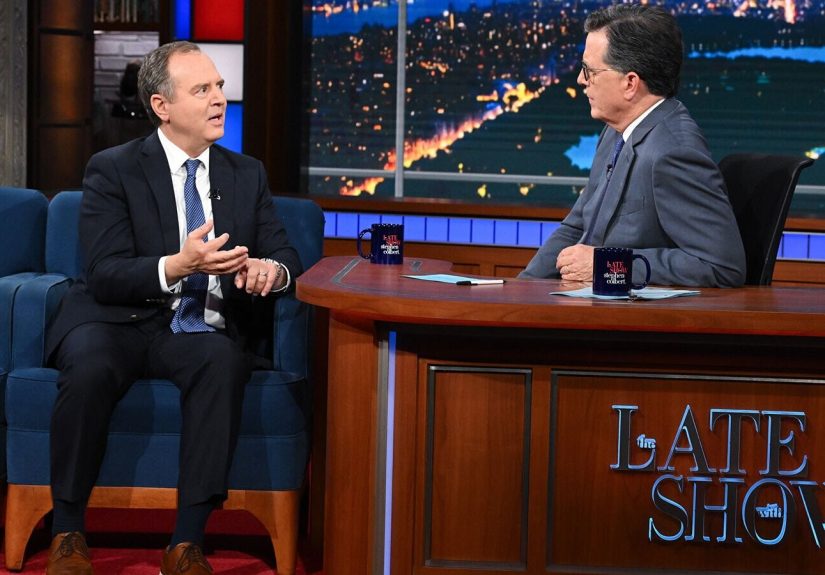
Instead, America got Senator Adam Schiff.
Why So Many Eyes Were on Colbert
The cancellation news turned a regular Thursday into “event TV”
Late-night doesn’t usually generate suspense unless someone’s about to eat something unholy on camera. But on this night, the suspense was existential: viewers tuned in to see how Colbert would respond to the news that his showand the entire Late Show brandwas being put on a calendar countdown.
Colbert addressed it head-on at the top of the broadcast, telling the studio audience that the next season would be the last and that he wasn’t being replaced. That detail mattered. In TV terms, “not being replaced” is the difference between “we’re changing roommates” and “the building has been condemned.”
The context was messy, political, and unbelievably flammable
CBS and Paramount framed the decision as financiallate-night ad economics are rough, audiences are fragmenting, and everything costs more than it did when people still bought individual songs on iTunes. But the timing ignited skepticism. The cancellation followed Colbert’s on-air criticism of Paramount’s $16 million settlement with Donald Trump over a lawsuit tied to a 60 Minutes interview edit. Colbert called it what many viewers suspected it looked like: an attempt to stay on the right side of power.
Meanwhile, Paramount’s broader business situationespecially a major merger requiring federal approvaladded gasoline to a story that was already surrounded by sparks. In other words, this wasn’t just entertainment news. It was media, politics, and corporate strategy colliding in the middle of a desk-and-mug monologue.
The Mood in the Room: Grief, Gratitude, and Gallows Humor
Colbert’s announcement: classy, controlled, and quietly furious
Colbert didn’t treat the moment like a tantrum or a farewell tour kickoff. He treated it like a professional gut punchabsorbing the blow in public without pretending it didn’t hurt. He thanked the audience, thanked the staff, thanked the network, and reminded everyone that an entire crew of people (roughly 200, by his own count) makes late-night happen nightly.
It landed because it was both dignified and unmistakably human. He wasn’t begging. He wasn’t burning it down on-air. He was doing the thing late-night hosts rarely have to do: explain the death of a format while standing inside the format.
The monologue still did what late-night does best: punch up at power
Then came the comedybecause Colbert is many things, but he is not a man who lets a news cycle go unroasted. He cracked jokes about Trump’s ever-expanding list of controversies and culture-war obsessions, including the kind of odd, tabloid-adjacent details that play perfectly at 11:35 p.m. When Colbert’s monologue is working, it’s not just “political jokes.” It’s a pressure valve: a way for an audience to exhale at the same time.
And for a few minutes, the show felt normal againuntil it didn’t.
Unfortunately for “Big Moment” TV, the Lead Guest Was Adam Schiff
Why that booking felt like a mismatch
Let’s be fair: Adam Schiff is not a disaster guest. He’s articulate, practiced, and comfortable with questions. But “lead guest on the night everyone is watching” is a very specific job. That job is usually filled by someone who can carry an interview like it’s a carnival ridebig energy, weird stories, a new project, maybe a little chaos.
Schiff is not chaos. Schiff is the polite human embodiment of a Senate briefing document.
That’s why the “unfortunate” part lands as comedy: the show had a rare, massive audiencesome of whom likely hadn’t watched in monthsand the first person in the chair after the announcement was a newly elected senator talking about democracy, threats, and political strategy. Important? Yes. Fluffy? Not exactly.
But the Schiff interview wasn’t pointlessit was revealing
Schiff used the platform to argue that Trump’s return to power had intensified a climate of fearaimed at institutions, critics, and even members of Trump’s own party. He talked about political threats becoming normalized and about the need to confront intimidation instead of accommodating it.
He also offered a blunt diagnosis of Democratic struggles: when voters feel crushed by affordability, housing, and healthcare, incrementalism can sound like a customer-service script. Schiff’s pitch was that Democrats can’t afford to be seen as guardians of a status quo that people experience as expensive and exhausting.
The “Watermelon Head” moment: late-night’s strange superpower
One of the most telling parts of the interview wasn’t a policy pointit was a story. Schiff described meeting farmers in California and hearing, essentially, “You seem normal… why does Trump call you that?” It’s late-night distilled into one interaction: a public caricature meets a real person, and the audience watches the gap between propaganda and reality widen in real time.
It also highlighted why Colbert books political figures at all. Late-night isn’t just comedy anymore. It’s a translation machine: turning civic anxiety into language people can processsometimes through a joke, sometimes through a conversation that feels like a verbal handrail.
What Else Happened on the Episode (Yes, There Were Other Guests)
If you only saw the announcement clip, you might assume the whole hour was one long emotional group hug. But the show still had its standard late-night structure. After Schiff, the episode included actor Anthony Carrigan and a musical performance by Noah Cyrus. In a normal week, that lineup would read like a perfectly reasonable booking sheet.
On this week, thoughwhen the show’s future became breaking newseverything got evaluated through a different lens: “Is this guest big enough for the moment?” That’s not really fair to Carrigan or Cyrus. But “not fair” is basically the national motto of online discourse.
The Business Reality: “Purely Financial” Can Still Feel Personal
Late-night is expensive, and the ad market isn’t what it used to be
Even the most loyal fans don’t usually think about the cost of a nightly talk show. But it’s a real factor: union crews, writers, production, musicians, sets, guest travel, editing, distribution, and all the invisible infrastructure that makes TV look effortless.
Meanwhile, audiences increasingly consume late-night as clipssnackable segments on YouTube, TikTok, Instagram, and whatever platform is currently winning the “who owns your attention span” battle. That’s great for reach. It’s trickier for traditional revenue models.
And yet Colbert was still winning the late-night ratings fight
Here’s the part that makes the story feel upside down: Colbert’s show remained a top performer in the broadcast late-night race. So the cancellation didn’t read like a mercy killing. It read like a strategic retreat: a network deciding the whole battlefield isn’t worth funding, even if it’s winning skirmishes.
That’s why the audience reaction was so intense. People weren’t just losing a show. They were watching a major network effectively say: “We’re leaving this part of culture behind.”
The Politics Question: Timing Matters, Even If It’s Coincidence
Schiff and others demanded clarity
Schiff didn’t just appear on the show. He publicly questioned the motives afterward, arguing that if politics played any role, the public deserved to know. Senator Elizabeth Warren similarly raised concerns, pointing to the proximity between Colbert’s criticism of Paramount and the cancellation news.
Even if CBS executives believed every word of “purely financial,” the optics were brutal: a major media company settles with a sitting president, then cancels one of his loudest late-night critics. In 2025 America, optics aren’t a side dish. They’re the whole meal.
The bigger fear: self-censorship by corporate pressure
The worry isn’t only about one host or one show. It’s about what happens when corporate decision-making intersects with political intimidationwhether direct or indirect. Late-night has historically served as a place where politicians get mocked without the formal constraints of traditional news coverage.
When that kind of outlet disappears, the cultural ecosystem gets a little quieterand not always in a healthy way.
What This Night Said About Colbert’s Brand
Colbert isn’t just hosting a show; he’s hosting a national mood
Colbert’s best episodes don’t merely deliver jokes. They organize the chaos of the day into something viewers can metabolize. That’s why this episode hit: it was simultaneously about the future of The Late Show and the future of late-night itself.
And the Adam Schiff bookingawkward as it felt for someactually underscored what Colbert has built: a show comfortable living at the intersection of comedy and civic life. Sometimes that intersection produces gold. Sometimes it produces a senator explaining why people threaten election workers while viewers whisper, “Where’s the fun celebrity?”
But that tension is the point. Colbert’s version of The Late Show has always been an argument that entertainment and politics aren’t separate rooms anymorethey’re roommates fighting over the thermostat.
What Happens Next: The Road to May 2026
Colbert promised to keep making the show with his “usual gang of idiots” through the final season. If history is any guide, the remaining months will likely feel like a rolling mix of celebration, anger, and unexpected poignancy.
- Expect bigger “legacy” interviews as the finale approachesfriends of the show, comedy peers, and people who shaped the franchise.
- Expect sharper monologues as Colbert has less reason to play nice and more reason to tell the truth as he sees it.
- Expect the internet to treat every segment like a referendum on whether late-night is dying or just evolving into something we haven’t named yet.
And yes: expect more nights where the audience shows up for history and accidentally sits through democracy homework.
Conclusion: The Night “Late Show” Stopped Being Just a Show
The July 17 episode was a reminder that late-night still matters when it collides with the real world. The show became the story. Colbert delivered a steady, grateful, quietly defiant announcement. The monologue did what it was supposed to do: turn the day’s madness into laughter. And then, in the most ironically perfect twist imaginable, the lead guest was Adam Schiffan earnest political figure on a night when many viewers probably wanted pure escapism.
But maybe that’s the real takeaway: Colbert’s Late Show has never been purely escapism. It’s been a nightly attempt to make sense of a country that can’t stop generating plot twists. And on the night his own show’s future became national news, Colbert didn’t give viewers a distraction. He gave them a mirrorthen invited a senator to explain why the reflection looks so tense.
Bonus: of “Experience” From Nights Like This (Because This Episode Was a Feeling)
There’s a particular modern experience that only happens when a late-night show turns into breaking news: you don’t watch it like TV anymoreyou watch it like a group project. Someone drops the clip in a group chat. Someone else replies with a meme before the video even loads. A third personwho hasn’t watched network television since the invention of “Skip Intro”suddenly has strong opinions about CBS’s ad revenue.
That’s what nights like Colbert’s cancellation announcement do. They pull people back into a shared cultural room. Not because everyone loves the same jokes, but because everyone recognizes the same moment: “Oh, this is bigger than the episode.”
If you’re the kind of viewer who typically sees Colbert in fragmentsten seconds on TikTok, a monologue clip on YouTube, a headline that reads like a panic attackthis was the rare night that rewarded watching the full sequence. The emotional arc mattered. The order mattered. The shift from announcement to jokes to interview mattered. It was like watching someone keep a dinner party going after the host announces, mid-toast, that the house has been sold.
And then came the Schiff factor, which produced its own very specific kind of viewer experience: the “Wait, is this still entertainment?” moment. Not because politics can’t be entertaining (it absolutely canoften in the way a raccoon in your kitchen is “entertaining”). But because lead-guest interviews usually serve as a release. The host sets down the hard news and picks up the lighter stuff: a movie, a tour, a ridiculous behind-the-scenes story.
Schiff, instead, leaned into seriousness. He talked about threats, fear, intimidation, and the need for political courage. That’s not a bad use of platform. It’s arguably the most responsible use of platform. But it creates a whiplash effect in viewers who tuned in expecting catharsis by celebrity.
Yet that whiplash is part of what made the episode memorable. It captured the weird truth of 2025-era late-night: it’s no longer a clean boundary between “news” and “fun.” It’s a revolving door. You walk through for jokes, and sometimes you bump into democracy on the way out.
From a content perspective, nights like this are a masterclass in attention. Colbert didn’t need clickbait; the story itself was the hook. He didn’t need to yell; the situation did the yelling. And he didn’t need a flashy lead guest to prove his show matteredbecause the fact that millions cared about his announcement proved it already.
Maybe that’s the strangest part of the whole thing: the night the Late Show was declared mortal was also the night it felt most alivemessy, emotional, funny, frustrating, and intensely shared. That’s not just a broadcast. That’s culture happening in real time.