Table of Contents >> Show >> Hide
- What “Superarchitettura” Really Means Here
- Why Primo’s Feels Like a Love Letter to 1970s Italian Style
- Camilla Deterre’s Design Vocabulary
- More Than a Pretty Room: The Food and Drink Match the Mood
- Why This Style Works So Well in TriBeCa
- Design Lessons You Can Steal From Primo’s
- Primo’s as a Modern New York Fantasy
- The Experience: What This Kind of Room Feels Like in Real Life
- Conclusion
- SEO Metadata
Some bars want your attention. Primo’s wants your imagination. Tucked inside The Frederick Hotel in TriBeCa, the downtown cocktail bar has built a reputation for doing something increasingly rare in New York: giving people a genuinely transportive room. Not a room that screams for selfies. Not a room that looks like an algorithm assembled it from trending mood boards and a fear of beige. A room with atmosphere, taste, and a pulse.
That is why the phrase “Superarchitettura” fits Primo’s so well. It is not just a stylish headline. It points to a whole Italian design attitude: anti-boring, anti-puritan, pro-color, pro-decoration, pro-emotion, and very much in favor of the idea that interiors should seduce you a little. Primo’s channels that spirit through terrazzo floors, velvet banquettes, chrome details, unusual vintage pieces, deep wood tones, and lighting that seems to understand the emotional importance of a good martini.
In other words, Primo’s is what happens when 1970s Italian style leaves the museum gift shop, books a table in TriBeCa, and orders something cold, salty, and expensive enough to feel like a decision.
What “Superarchitettura” Really Means Here
Strictly speaking, the design history behind this look begins before the 1970s. The radical Italian movements that shaped the decade had roots in the late 1960s, when designers and architects began pushing back against the sterile logic of orthodox modernism. Their work questioned the idea that interiors had to be quiet, obedient, and strictly functional. Groups such as Archizoom and Superstudio, and later figures linked to postmodern and anti-design currents, replaced dutiful minimalism with wit, provocation, pattern, color, symbolism, and theatricality.
That history matters because Primo’s does not simply “look vintage.” Plenty of places can buy an old chair, dim the lights, and call it a concept. Primo’s feels more specific than that. Its design language reflects a moment in Italian interior culture when furniture and décor stopped behaving like background actors and started acting like the whole cast. The room became not just a setting, but an argument.
And the argument, more or less, was this: why should domestic and social spaces be so humorless? Why should glamour be treated like a moral failure? Why should a lamp merely illuminate when it can also flirt?
Primo’s answers those questions the Italian way: with confidence, mood, and excellent surface drama.
Why Primo’s Feels Like a Love Letter to 1970s Italian Style
The bar, designed by Camilla Deterre, has long been described through a mix of references that sound almost suspiciously good together: Italian Art Deco, Mediterranean glamour, 1950s diner cues, European café nostalgia, and a distinctly ’70s Italian aesthetic. The miracle is that the place does not collapse under the weight of all those inspirations. It edits them. It choreographs them. It lets them mingle like well-dressed guests at a party where everyone claims they were “just stopping by for one.”
The Front Room: Bright, Graphic, and Slightly Cinematic
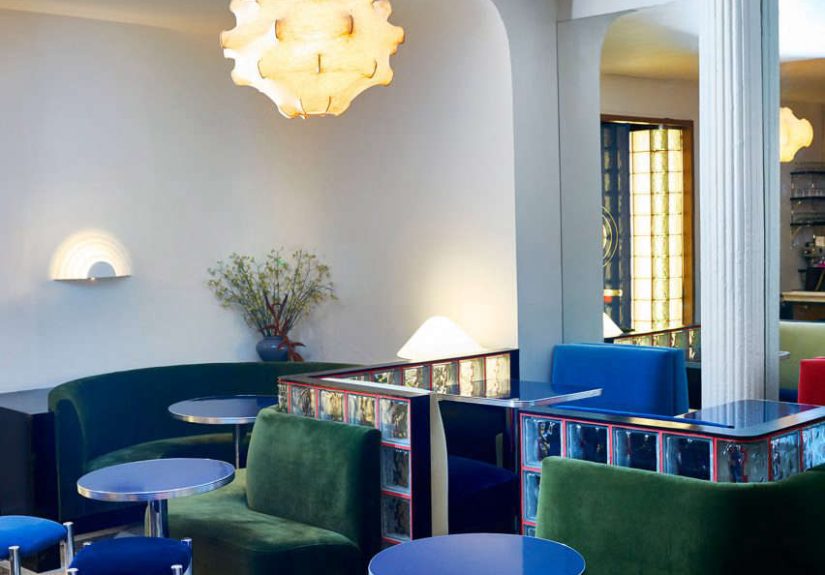
The front of Primo’s gives you the first clue that this is not your standard hotel bar. The terrazzo floor does not play it safe. The glass-block detailing does not whisper. The banquettes arrive in rich jewel tones rather than neutral compromise. Chrome-edged tables and curved seating suggest a retro café fantasy, but the effect is more sensual than nostalgic. It feels less like an exercise in period recreation and more like someone translated old-world glamour into a downtown New York accent.
That tension is the whole trick. Primo’s has enough polish to feel dressed up, but enough eccentricity to avoid becoming stiff. The result is a room that can handle a weekday aperitivo, an early date, a fashion person pretending not to be a fashion person, and a friend who insists they only came for “one quick drink” before accidentally becoming part of the décor.
The Back Room: Darker, Wilder, and Better After 11
Then there is the back room, where the mood deepens. Polished wood cladding, graphic art, vintage lighting, and a more nocturnal energy create a second act that feels intentionally different from the front. It is not just “more seating.” It is a tonal shift. The design becomes heavier, sexier, and a little less interested in being polite.
This is where Primo’s gets closest to the spirit of radical Italian interiors. The room is immersive without being overworked. It is moody without becoming gloomy. It has the kind of visual confidence that says yes, there is a mural, yes, there is drama, and no, nobody here is apologizing for either.
That split personality, bright front room and atmospheric back den, is one reason Primo’s still stands out. The place understands that nightlife is not one mood. It is a progression. First the martini. Then the second martini. Then the lighting gets a little more flattering and your opinions about walnut paneling become wildly passionate.
Camilla Deterre’s Design Vocabulary
A big part of Primo’s appeal is that Deterre does not design like someone trying to make an “Instagrammable” room. She designs like someone who still believes objects matter. Her work has often emphasized color, texture, handmade irregularity, and emotional atmosphere over the flattened perfection of digital rendering culture. That matters at Primo’s, where so much of the pleasure comes from materials that feel touchable, real, and distinctly human.
There are vintage lamps, uncommon furniture, velvet upholstery, graphic accents, wood with dramatic veining, and a mix of references that could have gone very wrong in less disciplined hands. Instead, the room feels personal. Lived in, but not sloppy. Styled, but not precious. There are even details that nod toward design icons and postwar European interiors, yet the overall impression remains unified rather than citation-heavy.
That is the real genius of the place. Primo’s is informed by design history, but it does not trap you in a lecture. You do not need to know who Archizoom was to understand that the room is funnier, warmer, and more vivid than the average “luxury” cocktail lounge. The design works on experts and civilians alike. Design nerds can discuss radical interiors and decorative rebellion. Everyone else can simply say, “This place looks amazing,” which is its own kind of scholarship.
More Than a Pretty Room: The Food and Drink Match the Mood
Primo’s would be a footnote if the drinks were all attitude and no follow-through. Thankfully, the bar program has always leaned into classics rather than gimmicks. Martini culture is central here, and that choice suits the space perfectly. A room this controlled, this tailored, and this slyly glamorous should not be serving cocktails that arrive smoking, foaming, or performing interpretive dance.
Instead, Primo’s has built its identity around straightforward but distinctive pleasures: martinis, Negroni-adjacent drinks, coffee cocktails, aperitivo-minded offerings, and late-night food that keeps the place from turning into a design showroom with glassware. Reported menu details over the years have included midnight pasta, cacio e pepe, shrimp cocktail, muffuletta, crudités, affogato, and other dishes that support the room’s European-social-club energy without overcomplicating the experience.
That balance is part of the restaurant’s SEO-friendly magic, too, whether or not the room cares about search engines. People looking for the best bars in TriBeCa, a stylish NYC cocktail bar, or a 1970s Italian-inspired restaurant interior are not just looking for aesthetics. They are looking for a mood that holds up under use. Primo’s does.
Why This Style Works So Well in TriBeCa
TriBeCa is a neighborhood with a long memory and a polished exterior. It has loft romance, old commercial architecture, celebrity gravity, stroller traffic, and just enough downtown mythology to make every new opening seem like it is auditioning for a role in a very expensive reboot of old New York. In that context, Primo’s is clever because it does not try to out-TriBeCa TriBeCa.
Instead, it sidesteps local clichés. It is not industrial-chic. It is not Scandinavian-calm. It is not trying to look like someone’s aggressively tasteful loft. Primo’s brings in a different lineage: continental glamour, decorative tension, and a touch of Mediterranean looseness. It gives the neighborhood a bar that feels dressed for evening, even when everyone else is still pretending they are casual.
That may be why Primo’s has lasted in the conversation. The bar occupies a sweet spot between hotel bar elegance and downtown nightlife energy. It can host reservations and retain spontaneity. It can feel polished without becoming uptown in the pejorative sense. It can be sceney without becoming unbearable, which in New York should probably qualify as public service.
Design Lessons You Can Steal From Primo’s
One reason the design world keeps circling back to places like Primo’s is that they offer useful lessons beyond the hospitality setting. If you are trying to create a room with personality, Primo’s demonstrates several ideas beautifully.
1. Mix eras, but commit to a feeling.
Primo’s pulls from multiple decades and influences, yet the emotional register remains consistent: glamorous, tactile, intimate, and faintly mischievous. The lesson is clear. Do not decorate by chronology. Decorate by mood.
2. Let materials do some of the storytelling.
Terrazzo, velvet, wood cladding, chrome, and glass block all carry cultural associations. At Primo’s, they are not random finishes. They are narrative devices. They tell you what kind of night this place expects you to have.
3. A room should change as the night changes.
The front and back spaces do not duplicate each other. They create a rhythm. Homes, restaurants, and bars all benefit when they allow for multiple intensities instead of one monotonous “vibe.”
4. Decoration is not the enemy of sophistication.
Italian radical design understood this decades ago. Primo’s proves it again. Pattern, color, shine, and ornament are not frivolous when used with discipline. They are often the reason a room becomes memorable.
Primo’s as a Modern New York Fantasy
There is also something deeply New York about Primo’s, even with all its Italian references. The bar understands the city’s hunger for reinvention. It offers a kind of controlled fantasy: downtown but elegant, nostalgic but not dusty, design-driven but usable, sexy but still capable of serving a proper snack. It gives people a chance to step into a version of urban life that feels slightly more cinematic than their own, which is what many great New York rooms have always done.
And that may be the most important thing to say about Superarchitettura at Primo’s in TriBeCa: the concept works because it never feels academic. The room is informed, yes. Historic, yes. But above all, it is social. This is not Italian design under glass. It is Italian design under low lighting, beside a polished bar, with someone in the background reconsidering their life because they just saw how good red grout can look against glass block.
The Experience: What This Kind of Room Feels Like in Real Life
To understand Primo’s fully, it helps to think beyond the design checklist and into the lived experience of the place. Not the press release version. The human version. The version where a room either works on your nerves, your senses, and your appetite, or it doesn’t.
At Primo’s, the experience starts with contrast. You come in from TriBeCa, which can feel controlled, quiet, and a little too expensive in the way New York neighborhoods sometimes do when they have spent enough years becoming their own luxury packaging. Then suddenly there is color. There is shine. There is softness. There is the suggestion that your evening might get more interesting than you originally intended.
The front room greets you with that first wave of visual pleasure. The terrazzo catches the eye before you consciously register it. The velvet seating makes the room feel upholstered in confidence. The chrome and glass details flicker like little stage directions. Nothing feels random, yet nothing feels museum-stiff either. You do not sit down thinking, “Ah yes, a coherent material strategy.” You sit down thinking, “Okay, this is dangerously nice.”
Then comes the social part of the experience, which matters just as much as the design. Primo’s has the rare ability to make different kinds of people look like they belong in the same frame. A couple on a date. Friends starting the night. Someone clearly here for the martini. Someone else clearly here because they heard there is a back room with actual atmosphere. In lesser bars, that mix can feel awkward. At Primo’s, it reads like casting.
And because the room is doing so much subtle work, everyone in it tends to look slightly improved by association. This is one of the oldest secrets in hospitality. Good lighting is kind. Good upholstery is diplomatic. A room with texture and shadow forgives a lot. Primo’s understands this deeply. It does not flatten people. It stages them.
As the evening moves on, the mood shifts almost without announcement. One drink becomes two. The front room, with all its polished charm, starts to feel like the introduction rather than the whole story. The back room calls. You go because curiosity is one of nightlife’s most reliable instincts.
Back there, the experience changes from stylish to atmospheric. The wood, the art, the darker palette, the den-like layout, the suggestion of music and movement: all of it makes the room feel more intimate and a little less supervised. This is the part of Primo’s that explains why design matters. A room can alter behavior. It can make people lean in, linger longer, talk louder, stay later, order dessert, forgive the cost of a martini, and entertain the ridiculous but delightful possibility that the night is still young.
That is where the “1970s Italian style” connection becomes more than a reference. It becomes a feeling. Not literal disco nostalgia, not costume, not theme-park retro, but a faith in pleasure, color, and cultivated excess. The sense that sophistication can be playful. The sense that elegance can have a pulse.
By the time you leave, Primo’s has done what the best New York bars do: it has changed your pace. Outside, the city is still the city. Cabs, corners, crosswalks, practical shoes, unfinished emails, the whole exhausting masterpiece. But for a few hours, the room has persuaded you that surfaces matter, that decoration is a form of hospitality, and that a bar can still deliver a small and very civilized illusion. That may not solve anything. But with the right martini, it can feel wonderfully close.
Conclusion
Primo’s in TriBeCa is compelling not because it revives the past with perfect historical purity, but because it borrows the best instincts from radical Italian and 1970s-inspired design and turns them into a working New York nightlife interior. It understands that a memorable bar must be more than photogenic. It has to be emotionally legible. It has to make people feel cooler, more relaxed, more awake, and maybe slightly more dramatic than they were before they walked in.
That is the lasting appeal of Superarchitettura at Primo’s. It is design with appetite. Design with humor. Design with enough confidence to use color, texture, ornament, and atmosphere as active ingredients rather than decorative afterthoughts. In a city full of bars that feel assembled by committee, Primo’s still feels like somebody had a point of view. And in New York, that may be the most luxurious detail of all.