Table of Contents >> Show >> Hide
- What Makes a Quarter Valuable?
- The 20 Most Valuable Quarters
- 1. 1796 Draped Bust Quarter
- 2. 1827/3/2 Capped Bust Quarter, Original Proof
- 3. 1823/2 Capped Bust Quarter
- 4. 1807 Draped Bust Quarter
- 5. 1901-S Barber Quarter
- 6. 1873-CC No Arrows Liberty Seated Quarter
- 7. 1871-CC Liberty Seated Quarter
- 8. 1805 Draped Bust Quarter
- 9. 1838 Liberty Seated Quarter, No Drapery
- 10. 1804 Draped Bust Quarter
- 11. 1870-CC Liberty Seated Quarter
- 12. 1920-D Standing Liberty Quarter
- 13. 1919-S Standing Liberty Quarter
- 14. 1916 Standing Liberty Quarter
- 15. 1918/7-S Standing Liberty Quarter
- 16. 1932-D Washington Quarter
- 17. 1932-S Washington Quarter
- 18. 1950-D/S Washington Quarter
- 19. 1965 Quarter Struck on a 90% Silver Planchet
- 20. 1970-S Proof Quarter Overstruck on a Canadian Quarter
- How to Tell Whether Your Quarter Might Be Special
- Final Thoughts
- Collector Experiences: What People Learn While Chasing Valuable Quarters
- SEO Tags
Most quarters are worth, well, a quarter. That is the bad news for couch-cushion prospectors everywhere. The good news is that a small group of U.S. quarters can be worth hundreds, thousands, or even eye-watering six- and seven-figure sums when the right date, mintmark, variety, error, and grade line up like the stars over a lucky flea market.
This guide covers 20 of the most valuable quarters collectors chase today, from early Draped Bust classics to modern mint errors that sound like they were invented by a very bored prankster with access to a coin press. Values below are approximate market snapshots for genuine, problem-free pieces unless otherwise noted. In the coin world, one tiny detail can move a price from “nice find” to “please sit down before I tell you.”
What Makes a Quarter Valuable?
Quarter values usually come down to five things: rarity, collector demand, grade, variety, and story. Early dates with low survival numbers are naturally expensive. Key mintmarks like Carson City or San Francisco can add serious scarcity. High-grade examples become especially valuable when very few survive with strong detail and original surfaces.
Then there are varieties and errors. Overdates, overmintmarks, wrong-planchet strikes, and transitional mistakes can transform an ordinary-looking coin into a heavyweight rarity. A coin’s backstory matters, too. If it comes from a famous collection or holds a major auction record, collectors pay attention. In other words, a quarter does not need to shout to be valuable. Sometimes it just needs the right tiny quirk and a very nerdy audience.
The 20 Most Valuable Quarters
1. 1796 Draped Bust Quarter
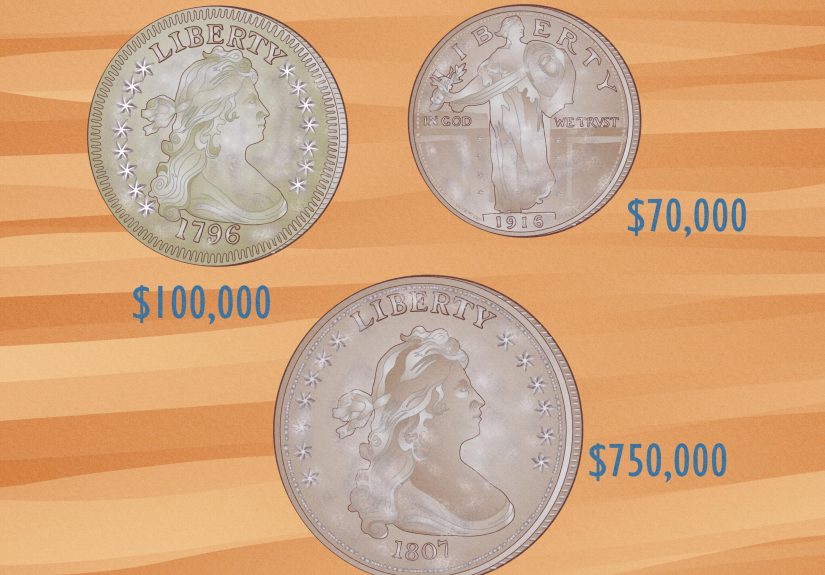
The 1796 quarter is the superstar of the denomination and one of the great trophies in early American numismatics. It was the first U.S. quarter ever issued, and surviving examples are scarce in every grade. Even worn pieces can live comfortably in the five-figure range, while elite examples have crossed into the seven-figure stratosphere.
Approximate value: around $11,500 to $100,000 in certified circulated grades, with famous top-end examples selling for well over $1 million.
2. 1827/3/2 Capped Bust Quarter, Original Proof
This is the sort of coin that makes advanced collectors suddenly start speaking in hushed museum voices. The 1827 Original Proof is one of the legendary rarities in the quarter series, and the overdate adds even more fascination. It is rare, famous, and expensive enough to make your accountant nervous.
Approximate value: roughly $120,000 to $840,000 for major certified originals, with standout examples having sold around $705,000.
3. 1823/2 Capped Bust Quarter
The 1823/2 overdate is a key rarity in the Capped Bust series and a favorite among collectors who appreciate coins with a little extra drama in the date. This issue is genuinely scarce, and problem-free examples become very expensive in a hurry. It is one of those coins where “nice for the grade” is a powerful phrase.
Approximate value: about $37,500 to $350,000 for certified examples, with major proof-level auction records approaching $400,000.
4. 1807 Draped Bust Quarter
The 1807 Draped Bust quarter is another heavy hitter from the early years of the Mint. Collectors love the type, but high-grade survivors are elusive. This date has produced enormous prices at the top of the market, especially for exceptional specimens with strong originality and eye appeal.
Approximate value: from a few hundred dollars in low grades to around $600,000 at the highest certified levels.
5. 1901-S Barber Quarter
If the Barber quarter series had a celebrity entrance music track, it would belong to the 1901-S. This is the best-known key date of the Barber quarter run and a coin collectors hunt with serious determination. Even low-grade examples are expensive, while gem pieces become monster rarities.
Approximate value: about $3,750 to $47,000 in many certified circulated and lower Mint State ranges, with top examples reaching roughly $550,000.
6. 1873-CC No Arrows Liberty Seated Quarter
Carson City already brings excitement, and the 1873-CC No Arrows issue adds true scarcity on top of that. This coin is one of the major prizes in the Seated Liberty quarter series. It is not the kind of quarter you casually “upgrade later.” If you get one, you have achieved something.
Approximate value: around $35,000 to $135,000 in certified circulated grades, with exceptional pieces reaching about $460,000.
7. 1871-CC Liberty Seated Quarter
The 1871-CC combines low mintage, Carson City prestige, and thin survival numbers. Collectors of Western mint coinage adore it, and advanced Seated Liberty specialists do not exactly leave extras lying around. This is the kind of coin that makes auction catalogs look more dramatic than usual.
Approximate value: roughly $11,500 to $150,000 for certified examples, with elite auction results climbing into the mid-six figures.
8. 1805 Draped Bust Quarter
The 1805 quarter may not always steal the loudest headlines, but it is still a serious rarity, especially in higher grades. Early quarters are tough across the board, and this date becomes especially desirable when surfaces are original and detail is strong. In coin terms, this one has old-money energy.
Approximate value: about $325 to $11,000 in many certified circulated grades, with finest-known pieces selling for more than $400,000.
9. 1838 Liberty Seated Quarter, No Drapery
As the first year of the Liberty Seated quarter type, 1838 has excellent collector appeal. Regular business strikes can be valuable, but proof examples are where things get spicy. First-year issues always get attention, and this coin benefits from being both historically important and condition-sensitive.
Approximate value: circulated and lower-end Mint State pieces range from the low hundreds upward, while proof examples have sold for nearly $382,000.
10. 1804 Draped Bust Quarter
The 1804 quarter is a famous early issue with a small surviving population and strong demand from type collectors and quarter specialists alike. It is not common in any meaningful sense of the word. If you own one, you are not just holding silver; you are holding a very expensive conversation starter.
Approximate value: roughly $3,250 to $95,000 for many certified pieces, with better-known examples selling well beyond $80,000 and some famous specimens topping $200,000.
11. 1870-CC Liberty Seated Quarter
The Carson City mintmark works like rocket fuel on scarce Seated Liberty quarters, and the 1870-CC is no exception. Collectors prize it for its rarity and Old West connection. Nice pieces do not stay cheap, and premium certified examples can bring astonishing numbers when they appear in public sales.
Approximate value: often in the five-figure range for better certified coins, with notable auction results around $184,000 for premium examples.
12. 1920-D Standing Liberty Quarter
The 1920-D is one of the sleepers casual collectors sometimes underestimate. Ordinary circulated pieces are collectible but not absurdly expensive, while Full Head gems become a different animal entirely. This is a classic case of condition rarity turning a relatively modest date into a six-figure headline machine.
Approximate value: around $50 to $5,760 for many Mint State examples without the Full Head designation, but Full Head examples can climb toward $275,000, with record sales around $372,000.
13. 1919-S Standing Liberty Quarter
The 1919-S is a semi-key date that gets much more serious as grade improves. In circulated condition it is already desirable, and in gem Full Head condition it becomes a major rarity. Collectors know this issue often comes weakly struck, so strong examples command a premium.
Approximate value: about $50 to $1,300 in circulated to lower certified levels, around $35 to $19,800 for many Mint State pieces, and up to roughly $270,000 in top Full Head territory.
14. 1916 Standing Liberty Quarter
The 1916 Standing Liberty quarter is the first-year issue of one of America’s most beautiful coin designs. It has a tiny mintage by series standards and a permanent spot on collector wish lists. This is the coin that makes people fall in love with Standing Liberty quarters and then immediately fear the budget consequences.
Approximate value: roughly $3,250 to $14,000 in certified circulated grades, with superior examples often selling in the tens of thousands and the best pieces nearing $200,000.
15. 1918/7-S Standing Liberty Quarter
The famous 1918/7-S overdate is one of the classic U.S. quarter varieties. Once you see the overdate, you cannot unsee it, and collectors happily pay for that privilege. It is scarce in all grades and especially tough in higher Mint State, making it one of the most exciting coins in the series.
Approximate value: around $1,250 to $17,500 in many certified grades, with top examples reaching six figures and some major records well above $100,000.
16. 1932-D Washington Quarter
The 1932-D is the king of the regular-issue Washington quarters. Because it is a first-year Washington issue with a low mintage, it has remained a cornerstone key date for decades. Even nice circulated examples are valuable, and gem coins make collectors start selling other things they like.
Approximate value: about $65 to $875 in certified circulated grades, with MS65 examples often around the low five figures and record pieces reaching about $143,750.
17. 1932-S Washington Quarter
The 1932-S is the essential companion to the 1932-D. It is usually more affordable than its Denver sibling, but “more affordable” is a very flexible phrase in coin collecting. It remains one of the key dates of the series and an important checkpoint for anyone building a serious Washington set.
Approximate value: around $65 to $375 in many circulated certified grades, about $100 to $200 in VF to XF retail levels, and up to roughly $52,800 for top auction-record coins.
18. 1950-D/S Washington Quarter
The 1950-D/S overmintmark is a favorite modern variety because it combines visibility, collectibility, and a genuinely interesting minting story. It is not in the same financial universe as an 18th-century quarter, but it can still be worth real money, especially in better Mint State grades.
Approximate value: often around $80 to a few hundred dollars in collectible circulated and lower Mint State grades, with high-end certified examples stretching into the thousands and top auction records around $29,375.
19. 1965 Quarter Struck on a 90% Silver Planchet
This famous transitional error exists because 1965 was the year U.S. quarters switched from 90% silver to clad composition. A few 1965-dated quarters were accidentally struck on leftover silver planchets, creating one of the coolest modern error coins around. To error collectors, this is catnip with reeded edges.
Approximate value: usually several thousand dollars for authenticated examples, with recent public sales ranging from about $7,200 to $9,600 and some references citing even higher prices for elite specimens.
20. 1970-S Proof Quarter Overstruck on a Canadian Quarter
Yes, this is real, and yes, it sounds like the setup for a coin collector joke. The 1970-S proof quarter struck over a Canadian quarter is one of the wildest and most famous quarter errors. It is a conversation piece, a mint-error trophy, and the numismatic equivalent of finding a tuxedo at a garage sale.
Approximate value: often discussed in the roughly $35,000 to $40,000 range in modern market commentary, though older auction appearances were much lower, so the exact number depends heavily on certification, venue, and collector appetite.
How to Tell Whether Your Quarter Might Be Special
Start with the obvious stuff: date, mintmark, and composition. On pre-1965 quarters, silver content alone gives you a floor value, but true rarity starts when the date and mintmark line up with known key issues. Look closely for overdates, doubled features, odd planchet color, unusual weight, and anything that seems “off” in a way that cannot be explained by ordinary damage.
If a quarter looks promising, do not clean it. Not with toothpaste, not with baking soda, not with your aunt’s “secret silver trick,” and definitely not with a rag and optimism. A cleaned coin can lose a huge portion of its value. Use a scale, compare the coin to trusted images, and consider professional authentication through a major grading service if the coin matches a known rarity.
Final Thoughts
The most valuable quarters are a reminder that coin collecting rewards patience, knowledge, and a slightly suspicious eye. A quarter can be valuable because it is ancient, because it is rare, because the dies were wrong, or because someone at the Mint had a very strange day. The best part is that these coins connect ordinary pocket change to major moments in American minting history.
So the next time you sort a coin jar, do not expect a million-dollar 1796 Draped Bust quarter to roll dramatically into your hand like it is auditioning for a movie. But do pay attention. In the world of rare quarters, tiny details can mean enormous money.
Collector Experiences: What People Learn While Chasing Valuable Quarters
Ask longtime collectors about valuable quarters and you will hear the same theme again and again: experience changes the eye. Beginners often focus only on the date, but experienced collectors quickly learn that grade, originality, and certification are just as important. A collector might find a 1932-D and feel like they won the lottery, only to discover that a cleaned surface or hidden damage changes the value dramatically. That sounds disappointing, but it is also how people learn the language of coins.
Another common experience is realizing that rarity on paper is not the same as rarity in the marketplace. A quarter may have a low mintage, but if enough examples survive, prices stay manageable. On the other hand, coins like the 1916 Standing Liberty quarter or the 1901-S Barber quarter can feel impossibly scarce in the grades collectors actually want. People often start by saying, “I just want one decent example,” and end up spending weeks comparing strike quality, toning, luster, and holder labels like they are judging an Olympic event for tiny silver discs.
Collectors also talk about how humbling early quarters can be. An 1805 or 1807 Draped Bust quarter in low grade may still cost serious money, and the learning curve is steep. You discover that two coins with the same date can have wildly different value because one has problems and the other has originality. You discover that auction records are inspiring but also dangerous if you forget they often reflect finest-known examples rather than average collector pieces. In plain English: seeing a six-figure result online does not mean every example of that coin is headed to a private island.
Error-coin collectors have their own stories, and they are usually even more entertaining. People find a strange 1965 quarter and instantly hope it is a silver transitional error. Usually it is not. Sometimes it is just damage. Sometimes it is wishful thinking with a reeded edge. But every now and then, an authenticated wrong-planchet or overstruck piece appears, and that possibility keeps the hunt alive. The experience of sending a coin for grading, waiting for the result, and opening the final attribution can feel like a suspense movie directed by accountants.
Perhaps the most relatable lesson is that valuable quarter collecting teaches patience. Few people build a great quarter collection overnight. Most learn by making a small mistake, asking questions, reading price guides, watching auctions, and slowly improving their taste. Over time, the chase becomes part of the reward. The coin is wonderful, of course, but so is the moment when a collector spots something others missed and realizes, with a perfectly calm face and absolutely uncalm heartbeat, that the quarter in front of them may be worth a whole lot more than twenty-five cents.