Table of Contents >> Show >> Hide
- Quick Picks: The Shortlist for 2025
- How We Chose These Gas Lawn Mowers
- Buying Guide: Choosing the Right Gas Lawn Mower in 2025
- The Best Gas Lawn Mowers for 2025: Full Reviews
- 1) Best Overall Gas Self-Propelled: Toro Super Recycler (21")
- 2) Best for Big Yards (Fast Walk-Behind): Toro TimeMaster (30")
- 3) Best Value Self-Propelled: Toro Recycler Personal Pace (22")
- 4) Best Budget Push Mower: Craftsman M110 (21")
- 5) Best for Small Garages: Toro SmartStow Gas Mower (Storage-Friendly)
- 6) Best “If You Find One” Classic: Honda HRX/HRN (Limited Availability)
- 7) Best for 1+ Acre: Toro TimeCutter 42" (Gas Zero-Turn Option)
- Gas Mower Maintenance in 2025: The Stuff That Actually Prevents Headaches
- Real-World Experiences: What Ownership Feels Like (The Extra )
- Conclusion: Pick the Mower That Fits Your Lawn (and Your Patience)
If your lawn had a group chat, it would absolutely roast you for mowing in “random scalped patches” mode.
The good news: 2025 has plenty of gas lawn mowers that cut cleaner, handle thicker grass, and keep going
long after a battery mower starts giving you the “low power” side-eye.
Gas mowers aren’t everyone’s first choice anymore (hello, battery boom), but they still win on
runtime, raw cutting power, and no-wait refueling.
If you’ve got a dense lawn, a larger yard, or grass that grows like it’s trying to pay rent, a good
walk-behind gas mower can be the difference between “weekend victory lap” and “why is this taking all day?”
Quick Picks: The Shortlist for 2025
- Best Overall Gas Self-Propelled: Toro Super Recycler (21″)
- Best for Big Yards (Fastest Walk-Behind): Toro TimeMaster (30″)
- Best Value Self-Propelled: Toro Recycler Personal Pace (22″)
- Best Budget Push Mower: Craftsman M110 (21″)
- Best for Small Garages/Storage: Toro SmartStow gas mower (fold/stand storage)
- Best “If You Find One” Classic: Honda HRX/HRN (limited availability)
- Best for 1+ Acre (Riding/Zero-Turn Option): Toro TimeCutter 42″ (gas)
How We Chose These Gas Lawn Mowers
This list is built by synthesizing real-world testing and long-running review programs from major U.S. outlets
that regularly evaluate mowers (cut quality, mulching/bagging, handling, reliability) alongside manufacturer
specs and ownership feedback. In plain English: we prioritized models that people can actually buy, start,
and use without needing a pep talk.
What “Best” Means Here
- Cut quality: Even cut, fewer stragglers, better lift, cleaner edges.
- Power under load: Doesn’t bog down the moment grass gets thick or slightly damp.
- Drive and handling: Self-propel that feels natural, stable traction, easy turning.
- Clipping performance: Mulch when you want, bag when you need, discharge when you’re in a hurry.
- Maintenance sanity: Straightforward oil/fuel routine, available parts, good support.
- Fit for yard size: Matching deck width and speed to how much grass you actually have.
Buying Guide: Choosing the Right Gas Lawn Mower in 2025
1) Yard size (the “how much suffering?” factor)
For most suburban lawns, a 21–22 inch deck is the sweet spot: nimble enough for trees and beds,
wide enough to avoid “I’ve been mowing since breakfast” vibes. If your yard is big (or you just hate repetition),
a 30-inch walk-behind can cut your passes dramatically. Once you’re consistently mowing
an acre or more, it’s worth considering a riding mower or zero-turn for time savings.
2) Push vs. self-propelled
Push mowers are cheaper, lighter, and great for smaller flat yards. But if you have hills, thick turf, or
you’d rather not count mowing as leg day, get a self-propelled model. Look for a drive system that
matches your pace without constant fiddlingbecause stopping every 12 feet to adjust speed is not a hobby.
3) Drive type matters on slopes
Most homeowners do fine with front- or rear-wheel drive. If your yard is steep or uneven, mowers designed
for stronger traction (including some AWD configurations) can feel steadier and less “whoa there, buddy.”
The trade-off is usually weight and cost.
4) Mulch, bag, or side discharge
Want a cleaner-looking lawn and less cleanup? Mulching returns nutrients to the turf and can reduce
fertilizer needs over time. Bagging is handy in spring growth spurts, after storms, or when you’re trying
to keep clippings out of a pool, patio, or neighbor’s soul. Side discharge is the “get it done” option
when the grass is too tall to mulch cleanly.
5) Set your cutting height like you mean it
Many extension programs recommend mowing most home lawns in the ballpark of 2.5–3.5 inches
(often higher in summer) and following the “one-third rule” (don’t remove more than one-third of blade height).
Taller grass can mean deeper roots, fewer weeds, and better drought tolerance. Translation: your lawn gets tougher,
and you get fewer patchy regrets.
The Best Gas Lawn Mowers for 2025: Full Reviews
1) Best Overall Gas Self-Propelled: Toro Super Recycler (21″)
The Super Recycler sits in that rare zone where “premium” actually feels justified. It’s built for homeowners who
want a cleaner cut, stronger mulching, and smoother self-propel controlwithout jumping to a commercial unit.
In many comparisons, it’s the mower people point to when they say, “I want the one that makes my lawn look nicer,
not just shorter.”
- Best for: Most average-to-large yards, weekly mowing, mulching-heavy routines.
- Why it wins: Strong cut quality and turf lift, refined self-propel feel, excellent mulch.
- Trade-offs: Costs more, and it’s not the lightest mower in the shed.
- Look for features like: Dual-blade/advanced mulch systems, easy speed control, sturdy deck build, vertical storage on select models.
2) Best for Big Yards (Fast Walk-Behind): Toro TimeMaster (30″)
If your lawn is big enough that you’ve considered hiring a small marching band to keep you motivated,
the TimeMaster is the “fewer passes, more progress” answer. That 30-inch deck covers more ground per lap,
and the self-propel system helps manage the added size. Many homeowners who upgrade to a wide-deck walk-behind
say the same thing: “I should’ve done this years ago.”
- Best for: Larger suburban lots, long straight runs, anyone who wants to finish faster.
- Why it wins: Big deck productivity, strong engine, convenience features like electric start on many configurations.
- Trade-offs: Bigger = heavier, less nimble around tight landscaping.
- Pro tip: Wide decks shine when your yard has open areas. If you’ve got lots of narrow gates or tight corners, measure first.
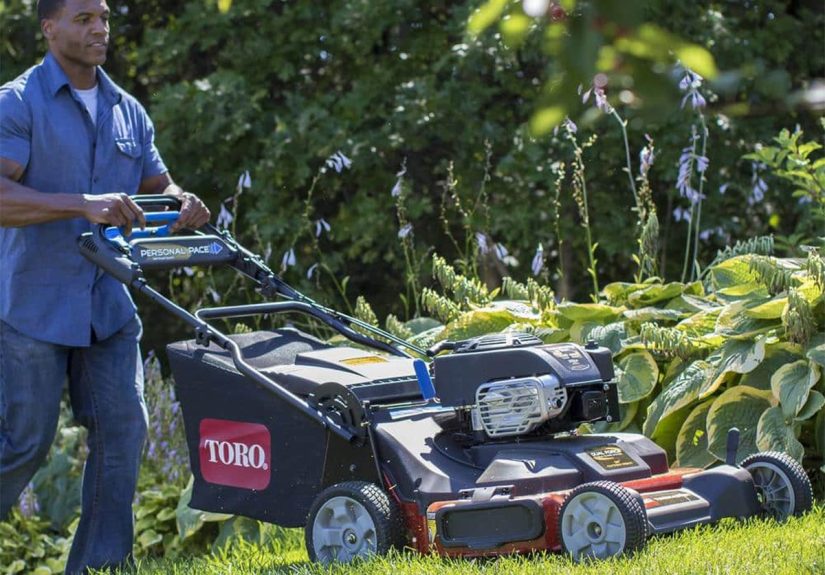
3) Best Value Self-Propelled: Toro Recycler Personal Pace (22″)
The Recycler line is a favorite because it nails the basics: reliable cutting, solid mulching, and a
self-propel system that tends to feel intuitive. It’s the kind of mower that makes sense for people
who want better results than a bargain push mower, but don’t need the top-shelf premium build.
- Best for: Medium yards, mixed mulching and bagging, “I want quality but not luxury pricing.”
- Why it wins: Excellent everyday performance, comfortable pace-matched drive, dependable cut.
- Trade-offs: Not as refined as premium models; feature sets vary by model number.
4) Best Budget Push Mower: Craftsman M110 (21″)
Not every yard needs a self-propelled spaceship. For smaller, flatter lawns, the Craftsman M110-style
gas push mower is a classic “simple, affordable, gets the job done” pick. It’s a strong match if you
want gas power on a budget and don’t mind pushing.
- Best for: Smaller lawns, flat terrain, budget-first shoppers.
- Why it wins: Solid gas performance for the money, uncomplicated operation.
- Trade-offs: Not ideal for hills; fewer premium comfort features.
5) Best for Small Garages: Toro SmartStow Gas Mower (Storage-Friendly)
If you’ve ever tried to park a mower in a crowded garage, you know the real enemy isn’t grassit’s
space. SmartStow-style designs are made to store more vertically and fold down with less drama,
which can be a huge quality-of-life upgrade if you’re playing Tetris with bikes, bins, and mystery
boxes labeled “cables??”
- Best for: Tight storage, small sheds, garages that are already doing too much.
- Why it wins: Easier storage footprint, still delivers the strength of a gas mower.
- Trade-offs: Often heavier than basic push models; pricing depends on trim/features.
6) Best “If You Find One” Classic: Honda HRX/HRN (Limited Availability)
Honda gas mowers earned a loyal following for good reasons: smooth running, great cut quality, and
a reputation for longevity. The catch for 2025 shoppers is availability. Production of many Honda
gas mower lines has been phased out, so new stock may be limited or sold through, depending on your area.
- Best for: Shoppers who can still find inventory, or buyers open to a carefully chosen used mower.
- Why it wins: Strong reputation for durability, refined cut, and long-term ownership satisfaction.
- Trade-offs: Harder to find new; pricing can be weird because scarcity does that to a product.
- Used-buying checklist: Start-up behavior, consistent idle, deck condition, wheel play, and whether it’s been stored with old fuel.
7) Best for 1+ Acre: Toro TimeCutter 42″ (Gas Zero-Turn Option)
This article is mainly about walk-behind mowers, but if you’re mowing a lot of land,
a gas zero-turn can turn your Saturday into… well, at least a shorter Saturday. A 42-inch-class
zero-turn is often a practical entry point for bigger properties: faster mowing, tighter turning,
and less back-and-forth.
- Best for: Big yards, lots of open mowing, homeowners who want speed and maneuverability.
- Why it wins: Covers ground quickly, steers around obstacles easily, strong gas performance.
- Trade-offs: Higher cost, storage space, learning curve compared to walk-behind.
Gas Mower Maintenance in 2025: The Stuff That Actually Prevents Headaches
Use the right fuel (and don’t let it go stale)
Gas mowers are reliable when the fuel system is happyand dramatic when it’s not.
A common best practice is to use fresh gasoline and avoid higher-ethanol blends that
small engines may not be designed for. If fuel will sit for weeks, a stabilizer or
ethanol-free canned fuel can reduce storage problems. If the mower will sit for a long
off-season, follow your manual’s guidance for storage steps.
Keep the blade sharp (your lawn will show you if you don’t)
A sharp blade cuts cleanly. A dull blade tears grass. Tearing stresses turf, makes it look ragged,
and can invite disease. If your lawn looks “frayed” after mowing, your blade is basically begging
for attention. Sharpen at least once a season (more if you hit sticks, rocks, or surprise roots).
Don’t mow wet grass unless you like clumping
Gas mowers handle thicker conditions better than many electric models, but wet grass still clumps,
sticks under the deck, and can leave uneven results. If you must mow after rain, raise the deck
slightly and plan to bag or discharge rather than forcing a perfect mulch.
Real-World Experiences: What Ownership Feels Like (The Extra )
Here’s the part mower reviews don’t always capture: ownership is less about horsepower math and more about
whether you finish mowing in a decent mood.
People who move from a basic push mower to a self-propelled gas model often describe the first mow like a tiny
life upgrade. The yard doesn’t get smaller, but it feels smaller because you’re not muscling a steel box across
the lawn like you’re training for a medieval tournament. Pace-matched drives are especially popular because they
feel naturalwalk faster, mower goes faster; slow down to navigate around landscaping, it chills out with you.
It’s the difference between “operating machinery” and “taking a brisk walk while the mower does the hard part.”
Wide-deck walk-behind mowers (like 30-inch models) generate a very specific type of satisfaction: the satisfaction
of fewer passes. Owners tend to mention time savings immediately. You see it in the stripes and the empty space
behind you where the lawn used to be tall. The flip side is that bigger decks can feel like steering a shopping cart
with one wonky wheel in tighter areasfine in open grass, less fun around narrow corners, trees, and garden beds.
The happiest wide-deck owners usually have at least one long, open section of lawn where the mower can stretch its legs.
Mulching performance is another “you don’t care until you care” feature. When it’s good, it’s invisible:
clippings vanish, the lawn looks clean, and you don’t have to empty a bag every ten minutes. When it’s bad, you notice
immediatelylittle clumps, uneven spread, and that awkward moment when you realize you’ve basically made confetti… but only
for the front half of the yard. Owners who mulch regularly tend to appreciate premium cutting systems because they give a
more consistent finish across different grass conditions.
Storage is the sleeper issue. A mower can be amazing until you try to fit it next to holiday decorations, sports gear, and
the unopened box that has followed you through three moves. Storage-friendly designs (folding/vertical storage) feel like
a practical miracle in smaller garages. Owners mention it as a “daily convenience” feature, not a “spec sheet” featurebecause
you deal with storage every time you’re done mowing, not just when you’re shopping.
Finally, there’s maintenance reality. Most mower frustrations aren’t caused by the mower being “bad.” They’re caused by
old fuel, dirty filters, ignored oil, or a blade that’s been hitting sticks since the early 2010s. Owners who do a simple
routinefresh fuel, stabilizer when appropriate, sharp blade, clean under-deck now and thentend to keep their mower starting
easily season after season. In other words: the best gas mower is the one you don’t have to argue with in the spring.
Conclusion: Pick the Mower That Fits Your Lawn (and Your Patience)
The best gas lawn mower for 2025 isn’t just “the strongest.” It’s the one that matches your yard size, terrain, and how you
actually mow. For most people, a high-quality 21–22 inch self-propelled mower hits the sweet spot. If you want to cut mowing time,
step up to a wide-deck walk-behind like a 30-inch. If you’re managing real acreage, a gas zero-turn can be a game-changer.
Choose the machine that makes mowing predictable: easy starting, steady drive, and clipping performance you can live with.
Your lawn will look better, your weekends will feel longer, and you’ll stop pretending the overgrown patch “is for biodiversity.”