Table of Contents >> Show >> Hide
- Why These Images Feel So Different From Ordinary Sports Photos
- How LEDs Turn Paddling Into Visual Music
- The Photography Behind the Magic
- What Canoe and Kayak Motions Actually Reveal
- Why This Style Says Something Bigger About Human Movement
- Safety Matters More Than the Photo
- How to Create This Look Yourself
- Common Mistakes That Ruin the Effect
- Why Viewers Keep Coming Back to These Photos
- Experiences Related to The Motions Of Canoers and Kayakers Revealed With LEDs In Long Exposure Photography
- Conclusion
Some photographs show a moment. Others show a mood. And then there is the strange, hypnotic magic of long exposure photography, which seems to show time itself stretching, looping, and showing off a little. That is exactly why images of canoeers and kayakers traced with LEDs feel so unforgettable. Instead of freezing a paddle stroke in one tidy instant, these photographs turn motion into glowing calligraphy. The water becomes a dark stage, the paddle becomes a light pen, and the athlete becomes part explorer, part accidental performance artist.
What makes this style so compelling is that it reveals something the naked eye cannot fully hold onto: rhythm. A paddler’s movement looks simple from shore, but long exposure photography exposes the hidden complexity inside every stroke. You can suddenly see the arc of the blade, the timing of recovery, the balance shifts, and the repeated curves that push the boat forward. It is sports photography, yes, but it also feels like abstract art, fluid dynamics, and a neon jazz solo all happening in the same frame.
In recent years, interest in this visual style has grown because it sits at the sweet spot between outdoor adventure and creative photography. People love paddling because it feels peaceful, physical, and deeply connected to nature. People love long exposure images because they make the familiar look mysterious. Put those together with programmable LED lights, and you get photographs that look as if a river briefly learned how to draw.
Why These Images Feel So Different From Ordinary Sports Photos
Traditional sports photography usually chases sharpness. Freeze the athlete. Freeze the splash. Freeze the victory face. Done. Long exposure photography takes the opposite path and asks a more interesting question: what if blur is the point? In LED kayak and canoe photography, blur is not a mistake. It is the story.
That shift changes how viewers read the image. Instead of focusing on facial expression or gear details, they follow the trail of movement. The photograph becomes less about who the paddler is and more about how the paddler moves through space. That is why these images can feel almost scientific while still being beautiful. They visualize pathlines, tempo, and repetition. They turn technique into shape.
There is also a delicious little visual trick at work. In low light, with a long enough exposure, the kayak or canoe may fade into darkness while the LEDs stay bright and crisp enough to dominate the frame. The result is an image that feels half real and half dream. You know someone is on the water, but what your eye remembers most is the ribbon of light left behind.
How LEDs Turn Paddling Into Visual Music
Light trails translate rhythm into design
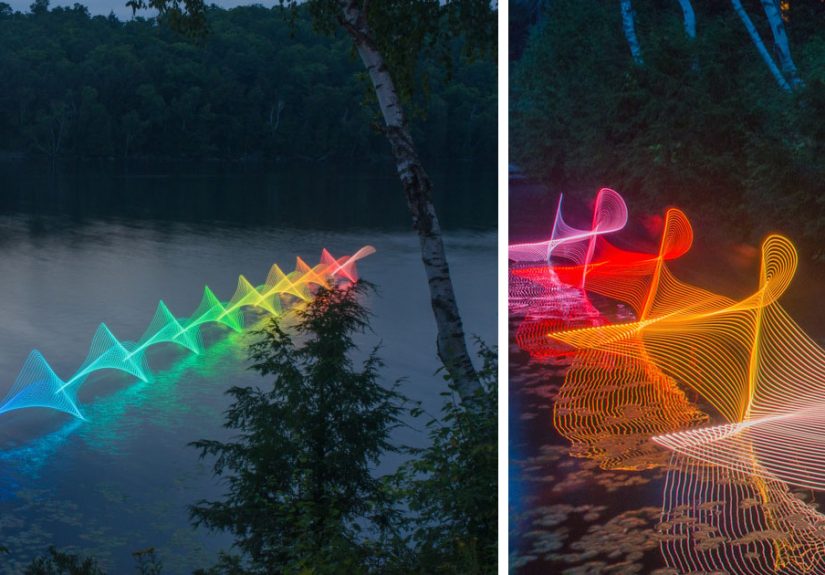
LEDs are the secret sauce here. Mounted to a paddle shaft or blade, they record motion continuously as the shutter stays open. If the lights are programmable, they can shift color or pattern over time, which makes each phase of the stroke easier to read. One section of the trail might glow blue, then green, then red, giving the final image a sense of sequence rather than a single flat streak.
That matters because paddling is repetitive, but it is not robotic. A forward stroke has reach, catch, power, release, and recovery. A sweep stroke opens wider. A brace interrupts the rhythm to stabilize the boat. With LEDs, those differences stop hiding. They become visible. What looked smooth from a distance suddenly reveals tiny adjustments, asymmetries, and changes in confidence.
Water doubles the drama
The reflection is not just a bonus. It is often half the show. Calm water mirrors the light trail and adds depth, symmetry, and texture. Instead of one glowing line, you get a conversation between the trail above and its reflection below. That reflection can make a simple paddle arc look like a heart monitor, a flame, or a glowing feather laid across black glass.
In other words, the water is not merely where the athlete happens to be. It is an active design partner. Ripples break up the reflection. Wind softens symmetry. A still lake gives you elegance, while moving current adds chaos. Same paddler, same LED rig, wildly different visual personality.
The Photography Behind the Magic
Slow shutter speed is the whole game
Long exposure photography works by keeping the shutter open long enough to record movement as a continuous trail. In daylight, that can be tricky because too much light will blow out the image. That is why many photographers either work at dusk, after sunset, or in other low-light conditions. Some also use neutral density filters to reduce incoming light and make longer shutter times possible without turning the photo into a white-hot mess.
Tripod, remote release, and manual focus are not glamorous, but they are heroes
This genre may look dreamy, but it is built on extremely unromantic stability. A sturdy tripod keeps the background sharp. A remote shutter release or self-timer helps avoid shaking the camera. Manual focus matters because autofocus can hunt in the dark and ruin the shot while the paddler is out there doing their glowing water ballet. If the exposure stretches beyond the camera’s standard limits, bulb mode gives the photographer more control over timing.
Composition still matters, even when the light trails steal the spotlight
One of the smartest lessons from this style is that the glowing lines are not enough on their own. Without a strong background, shoreline, horizon, or sense of place, the image can feel like random spaghetti with ambition. Good long exposure photography still needs composition. Foreground elements, open negative space, reflections, and the shape of the shoreline all help the image feel intentional rather than accidental.
What Canoe and Kayak Motions Actually Reveal
A well-made LED long exposure image is not just pretty; it quietly teaches paddling technique. That is one reason these photographs feel so satisfying to both photographers and paddlers. The image shows what the body is doing over time, not just in one frozen instant.
Forward strokes make clean, repeatable arcs
In efficient paddling, the forward stroke tends to produce a consistent pattern. The blade enters near the feet, pulls through the water, exits near the hip, and recovers forward again. When the paddler uses torso rotation instead of just arm strength, the trail often looks smoother and more balanced. Good technique tends to create visual rhythm. Sloppy technique tends to look like a glowing argument with gravity.
Sweep strokes open the frame
A sweep stroke, used for turning, creates a broader arc that reads almost like a semicircle in a long exposure. These wide motions are especially photogenic because they stretch outward and make the composition feel expansive. They also reveal how much of paddling is about boat control, not just brute force.
Braces and corrections add surprise
Brace strokes and quick corrections break the pattern. Suddenly the light trail dips, flares sideways, or snaps into a sharper angle. Those moments are gold for photographers because they show that paddling is a negotiation with water, wind, balance, and timing. The river or lake is not a treadmill. It talks back.
Why This Style Says Something Bigger About Human Movement
There is a reason viewers who know nothing about paddlesports still stop and stare at these images. They reveal a universal truth: movement has character. Every person develops a physical signature. In long exposure, that signature becomes visible. One paddler may produce tight, disciplined loops. Another may create loose, expressive sweeps. One feels precise. Another feels playful. Same boat category, completely different handwriting.
That is part of the emotional appeal. We are used to seeing results. We see the kayak move forward. We see a canoe crossing a lake. But these photographs reveal process. They show the labor, rhythm, and grace hidden inside progress. That makes them feel intimate. You are not just seeing where the athlete went. You are seeing how they got there.
Safety Matters More Than the Photo
Now for the least glamorous sentence in this entire article, which is also the most important: no photograph is worth becoming tomorrow’s cautionary tale. Paddling after dark or in low light increases risk, and any attempt to recreate this style should begin with safety planning, not camera settings.
That means wearing a properly fitted life jacket, choosing calm and protected water, paddling with others instead of going solo, and making sure the group understands basic rescue skills. A float plan is smart. Cold-water protection may be necessary even when the air feels mild. Beginners should stay in easy conditions and ideally work with an instructor or experienced guide. The phrase “it looked calm from shore” has probably introduced many terrible decisions in outdoor recreation.
It is also wise to simplify the creative setup. Use lightweight LED gear that does not interfere with paddle control. Avoid anything that tangles, shifts balance, or blocks grip. Keep the route short and familiar. The art should adapt to safe paddling, not the other way around.
How to Create This Look Yourself
1. Start with the right conditions
Choose a calm lake, pond, or slow-moving protected waterway. Early blue hour works beautifully because there is still enough ambient detail in the sky and shoreline, but the LEDs can shine clearly. Full darkness can work too, though it often makes composition harder.
2. Keep your camera setup simple
Use a tripod. Lock in your framing. Focus manually before the paddler moves into position. Start with a low ISO, a moderate aperture, and a shutter speed long enough to capture several paddle strokes. Test, adjust, repeat. Long exposure photography rewards patience and punishes overconfidence with the enthusiasm of a tax auditor.
3. Treat the LEDs as brushstrokes
Think about color, spacing, and motion. Straight monotone lights can look clean and graphic. Programmable color changes add narrative and make the stroke easier to read. The more intentional the light pattern, the stronger the final image tends to feel.
4. Coach the paddler like a collaborator
Ask for steady, repeatable strokes rather than speed. A smooth rhythm usually photographs better than frantic effort. A controlled sweep turn may create a more elegant frame than a sprint. This is a rare case where “go slower and be more graceful” is genuinely useful athletic advice.
5. Watch the background and reflection
A boring background can flatten the image. Trees, shoreline contours, docks, low fog, or a fading sunset can add context. Reflections can either elevate the composition or turn it into visual clutter, so shift your position until the mirror effect supports the shape of the light trail.
Common Mistakes That Ruin the Effect
One common mistake is trying to do too much at once. Too many LEDs, too many paddlers, too much ambient light, or too many motion patterns can turn a poetic image into a fluorescent traffic jam. Another mistake is ignoring technique. Jerky strokes produce messy trails, and bad balance reads immediately in the final frame.
Photographers also sometimes forget that night shooting has its own headaches. Vibration, lens fog, poor focus, and accidental camera shake can wreck an otherwise perfect setup. It is often worth taking a quick test image at a higher ISO to dial in framing and exposure before making the longer final shot. That saves time, battery, and sanity.
Why Viewers Keep Coming Back to These Photos
The best images in this style work because they are doing several jobs at once. They are athletic but calm. Technical but emotional. Abstract but still rooted in the real world. They invite curiosity. Viewers want to know how the image was made, what motion they are seeing, and why it feels so elegant. Very few genres get to be instructional and mesmerizing at the same time.
They also remind us that photography can reveal patterns we live inside without noticing. A paddle stroke is ordinary. A dozen paddle strokes layered into one glowing exposure becomes extraordinary. Suddenly the everyday mechanics of canoeing and kayaking look like choreography written in light. And that, frankly, is a pretty delightful trick for a camera to pull off.
Experiences Related to The Motions Of Canoers and Kayakers Revealed With LEDs In Long Exposure Photography
The most unforgettable thing about this kind of photography is that it changes how you experience both paddling and looking. If you are in the boat, the moment does not feel flashy at all. It feels quiet. The water is dark, the air is cooler, and every little sound becomes sharper: the blade entering the water, the drip on the recovery, the faint clink of gear, the whisper of the hull moving forward. You are not thinking, “I am making art.” You are usually thinking, “Please let this stroke stay smooth,” which is a very glamorous inner monologue indeed.
But once you see the finished image, the memory changes. What felt like a sequence of ordinary strokes suddenly looks lyrical. A gentle correction becomes a dramatic flare. A steady forward rhythm becomes a glowing ladder of movement. That contrast is part of the thrill. The athlete experiences effort, repetition, and balance. The viewer sees elegance, pattern, and light.
For the photographer, the experience is equally strange in the best way. You are working in near darkness, trusting the process more than the preview screen, and trying to anticipate motion that you cannot fully read in real time. It is part planning and part surrender. You set the frame, control the exposure, steady the tripod, and hope the paddler gives you a clean, confident sequence. Then the shutter closes, and for a second there is that tiny pause where nobody knows whether the image is brilliant or tragic. That suspense is addictive.
There is also a collaborative feeling that makes this niche especially satisfying. Unlike some genres where the subject simply poses, LED long exposure photography asks the paddler to become a partner in the visual outcome. Their consistency matters. Their technique matters. Their comfort on the water matters. When everything clicks, the final image feels shared rather than taken.
Emotionally, these images often land somewhere between serenity and surprise. Canoeing and kayaking already have a meditative quality. The repetitive motion can calm the mind. Adding LEDs and long exposure does not erase that calm; it translates it. The photograph becomes a visible version of concentration. You can almost feel the inhale before the catch and the slight body rotation that powers the stroke.
And then there is the setting. Water after sunset has a personality all its own. It can feel vast, glassy, and almost theatrical. Even familiar lakes look transformed. The shoreline recedes. Colors mute. The reflections grow deeper. In that environment, a moving LED does not just light the subject; it seems to carve the darkness open. That is why these photographs feel bigger than a simple camera trick. They preserve the sensation that something fleeting and private happened on the water, and somehow the camera was lucky enough to understand it.
Conclusion
The beauty of LED long exposure photography is that it reveals what paddling usually hides in plain sight: rhythm, structure, technique, and grace. Canoes and kayaks may glide across the surface, but the real story lives in the repeated motion of the paddle. By stretching time and recording that motion as light, photographers turn a familiar outdoor activity into something that feels fresh, futuristic, and surprisingly human.
That is why these photographs endure. They are not just cool effects. They are portraits of movement. They show that even a quiet evening paddle can contain geometry, emotion, and a little bit of visual mischief. Not bad for a boat, a paddle, a few LEDs, and a camera patient enough to let time do the drawing.