Table of Contents >> Show >> Hide
Some photo galleries are nice. This one is a full-on saltwater ambush for your eyeballs.
When the Ocean Photography Awards unveiled their finalists, they did not arrive quietly. They arrived with sharks slicing through surf, penguins serving accidental romance, freedivers drifting through blue cathedrals, and marine wildlife looking so impossibly cinematic that your average vacation snapshot immediately wanted to resign. The result is the kind of gallery that makes you stop scrolling, lean in, and suddenly care very deeply about fish you could not have named five minutes earlier.
That is the secret sauce behind the best ocean photography. It is not just pretty. It is persuasive. The strongest finalist images do two things at once: they show us a world most people will never visit in person, and they make that world feel personal anyway. One frame can be playful, eerie, majestic, heartbreaking, and educational all before you have even finished your coffee. Not bad for a bunch of photons and one very patient photographer hanging out in water that is usually cold, unpredictable, and not especially interested in human schedules.
This is why the Ocean Photography Awards continue to grab attention far beyond photography nerd circles. Yes, the technical skill is outrageous. Yes, the colors are absurdly good. But the bigger story is that these finalist photos remind us the ocean is not a wallpaper background for beach ads. It is a living, stressed, dazzling system packed with creatures, stories, collisions, and consequences.
Why These Ocean Photography Awards Finalists Hit So Hard
The finalists work because they are not all trying to do the same thing. Some images are pure spectacle. Others are quiet and intimate. Others feel like visual gut punches. Together, they turn the phrase ocean photography awards finalists into something much larger than a contest roundup.
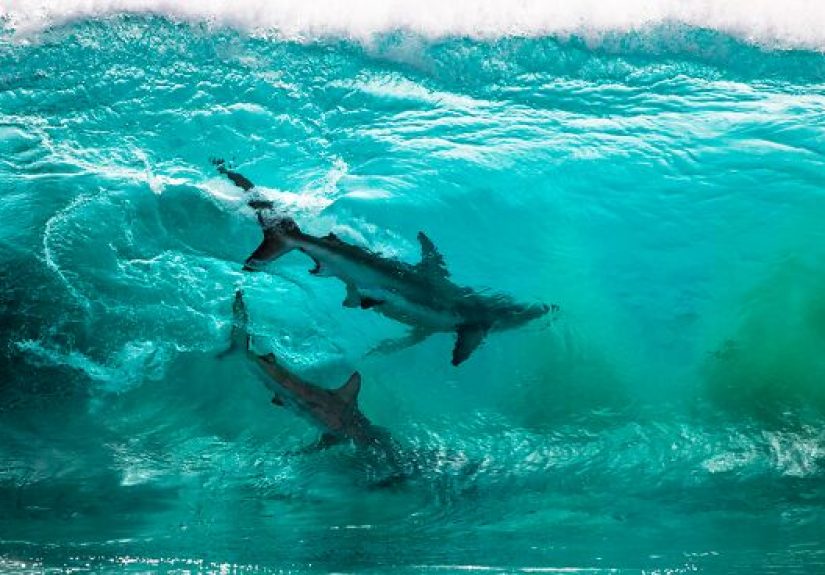
One moment you are looking at two sharks caught in a breaking wave off remote Western Australia, which sounds fake until you see it and realize the ocean occasionally directs its own action movies. The next moment you are staring at two penguins against Melbourne’s city lights, a scene so soft and cinematic it practically writes its own internet legend. Then the mood flips again: a freediver slips through a cave in Tonga like someone entering another dimension, and suddenly the whole gallery feels less like wildlife photography and more like science fiction directed by Mother Nature.
That emotional range matters. Great award galleries are not just collections of “best shots.” They are carefully shaped journeys. The best finalists create rhythm: awe, tension, wonder, worry, relief. That is why people keep clicking through image after image instead of bouncing after the third frame. The gallery becomes a story, and the reader becomes a traveler.
There is also a deeper reason these images land so well: ocean photography is hard. Really hard. Light disappears quickly underwater. Animals do not take notes from the production team. Weather changes. Visibility changes. Current changes. Your perfect composition may be interrupted by bubbles, sand, a wave, or the universe simply deciding that today is not your day. So when a finalist image looks effortless, it is usually the result of serious skill, timing, field knowledge, and a borderline unreasonable amount of patience.
What Makes the Ocean Photography Awards Different
The Ocean Photography Awards have always stood out because the competition is not built around one narrow definition of beauty. From the beginning, the awards were designed to recognize multiple ways of seeing the sea. The original framework included honors for overall ocean photography, conservation, adventure, exploration, youth work, community choice, and portfolio storytelling. That matters because the ocean is not just one thing, and ocean imagery should not be either.
Some photographers chase wildlife behavior. Some document human relationships with the sea. Some focus on environmental damage and recovery. Some create images that feel painterly or surreal. Some build bodies of work that say more together than any single frame ever could. By recognizing those different approaches, the awards avoid turning the ocean into a one-note fantasy postcard.
That broad approach also helps explain why the finalists feel so fresh. A winning ocean image does not have to be a diver next to a whale, though to be fair, that combo still goes hard. It can be a storm, a shoreline, a fishing community, a seabird attack, a coral spawning event, or a tiny creature that suddenly looks like an alien opera singer in a spotlight. The point is not just scale. The point is storytelling.
And that storytelling has become more urgent over time. Recent finalist selections have leaned into themes like wildlife, fine art, human connection, hope, and impact, showing how the awards now function as both a photography showcase and a cultural signal. The ocean is still beautiful, obviously. But the modern conversation is also about fragility, biodiversity loss, fishing pressure, entanglement, habitat decline, and what responsible admiration actually looks like.
The 30 Finalists That Turn a Gallery Into a Deep Dive
1. Wildlife steals the show, as usual
No offense to humans, but marine animals remain undefeated in the category of “things that make photographers look like sorcerers.” The strongest finalist images often capture behavior that feels almost mythic: mobula rays aggregating in clean blue water, penguins darting like torpedoes, whales suspended in shafts of light, or a sea creature so strange it looks like it arrived from another planet with a carry-on bag and a warning label.
That is what makes wildlife photography within these awards so sticky from an SEO and reader-engagement perspective. Readers are not just seeing “a fish.” They are seeing motion, personality, scale, and surprise. A marine iguana mid-sneeze. An orca breaching near stunned people onshore. A jellyfish shaped like a rocket. A pelican opportunistically robbing dolphins of lunch. These are not generic nature shots. They are narrative hooks disguised as beautiful images.
2. Adventure photography gives the ocean its swagger
Then there is the adventure side of the gallery, where the ocean stops being a habitat and starts acting like a very dramatic co-star. Surfers inside perfect barrels, divers framed by beams of light, boats wrestling rough seas, and swimmers dwarfed by caverns or ice all reveal a core truth: people do not just observe the ocean. They test themselves against it, play in it, work in it, and occasionally get humbled by it in spectacular fashion.
These images are especially effective because they scale the ocean correctly. They make human beings look small. Sometimes brave. Sometimes foolish. Often both. That balance keeps the gallery from turning sentimental. The sea is gorgeous, yes, but it is also wild, physical, and gloriously unconcerned with your camera settings.
3. Conservation images are the gallery’s emotional pivot
If the wildlife and adventure images pull you in, the conservation photographs make sure you do not leave unchanged. These are the frames that linger longest: plastic cutting into flesh, animals trapped or injured by human debris, species under pressure, shorelines full of labor and extraction, ecosystems that are still functioning but clearly vulnerable.
And yet the strongest conservation work is not only doom-heavy. It often includes recovery, hope, adaptation, or evidence that what we protect can still thrive. That balance is important. Nobody wants a gallery that feels like a lecture in a wet suit. The best conservation photography understands that emotion works better when wonder comes first and alarm follows close behind.
That is why these finalists matter beyond the awards themselves. They train the eye. They encourage viewers to see the ocean as interconnected rather than decorative. A photograph of a healthy seagrass meadow, coral spawning, or a whale’s quiet pass through clear water does not scream. It does something tougher: it convinces.
Why Ocean Photography Matters Beyond the “Wow” Factor
It is tempting to treat award galleries like snackable internet candy. Look, gasp, forward to a friend, move on. But ocean photography has a real cultural job to do. Most people will never dive under Antarctic ice, float next to a dwarf minke whale, or witness a mass movement of rays in Baja. Photography collapses that distance. It lets the unseen become emotionally available.
That access creates responsibility. Ethical ocean photography is not about chasing the most extreme shot at any cost. Responsible photographers and institutions increasingly stress non-interference, animal safety, legal viewing distances, and respect for habitat. In other words, the ocean does not owe us content. If a stunning image also preserves the dignity and safety of the subject, that is not just good ethics. It is better storytelling.
There is also something quietly powerful about the way these awards mix artistry with literacy. A great finalist image may teach viewers about feeding behavior, migration, spawning, entanglement, traditional fishing, or habitat loss without ever feeling like a textbook. It sneaks education in through awe. Honestly, that is elite behavior for a photograph.
And that is why the Ocean Photographer of the Year conversation keeps growing. The awards are not only rewarding technical excellence. They are helping define what ocean storytelling looks like in the visual age: emotionally immediate, biologically grounded, aesthetically rich, and unafraid to show both beauty and damage in the same breath.
Final Thoughts
The reason these finalists feel unforgettable is simple: they make the ocean look alive in every possible sense of the word. Not just scenic. Not just blue. Alive as theater, habitat, force, mystery, playground, warning, and miracle. The gallery’s best images capture that full range, and that is why they do more than impress. They persuade.
So yes, the photos look stunning. That part is obvious. But the deeper success of the Ocean Photography Awards finalists is that they make viewers care after the initial gasp fades. They turn scrolling into attention, attention into curiosity, and curiosity into something that looks suspiciously like respect. In internet terms, that is a miracle. In ocean terms, it is a very good start.
A 500-Word Reflection on the Experience of Seeing These Finalists
Looking through a gallery like this feels a little like standing on a pier at dusk and realizing the water beneath you is not empty at all. At first, you notice the obvious things: color, movement, the huge cinematic gestures. A wave curls around a surfer. A whale glides through a beam of light. A penguin pair looks oddly tender against a city skyline. Your brain does what brains do and immediately says, “Wow.” Fair enough. The photos earn it.
But after a few images, the experience changes. You stop consuming the pictures and start entering them. That is the strange magic of great ocean photography. It creates a feeling of proximity to a world that is normally hidden by distance, depth, and plain old human limitation. Most of us do not spend our mornings floating in blue water beside rays or watching seabirds raid a feeding frenzy at exactly the right second. Yet for a moment, these photographs make that world feel available. Not owned, not conquered, just available enough to witness.
There is also a humbling quality to it. The finalists repeatedly remind you that the ocean is operating on scales we barely understand. Tiny organisms can look architectural. A single wave can look like a collapsing cathedral. A familiar animal can suddenly seem prehistoric, alien, or almost comically expressive. The sea has range. One photo says serenity, the next says chaos, and the next says, “Hello, here is a jellyfish that appears to be launching into orbit.”
What stays with you most, though, is the emotional whiplash. Wonder is everywhere, but so is vulnerability. A healthy reef or curious whale can fill you with joy, and then one troubling image of injury, entanglement, or human pressure changes the temperature of the whole gallery. You realize these are not fantasy worlds. They are real places under real strain. That contrast makes the beauty sharper, not softer. It gives it stakes.
There is something deeply human in that response. We protect what we love, but we usually love what we first notice. These finalist images help people notice. They slow the eye down. They reward patience. They remind you that the ocean is not just a backdrop for summer plans or a convenient blue line on a map. It is crowded with lives, patterns, and dramas unfolding whether we are watching or not.
By the end of the gallery, the experience feels less like browsing and more like surfacing from a dive. You come back a little dazzled, slightly quieter, and maybe more aware that the world is far stranger and more beautiful than your daily routine suggests. That is what the best award photography does. It does not just show you something impressive. It gives your attention back to you, sharpened and pointed toward the living world. And honestly, that is more valuable than another forgettable batch of pretty pictures.