Table of Contents >> Show >> Hide
If space had a lost-and-found bin, Kamoʻoalewa might be sitting in it with a tag that reads: Property of the Moon, somehow ended up near Earth, please investigate. That is the strange and increasingly convincing story behind one of the weirdest objects in our cosmic neighborhood. For years, astronomers knew this tiny body was unusual. It moved with Earth in a way most asteroids do not, hovered in a rare orbital arrangement, and reflected light like something that did not quite belong to the usual near-Earth asteroid crowd. Now the evidence points to a delightfully dramatic explanation: this oddball may actually be a chunk of the Moon blasted into space by a violent impact long ago.
The object in question is asteroid 469219 Kamoʻoalewa, also known by its earlier designation, 2016 HO3. It is often described as a “quasi-satellite” of Earth, which sounds suspiciously like “moon with commitment issues.” That nickname is useful, but it needs a footnote. Kamoʻoalewa does not orbit Earth the way our Moon does. It orbits the Sun. Still, because its path is locked in a rare dance with Earth, it appears to loop around our planet over time, making it look like a persistent companion rather than a random passerby.
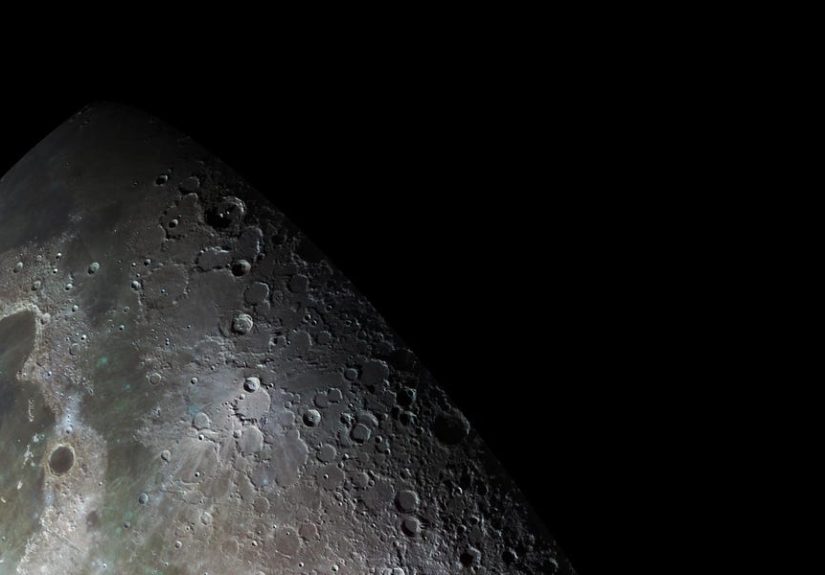
That strange orbit already made Kamoʻoalewa interesting. But what really turned astronomers into cosmic detectives was its surface composition. When researchers studied the asteroid’s reflected light, they found a signature much closer to weathered lunar material than to the ordinary stony asteroids that usually drift through near-Earth space. Later modeling showed that fragments blasted off the Moon could, in rare cases, slip into this kind of orbit. Then came an even sharper twist in the plot: a 2024 study traced the most likely source to Giordano Bruno, a young crater on the Moon’s far side.
In other words, this is not just a weird asteroid orbiting near Earth. It may be a relic of lunar violence, a fragment of the Moon that escaped, settled into an unusual solar orbit, and has been tagging along near our planet ever since. That idea matters for more than headline value. It changes how scientists think about near-Earth objects, lunar impacts, and the hidden traffic moving through the Earth-Moon system.
What Exactly Is Kamoʻoalewa?
Kamoʻoalewa was discovered in 2016 by the Pan-STARRS survey in Hawaii. It is small, with estimates generally placing it in the tens-of-meters range, roughly comparable to a Ferris wheel or a modest building, depending on which estimate you prefer. Tiny by planetary standards, yes. But in astronomy, “small” can still be scientifically priceless.
Its defining feature is not its size but its orbit. Kamoʻoalewa travels around the Sun on a path very similar to Earth’s. Because of that shared rhythm, it seems to circle Earth in a looping pattern when viewed from our moving perspective. This is why astronomers call it a quasi-satellite or co-orbital companion. It is not captured by Earth’s gravity as a true moon is. Instead, it is locked into a subtle resonance, like a runner staying in the next lane for lap after lap without ever stepping onto your track.
NASA described it early on as one of the best and most stable known examples of a near-Earth quasi-satellite. That matters because most co-orbital arrangements are temporary and dynamically messy. Kamoʻoalewa, by contrast, seemed unusually persistent. Right away, scientists suspected it might not have arrived by the usual route from the main asteroid belt between Mars and Jupiter.
That suspicion turned into something stronger when astronomers began looking not just at where it goes, but at what it appears to be made of.
Why Scientists Think It Is a Chunk of the Moon
Its reflected light looks lunar
One of the best ways to study a distant rocky object is to examine its spectrum, the pattern of light it reflects. Minerals interact with light in distinctive ways, so a spectrum works like a geological fingerprint. When astronomers observed Kamoʻoalewa, they found that its reflectance pattern did not fit comfortably with the typical near-Earth asteroid population.
Instead, it matched weathered lunar silicate material surprisingly well. That was a major clue. The asteroid looked more like moon rock than like the ordinary rubble usually found in near-Earth space. Researchers compared its spectrum with known samples, including lunar material returned by past missions, and the match was close enough to raise eyebrows across the planetary science community.
This was the turning point. A weird orbit can be coincidence. A weird orbit plus moon-like composition starts to sound like a confession.
Its orbit is also suspiciously Earth-Moon-friendly
Composition alone was not enough. Scientists still needed a realistic path that could explain how lunar material might leave the Moon, escape the Earth-Moon system, and settle into Kamoʻoalewa’s unusual co-orbital arrangement. That sounds like threading a needle while riding a roller coaster, because it basically is.
A 2023 study tackled that problem with dynamical simulations. The researchers showed that although this route is rare, it is not impossible. Under a small fraction of launch conditions, fragments blasted from the lunar surface can escape and evolve into an orbit compatible with Kamoʻoalewa’s. The favored scenarios involved ejecta leaving from the Moon’s trailing hemisphere at speeds just above lunar escape velocity.
That result did not prove the asteroid came from the Moon, but it removed a major objection. Lunar origin was no longer just a neat idea supported by chemistry. It became a physically plausible story.
The Crater Detective Story Gets Even Better
By 2024, the case got much more specific. A study in Nature Astronomy asked a bolder question: if Kamoʻoalewa is lunar ejecta, can we identify the exact crater that launched it?
That is an absurdly ambitious puzzle. The Moon has a lot of craters. It has been hit for billions of years, and many impacts threw debris all over the place. Pinpointing one crater as the source of a single asteroid sounds like forensic work performed with a magnifying glass the size of a planet.
Yet the researchers found a strong candidate: Giordano Bruno crater, a relatively young crater about 22 kilometers wide on the Moon’s far side. Their simulations suggested that an impact large enough to create a crater in the 10-to-20-kilometer class could have launched a fragment like Kamoʻoalewa into heliocentric orbit. Giordano Bruno fit the age, size, and dynamical requirements better than other candidate craters.
If that conclusion holds up, it would be remarkable. Scientists would have linked a specific asteroid in space to a specific crater on the Moon. That is not just “we think it’s moon rock.” That is closer to “we may know which lunar scar spat it out.”
Why This Discovery Matters
It expands the family tree of near-Earth objects
Most near-Earth asteroids are thought to originate in the main asteroid belt and get nudged inward over long timescales by collisions and gravitational effects. Kamoʻoalewa suggests that the Moon can also contribute material to near-Earth space. That means the menu of possible asteroid origins is broader than many people assume.
It also hints that Kamoʻoalewa may not be alone. If one lunar fragment made it into a stable or semi-stable Earth-like orbit, others may be out there too, especially as telescopes become better at detecting small, faint objects close to the Sun’s glare.
It could sharpen planetary defense models
Planetary defense is not just about spotting big rocks. It is also about understanding where different kinds of small bodies come from and how they move. If some near-Earth objects are actually lunar ejecta, scientists may need to account for that source population in their models. No, Kamoʻoalewa is not the villain of this story. But the broader lesson matters: the Earth-Moon system is not a static museum display. It is a place where impacts, debris, and orbital mechanics interact in ways that can leave behind odd survivors.
It gives scientists a new way to study the Moon
A lunar fragment in accessible space is scientifically irresistible. It could preserve clues about impact physics, the Moon’s crust, and the long-term effects of space weathering. In a strange way, Kamoʻoalewa may offer a sample of the Moon that delivered itself into a nearby solar orbit and waited patiently for humans to notice.
That is part of what makes the object so exciting. It sits at the intersection of asteroid science, lunar geology, impact dynamics, and space exploration. It is one small rock doing an impressive amount of interdisciplinary networking.
What Future Missions Could Reveal
The next big test of the lunar-fragment hypothesis may come from direct sampling. China’s Tianwen-2 mission is headed to Kamoʻoalewa, with the goal of studying the asteroid up close, collecting material, and returning samples to Earth. If successful, the mission could move this story from “strongly supported” to “case closed.”
That matters because remote observations, while powerful, still leave room for debate. Sample return changes the game. Scientists could compare Kamoʻoalewa’s chemistry, isotopes, and mineralogy with known lunar samples in far more detail than telescopes allow. If the match is solid, the Moon would officially lose a chunk and science would gain a spectacular confirmation.
Even if the asteroid turns out to be more complicated than expected, the mission will still be valuable. Kamoʻoalewa is an unusual co-orbital body, and close-up data on its surface, structure, rotation, and composition would improve models of small near-Earth objects across the board.
The Big Takeaway
The phrase “weird asteroid orbiting Earth” makes for a catchy headline, but the real story is better. Kamoʻoalewa is not just weird. It is revealing. It shows how violent the Moon’s history has been, how subtle orbital mechanics can preserve ancient debris, and how much of our local cosmic environment remains undiscovered or misunderstood.
For years, this object looked like a small mystery with a fancy orbit. Now it looks like a wandering fossil from the Moon’s battered surface. It is a reminder that the Earth-Moon system is not tidy and finished. It is dynamic, scarred, and still full of leftovers from old collisions.
And that may be the most satisfying part of the entire story. Kamoʻoalewa is not some random intruder from deep space. It may be family. Very distant family, admittedly. The kind that left home after a catastrophic event, circled the Sun for ages, and finally returned just close enough for us to say, “Hold on. Do you look familiar?”
Why This Story Feels So Wild Up Close: on the Human Experience of the Discovery
Part of what makes the Kamoʻoalewa story so memorable is not just the science, but the feeling it creates. Space news often comes in categories people already recognize: black hole, Mars rover, maybe a comet with a dramatic tail. This one lands differently. It starts with a seemingly ordinary asteroid and then slowly reveals that the object may be a piece of the Moon, moving through space in a strange partnership with Earth. That progression gives the discovery a rare emotional texture. It feels familiar and alien at the same time.
For skywatchers and science readers, there is something deeply satisfying about that kind of slow-burn mystery. Kamoʻoalewa was not discovered as a blockbuster object with flashing neon arrows pointing to its importance. It was small, faint, and hard to observe. The excitement built gradually, through repeated observations, odd spectra, orbital simulations, and careful elimination of less convincing explanations. That process mirrors what people often love about astronomy in the first place. It is not only about spectacle. It is about patience, pattern recognition, and the moment when scattered clues suddenly click.
There is also a psychological jolt in realizing that the Moon, which seems so permanent and serene from Earth, has a far more violent backstory. We grow up thinking of the Moon as stable, almost decorative, hanging over oceans, holidays, poems, and sleepless nights. Then science steps in and says: actually, it has been smashed repeatedly, and one of those ancient blows may have launched a fragment that still lingers near us today. That shift in perspective makes the Moon feel less like a postcard and more like a survivor.
For researchers, the experience is probably even stranger. Imagine spending years studying a dim object that most people have never heard of, only to realize you may be reconstructing a crime scene that took place on the Moon millions of years ago. The work is technical, but the emotional arc is almost cinematic. There is the first clue, then doubt, then follow-up evidence, then modeling, then the unexpected thrill of identifying a possible crater of origin. Scientific caution remains essential, of course, but you can still feel the human drama underneath it: curiosity, disbelief, persistence, and eventually a very careful kind of wonder.
This story also speaks to a broader experience many people have with modern science: the joy of watching certainty emerge step by step. In an age of hot takes and instant conclusions, Kamoʻoalewa is a refreshing example of how real discovery works. Researchers did not jump from “odd orbit” to “definitely moon rock” overnight. They built the case piece by piece. That can be thrilling in its own right, because it invites the audience into the process instead of only delivering the ending.
Most of all, Kamoʻoalewa makes our neighborhood feel alive. Earth is not drifting through an empty, orderly stage set. It moves through a cluttered, active environment shaped by impacts, fragments, and ancient accidents. Knowing that a likely piece of the Moon may be tagging along nearby makes the cosmos feel a little less abstract and a lot more intimate. It is the kind of discovery that reminds people why astronomy keeps pulling us back outside, back to telescopes, and back to the sky with that familiar thought: what else is up there that we have not understood yet?