Table of Contents >> Show >> Hide
- Meet Wat Rong Khun: Chiang Rai’s White Temple With a Wild Side
- Why It’s So White (And Why It Sparkles Like a Disco Snowdrift)
- The Walk From “Uh-Oh” to “Ahh”: Heaven And Hell Built Into the Route
- Inside the Ubosot: Buddhism Meets Modern Anxiety (And Pop Culture)
- Is It a Temple, a Museum, or a Mirror Held Up to You?
- How to Visit the White Temple Without Accidentally Becoming the Lesson
- Why the White Temple’s “Heaven and Hell” Theme Sticks With You
- of Visit-Style Experiences: What It Feels Like to See “Heaven and Hell” in One Place
- SEO Tags
Some places try to be “a vibe.” Wat Rong Khunbetter known as Thailand’s White Templetries to be
the entire moral universe. It shows up like a blindingly beautiful snow palace, then immediately
reminds you that humans are… complicated. Think: angelic white spires, mirrored sparkle, serene ponds,
and thensurprisean underworld of grasping hands and monsters that look like they’ve been stress-shopping
in the same nightmares you have.
Located just outside Chiang Rai in northern Thailand, this modern temple isn’t a relic of ancient dynasties.
It’s a living art project (and a working Buddhist site) created to make you wrestle with big ideas:
purity and temptation, wisdom and ego, enlightenment and the part of your brain that still wants to take
a selfie at the worst possible moment. If you’ve ever thought, “I want a temple that feels like heaven,
hell, and a contemporary art museum had a thoughtful group project,” welcome home.
Meet Wat Rong Khun: Chiang Rai’s White Temple With a Wild Side
Wat Rong Khun (pronounced roughly like “wat rong-KOON”) sits in the village area outside Chiang Rai,
a quieter northern city near Thailand’s borders with Laos and Myanmar. While Bangkok’s famous temples
dazzle with gold, this one goes full celestial: white-on-white architecture with glass and mirrored
accents that catch the sun like a thousand tiny camera flashes. If you arrive at midday, you may
briefly wonder whether you need sunglassesor spiritual forgivenessfor squinting.
Who built it, and why it’s still growing
The White Temple is strongly tied to one name: Thai artist Chalermchai Kositpipat. Rather than
building a typical temple and calling it a day, he envisioned a sprawling complex that blends
traditional Buddhist symbolism with modern visual language. In other words: he wanted a place
that could speak to today’s world without pretending today’s world is always serene, wise, or
well-behaved.
That’s also why the site has felt “in progress” for years. Parts have been completed and opened
to visitors, while additional structures, details, and artistic elements continue to evolve.
The result is a destination that’s part sacred space, part art installation, and part ongoing
conversationlike a TED Talk, but with dragons.
Why It’s So White (And Why It Sparkles Like a Disco Snowdrift)
The temple’s signature look isn’t just an aesthetic flex. The dominant white color is commonly
interpreted as a symbol of purity and the Buddha’s teachings. Meanwhile, the embedded mirrored
glass catches and reflects lightoften explained as a visual metaphor for wisdom shining outward.
It’s architecture doing philosophy without needing subtitles.
This is the genius of the White Temple: it doesn’t separate “pretty” from “meaningful.” Every curl,
spike, serpent, and filigree flourish is trying to say something about how you live your life.
Even if you arrive purely for the photos, the building keeps nudging you toward the bigger question:
“Okay, but what kind of person are you when no one is double-tapping?”
Beauty as a trap (in the best way)
Wat Rong Khun weaponizes beautypolitely. The glowing façade draws you in with a sense of innocence.
Then the temple starts layering in unease. That emotional whiplash is intentional: it mirrors the
Buddhist idea that appearances can be seductive, and that clarity often requires looking past
surface-level sparkle (even when the sparkle is objectively delightful).
The Walk From “Uh-Oh” to “Ahh”: Heaven And Hell Built Into the Route
Calling this place “both heaven and hell” isn’t just clicky phrasingit’s literally designed into
the experience. Your approach to the main ordination hall (ubosot) is a symbolic journey. Instead
of strolling straight into a peaceful sanctuary, you move through a story about human suffering,
desire, and the possibility of release.
The sea of hands: a not-so-subtle underworld
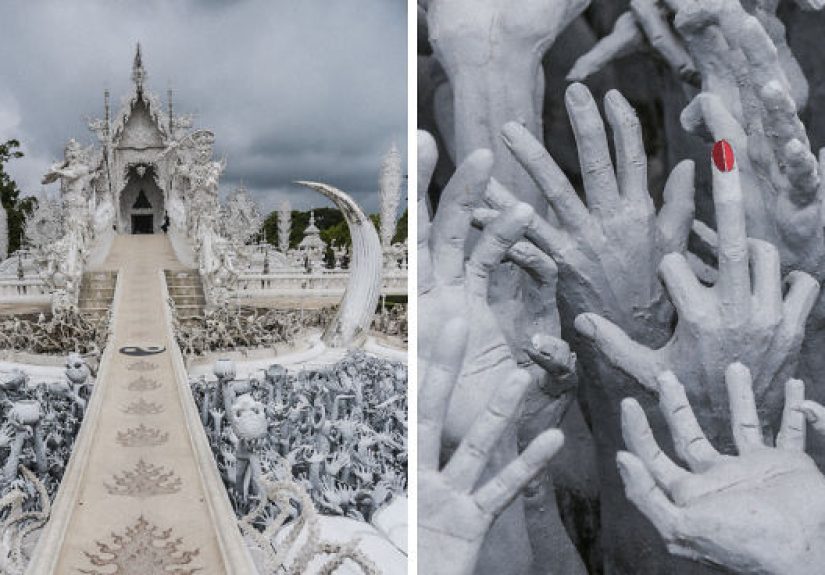
One of the most talked-about features is the pit filled with sculpted hands reaching upward.
It’s dramatic, unsettling, and extremely memorablelike a haunted house, if the haunted house
was trying to teach you about attachment. The hands evoke craving, desperation, and the way
suffering can feel like being pulled down by your own wants.
This “hell” isn’t about jump-scares. It’s more like a visual reminder: when we cling to greed,
anger, or obsession, life can become its own underworld. The hands don’t just reach for you;
they reach for everythingstatus, pleasure, control, the last word in an argument, and maybe your
phone charger.
The bridge of rebirth: crossing the problem on purpose
To enter the temple, visitors cross a bridge that’s often described as representing the cycle of
rebirth (samsara) and the transition from suffering toward enlightenment. The point is not to
pretend the ugly parts of existence aren’t thereit’s to acknowledge them, then choose a wiser
path forward.
In practical terms: you walk over the chaos, not around it. In symbolic terms: that’s… pretty accurate
for being a human.
The “heaven” moment: calm, order, and a different kind of glow
After the intensity of the approach, the main temple structure feels almost weightless. The white
surfaces, symmetrical lines, and clean brightness contrast sharply with the underworld imagery
below. This is the “heaven” side: not necessarily a literal paradise, but a visual language of
clarity, virtue, and spiritual aspiration.
The temple’s gates and guardian figures add another layer: the idea that entry into a sacred space
involves choice and responsibility. The visual message is basically, “You can come inbut you’re
not bringing all your nonsense with you.”
The golden restroom: yes, it’s famousand yes, it’s on purpose
Among the most joked-about (and genuinely photographed) elements is a richly gilded building that
functions as a restroom. It’s ornate, gold, and unapologetically flashyespecially compared to the
temple’s dominant white. The contrast works like a punchline with a thesis statement: gold can
represent worldly obsession, while white points toward spiritual purity.
It’s hilarious. It’s also… a pretty direct commentary on how humans treat material desire.
Leave it to an artist to say, “Here’s enlightenmentalso, here’s capitalismplease wash your hands.”
Inside the Ubosot: Buddhism Meets Modern Anxiety (And Pop Culture)
The interior is one of Wat Rong Khun’s most surprising aspects. Traditional Thai temples often use
murals to depict Buddhist stories and moral lessons. Here, the moral lessons remainbut the visuals
can jump across time. Visitors have noted contemporary references and pop-culture figures woven into
dramatic scenes that comment on violence, temptation, and the chaos of modern life.
It’s not random. The mash-up is meant to show that “good vs. evil” isn’t an antique concept sealed
in a museum. It’s happening nowthrough media, consumerism, conflict, and the everyday choices that
either strengthen compassion or feed ego.
Why the pop-culture mash-up actually works
Pop culture is a shared language. When a temple uses it, the message can land faster, especially for
visitors who didn’t grow up with Buddhist iconography. A superhero or familiar movie reference can
act like a signpost: “This is about your world.” The goal isn’t to be edgy; it’s to be legible.
Another notable detail: photography inside the ubosot is typically not allowed. That rule reinforces
the idea that the interior is meant for reflection, not just documentation. In a place that’s wildly
photogenic outside, the inside asks you to practice the rare art of paying attention without proof.
Is It a Temple, a Museum, or a Mirror Held Up to You?
The White Temple sits at an interesting intersection: it operates with the gravity of a religious
site while also functioning as a contemporary art environment. That dual identity is exactly why it
sticks in people’s minds. You don’t just “see” ityou get confronted by it (politely, with great lighting).
If you’re used to thinking of temples as uniformly calm, Wat Rong Khun expands the category. It suggests
that spiritual practice isn’t only about serenity; it’s also about honest accounting. What are you attached
to? What scares you? What do you worship without realizing it?
That’s the heaven-and-hell concept in a nutshell: both exist as possibilities in the human mind. The temple
simply makes those possibilities hard to ignore.
How to Visit the White Temple Without Accidentally Becoming the Lesson
Wat Rong Khun is one of Chiang Rai’s most popular attractions, which means crowds can show up with
enthusiasmand matching tour-bus energy. A little planning goes a long way.
Timing tips
- Go early if you can. Softer light, fewer people, less “why is the sun personally attacking me?”
- Weekdays are often calmer than weekends and holidays.
- Give yourself buffer time for lines and slow-moving photo clusters.
Dress code and etiquette
- Cover shoulders and knees (think: respectful, not beach-mode).
- Expect to remove shoes in certain areas.
- Follow posted rulesespecially around interior photography.
What to bring
- Sunglasses (mirrored details + sun = sparkle overload).
- Water in hot months, because enlightenment is easier when you’re hydrated.
- A light scarf or cover-up if you’re unsure about temple-appropriate clothing.
Make it a Chiang Rai “art temple” day
Many travelers pair the White Temple with other Chiang Rai-area landmarks for a full day of
color-and-contrast: the Blue Temple (Wat Rong Suea Ten), the Black House (Baan Dam), and other
sculptural sites nearby. It’s a surprisingly coherent itinerary: light, dark, vivid color, and
then a big existential shrug over iced coffee.
Why the White Temple’s “Heaven and Hell” Theme Sticks With You
Plenty of places are beautiful. Wat Rong Khun is beautiful and argumentative. It doesn’t let you
treat spirituality as décor. It insists that life has shadows, that desire has consequences, and that
wisdom is more than a slogan on a tote bag.
The genius is that the temple doesn’t preach at you with words. It lets architecture do the talking.
The underworld is loud and frantic. The bridge demands a choice. The white sanctuary offers calm.
The gold restroom winks at your material instincts. And the modern murals remind you that “good vs. evil”
didn’t retire when smartphones showed up.
In the end, the White Temple feels like a place that doesn’t just ask for your attentionit asks for
your honesty. Which is rarer than a quiet moment in a tourist attraction, and arguably more valuable.
of Visit-Style Experiences: What It Feels Like to See “Heaven and Hell” in One Place
A typical visit starts with a moment of disbelief: the temple looks like it was carved from frosting and
moonlight, then sprinkled with glitter by someone who takes “extra” as a spiritual practice. As you walk
closer, the mirrored glass flashes in the sun, and the whole structure seems to shimmerlike it’s trying
to be both solid architecture and a mirage.
Then the mood shifts. You notice the path is guiding you deliberately, and the symbolism starts to feel
less like background decoration and more like a storyline you’re walking through. The famous “sea of hands”
appears, and people naturally slow downpartly to stare, partly to process. The hands can feel eerie, but
also strangely familiar: they look like craving made physical. You’ll likely hear a few nervous laughs,
because humor is what humans do when something hits too close to home.
Crossing the bridge feels like a small ceremony, even if you didn’t plan on being ceremonial. The crowd
noise fades in and out, and you realize that the structure is quietly directing your attention away from
the chaos below and toward the calm ahead. It’s one of those rare tourist moments where the design
successfully changes your pace: you stop rushing, you look longer, you notice details.
Outside, the experience is intensely visualpeople frame photos, step aside, step back in, and try to
capture the “impossible white” without overexposing the shot. (Pro tip: your camera will be confused; it’s
not personal.) You might find yourself hunting for tiny carvingsserpents here, floral filigree there,
strange little figures tucked into corners like Easter eggs for the spiritually curious.
The interior, by contrast, is more about attention than evidence. With photography typically restricted,
visitors actually have to look. You’ll see people exit with that expression that says, “I need a minute,
because I just watched centuries-old symbolism collide with modern culture and it weirdly made sense.” It’s
the kind of art that doesn’t demand you agree with every choiceit just demands that you notice what it’s
pointing at: violence, obsession, distraction, and the possibility of living differently.
Finally, there’s the lighthearted moment everyone remembers: spotting the ornate gold restroom. People grin,
because it’s funny, but it also lands as a clever contrastwhite purity on one side, gold worldly shine on
the other. It’s a small reminder that the temple experience isn’t “escape reality.” It’s “see reality clearly,
including your own impulses.” And that’s why, hours later, you may still be thinking about itlong after the
glitter stops sparkling in your eyes.