Table of Contents >> Show >> Hide
- What Exactly Is the Tuscan Farmhouse 1000 Double Arabescato Marble Sink?
- Arabescato Marble 101: Why It Feels So Luxurious
- Key Features of the Tuscan Farmhouse 1000 Double Arabescato Sink
- How a Tuscan Farmhouse Marble Sink Works in Real Kitchens
- Pros and Cons: Is an Arabescato Farmhouse Sink Right for You?
- Design Tips: Styling Around a Tuscan Farmhouse Double Marble Sink
- Care and Maintenance Essentials
- How It Compares to Other Farmhouse Sink Materials
- of Real-Life Inspiration and Experience with Tuscan Farmhouse Arabescato Sinks
- Conclusion
If your dream kitchen looks like an old stone farmhouse in the Tuscan hillsbut with a Wi-Fi signal and an espresso machinethe Tuscan Farmhouse 1000 Double Arabescato Marble Sink is basically your spirit animal in sink form. Designed by deVOL Kitchens and carved from a single block of Italian Arabescato marble, this double-bowl farmhouse sink combines artisanal craftsmanship, old-world romance, and serious functionality in one very luxurious hunk of stone.
What Exactly Is the Tuscan Farmhouse 1000 Double Arabescato Marble Sink?
The Tuscan Farmhouse 1000 is a double-basin apron-front sink originally offered by deVOL Kitchens. It’s machined from solid Arabescato Corchia marble, a highly figured stone quarried in Tuscany, Italy. The “1000” refers to its width of roughly 1000 millimeters (about 39⅜ inches), paired with a height of around 220 millimeters (8⅝ inches) and depth of about 535 millimeters (21 inches).
Instead of a thin shell or veneer, this is a sink block: thick, 30 mm walls, rounded internal corners, and a generous apron front that instantly anchors a kitchen. Many versions were offered in both Carrara and Arabescato marble, sometimes with a fluted front for extra detail. The Arabescato variantour focus hereis the bold, high-contrast showstopper, with dramatic gray veining swirling over a bright white background.
Arabescato Marble 101: Why It Feels So Luxurious
Arabescato marble often gets mentioned in the same breath as Carrara and Calacatta, and all three come from the Tuscany region of Italy. But they’re not identical triplets. Arabescato sits somewhere between the softer, gentler veining of Carrara and the big, dramatic patterns of Calacatta. It’s known for:
- A bright white background that looks fresh and clean.
- Bold gray veining that can form circular or flowing “webs” across the surface.
- High contrast that reads as elegant rather than busy when used thoughtfully.
Compared with Carrara, which leans gray and subtle, Arabescato brings more drama, movement, and contrast. That’s why it’s often used in statement applications like feature walls, countertops, and, yes, farmhouse sinks that are meant to be the star of the kitchen.
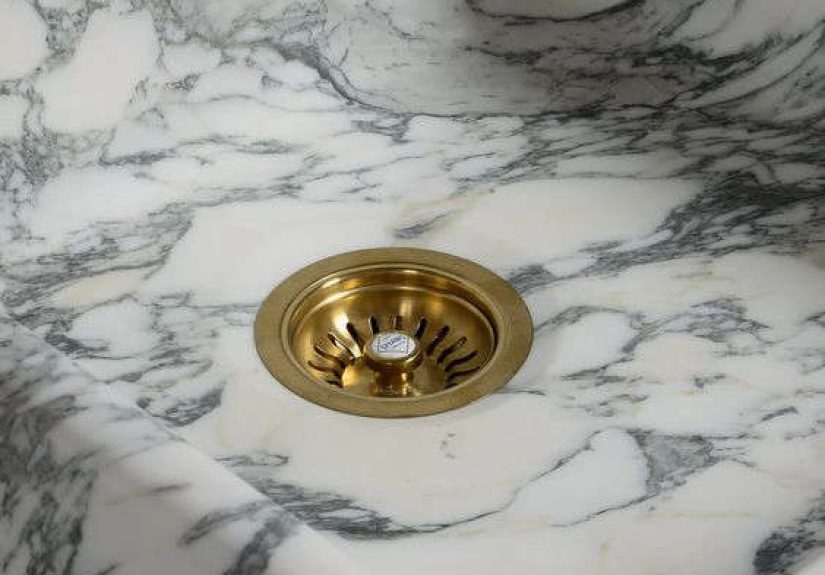
In the Tuscan Farmhouse 1000 Double sink, the veining swoops over the apron front, pools around the brass or gold-tone drains, and continues up the inner walls. The effect is almost like a piece of sculpture that just happens to deal with your dirty dishes.
Key Features of the Tuscan Farmhouse 1000 Double Arabescato Sink
1. Double-Bowl Layout
The “1000 Double” configuration gives you two generous basins in one long block of stone. That layout is ideal if you like to:
- Keep one side for washing and one for rinsing.
- Separate food prep from dish cleanup.
- Hide a few dishes in one half when guests arrive and pretend you are extremely on top of life.
At roughly a meter wide, this is not a dainty bar sink. It fills a sizable cabinet run and looks perfectly at home under a large window or centered on a main wall.
2. Apron-Front Farmhouse Design
The sink has an exposed front, or “apron,” that projects slightly beyond the cabinetry. That’s the classic farmhouse silhouette, but instead of fireclay or enamel, you get a solid marble front panel with continuous veining. Some related models feature fluted frontsvertical ridges that add shadow and texturebut the Double Arabescato version is often seen with a smooth apron, which lets the veining do the talking.
3. Thick Walls and Soft Radiuses
Unlike thin, sharp-cornered stainless or composite sinks, this one is intentionally chunky and traditional. The 30 mm thick walls and rounded internal corners give it a softer, more substantial look and make it feel original to a period house, even if your home was built last year.
4. Hand-Finished, Honed Surface
These sinks are machined from a single block of marble and then finished with a honed surface rather than a high polish. A honed finish is matte and velvety, which:
- Diffuses light for a softer, more rustic effect.
- Makes water spots and fine etching slightly less noticeable than on a glossy, polished finish.
- Fits perfectly with Tuscan farmhouse and English country kitchen aesthetics.
deVOL emphasizes that their marble sinks are meant to age and develop patina; they’re not for anyone who wants pristine, untouched perfection forever.
How a Tuscan Farmhouse Marble Sink Works in Real Kitchens
You’ll spot this sinkand its Carrara cousinsin high-end kitchen projects published in interiors magazines and design blogs. Homes & Gardens, Remodelista, and other outlets have featured deVOL kitchens where the Arabescato farmhouse sink is paired with:
- Dark painted cabinetry (deep green, charcoal, or inky blue).
- Warm brass or aged bronze taps and pot fillers.
- Simple marble slab backsplashes to continue the veining up the wall.
- Open shelving with copper pots and terracotta planters for a European look.
In these projects, the sink becomes the focal point: a bright, veined rectangle set against darker cabinets and warm metal finishes. The overall effect feels like a Tuscan farmhouse met an English country house and they agreed to share the kitchen.
Pros and Cons: Is an Arabescato Farmhouse Sink Right for You?
Benefits
-
Unmatched visual impact.
A Tuscan Farmhouse 1000 Double Arabescato Marble Sink isn’t background; it’s the main character. If you want your kitchen to feel custom and curated, this does the job instantly. -
Natural stone character.
Each block of Arabescato has unique veining, so no two sinks are exactly alike. You’re literally installing a functional piece of stone art. -
Longevity in the right context.
Properly installed and supported, a solid marble sink is extremely durable. The stone itself can last for generations, even though its surface will evolve over time. -
Design flexibility.
Arabescato works beautifully with many palettes: warm woods, dark painted cabinets, neutral plaster walls, earthy terracotta, and even sleek, modern fixtures.
Trade-Offs
-
Maintenance and patina.
Marble is porous and reactive. It can etch from acidic foods (like lemon, vinegar, and tomato sauce) and stain if spills sit too long. Regular sealing and quick wipe-ups are non-negotiable. -
Weight.
This isn’t something you casually drop into a standard sink cutout. A 1000 mm double marble sink can weigh close to 90 kg (about 200 pounds) before you even add water or dishes. You’ll need proper cabinet reinforcement and professional installation. -
Cost.
Arabescato farmhouse sinks from boutique makers are firmly in the luxury category, with prices that reflect the stone quality, machining, and import logistics. -
Lead times and availability.
Many marble sinks are made to order in Italian quarries, with lead times that can run several weeks or more. Some specific models, like the exact Tuscan Farmhouse 1000 Double Arabescato, have been listed as discontinued or not available to order online, so sourcing might require direct inquiries or secondary markets.
Design Tips: Styling Around a Tuscan Farmhouse Double Marble Sink
1. Let the Sink Be the Hero
With Arabescato’s strong veining, the safest strategy is to keep surrounding finishes quieter. Consider:
- Plain cabinet fronts (Shaker or slab) in a solid color.
- Subtle counterseither matching marble for a full-slab look or a simple wood or stone with minimal pattern.
- Unfussy backsplash tiles or a matching marble splash up the wall.
2. Warm Metals for Balance
The combination of bright white marble and platinum-gray veining can feel cool on its own. Warm metals bring it back down to earth. Aged brass or burnished bronze taps, pot fillers, and drain fittings echo many deVOL installations and add that “lived-in European” vibe.
3. Layer in Natural Materials
To fully sell the farmhouse story, pair your marble sink with:
- Wood countertops or cutting boards.
- Terracotta or limestone flooring.
- Linen curtains and woven pendants or shades.
- Herbs in clay pots lined up along the sill or shelf above the sink.
This mix keeps the kitchen warm and tactile instead of museum-like.
4. Plan for Everyday Life
If you’re worried about marble’s sensitivity but still in love with the look, you can:
- Use a protective sink grid at the bottom of each bowl.
- Keep everyday heavy pans and cast iron slightly away from the edges.
- Adopt a “patina is charming” mindsetbecause perfectionism and marble are not friends.
Care and Maintenance Essentials
Taking care of an Arabescato farmhouse sink is less about complicated routines and more about consistent, gentle habits:
- Seal regularly. Use a quality stone sealer on schedule (often once or twice a year) to help resist staining and make cleanup easier.
- Wipe up spills quickly. Acidic foods and dark liquids like coffee, wine, and tomato sauce can etch or stain if left sitting.
- Use pH-neutral cleaners. Avoid harsh chemicals and vinegar-based cleaners; they can damage the surface over time.
- Expect micro-scratches and marks. Tiny abrasions, etched spots, and soft discolorations are part of the material’s charm and history.
If you’re the type who loves a perfectly white, always-uniform sink, marble might drive you a little wild. But if you love the idea that your kitchen will wear in like a favorite leather bag, the Tuscan Farmhouse 1000 Double Arabescato Marble Sink fits beautifully.
How It Compares to Other Farmhouse Sink Materials
When clients or homeowners debate this sink, they’re usually comparing it to:
- Fireclay farmhouse sinks – Very popular, bright, and durable but visually simpler. They’re easier to live with but don’t have the strong veining and natural variation of Arabescato.
- Stainless-steel farmhouse sinks – Modern, tough, and functional. Great if you cook a ton but want minimal maintenance. They lack the old-world romance of a stone sink.
- Composite or granite sinks – Often very practical and stain-resistant, with speckled or solid colors. They’re a middle ground between utility and design, but rarely as “wow” as a full marble front.
- Other marble or stone sinks – Nero Marquina, Calacatta, and other stones can be more dramatic or darker, shifting the mood from breezy Tuscan farmhouse to moody modern villa.
The Tuscan Farmhouse 1000 Double Arabescato lands squarely in the “luxury focal point” category: not the most forgiving or budget-friendly, but unforgettable when it’s right for the space.
of Real-Life Inspiration and Experience with Tuscan Farmhouse Arabescato Sinks
Imagine walking into a kitchen first thing in the morning. The light comes in low and sideways, and the first thing it hits is that wide apron of Arabescato marble. The gray veining catches the shadows, the white background glows, and suddenly rinsing berries at 7 a.m. feels like a tiny vacation in Italy. That’s the emotional pull of a Tuscan farmhouse marble sinkand it’s why so many design enthusiasts hunt down this exact style, even when lead times and price tags try to talk them out of it.
Kitchens that use the Tuscan Farmhouse 1000 Double Arabescato Marble Sink often share a few traits. First, the sink zone becomes the “moment” in the room. Designers will center it on a window or under an open shelf, flank it with dark cabinetry, and run a matching marble slab up the wall behind it. The result: a vertical marble frame that feels like a water-focused altar (in the best way). Copper pans, olive oil bottles, and terracotta pots add texture and color, reinforcing that Tuscan-meets-English-country mood.
People who live with this type of sink tend to describe two phases. Phase one: the adjustment period. The first etch from a lemon slice, the first faint ring from a glass, the first tiny chip from an escaped cast-iron paneach one feels like an event. Then, at some point, you cross into phase two: acceptance and appreciation. The surface starts to tell your kitchen’s story. A faint mark near the drain reminds you of making homemade tomato sauce; a softened scratch recalls the Great Lasagna Marathon of last Thanksgiving. You stop worrying about keeping it pristine and start focusing on keeping it clean and cared for.
Day-to-day use can be surprisingly practical, especially with the double-bowl configuration. In many households, one side becomes the “clean” prep zone. That’s where you rinse greens, soak beans, or chill bottles of sparkling water in a quick ice bath. The other side unofficially becomes the “chaos” zone: soaking pans, stacking plates for a rinse, or hiding breakfast dishes when you need the counters clear in a hurry. The solid stone walls and gentle curves make it easy to maneuver large pots and baking sheets without clanging against metal or worrying about hairline cracks in enamel.
There are also little sensory details that don’t show up in product specs. The sound of water hitting honed marble is softer than on stainless steel; it’s more of a muted splash than a sharp ping. When you rest your hands on the edge of the apron, the stone feels cool and substantial, like the steps of an old building that’s been there forever. In warm climates or during a long day of cooking, that coolness is oddly refreshinglike a tiny reset every time you lean on the sink.
Of course, this isn’t a sink for everyone. If you know you’ll never forgive a stain, a different material will probably make you happier. But if you love houses with character and you’re drawn to materials that age visibly, a Tuscan farmhouse-style Arabescato sink is almost like inviting in a very glamorous, slightly high-maintenance houseguest. It will be stunning, it will occasionally misbehave, and in the end, you’ll probably be glad you made room for it.
For remodelers, the sink can also serve as a powerful design anchor. Once you’ve committed to this piece, many other decisions get easier: you know the kitchen needs to feel layered, textural, and intentional. You’re less likely to clutter the space with too many competing patterns or trendy finishes, and more likely to choose timeless materials that can hold their own beside the marble. In that sense, the Tuscan Farmhouse 1000 Double Arabescato Marble Sink doesn’t just upgrade your kitchenit quietly upgrades your design discipline, too.
Conclusion
The Tuscan Farmhouse 1000 Double Arabescato Marble Sink is more than a place to wash dishes; it’s a statement piece that frames your entire kitchen experience. With its solid Italian marble construction, dramatic veining, and generous double-bowl layout, it brings serious function and high romance in equal measure. It asks for thoughtful installation, regular care, and a relaxed attitude toward patinabut in return, it offers daily moments of beauty and a sense that your kitchen belongs to a bigger architectural story.
meta_title: Tuscan Farmhouse Double Arabescato Marble Sink
meta_description:
Discover the Tuscan Farmhouse 1000 Double Arabescato Marble Sink, its features, pros, cons, and design tips for a timeless luxury kitchen.
sapo:
The Tuscan Farmhouse 1000 Double Arabescato Marble Sink is a solid Italian marble farmhouse sink that turns everyday kitchen tasks into a design moment. With its dramatic gray veining, generous double-bowl layout, and classic apron-front silhouette, it delivers both serious function and old-world charm. Learn what makes Arabescato marble special, how this sink performs in real kitchens, what maintenance it truly requires, and how to style it with cabinetry, lighting, and hardware for a warm, timeless Tuscan farmhouse feelwhether you’re renovating a country cottage or upgrading a city condo.
keywords:
Tuscan Farmhouse 1000 Double Arabescato Marble Sink, Arabescato marble farmhouse sink, deVOL Tuscan farmhouse sink, double bowl marble kitchen sink, Italian marble apron-front sink, luxury farmhouse kitchen sink, Arabescato marble kitchen design