Table of Contents >> Show >> Hide
- Why This High/Low Comparison Still Feels Fresh
- The Low: Ikea and the Case for Affordable Scandinavian Style
- The High: Alvar Aalto Editions and the Original Modernist Magic
- Tea Trolley 900 vs. Tea Trolley 901
- What Both the Ikea and Aalto Versions Understand About Scandinavian Design
- How to Choose Between Ikea and Aalto
- How to Style a Scandi Drinks Trolley Without Overdoing It
- Which One Offers the Better Value?
- Experience: Living With the High/Low Scandi Trolley
- Conclusion
If Scandinavian design had a party trick, it would probably be this: taking an everyday object and making it look calm, clever, and just a little more grown-up than it has any right to be. A drinks trolley is a perfect example. In less thoughtful hands, it can slide into shiny hotel-lobby territory. In Scandinavian hands, it becomes something better: lighter, quieter, warmer, and more useful than a piece of furniture with wheels should reasonably be.
That is exactly why the old high/low comparison between Ikea and Alvar Aalto still works so well. On one end, you have Ikea’s democratic, mobile, budget-friendly trolley spirit: practical, easygoing, and happy to moonlight as a coffee station, plant stand, bedside table, or snack command center. On the other, you have Alvar Aalto’s iconic Tea Trolley editions for Artek: sculptural, historic, beautifully engineered, and expensive enough to make your wallet whisper, “Let’s sit down before we continue this conversation.”
The fun part is that both versions speak the same visual language. They both lean on the core ideas that make Scandinavian interiors so appealing: clean lines, natural materials, restraint, flexibility, and a sense that design should make daily life smoother rather than louder. So while one trolley may cost less than a dinner party and the other may cost as much as rethinking your tax strategy, they are part of the same family tree.
This is what makes the Scandi drinks trolley such a smart design story. It is not just about “cheap versus expensive.” It is about how a great idea travels: from modernist icon to mass-market favorite, from collectible design object to useful home companion, from “museum-worthy” to “where should I put the seltzer?”
Why This High/Low Comparison Still Feels Fresh
The original appeal of the comparison was simple: Ikea released a wheeled piece in its PS 2017 collection that echoed the silhouette and mood of Aalto’s classic tea trolleys. The resemblance was not exact, but the vibe was unmistakable. Pale wood, airy structure, easy movement, and a shape that felt more elegant than bulky. It was a familiar Scandinavian trick: make function beautiful, then politely act like that happened by accident.
Years later, the idea still lands because the broader design culture has caught up to it. Americans have become much more comfortable with flexible furniture. We expect pieces to multitask. We want a cart that can hold cocktail glasses on Friday, a stack of cookbooks on Saturday, and a very optimistic eucalyptus arrangement by Sunday afternoon. That blend of utility and softness is pure Nordic territory.
Scandinavian design continues to resonate because it avoids two common decorating traps. First, it does not confuse minimalism with sterility. Second, it does not confuse coziness with clutter. The best Scandi furniture offers both clarity and warmth. A trolley, especially one in light wood or a restrained neutral finish, can do exactly that while moving gracefully through small apartments, open kitchens, and multipurpose living spaces.
The Low: Ikea and the Case for Affordable Scandinavian Style
Ikea’s genius has never been about inventing every great form from scratch. Its real superpower is translating design ideas into everyday life at everyday prices. That is why Ikea has become so closely associated with Scandinavian style in American homes. It delivers the essentials: functionality, lightness, small-space intelligence, and a look that feels orderly without feeling uptight.
Even when a specific Ikea trolley comes and goes, the formula stays the same. Today, carts such as RASKOG and NISSAFORS continue the brand’s rolling, compact, practical approach. They are slim enough for tight spaces, versatile enough for kitchens and home offices, and simple enough to dress up or down depending on what you load onto them. In other words, they are less “formal bar cart” and more “useful sidekick with unexpectedly good taste.”
What Ikea Gets Right
It understands function first. A trolley has to move well, park neatly, and hold more than two fashionable lemons and one lonely bottle of vermouth. Ikea carts are designed for actual homes, not just styled photos. They earn their keep.
It keeps the silhouette clean. Scandinavian design depends on visual restraint, and Ikea usually knows when to stop. A rolling cart with open tiers, uncomplicated lines, and a quiet finish feels lighter than a bulky cabinet or flashy chrome bar cart.
It invites creative use. This may be the most Scandinavian quality of all. A trolley is never just a trolley. It can be a breakfast station, a plant shelf, a tea corner, a mobile pantry, a bedside table, or a tiny design flex next to the sofa.
It makes good design feel casual. Ikea’s best pieces do not demand ceremony. They fit into daily life with very little fuss, which is exactly what many people want from a home that is stylish but still relaxed.
The low route is especially appealing if you like refreshing your rooms, moving things around, or trying out a look before committing to an heirloom purchase. An Ikea trolley lets you borrow the spirit of Scandinavian entertaining without taking out a second mortgage to display tonic water attractively.
The High: Alvar Aalto Editions and the Original Modernist Magic
Then there is the high version: Alvar Aalto’s Tea Trolley. Actually, tea trolleys, plural. And this is where the story gets genuinely juicy for design lovers.
Aalto’s trolleys are not famous because they are expensive. They are expensive because they are famous for good reason. They sit at the intersection of modernism, craftsmanship, and human-centered design. Rather than treating furniture like cold machinery, Aalto brought softness, curve, and tactility into modern design. His work helped define a version of modernism that felt livable. Less machine age, more “please have another cup of tea.”
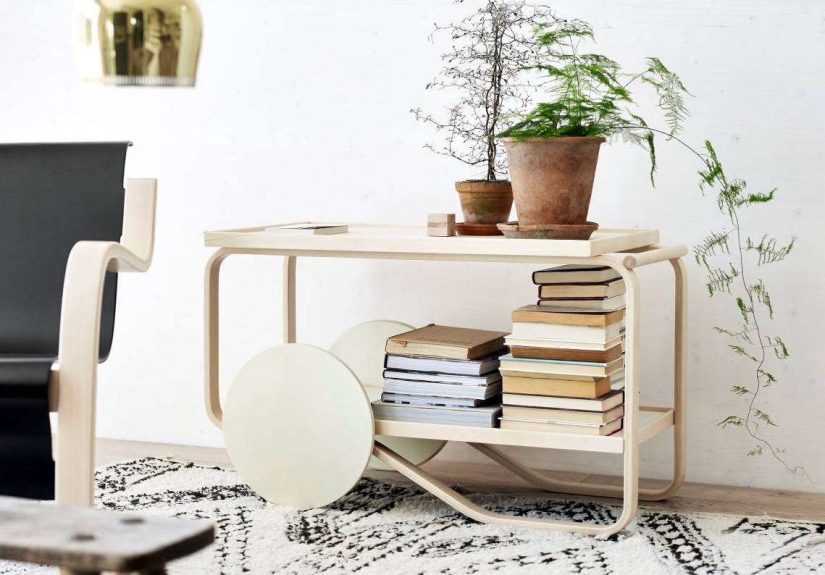
The best-known editions in this conversation are Tea Trolley 900 and Tea Trolley 901. The 900, first launched internationally in 1937, is the more decorative sibling, with ceramic tiles and a woven rattan basket. The 901, dating to 1936, is leaner and perhaps a touch more architectural, built around bent birch loops, two trays, and striking large wheels. Both are unmistakably Aalto: curved, intelligent, airy, and warm.
Why Aalto’s Trolleys Matter
They merge cultures beautifully. Aalto’s trolley designs are often linked to British tea culture and to Japanese woodwork and architecture. That cross-pollination matters. These pieces are Scandinavian, yes, but not provincial. They are cosmopolitan designs distilled into something serene.
They make engineering look poetic. The bent birch structure is not just a technical feat; it is the visual soul of the trolley. Those loops and wheels give the piece movement even when it is standing still.
They are useful without looking utilitarian. That is harder than it sounds. Plenty of furniture is practical. Far less of it feels elegant while being practical. Aalto’s trolleys manage both.
They have real design history. These are not “inspired by Scandinavian design.” They are Scandinavian design history. MoMA holds Aalto tea trolley works in its collection, which tells you this is more than a pretty serving piece. It is a recognized design object.
They keep evolving. Over the years, the Tea Trolley has appeared in multiple variations, including reinterpretations by Hella Jongerius, whose darker color treatments gave the 901 a moodier, more contemporary edge. That ability to absorb new finishes without losing identity is the mark of a classic.
Tea Trolley 900 vs. Tea Trolley 901
If you are comparing Aalto editions, the distinction is worth knowing.
Tea Trolley 900 is the more expressive one. With its ceramic tile surface and rattan basket, it feels almost like a conversation between architecture and craft. It has a slightly more decorative, collected presence, which makes it especially appealing in rooms with texture, ceramics, books, and layered materials.
Tea Trolley 901 is the cleaner and more stripped-back model. The composition is lighter, the silhouette more graphic, and the overall mood more quietly modern. It reads beautifully as a bar cart, side table, or sculptural accent in a room that values negative space.
That difference matters because when people say they want a “Scandi drinks trolley,” they often mean one of two things: either something more relaxed and textured, or something more pared down and architectural. The 900 and 901 practically split those personalities between them.
What Both the Ikea and Aalto Versions Understand About Scandinavian Design
The reason this high/low pairing feels so satisfying is that both versions grasp the same design fundamentals.
1. Mobility is part of the charm
A trolley is not a static object. It is furniture with a little freedom built in. That makes it ideal for modern homes where rooms overlap and furniture has to adapt. Scandinavian interiors often prioritize flow and usability, so a rolling piece makes perfect sense.
2. Materials matter
Light wood, painted metal, laminate, linoleum, woven texture, ceramic tile: these finishes all contribute to the character of the trolley. Scandinavian design loves materials that feel honest and tactile. The best carts do not hide what they are made of.
3. Simplicity does the heavy lifting
Nothing on a good Scandi trolley feels fussy. The silhouette is restrained. The storage is visible and easy to reach. The shape does not beg for attention, which is precisely why it earns it.
4. Function is the aesthetic
This is the big one. In Scandinavian design, usefulness is not the boring part. It is the beautiful part. A trolley that moves well, stores well, and fits elegantly into a room is doing exactly what Nordic design asks of it.
How to Choose Between Ikea and Aalto
Pick Ikea if you want flexibility, affordability, and low-pressure styling. It is the right choice if you live in a smaller space, like to rearrange furniture, or want a trolley that can change jobs every week without filing a complaint.
Pick Aalto if you want a long-term design piece with cultural and aesthetic weight. It is not just furniture; it is a statement about what you value in a home. Craft, history, proportion, and quiet beauty all show up here.
In short, Ikea is brilliant for trying the look. Aalto is brilliant for living with the idea for decades.
How to Style a Scandi Drinks Trolley Without Overdoing It
A Scandinavian trolley works best when it is edited. Not empty. Not chaotic. Edited. That means a few useful things, a few beautiful things, and enough breathing room that the trolley still reads as furniture rather than an emergency storage unit.
Try a mix like this:
- One tray of glassware or mugs
- One bottle cluster or coffee tools
- A small lamp, candle, or ceramic vase
- A stacked book or two
- One organic element, like greenery or fruit
The trick is contrast. Smooth glass against wood. Soft foliage against a geometric frame. A practical object next to a beautiful one. Scandinavian styling always looks easier than it is, which is rude, but also part of the fun.
Which One Offers the Better Value?
If value means price alone, Ikea wins before the starting whistle blows. No drama there.
If value means design pedigree, craftsmanship, longevity, and cultural significance, Aalto wins. Also no drama, unless you are discussing it with your bank account.
But the more interesting answer is that both offer value in different currencies. Ikea offers access. Aalto offers permanence. Ikea says, “You can have good design now.” Aalto says, “You can live with great design for a very long time.” There is room for both ideas in the same design universe, and honestly, that is part of what makes the high/low comparison so satisfying.
Experience: Living With the High/Low Scandi Trolley
What does this comparison feel like in real life, outside catalog language and carefully arranged product shots? Surprisingly emotional, actually. A good trolley changes the rhythm of a room more than its size would suggest. It adds movement, and movement makes a space feel alive.
With the Ikea version, the experience is immediate. You bring it home, assemble it, park it somewhere convenient, and it starts working almost before the screwdriver cools off. It is forgiving. If it ends up holding sparkling water, olive oil, scissors, mail, and a candle you forgot to light last winter, it somehow still feels charming. Ikea furniture has that rare ability to let people experiment without fear. You are not worried about being too precious with it. You roll it into the kitchen during a dinner party, back into the corner after dessert, then repurpose it as a coffee station on Monday morning. It keeps up.
The Aalto experience is different. Slower. More intentional. You notice the curve of the wood. You notice the proportion. You notice how the trolley looks when morning light hits the wheels, or how it anchors a room without shouting. It does not feel like a storage solution that happens to be attractive. It feels like an object someone truly thought through. That changes how you live with it. You edit what goes on top. You give it breathing room. You let it be seen.
And yet, the funniest part is that both versions encourage the same behavior: they make you more thoughtful about everyday rituals. Suddenly pouring a drink feels slightly ceremonial. Setting out cups for coffee feels intentional. Arranging a bottle, a bowl of citrus, and two glasses feels less like “putting things somewhere” and more like composing a little still life you can wheel into another room.
That is the quiet magic of the Scandi trolley. It adds a layer of grace to ordinary habits. Not in a grand, intimidating way. In a domestic way. A civilized way. A “yes, I do keep my tonic and tiny plates arranged with suspicious care” kind of way.
For small apartments, this matters even more. A trolley creates a zone without building a wall. It can turn one corner into a bar, tea station, breakfast nook, or dessert setup, then disappear into another role the next day. It helps you host without needing a dedicated entertaining room. It helps you style without committing to built-ins. It helps you feel like the room is working a little harder and looking a little better.
There is also a psychological difference between furniture that merely stores things and furniture that stages life. The Ikea trolley tends to be the cheerful organizer. The Aalto trolley tends to be the elegant curator. But both nudge you toward the same end result: a home that feels considered, flexible, and welcoming.
So yes, the high/low comparison is about price. But once you actually live with either version, the bigger story is about atmosphere. The trolley becomes a tiny moving platform for the life of the room. Drinks, books, flowers, breakfast, candles, records, dessert, extra cups when friends come over, the whole lovely mess of living. And that, more than the wheels or the wood or the pedigree, is why the Scandi trolley remains such a smart piece of design.
Conclusion
The Ikea-and-Aalto comparison endures because it captures one of the best truths in design: a strong idea can exist at more than one price point. Ikea brings Scandinavian style into reach with pieces that are useful, flexible, and refreshingly unpretentious. Alvar Aalto’s editions show what happens when that same spirit is elevated through craftsmanship, history, and extraordinary form.
If you want a practical entry into the look, go low and enjoy it. If you want an heirloom with design-world gravitas, go high and never apologize for it. Either way, the Scandi drinks trolley proves that good design does not have to sit still to make an impression.