Table of Contents >> Show >> Hide
- Why Titan Is One of the Most Earth-Like Places That Is Nothing Like Earth
- The Icy Crust: More Than a Frozen Shell
- Does Titan Have an Ocean Under Its Ice?
- Why Titan Matters for Understanding Early Earth
- The Methane Cycle: Titan’s Alien Version of Weather
- NASA’s Dragonfly Mission: A Flying Laboratory for Titan
- What Titan Could Teach Us About Life Beyond Earth
- Why the Icy Crust Is the Key to the Mystery
- Experience Section: How Thinking About Titan Changes the Way We See Earth
- Conclusion: Titan Is a Frozen World With Warm Questions
- SEO Tags
Saturn’s moon Titan looks like the universe decided to build a haunted version of Earth, dim the lights, lower the thermostat to “absolutely not,” and replace the water cycle with liquid methane. It has clouds, rain, rivers, lakes, seas, dunes, coastlines, weather, seasons, and a thick nitrogen atmosphere. If Earth is a lively blue marble, Titan is its orange, frozen, chemistry-obsessed cousin who lives very far away and refuses to answer texts quickly because the signal takes more than an hour to get there.
But beneath Titan’s golden haze and rock-hard water-ice surface, scientists suspect something even more interesting may be happening. Its icy crust may preserve clues about early Earth, prebiotic chemistry, possible liquid water pockets, and the long cosmic road from simple molecules to biology. Recent research suggests Titan’s crust may include a methane-rich layer, possibly made partly of methane clathrate, a strange solid in which methane is trapped inside a cage-like structure of water ice. That layer could help explain Titan’s shallow impact craters, its methane atmosphere, and the way heat moves through its interior.
At the same time, newer analysis of NASA’s Cassini data has made the story more complicated. Titan may not contain a simple global ocean under its crust after all. Instead, it may have a deep, slushy interior with isolated pockets of liquid water near warmer regions. That uncertainty does not make Titan less exciting. It makes Titan more realistic, more scientifically delicious, and, frankly, more Titan-like. This moon does not hand out easy answers. It hides them under ice, haze, methane rain, and planetary-scale weirdness.
Why Titan Is One of the Most Earth-Like Places That Is Nothing Like Earth
Titan is Saturn’s largest moon and the second-largest moon in the solar system. It is larger than Mercury, wrapped in a dense atmosphere, and cold enough that water behaves like stone. Its surface temperature is roughly minus 290 degrees Fahrenheit, which is not “bring a jacket” weather. It is “your jacket has become a historical artifact” weather.
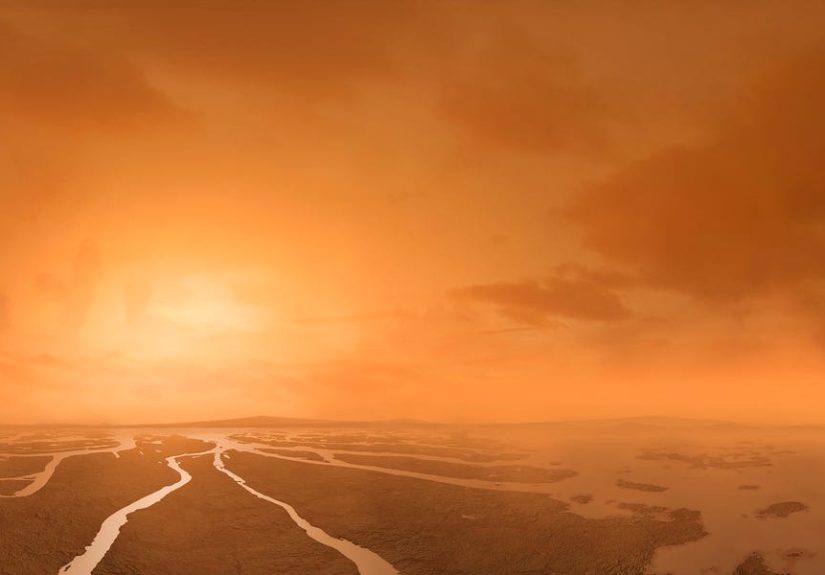
Still, Titan looks oddly familiar. It has river channels, lake basins, shorelines, dunes, clouds, and rain. The twist is that Titan’s active surface liquids are not water. They are hydrocarbons, mainly methane and ethane, which flow across the landscape the way water flows across Earth. On Earth, methane is a gas we associate with natural gas, wetlands, and questionable decisions near campfires. On Titan, methane rains from the sky, gathers in lakes, and helps carve the surface.
This makes Titan a natural laboratory for planetary science. It lets researchers ask a thrilling question: how much of “Earth-like” geology depends on water, and how much depends simply on having an atmosphere, gravity, weather, and a liquid that can flow? Titan answers with a shrug and a methane drizzle: apparently, a lot can happen even when the liquid is not water.
The Icy Crust: More Than a Frozen Shell
When people hear “icy crust,” they may imagine a boring frozen lid. Titan’s crust is anything but boring. It is likely made largely of water ice, but at Titan’s temperatures, water ice behaves more like bedrock than snow. Mountains, plains, impact craters, and possible cryovolcanic features may all be sculpted into this frozen shell.
Recent research led by planetary scientists at the University of Hawaiʻi proposed that methane gas may be trapped within Titan’s ice, forming a methane-rich crust up to about six miles thick. This matters because methane clathrate has different physical properties than ordinary water ice. It can insulate the layers below, influence how craters relax over time, and affect how scientists estimate Titan’s surface age.
One puzzle is that Titan has relatively few confirmed impact craters, and many of them appear shallower than expected. On a dead, rigid surface, craters should remain crisp for ages. On Titan, something seems to soften the record. A methane-rich crust could make the icy shell warmer and more mobile underneath, allowing craters to gradually rebound, relax, or become buried by organic sediments. In other words, Titan may be editing its own diary.
What Is Methane Clathrate?
Methane clathrate is a crystalline structure where water molecules form cages that trap methane molecules inside. On Earth, methane clathrates exist in deep ocean sediments and permafrost regions. On Titan, where methane is abundant and temperatures are extremely low, clathrates may be widespread in the crust.
If Titan’s crust contains a thick layer of methane clathrate, that layer could act like a planetary blanket. It may slow the escape of heat from the interior, influence the stability of subsurface water or slush, and feed methane into the atmosphere over geologic time. That is a big deal because sunlight breaks methane apart in Titan’s upper atmosphere. Without some form of resupply, Titan’s atmospheric methane should disappear on geological timescales. The fact that methane is still there suggests an active or long-lasting source.
Does Titan Have an Ocean Under Its Ice?
For years, Titan was widely discussed as an ocean world. Cassini measurements suggested that the moon’s crust flexed under Saturn’s gravity in a way that could indicate a buried global ocean of water mixed with ammonia. That possibility made Titan even more interesting for astrobiology, because life as we know it requires liquid water.
Then came a twist worthy of a science documentary cliffhanger. A 2025 reanalysis of Cassini radio-tracking data suggested Titan may not have a simple global ocean beneath its icy crust. Instead, researchers proposed a more complex interior: thick ice, slushy layers, and isolated pockets of liquid water, possibly near the rocky core. The key clue involved the timing of Titan’s tidal response. Titan stretches under Saturn’s gravitational pull, but the delay in that deformation may point to a slushy, viscous interior rather than a clean, liquid ocean layer.
This does not kill the idea of habitability. It changes the map. A global ocean would be one kind of habitat. Slushy pockets and meltwater zones would be another. On Earth, life is astonishingly good at making a living in small spaces: under ice, inside rocks, near hydrothermal vents, and in salty underground water. Titan may not offer a giant underground sea with a welcome mat. It may offer scattered chemistry kitchens hidden deep inside the crust.
Why Titan Matters for Understanding Early Earth
Titan’s greatest secret may not be whether life exists there today. It may be what Titan can teach us about how life begins.
Earth’s earliest atmosphere was very different from the oxygen-rich air we breathe now. Titan’s atmosphere is mostly nitrogen, with methane and complex organic chemistry. Sunlight and energetic particles break apart methane and nitrogen high in Titan’s atmosphere, producing a rich haze of organic molecules. These molecules drift downward and settle onto the surface like cosmic soot.
That organic material may include ingredients relevant to prebiotic chemistry, the chemical steps that happen before biology begins. Titan is not early Earth, but it may preserve some of the same kinds of chemical possibilities in a deep freeze. It is like a planetary freezer full of ancient recipe cards. Scientists do not expect to find dinosaurs, houseplants, or tiny aliens waving politely from a methane pond. The real prize is subtler: molecules, pathways, reactions, and environments that show how chemistry can become increasingly complex.
Impact Craters as Temporary Chemistry Labs
One of the most intriguing ideas involves impact craters. When a large object strikes Titan, it can melt water ice and create temporary pools of liquid water. If those melt pools mix with organic materials from Titan’s surface, they could briefly create conditions that are far more Earth-like than Titan’s normal frozen landscape.
These impact-generated environments would not last forever. They might freeze again over thousands of years, or much faster depending on size and conditions. But in planetary chemistry, “temporary” does not mean “unimportant.” A short-lived warm pond, crater lake, or slushy melt zone could allow organic molecules to react in ways that are impossible on Titan’s frigid surface. Early Earth may have hosted many transient environments where wet-dry cycles, impacts, minerals, and energy sources helped push chemistry forward.
Titan gives scientists a chance to study a world where organic materials are abundant, water is mostly locked away, and occasional events may bring the two together. That combination is fascinating because the interaction between organics and liquid water is one of the most important questions in the search for life beyond Earth.
The Methane Cycle: Titan’s Alien Version of Weather
On Earth, water evaporates, forms clouds, falls as rain, flows through rivers, fills lakes and seas, and returns to the atmosphere. Titan runs a similar system using methane and ethane. This methane-based hydrologic cycle shapes the moon’s landscape, especially near the poles where large seas such as Kraken Mare, Ligeia Mare, and Punga Mare sit beneath the orange sky.
Recent radar studies of Cassini data have revealed more about Titan’s hydrocarbon seas. Their composition appears to vary, with methane and ethane mixing in different proportions. Some regions show evidence of waves, tidal currents, and estuary-like zones where rivers meet seas. That is astonishing. Titan has shorelines where alien liquids may lap slowly against icy land under a sky thicker than Earth’s.
This does not mean Titan’s surface seas are friendly to Earth-like life. They are far too cold for liquid water biology as we know it. But they are chemically interesting. Some scientists have speculated about exotic forms of life that might use liquid methane as a solvent, although that remains highly theoretical. For now, the more grounded scientific question is how Titan’s surface organics move, concentrate, react, and possibly reach water-rich zones below.
NASA’s Dragonfly Mission: A Flying Laboratory for Titan
The next major chapter in Titan exploration is NASA’s Dragonfly mission. Dragonfly is a nuclear-powered rotorcraft designed to fly from place to place on Titan, sampling the surface and studying chemistry, geology, and habitability. NASA currently lists Dragonfly’s launch as no earlier than July 2028, with arrival at Titan in late 2034.
Dragonfly is not designed primarily to detect living organisms. Its central goal is to investigate prebiotic chemistry and habitability. It will explore dunes, impact-related terrain, and eventually the Selk Crater region, a place of special interest because impacts may have mixed surface organics with liquid water in the past.
Flying on Titan is not as absurd as it sounds. Titan’s dense atmosphere and low gravity make powered flight easier than on many other worlds. The challenge is surviving the cold, navigating an alien landscape, operating far from Earth, and doing meaningful chemistry with a robot that cannot call tech support when it gets confused. Dragonfly must be part drone, part laboratory, part survivalist, and part extremely patient explorer.
What Titan Could Teach Us About Life Beyond Earth
When scientists search for life beyond Earth, they usually look for three essentials: liquid, chemistry, and energy. Titan has chemistry in abundance. It has liquids on the surface, though they are hydrocarbons rather than water. It may have liquid water or slush underground. It receives energy from sunlight, Saturn’s gravitational pull, cosmic rays, and internal processes. The big question is whether these ingredients ever meet in the right way.
If Titan’s icy crust is thick, methane-rich, and insulating, it may help preserve warm layers below. If the interior contains slushy pockets rather than a global ocean, habitability may be patchy but not impossible. If impacts create temporary melt zones, Titan may host short-lived environments where complex organic chemistry can advance. None of this proves life exists there. Science is not a vending machine where you insert “organic molecules” and receive “aliens.” But Titan provides one of the best natural experiments in the solar system for studying how far chemistry can go before biology begins.
Titan also helps scientists think beyond Earth bias. Our planet is wet, oxygenated, and biologically loud. Titan is cold, hazy, hydrocarbon-rich, and chemically slow. If Earth is a roaring jazz band, Titan is a mysterious bass note echoing from another room. Studying both may help researchers understand which features are essential for life and which are merely local flavor.
Why the Icy Crust Is the Key to the Mystery
The crust is where Titan’s biggest questions meet. Surface organics fall from the atmosphere and collect on top of it. Methane may be trapped within it. Craters deform in it. Heat moves through it. Possible slush or meltwater hides beneath it. Any exchange between Titan’s surface and interior must pass through this frozen shell.
That makes the icy crust more
That makes the icy crust more than a barrier. It is a gatekeeper, archive, refrigerator, chemical filter, and geological storyteller. Its structure may reveal whether Titan still has liquid water pockets. Its composition may explain how methane survives in the atmosphere. Its craters may preserve evidence of past warm environments. Its organic-rich surface may hold clues about the chemical steps that once mattered on young Earth.
In short, Titan’s crust may be hiding secrets not because it is silent, but because we have not yet learned how to read it fluently.
Experience Section: How Thinking About Titan Changes the Way We See Earth
One useful way to understand Titan is to step outside after a rainstorm and look at the ordinary world with alien eyes. Water slides along the curb, gathers in low places, darkens soil, carries leaves, cuts little channels in sand, and disappears into drains. On Earth, this feels normal because we were born into a water-shaped planet. Titan asks us to imagine the same choreography performed by methane under an orange sky. The actors change, but the stage directions look strangely familiar.
Picture standing beside a frozen lake in winter. The ice seems solid and final, but beneath it there may be water, currents, trapped gases, and life moving slowly in the dark. That experience gives a small Earthly analogy for Titan’s crust. A frozen surface does not always mean a dead world. Ice can preserve, insulate, conceal, and separate environments that behave very differently from the landscape above. On Titan, the crust may hide slush, melt pockets, or chemical records older than human civilization by billions of years.
Another helpful experience is watching frost form inside a freezer. It looks simple, but it is really a record of temperature, vapor, surfaces, and time. Titan’s surface is like that on a planetary scale. Organic haze falls from the atmosphere. Methane rain reshapes terrain. Craters soften. Dunes migrate. The crust stores evidence of all these processes, like a frozen notebook written in chemistry instead of ink.
Titan also changes how we think about habitability. Many people imagine life beyond Earth as something dramatic: glowing cities under alien oceans, green creatures with excellent cheekbones, or at least a suspiciously musical signal from space. Titan encourages a more patient kind of wonder. The most important discoveries may be molecules in a sample cup, a pattern in ice, a mineral grain altered by ancient meltwater, or a chemical imbalance that hints at energy flow.
For students, writers, skywatchers, and anyone who has ever stared at the Moon and felt small in a good way, Titan offers a powerful lesson: familiar processes can appear in unfamiliar forms. Rain does not have to be water. Rock does not have to be silicate. A sea does not have to be blue. A world can be frozen and still active, distant and still relevant, alien and still connected to our own origins.
That is why Titan’s icy crust feels so compelling. It is not just a scientific target. It is a reminder that Earth’s story may not be as isolated as it seems. The chemistry that led to life here may have cousins elsewhere, some thriving, some stalled, some preserved in cold storage. Titan may not be alive, but it may know something about the long road to life. And thanks to Cassini, Dragonfly, and the scientists reading the moon’s frozen clues, we are finally learning how to ask better questions.
Conclusion: Titan Is a Frozen World With Warm Questions
The icy crust of Saturn’s moon Titan could be hiding some of the most important clues in planetary science. It may contain methane-rich layers that reshape our understanding of Titan’s atmosphere and geology. It may cover slushy zones or pockets of liquid water. It may preserve organic chemistry that resembles some of the ingredients present on early Earth. And it may hold the key to understanding whether worlds far from the Sun can still host environments where life-related chemistry has room to grow.
Titan is not a simple “second Earth.” It is colder, stranger, darker, and chemically more alien than any familiar landscape. Yet that is exactly why it matters. By studying Titan, scientists are not just searching for life beyond Earth. They are searching for the conditions that make life possible, the pathways chemistry can take, and the planetary stories that may be written beneath ice.